Best Solder Paste: 9 Picks in 2026

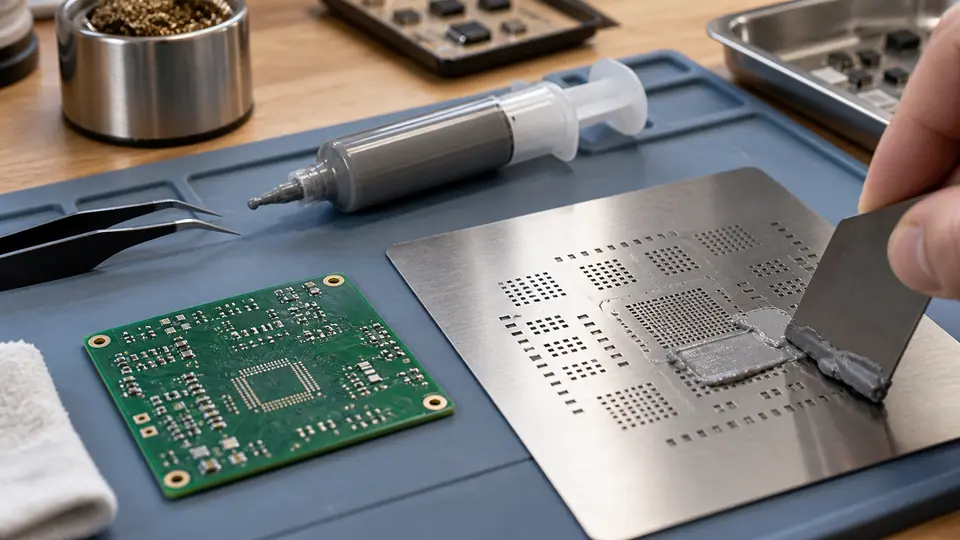
Solder paste can make a small PCB repair feel wonderfully controlled, or turn a careful rework job into a sticky, uneven mess. The right choice depends on more than the words “lead-free” or “no-clean” on the label. Alloy composition, melting point, particle size, flux content, package size, and the way paste leaves the syringe all affect how well it suits SMD placement, stencil work, BGA repair, or occasional pad touch-ups.
The biggest split in this group is between low-temperature Sn42/Bi58 paste and traditional Sn63/Pb37 paste. The bismuth-based options melt at 138°C, which can be useful around heat-sensitive boards and small components. The tin-lead formulas melt at 183°C and remain familiar for many electronics applications, though lead handling requires appropriate hygiene and disposal practices. A common buying error is choosing by container size alone, then discovering that the alloy or particle grade does not match the job.
Different benches call for different quantities. A repairer working on a few boards may prefer a 20g syringe, while repeated stencil work favors 30g or a four-pack. For the broadest balance of low-temperature operation, fine-particle positioning, and straightforward application, the Sn42/Bi58 T4 Lead-Free Solder Paste, 138°C Melting Point, T4 Particle (30g) earns the top position. The options below also include leaded paste and larger multi-pack formats for more specialized routines.
Quick Answer
- Best Overall: Sn42/Bi58 Lead-Free Solder Paste, 138°C Melting Point, T4 Particle (30g)
- Best for Traditional Electronics Work: Solder Paste Sn63/Pb37 30g With No-Clean Flux
- Best for Lower-Temperature Repairs: Wonderway Sn42/Bi58 T4 Lead-Free Solder Paste (30g)
- Best for Higher-Volume Use: Wonderway Sn42/Bi58 T4 Lead-Free Solder Paste, Four-Pack
Best Solder Paste Comparison Table
| Product | Best For | Alloy and Melting Point | Package Details |
|---|---|---|---|
| Sn42/Bi58 T4 Lead-Free Solder Paste | Fine SMD and PCB work | Sn42/Bi58, 138°C | 30g, T4 particles |
| Solder Paste Sn63/Pb37 With Flux | Traditional electronics soldering | Sn63/Pb37, 183°C | 30g plus 10cc flux |
| Wonderway Sn42/Bi58 T4 Paste | General low-temperature repairs | Sn42/Bi58, 138°C | 30g |
| Wonderway Sn42/Bi58 T4 Four-Pack | Repeated board work | Sn42/Bi58, 138°C | Four 30g packs |
| Sn42/Bi58 Paste With Flux and Wick | Repair and component replacement | Sn42/Bi58, 138°C | 30g plus 10cc flux and wick |
| Wonderway Sn63/Pb37 T4 Paste | Small traditional soldering jobs | Sn63/Pb37, 183°C | 20g |
| Wonderway Sn63/Pb37 T4 Paste | More frequent leaded work | Sn63/Pb37, 183°C | 30g |
| Sn42/Bi58 T4 Lead-Free Paste (20g) | Compact repair jobs | Sn42/Bi58, 138°C | 20g, 20 to 38μm particles |
| Wonderway Sn42/Bi58 T4 Paste (20g) | Occasional low-temperature use | Sn42/Bi58, 138°C | 20g |
The detailed reviews explain where each alloy, particle grade, package size, and accessory bundle makes practical sense.
1. Sn42/Bi58 Lead-Free Solder Paste, 138°C Melting Point, T4 Particle (30g) — Best Overall

For delicate board work, this paste has the most useful combination of specifications in the group. Its Sn42/Bi58 alloy melts at 138°C, considerably below the 183°C listed for the Sn63/Pb37 products. That lower melting point can give a repairer more thermal breathing room around small components and boards that should not be exposed to unnecessary heat. The T4 particle grade is identified as 20 to 38μm, a useful detail for stencil printing and mini-component placement.
The listing also describes a no-clean, non-corrosive, non-conductive flux residue and applications including BGA, SMT, and PCB repairs. Those claims should still be read as listing information rather than independent test results, but they describe a sensible target use. The 30g size is large enough for repeated projects without jumping to a four-pack, while the fine particle specification gives it a clearer precision focus than several broadly described alternatives.
Pros
- Low 138°C melting point suits heat-sensitive PCB and component work.
- T4 particle size is listed as 20 to 38μm for fine placement tasks.
- Lead-free Sn42/Bi58 alloy fits buyers avoiding leaded solder paste.
- No-clean flux is described as non-corrosive and non-conductive.
- 30g quantity balances repeated use with manageable storage.
Cons
- The listing does not clearly specify storage temperature or post-opening shelf life.
- Low-temperature bismuth paste may not be the preferred alloy for every existing reflow process.
This is the strongest match for SMD repair, stencil work, and small electronics jobs where a lower reflow temperature matters. Choose it over a generic 20g option when the particle specification and extra quantity are useful. Buyers who specifically need Sn63/Pb37 should look elsewhere, and anyone working with lead-free paste should still follow the process requirements of the board and components.
To buy this product, click here.
2. Solder Paste Sn63/Pb37 30g With No-Clean Flux — Best Traditional Electronics Formula

Sn63/Pb37 remains a familiar choice for many electronics processes, and this package gives the buyer both solder paste and a separate 10cc container of no-clean flux. The listed melting point is 183°C, so it belongs in a different thermal category from the 138°C bismuth formulas. Its T5 particle specification is 15 to 25 microns, which is finer than the T4 range listed for several other products here and may appeal to buyers working with small pads or detailed stencil placement.
The product information names BGA, SMD, SMT, ICs, connectors, sensors, phones, and general circuit-board maintenance among its applications. That broad list does not guarantee identical results across every board, but it does show the intended electronics focus. The push-type design is described as helping the paste flow smoothly and reduce waste, while the separate flux adds flexibility for joints that need extra wetting support.
Pros
- Sn63/Pb37 alloy is clearly identified for traditional leaded soldering work.
- Listed 183°C melting point provides a defined medium-temperature process.
- T5 particles are specified at 15 to 25 microns.
- Includes a separate 10cc no-clean soldering flux.
- Application list covers BGA, SMD, SMT, phones, and circuit-board repair.
Cons
- Contains lead, so handling, ventilation, hygiene, and disposal require appropriate care.
- The 183°C melting point is less suitable than low-temperature paste for some heat-sensitive work.
This package makes sense for a bench already organized around Sn63/Pb37 processes and for users who want extra flux available beside the paste. It is a stronger choice than a low-temperature bismuth product when the alloy must match an established workflow. Skip it if lead-free material is a firm requirement or if the board calls for a lower thermal process.
To buy this product, click here.
3. Wonderway Sn42/Bi58 T4 Lead-Free Solder Paste (30g) — Best for General Low-Temperature Repairs

This Wonderway formula takes a straightforward approach: Sn42/Bi58 alloy, T4 classification, a 138°C melting point, and 30g of paste. The listing gives the flux content as 10.5% and describes strong viscosity with a bright soldering point. Those details matter at the bench because paste that stays where it is placed can be easier to control than a thin, wandering deposit, especially around closely spaced pads.
The push-style package is presented as helping the paste flow smoothly and reducing waste. It is listed for circuit boards, ICs, phones, televisions, household appliances, and industrial equipment, although the supplied information does not provide a specific particle-size range or storage schedule. That makes it a practical general-purpose pick rather than the most specification-rich choice for demanding stencil work.
Pros
- Lead-free Sn42/Bi58 alloy melts at a relatively low 138°C.
- 30g quantity suits repeated repair work.
- Flux content is listed as 10.5%.
- Push-style packaging is intended to support controlled flow.
- Strong viscosity is listed as a product characteristic.
Cons
- The listing does not identify a precise particle-size range.
- Storage requirements and shelf life are not clearly stated.
Choose this version for general PCB repairs where low-temperature lead-free paste is more important than a detailed particle specification. It is a sensible middle ground between a small syringe and the four-pack. For precision stencil printing, the product with the clearly stated 20 to 38μm T4 range offers more information to work from.
To buy this product, click here.
4. Wonderway Sn42/Bi58 T4 Lead-Free Solder Paste, Four-Pack — Best for Higher-Volume Use

Four 30g packs make this the practical bulk option for a busy repair drawer or a series of board projects. Each pack is identified as Sn42/Bi58 T4 paste with a 138°C melting point and 10.5% flux content. Dividing the quantity into separate packs can be more convenient than opening one large container, though the listing does not explain its storage or post-opening schedule.
The same push-style format appears here, with the listing emphasizing smooth flow, strong viscosity, bright joints, and reduced waste. This is less about discovering a new soldering behavior and more about keeping a familiar low-temperature formula available. A buyer handling one occasional board may find the quantity excessive, while repeated SMD or PCB repair work can make the four-pack far more sensible.
Pros
- Four separate 30g packs provide a total of 120g of listed paste.
- Sn42/Bi58 alloy has a 138°C melting point.
- 10.5% flux content is identified in the product information.
- Push-style packaging is intended to reduce wasted paste.
- Separate packs can help organize multiple repair sessions.
Cons
- It is excessive for occasional users who need only a small amount.
- The listing does not state a storage temperature or shelf life.
This package earns its place for people who already know they want this alloy and expect regular use. It costs more upfront than a single syringe, but the useful distinction is quantity and pack separation rather than a different formula. For a first purchase or uncertain application, a 20g or 30g option is easier to evaluate before committing to bulk.
To buy this product, click here.
5. Sn42/Bi58 Lead-Free Solder Paste With Flux and Wick — Best Repair Bundle

Board repair rarely follows a neat script. A component comes off, a pad needs fresh paste, and an adjacent joint must be cleared before the replacement goes down. This bundle addresses that kind of workflow with 30g of Sn42/Bi58 paste, 10cc of no-clean flux, and solder wick. The paste melts at 138°C and is described as suitable for small components and boards that cannot withstand higher temperatures.
The flux is identified as lead-free, halogen-free, and non-corrosive, while the wick is intended for SMD and SMT removal. Those accessories do not change the paste alloy, but they can make a repair kit more self-contained. The listing does not specify the wick width or length, so buyers needing a particular braid size should confirm the current details before ordering.
Pros
- Includes 30g of low-temperature Sn42/Bi58 solder paste.
- 138°C melting point suits the stated small-component applications.
- Includes 10cc of no-clean soldering flux.
- Includes solder wick for removing existing solder.
- Flux is listed as lead-free, halogen-free, and non-corrosive.
Cons
- The listing does not clearly specify the solder-wick dimensions.
- Buyers who already own flux and wick may get limited benefit from the bundle format.
This is a strong choice for repair sessions that involve both adding and removing solder. It offers more bench utility than a paste-only syringe, but it is less focused if your process is strictly stencil printing. Treat the wick and flux as included accessories, not proof that every repair will require the same combination of materials.
To buy this product, click here.
6. Wonderway Sn63/Pb37 T4 Tin-Lead Solder Paste (20g) — Best Compact Leaded Option

A 20g syringe is a comfortable quantity for occasional board repairs, especially when you want Sn63/Pb37 but do not need a larger pack. The alloy is listed as 63% tin and 37% lead, with a 183°C melting point and 10.5% flux content. That makes the product easy to distinguish from the low-temperature bismuth formulas, which may be more suitable for heat-sensitive work.
The listing describes strong viscosity, a bright soldering point, no-clean performance, and a push-style package intended to reduce waste. It does not provide a particle-size range, so the product information supports a general electronics recommendation more confidently than a highly specific stencil-printing claim. Leaded solder requires sensible handling practices, including avoiding contamination of food surfaces and washing hands after use.
Pros
- Sn63/Pb37 alloy composition is clearly identified.
- 183°C melting point suits traditional medium-temperature soldering.
- Compact 20g quantity limits excess for occasional projects.
- 10.5% flux content is listed.
- No-clean and strong-viscosity characteristics are stated.
Cons
- Contains lead and requires appropriate handling and cleanup practices.
- The listing does not specify particle size.
This option suits a buyer who wants a smaller amount of leaded paste for electronics work. It is easier to justify than the 30g version for a few repairs, while the 30g package becomes more practical for repeated use. Choose a lead-free Sn42/Bi58 option if material restrictions or lower-temperature operation matter more than matching a Sn63/Pb37 process.
To buy this product, click here.
7. Wonderway Sn63/Pb37 T4 Tin-Lead Solder Paste (30g) — Best for Frequent Leaded Work

This is the larger single-pack counterpart to the 20g Wonderway Sn63/Pb37 option. Its listed composition is 63% tin and 37% lead, with a 183°C melting point and 10.5% flux content. The extra 10g matters when a syringe is used across multiple board sessions, though it does not represent a different alloy or a separately identified particle grade.
The product information emphasizes strong viscosity, bright solder joints, no-clean use, and smooth flow from the push-style package. Those features point toward practical bench application rather than a specialized stencil specification. Since the listing does not give storage conditions or shelf life, buyers should follow the product instructions and avoid assuming that no-clean means every residue can be ignored in every situation.
Pros
- 30g quantity is suited to repeated use.
- Sn63/Pb37 composition is clearly stated.
- 183°C melting point provides a defined leaded process.
- 10.5% flux content is listed.
- Push-style design is intended to support smooth application.
Cons
- Contains lead and requires careful handling.
- No particle-size range is provided in the listing information.
Pick this package over the 20g version when the alloy already matches your bench and the additional quantity will be used within a reasonable storage period. It is a straightforward leaded paste choice, but the lower-temperature products remain better suited to users trying to reduce thermal exposure or avoid lead altogether.
To buy this product, click here.
8. Sn42/Bi58 Lead-Free Solder Paste, 138°C Melting Point, T4 Particle (20g) — Best Compact Precision Option
When the work is occasional but the application is precise, this 20g T4 paste offers a useful balance. The Sn42/Bi58 alloy melts at 138°C, and the listed particle range is 20 to 38μm. That particle information is particularly helpful for buyers comparing paste for stencil printing, BGA work, or small component placement rather than choosing by alloy name alone.
The listing describes a no-clean flux residue as non-corrosive and non-conductive, and identifies BGA, SMT, and PCB repair as intended applications. The smaller container reduces the commitment compared with a four-pack, while the 30g version provides more material for repeated work. The available information does not identify storage temperature or shelf life, so those details should be confirmed before long-term storage.
Pros
- Low 138°C melting point supports lower-temperature soldering.
- T4 particle range is listed as 20 to 38μm.
- Lead-free Sn42/Bi58 composition is clearly identified.
- 20g quantity suits occasional precision work.
- Application information includes BGA, SMT, and PCB repair.
Cons
- 20g may be limiting for repeated production-style work.
- Storage and shelf-life information is not clearly supplied.
This is the compact alternative to the 30g precision-focused paste at the top of the list. It suits a small repair drawer, a limited stencil project, or anyone wanting the stated particle range without buying a larger quantity. Choose the 30g version for more frequent use, or a general Wonderway syringe if particle-size documentation matters less than a simple package.
To buy this product, click here.
9. Wonderway Sn42/Bi58 T4 Lead-Free Solder Paste (20g) — Best for Occasional Low-Temperature Use

This 20g Wonderway syringe keeps the basic formula simple: Sn42/Bi58 alloy, 138°C melting point, 10.5% flux content, and a no-clean description. It is aimed at the same broad group of circuit-board, IC, phone, television, and appliance repairs as the larger Wonderway package. For someone who opens a syringe only now and then, the smaller quantity can be easier to justify.
The push-style design is described as providing smoother flow and reducing waste, while strong viscosity is intended to help the paste stay under control during application. The product information does not specify particle dimensions, so it has less documented precision detail than the T4 paste listed at 20 to 38μm. Its appeal is the compact format and lower melting point rather than a specialized process specification.
Pros
- Lead-free Sn42/Bi58 alloy melts at 138°C.
- 20g package suits occasional repairs.
- 10.5% flux content is listed.
- Strong viscosity is identified as a paste characteristic.
- Push-style packaging is intended to reduce waste.
Cons
- The listing does not specify the exact particle-size range.
- Smaller quantity may be inconvenient for frequent board work.
This is the sensible small-format pick for someone who wants a low-temperature, lead-free paste without committing to multiple syringes. The precision-focused 20g product supplies more particle information, while this one keeps the decision centered on alloy, quantity, and application control. Store it according to the current product instructions and match the reflow process to the board and components in front of you.
To buy this product, click here.
Buying Guide
Choose the Alloy Before Comparing Package Size
Sn42/Bi58 and Sn63/Pb37 are not interchangeable labels. The Sn42/Bi58 products in this roundup list a 138°C melting point, while the Sn63/Pb37 products list 183°C. The lower-temperature formula can be useful around heat-sensitive components, but the right choice depends on the board, existing solder, and process. Leaded paste also requires careful handling, hand washing, and sensible workspace practices.
Particle Grade Matters for Fine Placement
T4 paste is listed across several products, but only some entries provide a numerical particle range. The products identifying 20 to 38μm or 15 to 25 microns give more useful information for buyers working with stencil printing and small pads. A product with a stated particle size is easier to compare than one that simply repeats “T4” without further detail.
Flux Content and Flux Format Affect Application
Several syringes list flux content of 10.5%, while the Sn63/Pb37 bundle lists 10.8% and includes separate 10cc flux. Flux helps solder wet the pad and component lead, but no-clean wording does not mean every residue should be ignored in every repair. Apply only as much as the joint requires, and follow the product instructions for cleanup.
Pick the Quantity That Matches Your Work Rate
A 20g syringe is easier to match to occasional repairs, while 30g works better for repeated projects. The four-pack supplies four 30g containers, making it the bulk choice here. More paste is useful only if it will be stored and used properly, since the supplied information does not provide a universal storage temperature or shelf-life guarantee for these products.
Push-Style Packaging Can Reduce Mess, But Technique Still Matters
The push-style packages are described as supporting smoother flow and reducing waste. That can help with controlled placement, but a syringe does not replace a stencil, dispenser setting, or careful volume control. Small pads need a small deposit. Too much paste can create bridging, while too little may produce an incomplete joint.
Best Solder Paste FAQ
What is the best solder paste for small PCB repairs?
The Sn42/Bi58 T4 paste with the listed 20 to 38μm particle range is the strongest overall match here for small PCB and SMD work. Its 138°C melting point and stated precision particle range give it a clearer fit than products with less detailed particle information.
Is Sn42/Bi58 solder paste lead-free?
Yes. Sn42/Bi58 identifies a tin and bismuth alloy without lead in the stated composition. The product listings describe these options as lead-free, but users should still follow normal soldering safety practices and product instructions.
What is the difference between Sn42/Bi58 and Sn63/Pb37 paste?
The alloy composition and listed melting point differ. Sn42/Bi58 products list 138°C, while Sn63/Pb37 products list 183°C. Sn63/Pb37 contains lead, so handling requirements also differ. Select the alloy that matches the board, process, and material requirements rather than choosing solely by package price or quantity.
Does no-clean solder paste require cleaning?
No-clean describes the intended residue behavior, but it does not mean cleaning is forbidden or universally unnecessary. Residue appearance, the board application, later inspection, and the product instructions all matter. Use the minimum paste and flux needed for the joint.
Is a 20g or 30g syringe better?
A 20g syringe suits occasional work and reduces the amount left in storage. A 30g syringe is more practical for repeated repairs or several boards. The four-pack is aimed at much higher usage and supplies four separate 30g packs.
What does T4 mean in solder paste?
T4 is a particle classification used in the product descriptions. The exact numerical range should be checked for the specific paste because the listings do not all provide the same level of detail. In this selection, some products identify particles at 20 to 38μm, while another lists 15 to 25 microns.
Can solder paste be used for all electronics?
No single paste should be treated as universal. Alloy, melting point, particle size, flux behavior, component sensitivity, and the board’s existing solder all affect suitability. Match the paste to the reflow or repair process, then confirm the current product instructions before use.
Final Verdict
The Sn42/Bi58 Lead-Free Solder Paste, 138°C Melting Point, T4 Particle (30g) is the strongest overall choice because it combines a low listed melting point, a stated 20 to 38μm particle range, lead-free composition, and a useful 30g quantity. It has the clearest fit for careful SMD, SMT, BGA, and PCB repair work among these options. For traditional leaded electronics processes, the Sn63/Pb37 30g package with separate flux is the more appropriate alternative, provided its 183°C process and lead content match the job.
The 20g T4 Sn42/Bi58 paste is a sensible compact choice, while the Wonderway four-pack suits repeated low-temperature work. Before ordering, match the alloy first, then check particle information, quantity, flux requirements, and storage instructions. A smaller syringe is often the smarter purchase for occasional repairs, while larger quantities make sense only when the paste will be used and stored properly.

- Jesse
Jesse is the editor behind Soldering Gear, where he covers soldering irons, stations, rework equipment, and the tools that belong on a practical electronics bench. His work focuses on comparing product specifications, features, compatibility, and intended uses so readers can make more informed buying decisions.
- Best Soldering Iron for Microsoldering: 9 Picks in 2026 November 10, 2026
- Best Soldering Station for PCB Repair: 9 Picks in 2026 November 9, 2026
- How to Desolder Electronics November 8, 2026
- Best Hot Air Rework Station for PCB Repair: 9 Picks in 2026 November 7, 2026
- Soldering Iron Tip Shapes Explained November 6, 2026