Best Solder Paste for Electronics: 9 Picks in 2026

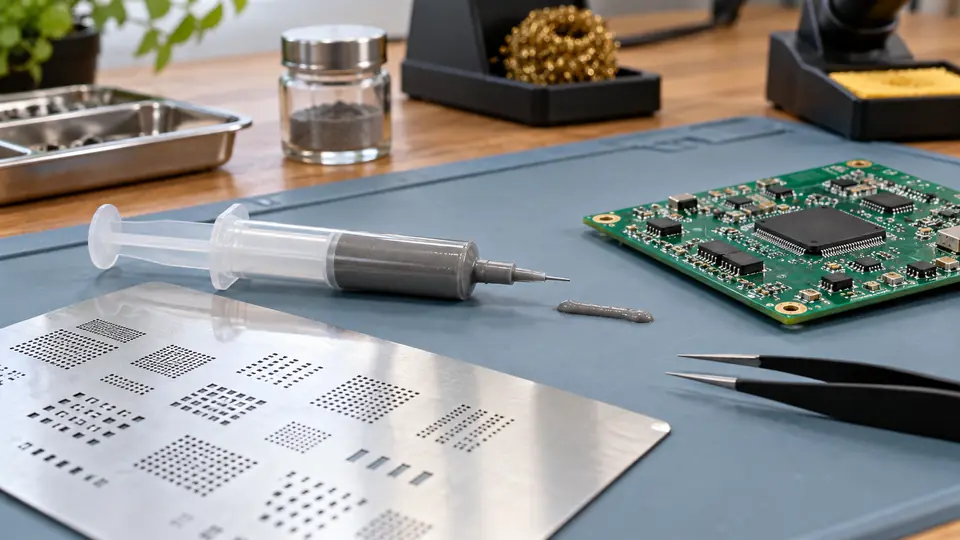
Solder paste for electronics sits at the intersection of alloy choice, heat control, application accuracy, and cleanup. A paste that reflows at 138°C may suit heat-sensitive boards, while a Sn63/Pb37 formula melting at 183°C can make more sense for traditional electronics work. Particle size, flux content, packaging, and whether the material is lead-free often matter more than a glossy product title.
The alloy changes the working rhythm. Sn42/Bi58 paste uses a lower melting point and can be useful for small components or boards that should see less heat. Sn63/Pb37 paste brings a familiar leaded formulation, but it requires responsible handling and suitable cleanup practices. Buyers also need to separate actual solder paste from flux-only products and desoldering kits, since flux can improve wetting but cannot replace the metal powder that forms the joint.
This comparison weighs the listed alloy, melting point, particle size, flux format, quantity, application method, and included repair accessories. The Wonderway Sn42/Bi58 20g paste takes the overall spot for its low-temperature lead-free formula and controlled syringe-style delivery, while the Sn63/Pb37 options remain strong alternatives for buyers who specifically need leaded paste.
Quick Answer
- Best Overall: Wonderway Sn42/Bi58 T4 Lead-Free Solder Paste, 20g for lower-temperature electronics rework.
- Best Leaded Option: Sn63/Pb37 30g Solder Paste With No-Clean Flux for buyers who specifically want a 63/37 alloy.
- Best for Precision Stencil Work: Sn42/Bi58 T4 Lead-Free Solder Paste, 20g with listed 20 to 38 micron particles.
- Best Larger Supply: Wonderway Sn42/Bi58 T4 Lead-Free Solder Paste, Four 30g Packs for repeated repair work.
Best Solder Paste for Electronics Comparison Table
| Product | Best For | Alloy or Type | Melting Point |
|---|---|---|---|
| Wonderway Sn42/Bi58 20g | Low-temperature lead-free rework | Sn42/Bi58, T4 | 138°C |
| Sn63/Pb37 30g With Flux | Leaded PCB and SMD work | Sn63/Pb37, T5 | 183°C |
| Sn42/Bi58 T4 20g | Fine-particle stencil work | Sn42/Bi58, T4 | 138°C |
| Wonderway Sn42/Bi58 30g | Regular repair sessions | Sn42/Bi58, T4 | 138°C |
| Sn42/Bi58 Repair Kit | SMD replacement work | Sn42/Bi58 | 138°C |
| Wonderway Sn42/Bi58 Four-Pack | High-volume bench use | Sn42/Bi58, T4 | 138°C |
| Wonderway Sn63/Pb37 30g | Lead-based electronics soldering | Sn63/Pb37, T4 | 183°C |
| Solder-It SP-7 Silver Solder Paste | Specialized wiring and metal joints | Silver solder paste | Flows at 430°F |
| SRA 135 Rosin Paste Flux | Flux-assisted soldering | RA rosin flux | 93 to 315°C activity range |
The detailed reviews below separate genuine solder paste choices from supporting flux products, so the alloy and application differences remain clear.
1. Wonderway Sn42/Bi58 T4 Lead-Free Solder Paste, 20g — Best Overall

The case for this Wonderway paste starts with its Sn42/Bi58 alloy and 138°C melting point. That lower temperature can be useful during small-board repair, especially when a component or PCB should not be exposed to the higher heat associated with 183°C Sn63/Pb37 paste. It is a lead-free formula, and the listing identifies T4 paste with 10.5% flux content.
The 20g net quantity gives a practical middle ground for occasional SMD work, while the push-style package is aimed at smoother dispensing with less leftover material around the syringe. A strong-viscosity paste can stay where it is placed rather than spreading across neighboring pads, though actual results still depend on storage, stencil technique, reflow profile, and pad preparation.
Pros
- Lead-free Sn42/Bi58 alloy.
- Listed 138°C melting point supports lower-temperature rework.
- T4 particle classification is suited to fine electronics applications.
- 10.5% flux content is included in the paste.
- Push-style packaging is intended to reduce waste during dispensing.
Cons
- The listing does not clearly specify storage temperature or shelf-life details.
- 20g may be limiting for frequent stencil-printing work.
This is the strongest general choice for readers who want lead-free paste with a lower listed melting point and a manageable quantity. It should appeal to small PCB repairs, phone-related component work, and occasional SMD projects. Buyers who need a leaded alloy, a large production quantity, or a clearly documented reflow profile should look elsewhere.
To buy this product, click here.
2. Sn63/Pb37 30g Solder Paste With No-Clean Flux — Best Leaded Option

For a buyer who specifically wants traditional 63/37 leaded solder paste, this package is the clearest fit in the group. The listing identifies a 63% tin and 37% lead alloy, a 183°C melting point, and T5 particles sized at 15 to 25 microns. That combination points toward PCB, chip, BGA, and SMD maintenance rather than low-temperature specialty rework.
The package includes 30g of solder paste plus 10cc of no-clean flux, giving the bench a separate flux option for joints that need extra wetting assistance. The push-type dispenser is described as smoother flowing and less wasteful. Since this is lead-containing material, users should follow suitable handling, ventilation, hygiene, and waste practices rather than treating the no-clean label as a reason to ignore residue or exposure precautions.
Pros
- Clearly identified Sn63/Pb37 leaded alloy.
- Listed 183°C melting point suits conventional electronics rework.
- T5 particles are listed at 15 to 25 microns.
- Includes 30g of paste and a separate 10cc flux container.
- Suitable listing applications include SMD, BGA, IC, and PCB maintenance.
Cons
- Contains lead, so handling and cleanup require extra care.
- The higher melting point may be less suitable for heat-sensitive boards than Sn42/Bi58 paste.
This package makes sense for experienced users who have a specific reason to choose 63/37 solder and want a larger paste quantity with extra flux on hand. It is a poor match for someone seeking a lead-free formula or the lowest possible reflow temperature. Compared with the Wonderway lead-free options, its main advantage is alloy familiarity, while its main trade-off is heat and lead handling.
To buy this product, click here.
3. Sn42/Bi58 T4 Lead-Free Solder Paste, 20g — Best for Fine Particle Work

This listing gives more particle detail than many of the alternatives. Its T4 paste is identified as having 20 to 38 micron particles, a useful piece of information for buyers thinking about stencil printing and small component placement. The Sn42/Bi58 alloy has a listed melting point of 138°C, placing it in the lower-temperature lead-free group.
The product information also describes the residue as no-clean, non-corrosive, and non-conductive, although those claims should be interpreted according to the product instructions and the amount of residue left on a real board. Its stated applications include BGA, SMT, and PCB repair. There is no separate flux or wick in the package description, which keeps the purchase focused on the paste itself.
Pros
- Lead-free Sn42/Bi58 composition.
- Listed 138°C melting point.
- Specified 20 to 38 micron T4 particle size.
- Positioned for stencil printing and mini-component soldering.
- Listed for BGA, SMT, and PCB repairs.
Cons
- The 20g quantity may not suit a busy repair bench.
- The listing does not clearly provide a storage temperature or shelf-life figure.
This is a sensible choice for buyers who care about particle information and expect to work with fine pads or compact components. It ranks below the top pick because the package information says less about the dispensing format and flux percentage. Choose it when the stated particle range matters more than getting a separate flux accessory.
To buy this product, click here.
4. Wonderway Sn42/Bi58 T4 Lead-Free Solder Paste, 30g — Best Single Larger Pack

The 30g Wonderway version keeps the same basic Sn42/Bi58, T4, 138°C formula as the smaller pack while offering 30g of net paste. That extra quantity can be useful when a project involves several boards, repeated component replacement, or multiple stencil applications. The listing also identifies 10.5% flux content and a strong-viscosity consistency.
Its push-style design is aimed at smoother flow and reduced waste. That detail matters during small repairs, where a blob of excess paste can bridge adjacent pads and turn a quick job into a cleanup session. The product information mentions circuit boards, ICs, phones, televisions, and household appliances, though buyers should still match the alloy and reflow process to the particular board and component requirements.
Pros
- 30g net quantity for longer use than the 20g versions.
- Lead-free Sn42/Bi58 alloy.
- Listed 138°C melting point.
- T4 paste with 10.5% flux content.
- Push-style package is intended to minimize dispensing waste.
Cons
- The listing does not state a precise particle-size range.
- A larger package may be unnecessary for occasional repairs.
Pick this version when the low-temperature alloy is right for your work and 20g feels too tight. It offers a straightforward quantity upgrade without changing the advertised alloy or melting point. Buyers who need precise particle data should select the T4 product with the stated 20 to 38 micron range instead.
To buy this product, click here.
5. Sn42/Bi58 Lead-Free Solder Paste Repair Kit, 30g — Best All-in-One Rework Package

A solder paste syringe handles component placement, but repair work often creates a second problem: removing the old solder. This package pairs 30g of Sn42/Bi58 paste with 10cc of no-clean flux and solder wick. The listed melting point is 138°C, and the kit is aimed at SMD and SMT component removal as well as replacement work.
The flux is described as lead-free, halogen-free, and non-corrosive, while the wick is intended to leave little residue. That combination can make a compact repair drawer feel far more complete than a paste-only purchase. Still, the extra accessories do not automatically make the paste itself better, and buyers focused on stencil printing may prefer a dedicated paste package with more detailed particle specifications.
Pros
- Includes 30g of Sn42/Bi58 lead-free solder paste.
- Listed 138°C melting point suits lower-temperature applications.
- Includes 10cc of no-clean soldering flux.
- Includes solder wick for SMD and SMT removal work.
- Flux is described as halogen-free and non-corrosive.
Cons
- The listing does not specify the paste particle size.
- Extra repair accessories may be unnecessary for stencil-only work.
This package suits a repair scenario where old solder must come off before new paste goes down. It gives up some specification detail compared with the dedicated T4 paste listings, but the wick and flux can save a separate purchase for occasional board repair. Choose it for a mixed repair drawer, not for a tightly controlled production process.
To buy this product, click here.
6. Wonderway Sn42/Bi58 T4 Lead-Free Solder Paste, Four 30g Packs — Best for Frequent Repairs

Four separate 30g packs make this the quantity-oriented option in the group. The formula remains Wonderway’s Sn42/Bi58 T4 lead-free paste with a listed 138°C melting point and 10.5% flux content. Separate packs can be practical for a repair bench that handles multiple projects, since each container can remain sealed until needed.
The push-style dispensing format is described as smooth flowing and low waste. The listing gives a total net paste quantity of 120g across four packs, although the package’s total shipping weight is listed separately from the paste itself. Buyers should pay attention to storage and product age, since purchasing more paste makes shelf-life information more relevant than it would be for a single small project.
Pros
- Four individual 30g packs provide a substantial total supply.
- Lead-free Sn42/Bi58 alloy.
- Listed 138°C melting point.
- T4 formulation with 10.5% flux content.
- Separate packs can help keep unused material sealed.
Cons
- The listing does not clearly state storage temperature or shelf life.
- A four-pack may be excessive for occasional users.
This is the practical pick for repeated low-temperature lead-free repairs, especially where a single 30g pack would disappear quickly. It does not provide a new alloy or particle specification, so its reason for ranking is supply rather than a different reflow behavior. Check the package dates and storage guidance before committing to a large quantity.
To buy this product, click here.
7. Wonderway Sn63/Pb37 T4 Tin-Lead Solder Paste, 30g — Best Leaded Single Pack

This Wonderway paste gives leaded-solder users a single 30g package built around a 63% tin and 37% lead alloy. The listing identifies a 183°C melting point, 10.5% flux content, and T4 particle designation. Those details make it a more direct alternative to the other Sn63/Pb37 package for buyers who want a simple paste-only purchase.
The strong-viscosity, push-style design is intended to keep application controlled and reduce waste. That can matter around tightly spaced pads, where excessive paste can create bridges. The listing describes use across circuit boards, ICs, phones, televisions, and household appliances, but the lead content remains the central buying distinction and should guide handling decisions.
Pros
- Clearly identified Sn63/Pb37 leaded alloy.
- 30g net paste quantity.
- Listed 183°C melting point.
- 10.5% flux content is identified.
- Push-style package is intended for controlled flow.
Cons
- Contains lead and requires responsible handling practices.
- The listing does not provide a precise particle-size range.
This option suits users who want a leaded 63/37 paste without a separate flux bottle or repair wick. It ranks below the Sn63/Pb37 package with documented 15 to 25 micron T5 particles because that competing listing gives more particle information and includes extra flux. Select Wonderway when the single-pack format and T4 designation fit your process.
To buy this product, click here.
8. Solder-It SP-7 Silver Solder Paste, 7.1g — Best for Specialized Metal and Wiring Work

Solder-It SP-7 is a more specialized paste than the Sn42/Bi58 and Sn63/Pb37 choices above. The product information describes a lead-free silver solder paste for electronic components, wiring, instrument assembly, jewelry, and several metal types. It comes in a 7.1g syringe, so the package is much smaller than the 20g and 30g electronics pastes.
The listing gives a flow temperature of 430°F and says the material can re-melt at 650°F. It also describes a no-mess syringe format and compatibility with brass, bronze, nickel, stainless steel, copper-based metals, and steel. Those broader metal applications make it interesting for specialized joints, but the information does not provide a standard electronics paste particle classification or a conventional reflow profile.
Pros
- Lead-free formulation according to the listing.
- Syringe packaging supports targeted application.
- Listed for electronic components, wiring, and instrument assembly.
- Suitable for several named metal types.
- Listed flow temperature is 430°F.
Cons
- 7.1g quantity is small for repeated PCB work.
- The listing does not identify a T4 or T5 particle classification.
This paste is better suited to a buyer whose projects cross from electronics into wiring, instruments, or metal joining. It is less compelling for routine SMD stencil work, where alloy and particle specifications usually deserve priority. Choose it for the broader material-use description, not as a direct substitute for a conventional PCB reflow paste.
To buy this product, click here.
9. SRA 135 Rosin Paste Flux, 2oz — Best Flux Companion
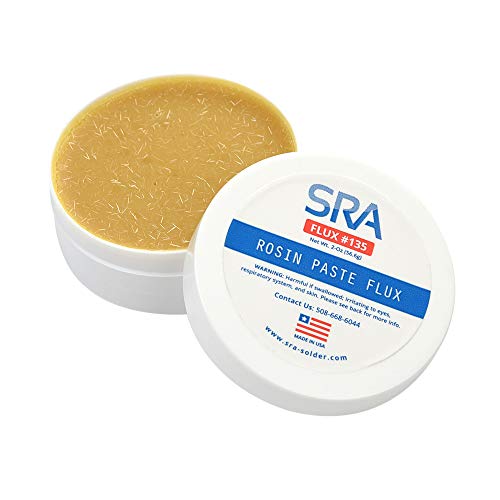
SRA 135 is flux paste rather than solder paste, so it does not supply the alloy particles needed to form a solder joint by itself. It earns a place as a companion choice for electronics work because the listing describes an acid-free RA rosin formula for circuit boards, copper wire, car audio, computers, RC vehicles, consoles, and similar projects.
The semi-solid wax-like consistency is intended to stay under control during application, whether it is placed on a PCB or used with copper wire. The listing gives an active temperature range of 93 to 315°C and a 2oz, or 56.6g, jar. That format favors bench use and repeated brush or tip application over the pinpoint delivery of a syringe.
Pros
- Acid-free flux intended for electrical and electronics work.
- RA rosin flux classification is identified.
- Semi-solid consistency supports controlled application.
- Listed for both leaded and lead-free soldering.
- 2oz jar provides more material than the small syringe flux packages.
Cons
- It is flux only and does not replace solder paste.
- The jar format may be less precise than a fine-tip syringe for tiny pads.
Choose SRA 135 alongside solder paste when extra wetting assistance is useful, particularly for oxidized wire or board surfaces. It should not be selected as the sole material for stencil printing or paste reflow. Buyers seeking a complete paste purchase should start with one of the first eight products and treat this jar as a separate flux option.
To buy this product, click here.
Buying Guide
Match the Alloy to the Board and Process
Sn42/Bi58 paste has a listed 138°C melting point in several products here, while Sn63/Pb37 products are listed at 183°C. Lower-temperature paste can reduce the heat demanded by a rework process, but the correct choice still depends on component limits, board construction, equipment, and the soldering profile being used. Leaded paste also brings handling requirements that do not disappear because the product is labeled no-clean.
Particle Size Matters for Small Pads
Particle information is especially useful for stencil printing and compact SMD layouts. The Sn63/Pb37 package lists T5 particles at 15 to 25 microns, while one Sn42/Bi58 product lists T4 particles at 20 to 38 microns. A T4 or T5 label alone does not guarantee a perfect print, but documented particle size gives a clearer basis for comparing paste intended for fine work.
Choose Packaging for the Way You Apply Paste
A syringe or push-style package can place paste directly on individual pads and may help control waste. A jar can suit stencil work or repeated bench application, but it generally requires a separate tool for transfer. The product information does not provide a universal shelf-life or storage rule across these listings, so check the current label and seal unused material carefully.
Separate Solder Paste from Flux
Solder paste contains solder alloy particles suspended in flux. Flux-only products, such as SRA 135, can improve wetting and help remove oxidation, but they do not create the metal joint by themselves. A repair kit that includes paste, flux, and wick can be convenient, while a dedicated paste is usually easier to evaluate for alloy and particle requirements.
Decide Whether Accessories Are Useful
The Sn42/Bi58 repair kit includes solder wick and 10cc of flux, which can be handy during component replacement. A separate paste-only product may be preferable for stencil work where the extra items sit unused. Compare the actual paste quantity, alloy, particle information, and application method before treating a bundle as better value.
Use “No-Clean” Carefully
No-clean describes the intended residue behavior, not a universal promise that every board can skip inspection or cleaning. Excess paste, visible residue, sensitive assemblies, and the requirements of a particular product may still call for cleaning. Follow the product directions, especially around lead-containing material and boards that will be handled frequently.
Best Solder Paste for Electronics FAQ
What alloy is best for electronics solder paste?
There is no single alloy for every electronics job. Sn42/Bi58 products in this comparison have a listed 138°C melting point and suit buyers seeking a lower-temperature lead-free option. Sn63/Pb37 products are listed at 183°C and may appeal to users who specifically need a traditional 63/37 alloy. Match the paste to the board, components, equipment, and handling requirements.
Is solder paste the same as flux paste?
No. Solder paste contains metal solder particles suspended in flux. Flux paste contains the chemical material that helps solder wet the surface, but it does not provide the solder alloy needed to create the joint. SRA 135 is a flux product, while the Wonderway and Sn42/Bi58 listings are solder pastes.
What does T4 mean in solder paste?
T4 identifies a particle-size class used for solder paste. The exact range can vary by product information, so read the listing rather than assuming every T4 paste has identical particles. One product here lists 20 to 38 micron particles, while other T4 listings provide the class without a precise range.
Is lead-free solder paste safer?
Lead-free paste avoids lead in the alloy, but soldering still involves heat, fumes, flux, and small particles. Use ventilation, suitable eye protection, careful hand hygiene, and the product instructions. Lead-free also does not mean that every flux residue can be ignored.
Can solder paste be used with a soldering iron?
Paste can be placed on pads and heated with suitable equipment, but the correct method depends on the board, component, paste, and desired reflow process. A soldering iron may work for localized repair, while stencil application and reflow are more typical for paste across multiple pads. Avoid assuming that the listed melting point guarantees the same temperature at every joint.
How much solder paste should be applied?
Use enough to cover the pad without creating a large mound that can bridge neighboring contacts. Stencil thickness, aperture size, pad geometry, component spacing, and paste viscosity all affect the amount. The push-style syringes in several products can help with small deposits, but application technique remains a major part of the result.
Does no-clean solder paste require cleaning?
No-clean paste is formulated to reduce the need for post-solder cleaning, but residue should still be inspected. Excess material, visible contamination, sensitive circuits, and product-specific instructions may justify cleaning. Treat the label as an application guideline rather than an unconditional promise.
Final Verdict
The Wonderway Sn42/Bi58 T4 20g paste is the strongest overall choice here for buyers who want a lower-temperature, lead-free solder paste with a controlled push-style package. Its 138°C melting point, T4 designation, 10.5% listed flux content, and manageable quantity create a balanced fit for small electronics repair. The Sn42/Bi58 T4 20g product with the stated 20 to 38 micron particle range is a sharper alternative for buyers who care most about documented fine-particle information.
For leaded work, the Sn63/Pb37 30g package with 15 to 25 micron T5 particles gives the clearest specification set, while the Wonderway Sn63/Pb37 30g paste offers a simpler single-pack route. Frequent users can step up to the four-pack of Wonderway Sn42/Bi58 paste, and repair-focused buyers may prefer the kit with flux and solder wick. Match the alloy, melting point, particle class, quantity, and dispensing format to the board in front of you, then verify storage and handling instructions before opening the syringe.

- Jesse
Jesse is the editor behind Soldering Gear, where he covers soldering irons, stations, rework equipment, and the tools that belong on a practical electronics bench. His work focuses on comparing product specifications, features, compatibility, and intended uses so readers can make more informed buying decisions.
- Best Soldering Iron for Microsoldering: 9 Picks in 2026 November 10, 2026
- Best Soldering Station for PCB Repair: 9 Picks in 2026 November 9, 2026
- How to Desolder Electronics November 8, 2026
- Best Hot Air Rework Station for PCB Repair: 9 Picks in 2026 November 7, 2026
- Soldering Iron Tip Shapes Explained November 6, 2026