Best Soldering Station for PCB Repair: 9 Picks in 2026

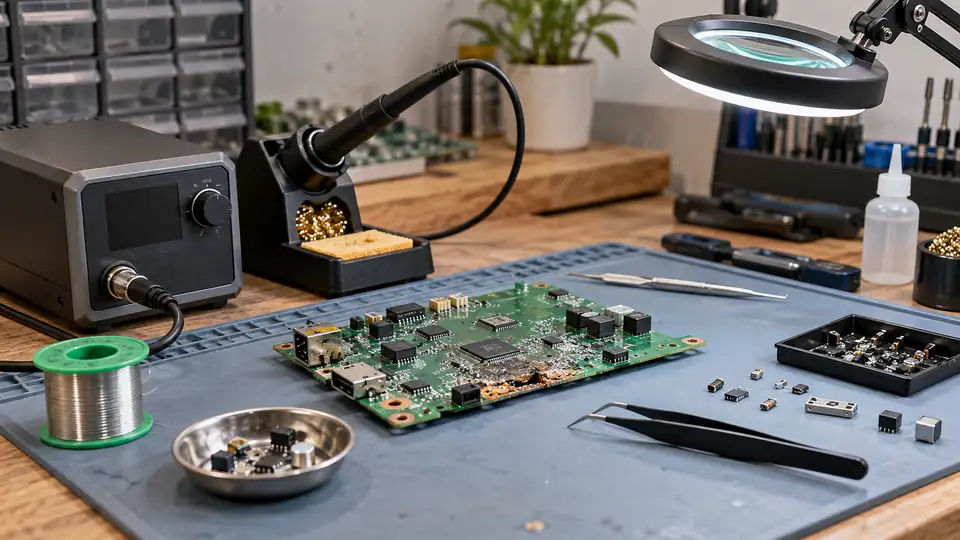
PCB repair demands more control than a basic plug-in soldering iron can usually provide. Small pads, delicate traces, through-hole joints, and heat-sensitive components all respond better to a station with adjustable temperature, a stable holder, and tips suited to the work. The strongest choices here also make it easier to pause safely, clean the tip, and move between fine joints and larger connections without guessing at the heat.
The headline wattage can be misleading. A 110W station may offer more heating capacity, while a 60W model may be perfectly practical for lighter board work, but wattage alone does not prove temperature stability or recovery at the joint. Tip shape, control layout, included accessories, ESD claims, and the ability to handle hot-air rework can matter more during a cramped repair. A compact basic station may suit occasional repairs, while a 2-in-1 unit makes more sense for SMD work, IC removal, and repeated board service.
This comparison weighs those practical differences rather than treating every digital display as a sign of equal performance. The YIHUA 926 III is the strongest overall choice for many PCB repair benches because it combines PID control, calibration support, sleep settings, useful tips, and a substantial accessory kit without moving into the larger footprint of a 2-in-1 rework station.
Quick Answer
- Best Overall: YIHUA 926 III, for adjustable control, calibration, sleep mode, and a useful set of PCB accessories.
- Best 2-in-1 Station: YIHUA 862BD+, for buyers who need a soldering iron and hot-air rework in one unit.
- Best Value 2-in-1: WEP 882D, with separate controls for the iron and hot-air side.
- Best Compact Station: Digital 75W Soldering Station, for straightforward temperature-controlled PCB work in a small workspace.
Best Soldering Station for PCB Repair Comparison Table
| Product | Best For | Temperature Control | Standout Feature |
|---|---|---|---|
| YIHUA 926 III | Overall PCB repair | 194°F to 896°F, PID | Calibration, sleep mode, 6 tips |
| YIHUA 862BD+ | Frequent iron and hot-air work | 392°F to 896°F iron range | Detachable handpieces, 3 displays |
| WEP 882D | Budget SMD rework | Iron 392°F to 896°F, hot air 212°F to 896°F | Two functions in one station |
| WEP 2009D-II | Hot-air PCB rework | 212°F to 896°F | Air volume 1 to 10, four presets |
| Digital 75W Soldering Station | Simple bench repairs | 392°F to 896°F | Compact design, ESD claim |
| Plusivo 60W Soldering Iron Kit | Portable starter setup | 392°F to 932°F | Carry bag and 5 tips |
| WEP 927-IV | Organized workbench | 194°F to 896°F | 110W, presets, magnifier |
| LRT 858D | Dedicated hot-air work | Digital adjustable control | 700W heater, brushless fan |
| Liouhoum 80W LCD Soldering Iron | Low-cost occasional repairs | 356°F to 896°F | Automatic sleep and memory |
The detailed reviews explain where each station fits, what its controls and accessories add, and which limitations deserve attention before ordering.
1. YIHUA 926 III — Best Overall
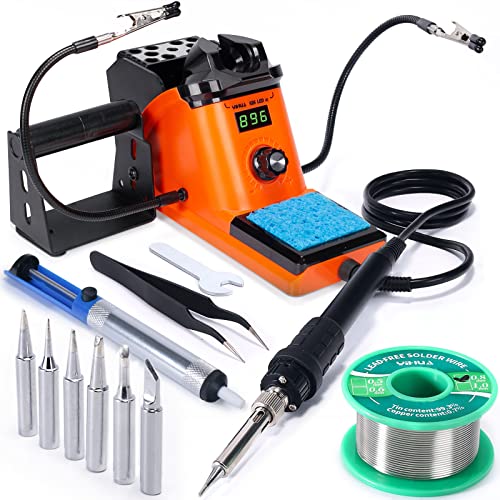
A PCB repair station needs more than a temperature number on a screen, and the YIHUA 926 III offers several controls that make repeated work easier to manage. Its listing gives a 60W rating, a 194°F to 896°F adjustment range, PID heat control, temperature calibration, and a display that can switch between Celsius and Fahrenheit. Calibration support matters because the displayed setting is a control target, not a guarantee that every joint sees the same heat.
The accessory package is unusually practical for a first electronics bench. Six soldering tips, lead-free solder, a solder sucker, tweezers, a sponge, a wire bracket, and two helping hands cover many basic repairs without forcing a separate shopping trip. A board with a loose connector can be held steady while the iron handles the joint, and the sleep timer can be set to 0, 5, 10, or 30 minutes during pauses. Its 110V to 127V requirement also makes the intended electrical setup clear.
Pros
- PID heat control and temperature calibration support are listed.
- Wide 194°F to 896°F temperature adjustment range.
- Includes six tips, helping hands, solder, tweezers, and a solder sucker.
- Sleep mode offers selectable 0, 5, 10, or 30-minute settings.
- Compact design combines the station and iron stand.
Cons
- The 60W rating gives less stated power than several larger stations.
- It is a soldering station rather than a hot-air rework unit.
This is the most balanced choice for a bench that mainly handles soldered PCB joints, connectors, wires, and ordinary component work. The controls and included tools are useful without pushing the setup toward a specialized rework platform. Buyers who routinely remove SMD ICs with hot air should step up to a 2-in-1 station instead, but for conventional iron work, the 926 III offers the clearest mix of control and practical setup support.
To buy this product, click here.
2. YIHUA 862BD+ — Best Premium 2-in-1
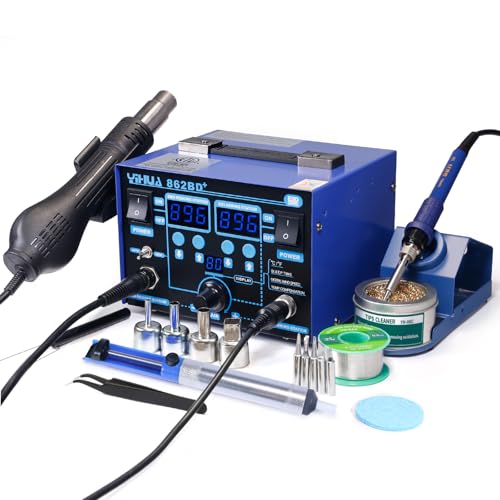
The YIHUA 862BD+ earns its higher position by combining a conventional soldering station with hot-air rework rather than asking the user to buy two separate machines. The iron temperature is adjustable from 392°F to 896°F, while the listing identifies PID stabilization powered by a dual-core microprocessor. That gives the controls a more useful role than a simple dial, particularly when the board contains a mixture of small signal components and heavier joints.
Three digital displays show iron temperature, hot-air temperature, and simulated air volume. The hot-air side is valuable for SMD removal, reflow assistance, and work around components that are awkward to reach with a standard tip. The detachable iron and hot-air handpieces also make replacement more practical than replacing the full station, according to the product information. Included tips, nozzles, lead-free solder, tweezers, a pump, and an IC popper help create a more complete repair setup.
Pros
- Combines soldering iron and hot-air rework functions.
- PID temperature stabilization is listed for the iron.
- Three displays show key iron, hot-air, and air-volume settings.
- Includes five soldering tips, four hot-air nozzles, solder, and repair tools.
- Adjustable sleep mode can be set from 0 to 99 minutes.
Cons
- Its 110V to 127V specification limits the intended operating range.
- The larger 2-in-1 design is more equipment than a simple iron-only bench needs.
This station fits repairs that move between soldering, desoldering, and hot-air work throughout the same session. It is a stronger match for SMD-heavy boards than a conventional station, although hot-air technique still depends on nozzle choice, airflow, board layout, and heat exposure. Choose it over the YIHUA 926 III when hot air is part of the regular workflow, not merely an occasional curiosity.
To buy this product, click here.
3. WEP 882D — Best Value 2-in-1

For a repair bench that needs both an iron and hot air without moving to a more elaborate station, the WEP 882D keeps the arrangement compact. Separate LED displays, power switches, temperature controls, and air-volume adjustment let each function be handled independently. The iron is adjustable from 392°F to 896°F, while the hot-air side is listed from 212°F to 896°F, giving the unit a broad range for board repair tasks.
The package leans heavily toward getting a new setup operational quickly. It includes two spools of solder wire, five iron tips, three hot-air nozzles, brass wool, tweezers, and a desoldering pump. Sleep mode for the iron, standby for the hot-air gun, automatic shutdown, and calibration functions add useful control during stop-start repair work. The product is rated for 110V to 127V, so buyers should match the station to the intended outlet rather than treating the plug as universal.
Pros
- Combines adjustable soldering and hot-air functions in one compact unit.
- Separate controls and displays keep the two heat sources distinct.
- Includes five iron tips and three hot-air nozzles.
- PID control and calibration functions are listed for temperature management.
- Includes solder wire, brass wool, tweezers, and a desoldering pump.
Cons
- The supplied information does not specify a detailed airflow range.
- Its 110V to 127V rating is a firm electrical limitation.
The WEP 882D is a sensible route into SMD rework for someone who also needs ordinary iron soldering in the same workspace. It gives up some of the more detailed control information found on the YIHUA 862BD+, yet its separate displays and broad accessory package keep it practical. It may be excessive for occasional through-hole repairs, but it has a clear purpose on boards requiring both contact soldering and directed hot air.
To buy this product, click here.
4. WEP 2009D-II — Best for Hot-Air PCB Rework

The WEP 2009D-II is aimed at the hot-air side of PCB repair, where repeatable settings and manageable airflow can matter more than a large collection of conventional iron tips. It offers a 212°F to 896°F temperature range, air-volume adjustment from 1 to 10, four preset channels, and a cool-air mode. Those controls can reduce repeated knob adjustments when moving between familiar board tasks.
A detachable R118B hot-air gun, three nozzles, ESD-safe tweezers, and an IC extractor are included. The automatic standby function lowers the gun to 212°F when it is placed in the holder, according to the listing. That is a useful pause feature, but the temperature shown by a station remains a setpoint rather than a direct reading of the component. Proper nozzle selection, distance, dwell time, and board protection still determine how heat reaches the work.
Pros
- Air volume is adjustable from 1 to 10.
- Four preset channels support repeated repair routines.
- Includes three hot-air nozzles and an IC extractor.
- Detachable hot-air gun can be replaced separately according to the listing.
- Offers cool-air mode and automatic standby reduction.
Cons
- It is focused on hot-air rework rather than a conventional soldering iron station.
- The product information does not state a separate soldering-iron function.
This is the better fit for IC removal, SMD reflow, and hot-air-focused board service than for general bench soldering. The four presets and air control are useful for repeated jobs, while the included nozzles cover several work areas without claiming universal component compatibility. Select a conventional or 2-in-1 station instead if your repairs mainly involve soldering wires and component leads with a tip.
To buy this product, click here.
5. Digital 75W Soldering Station — Best Compact Station

A small repair bench can benefit from a station that does the basics without spreading accessories across every spare inch. This digital 75W model combines the control unit, iron, holder, and brass cleaning ball in a compact format. Its listing gives an adjustable range of 392°F to 896°F and a front LED display, so the user can see the selected setting while adjusting the control knob.
The product information describes the station as ESD safe for electronics repair and PCB work. That is a stated design claim, not a substitute for a complete ESD-controlled workstation, but it is still a relevant feature for component-level tasks. The package is much simpler than the YIHUA 926 III, with the station, handle, holder, and brass cleaner identified. A repairer who already owns solder, tweezers, and desoldering tools may appreciate that focused arrangement.
Pros
- 75W station format provides a dedicated control unit and iron holder.
- Adjustable 392°F to 896°F temperature range.
- Clear LED display and simple control knob.
- Listing identifies ESD-safe protection for electronics work.
- Compact footprint suits smaller workbenches.
Cons
- The included package has fewer repair accessories than the YIHUA 926 III.
- The available information does not specify calibration, PID control, or sleep mode.
This station makes sense for straightforward PCB soldering where the priority is a compact digital control unit rather than a full rework toolkit. It can handle a board-side workflow involving a soldering iron, holder, and brass cleaner, but buyers should budget for separate solder and desoldering equipment if those tools are missing from the bench. Its simple layout is appealing, while the limited published feature detail makes it less informative for demanding repeat-use work.
To buy this product, click here.
6. Plusivo 60W Soldering Iron Kit — Best Portable Starter Setup

The Plusivo kit takes a simpler path than a full station. It is a 60W, 120V digital soldering iron with a 392°F to 932°F adjustment range, a ceramic heating element, and a silicone grip. The handle includes four ventilation holes for heat dissipation, while the display gives the user a visible temperature reference. For a drawer, field kit, or occasional home repair, the bundled format can be easier to store than a collection of loose tools.
Its 21-in-1 package includes five replaceable tips, 0.8mm flux-cored SnPb solder wire, a desoldering pump, tweezers, a stand, sponge, wire stripper, screwdrivers, heat-shrink tubes, and a carry bag. Those details make it more useful for a first repair kit than a bare iron. It remains a pen-style tool rather than a separate station with advanced control features, so repeated board work may favor the YIHUA 926 III or WEP 927-IV.
Pros
- 60W digital iron offers a 392°F to 932°F adjustment range.
- Includes five replaceable tips.
- Package includes solder, pump, tweezers, stand, and small hand tools.
- Carry bag keeps the kit organized for storage or transport.
- Silicone grip and ventilation holes are listed as handle features.
Cons
- It is a soldering iron kit rather than a full temperature-control station.
- The included solder is identified as SnPb, which may not suit every material or handling preference.
This kit is a practical entry point for light PCB repairs, cable work, and household electronics maintenance. The included solder and accessories mean less setup friction, while the carry case helps keep the small parts from disappearing into a drawer. Buyers doing frequent precision work may prefer a station with a separate holder, calibration support, and more explicit control functions, but occasional users get a broader kit here than from a bare iron.
To buy this product, click here.
7. WEP 927-IV — Best Organized Workbench Station
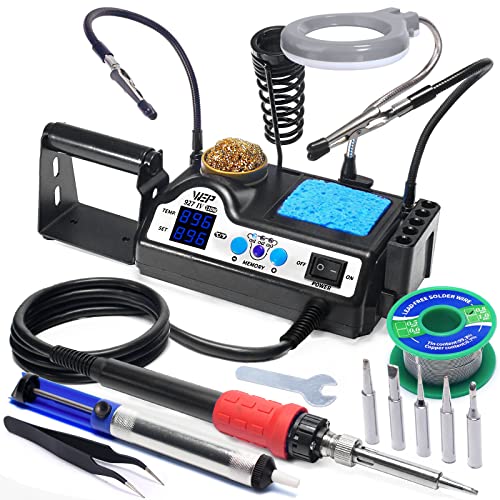
The WEP 927-IV is built around a busy bench where the problem is often tool sprawl rather than a lack of heat. Its 110W heating element, adjustable 194°F to 896°F range, and double display showing set and actual temperature give it a stronger control presentation than a basic pen-style iron. Three preset channels can save recurring settings, while sleep mode is adjustable from 0 to 99 minutes.
The integrated layout includes an iron holder, tip cleaner, solder wire dispenser, tip storage slots, two helping hands, and an LED magnifier. That can be handy when a board, wire, and solder spool all need to stay within reach, although the built-in accessories also make the station more specialized and physically busy. The listing specifically identifies WEP #1400 soldering tips, so replacement planning matters before the original tips are worn or damaged.
Pros
- 110W heating element offers substantial stated power capacity.
- Double numerical display shows set and actual temperature.
- Three preset channels support repeated temperature settings.
- Integrated helping hands, LED magnifier, tip cleaner, and storage slots.
- Sleep timer can be adjusted from 0 to 99 minutes.
Cons
- The listing specifies WEP #1400 tips, creating a defined replacement ecosystem.
- The integrated layout may take more bench space than a basic station.
This model suits someone who wants the station to function as a small soldering center rather than a control box beside a separate tool tray. The magnifier and helping hands can make component positioning easier, particularly during a fiddly connector repair, while the preset controls reduce repeated setup. It is less attractive for a minimal bench or for anyone who wants to choose from a broad, unspecified range of tip families.
To buy this product, click here.
8. LRT 858D — Best Dedicated Hot-Air Value

Hot air changes the repair equation for SMD components, IC removal, USB-C port work, and parts surrounded by nearby joints. The LRT 858D uses a listed 700W heating system, digital temperature control, and adjustable airflow. Its brushless fan is described as supporting stable airflow, lower noise, and longer operating life than traditional brushed motors. Those are listing claims, but they identify the product’s intended role clearly.
The station is aimed at PCB repair rather than ordinary iron soldering. Its hot-air handle is described as ergonomic, and the product information names applications such as IC removal, BGA rework, mobile phone repair, and laptop maintenance. The listing does not provide a detailed airflow scale or nozzle package in the supplied information, so buyers should confirm the current contents and control details before ordering if a particular nozzle or air range is required.
Pros
- 700W heating system is intended for rapid hot-air work.
- Digital temperature and adjustable airflow controls are listed.
- Brushless fan design is specified.
- Product information directly identifies PCB, SMD, IC, and USB-C repair applications.
- Compact station and ergonomic hot-air handle suit bench use.
Cons
- It does not replace a conventional soldering iron station for tip-based joints.
- The supplied information does not clearly identify included nozzles or a numerical airflow range.
The LRT 858D belongs on a bench where hot air is the main requirement, especially for board components that are difficult to approach with a pointed tip. It is a narrower purchase than the WEP 882D or YIHUA 862BD+, since those combine hot air with conventional soldering, but that specialization may be welcome when a separate iron is already available. Confirm the specific accessories needed for your board size before purchase.
To buy this product, click here.
9. Liouhoum 80W LCD Soldering Iron — Best Low-Cost Iron

This 80W LCD iron offers a straightforward alternative to a full station for small repairs and learning projects. The product information gives a 356°F to 896°F temperature range, Celsius and Fahrenheit switching, a ceramic core, and a claimed 10-second heat-up time. The heat-up figure is a listing claim rather than an independently measured result, while the temperature range tells you what the control is intended to set, not the exact heat at every PCB joint.
Its automatic sleep behavior lowers the temperature after five minutes on the stand, and the memory function restores the previous setting when powered back on. The LCD screen and heat-resistant handle keep the basic controls easy to read and use. It is portable and includes a stand, but the supplied information does not identify a broader tip system or a separate station control box, so it is better suited to occasional work than a repair bench handling boards all day.
Pros
- 80W ceramic-core iron with adjustable 356°F to 896°F range.
- LCD display supports visible temperature adjustment.
- Automatic sleep function activates after five minutes on the stand.
- Temperature memory restores the previous setting after shutdown.
- Portable pen-style format is easy to store and carry.
Cons
- It lacks the separate station controls and accessory depth of the top-ranked models.
- The available information does not specify included replacement tips.
This is a reasonable low-cost choice for occasional component, wire, and basic circuit-board work where portability matters more than advanced station functions. The sleep and memory features are useful for stop-start repairs, but the limited supplied information about tips and accessories makes it harder to plan a long-term repair setup. Choose a full station if you expect frequent soldering, repeated temperature changes, or more demanding PCB rework.
To buy this product, click here.
Buying Guide
Choose Contact Soldering or Hot-Air Rework First
A conventional soldering station uses a heated tip to transfer solder to a joint. That is the right approach for many through-hole parts, wires, connector pins, and accessible PCB pads. Hot-air stations direct heated air across a broader area, which can help loosen SMD components and reflow multiple nearby joints. The YIHUA 926 III is a stronger contact-soldering choice, while the WEP 2009D-II and LRT 858D focus on hot-air work. A 2-in-1 station is useful when both tasks appear regularly.
Wattage Does Not Tell the Whole Heating Story
Power ratings describe available electrical power, but they do not independently prove temperature stability or recovery at a joint. Tip size, heater design, control behavior, contact with the work, and the thermal mass of the board all affect the result. The WEP 927-IV lists 110W, while the YIHUA 926 III lists 60W with PID control and calibration support. That difference should prompt a closer look at the control system rather than an automatic assumption that the higher number is better for every PCB.
Temperature Range Is a Control Range, Not a Joint Guarantee
A station set to 650°F does not mean the pad, component lead, and solder are all at precisely 650°F. Heat leaves the tip as it touches the work, and a larger ground plane can pull heat away quickly. Use the published range to understand adjustment flexibility, then match tip geometry and solder type to the joint. Avoid selecting a station solely because its maximum temperature is higher.
Tip Selection and Replacement Planning Matter
Fine conical or small chisel tips can help with compact pads, while wider shapes transfer heat more effectively to larger joints. The YIHUA 926 III includes six tips, and the Plusivo kit includes five replaceable tips. The WEP 927-IV specifically identifies WEP #1400 tips, which is useful information but also means replacement planning should follow that tip family. Included tips are not proof that every optional shape will fit.
PID, Calibration, and Sleep Functions Add Practical Control
PID control uses feedback to adjust heating toward the selected setting, while calibration support can help correct a discrepancy between the control setting and the working temperature. These functions do not remove the need for proper tip care or technique, but they are more informative than a temperature range alone. Sleep mode reduces heat during idle periods, as seen on the YIHUA 926 III, WEP 882D, YIHUA 862BD+, and WEP 927-IV.
Mind Voltage and the Contents of the Box
Several products here specify 110V to 127V operation, including the YIHUA 926 III, YIHUA 862BD+, WEP 882D, WEP 2009D-II, and WEP 927-IV. Confirm the electrical version before ordering. Also separate included items from supported accessories. A station may include several tips or nozzles, but that does not mean every replacement size is included. The same applies to solder, tweezers, helping hands, and desoldering tools.
ESD Claims Do Not Replace a Complete ESD Setup
Some stations identify ESD-safe protection, including the compact 75W model and YIHUA 862BD+. That can be relevant around sensitive components, but an ESD claim on one tool does not turn the entire bench into a controlled static-safe environment. Grounding, work-surface choices, handling technique, and the surrounding equipment still matter for delicate electronics.
Best Soldering Station for PCB Repair FAQ
What type of station is best for PCB repair?
For conventional joints, choose a temperature-controlled soldering station with a stable holder, suitable tips, and controls that are easy to adjust. The YIHUA 926 III is the strongest general-purpose choice in this group. If the work includes SMD removal or reflow, a 2-in-1 model such as the YIHUA 862BD+ or WEP 882D provides hot-air capability as well.
Is higher wattage better for PCB soldering?
Higher wattage can provide more available heating power, but it does not automatically mean better soldering. Control behavior, heater design, tip geometry, and the board’s thermal mass also affect performance. A high-power station can be useful for larger joints, while careful temperature control remains important around small pads and sensitive components.
Do I need hot air for PCB repair?
Many PCB repairs can be completed with a conventional soldering iron. Hot air becomes more useful for SMD components, IC removal, reflowing multiple nearby joints, and parts with limited tip access. A 2-in-1 station is a practical compromise if both types of work occur on the same bench.
What temperature should I use for PCB soldering?
The suitable setting depends on the solder alloy, tip size, joint mass, and component sensitivity. Use the product’s temperature control carefully rather than treating the maximum setting as a target. Lead-free and leaded solder can require different working approaches, and a large ground plane may need more heat transfer without exposing nearby parts to unnecessary heat.
Are included soldering tips universal?
No. Tip fit depends on the handpiece and tip family. A station that includes five or six tips does not necessarily accept every replacement tip on the market. The WEP 927-IV listing identifies WEP #1400 tips, while other products in this roundup do not provide the same replacement detail. Confirm the exact model and tip family before buying extras.
What does ESD-safe mean on a soldering station?
It indicates that the product is described as offering protection intended to reduce static-related risk. It does not guarantee that every component of the workbench is ESD controlled or that damage is impossible. Use appropriate grounding and handling practices for static-sensitive parts.
Should I buy a complete soldering kit or a station by itself?
A complete kit can be convenient if you need solder, tweezers, a pump, tips, and a stand at the same time. The YIHUA 926 III and Plusivo kit provide many useful starting items. A station with fewer accessories may be preferable if you already own quality tools or want to select specialized tips and solder separately.
Final Verdict
The YIHUA 926 III is the strongest overall choice for PCB repair in this comparison. Its 60W rating is adequate for many electronics tasks, while PID control, calibration support, sleep settings, a wide adjustment range, and six included tips give it a more complete control package than a basic digital iron. The helping hands, solder, tweezers, and solder sucker also reduce the amount of extra bench equipment needed at the start.
For SMD-heavy work, the YIHUA 862BD+ is the more capable premium alternative because it combines contact soldering and hot air with detachable handpieces and three displays. The WEP 882D offers a value-oriented version of that same broader workflow, while the compact 75W station and Plusivo kit suit simpler or more portable repairs. Match the purchase to the work in front of you. A conventional station is usually the cleaner choice for routine joints, while hot air earns its space when board repair involves dense SMD parts, IC removal, or repeated rework.

- Jesse
Jesse is the editor behind Soldering Gear, where he covers soldering irons, stations, rework equipment, and the tools that belong on a practical electronics bench. His work focuses on comparing product specifications, features, compatibility, and intended uses so readers can make more informed buying decisions.
- Best Soldering Iron for Microsoldering: 9 Picks in 2026 November 10, 2026
- Best Soldering Station for PCB Repair: 9 Picks in 2026 November 9, 2026
- How to Desolder Electronics November 8, 2026
- Best Hot Air Rework Station for PCB Repair: 9 Picks in 2026 November 7, 2026
- Soldering Iron Tip Shapes Explained November 6, 2026