Best Soldering Station for Phone Repair: 9 Picks in 2026

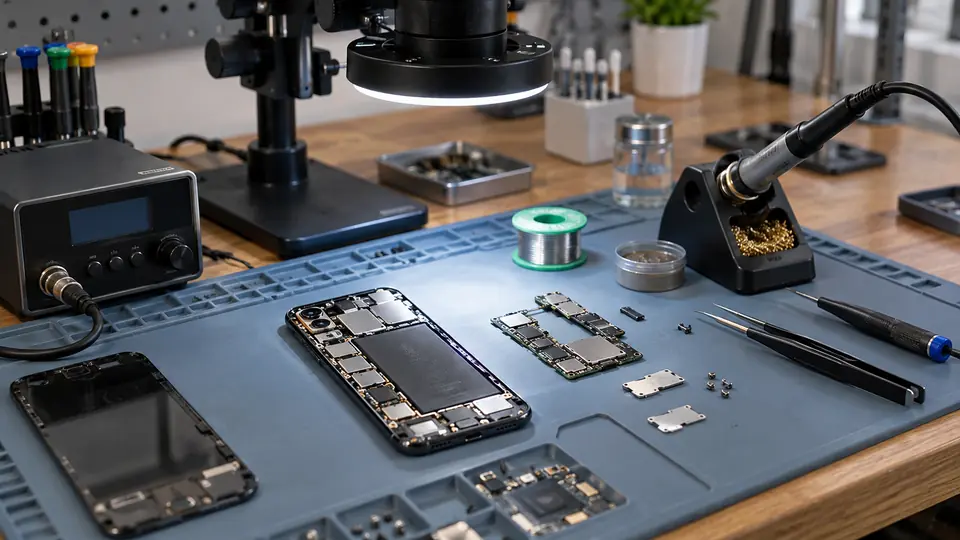
Phone repair asks more of a soldering setup than a quick wire fix. Small pads, crowded boards, heat-sensitive connectors, and tiny surface-mount components reward controlled temperature and manageable airflow. A station with a clear display and useful adjustment can make the difference between a clean repair and a lifted pad surrounded by scorched flux.
The central choice is whether you need a conventional soldering iron, a hot-air rework tool, or both. A soldering iron handles precise joints and wire work, while hot air is better suited to loosening and placing many SMD components at once. Maximum temperature alone does not settle the question. Control, tip or nozzle selection, standby behavior, voltage compatibility, and the ability to work gently around nearby components matter more for phone boards.
This comparison gives priority to stations that cover actual electronics repair tasks, then includes compact iron kits for buyers who mainly need controlled point soldering. The YIHUA 8786D I earns the strongest overall position because it combines an iron and hot-air system, while the YIHUA 926 III is a simpler choice for precise iron work and the YIHUA 853D adds useful bench power and testing functions.
Quick Answer
- Best Overall: YIHUA 8786D I for buyers who need both soldering and hot-air rework.
- Best Conventional Station: YIHUA 926 III for controlled iron work, included tips, and a compact bench setup.
- Best for a More Complete Repair Bench: YIHUA 853D for its integrated iron, hot air, adjustable DC supply, and voltage testing.
- Best Compact Hot-Air Option: GOORY 8858-V for phone-oriented SMD work in a small workspace.
Best Soldering Station for Phone Repair Comparison Table
| Product | Best For | System Type | Key Controls |
|---|---|---|---|
| YIHUA 8786D I | Complete phone repair setup | Iron and hot air | PID, dual display, sleep |
| YIHUA 926 III | Fine iron work | 60W soldering station | 194°F to 896°F, calibration |
| YIHUA 853D | Expanded electronics bench | Three-in-one station | Iron, hot air, 0 to 15V supply |
| WEP 2009D-II | Repeatable hot-air jobs | Hot-air rework station | Four presets, airflow 1 to 10 |
| GOORY 8858-V | Compact SMD rework | Hot-air rework station | 700W heater, auto standby |
| WEP 8858-V | Simple hot-air control | Hot-air rework station | Adjustable heat and airflow |
| Plusivo 60W Kit | Basic point soldering | Digital soldering iron | 392°F to 932°F |
| Liouhoum 80W Kit | Portable low-cost iron work | Digital soldering iron | 356°F to 896°F, sleep mode |
| 80W LCD Soldering Kit | Simple electronic repairs | Digital soldering iron | 356°F to 896°F |
The detailed reviews explain how each station approaches heat, airflow, controls, accessories, and the cramped working conditions found in phone repair.
1. YIHUA 8786D I — Best Overall

Phone repair often moves back and forth between two very different jobs. One minute you are touching a fine solder joint with an iron, and the next you are warming a connector or SMD component with hot air. The YIHUA 8786D I addresses that split with separate soldering and hot-air systems, dual displays, and dual power switches, so the setup is broader than a conventional iron station.
Its PID temperature program is listed as monitoring and correcting temperature quickly, while the hot-air side includes a fail-safe that cuts power to the heating element if airflow stops unexpectedly. Those functions do not eliminate the need for careful heat and airflow technique, but they give the operator useful control around delicate boards. The package includes 10 soldering tips, four hot-air nozzles, an IC extractor, a solder pump, and lead-free solder, creating a practical starting point for mixed repair work.
Pros
- Combines a soldering iron and hot-air rework station.
- Provides separate displays and power switches for the two systems.
- Uses PID temperature control for both heating functions.
- Includes 10 soldering tips and four hot-air nozzles.
- Lists a hot-air fail-safe that cuts heater power if airflow stops.
Cons
- Its 110 to 127V specification limits it to compatible North American power setups.
- A dual-function station takes more bench space and setup attention than an iron-only unit.
This is the strongest fit for a repairer who expects to handle connectors, shields, SMD components, and ordinary solder joints on the same bench. Someone who only solders occasional wires will pay for capabilities they may rarely use, while a phone-focused setup gains a great deal from having hot air immediately available. The included tips and nozzles are useful for getting started, but future replacements still need to match the appropriate system.
To buy this product, click here.
2. YIHUA 926 III — Best Conventional Station
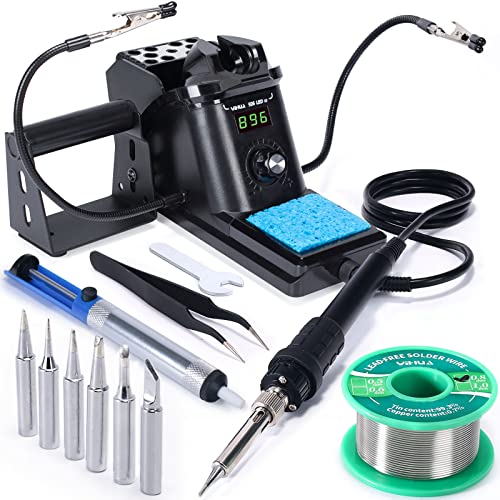
For many repairs, a dependable iron is the tool that stays in hand longest. The YIHUA 926 III uses a 60W station format with a digital display, adjustable temperature from 194°F to 896°F, PID temperature stabilization, and digital calibration support. That combination gives the user a visible setting and a way to adjust the station rather than relying on a basic fixed-output iron.
The kit is especially practical for a first organized bench because it includes two helping hands, six #1200/900M-series tips, lead-free solder, a solder sucker, ESD-safe tweezers, a dispenser, and a cleaning sponge. The adjustable sleep mode can be set to 5, 10, or 30 minutes. This is an iron-only station, so it will not replace hot air for broad SMD removal, but it keeps the controls and footprint simpler for precise soldering around wires, pads, and replacement components.
Pros
- Offers a broad listed temperature range from 194°F to 896°F.
- Includes PID stabilization and digital temperature calibration.
- Comes with six listed #1200/900M-series soldering tips.
- Includes two helping hands and ESD-safe tweezers.
- Provides selectable 5, 10, and 30-minute sleep settings.
Cons
- Does not provide a hot-air function for heating groups of SMD components.
- The supplied 110 to 127V design requires a compatible US-standard outlet.
The 926 III suits buyers who want a conventional station with useful safeguards and a fuller accessory package than a bare iron. It is a sensible choice for connector wires, small board repairs, and rework that can be handled with a tip. Pick a hot-air model instead if the repair list includes frequent shield removal or multi-pin component work, where directing heat across several joints is more practical.
To buy this product, click here.
3. YIHUA 853D — Best for an Expanded Repair Bench

The 853D takes the idea of a repair station beyond soldering and hot air. It integrates a soldering iron station, a hot-air rework station, and a DC power supply with a voltage test function. For phone repair, that extra section can be useful when a board needs controlled power or a quick voltage check, although the published supply output is limited to 0 to 15V and 0 to 2A.
The iron is listed from 392°F to 896°F, while the hot-air section runs from 212°F to 896°F with adjustable airflow listed up to 120 L/min. Both heating sections use PID stabilization. A 5V USB port is also included for charging or powering compatible work, and the instrument can measure DC voltage up to 35V in test mode. It is a larger commitment than a simple iron station, but it can reduce the number of separate boxes around a crowded repair bench.
Pros
- Combines soldering, hot air, and an adjustable DC power supply.
- Includes a DC voltage test mode listed up to 35V.
- Offers 0 to 15V and 0 to 2A output for suitable low-voltage work.
- Provides PID stabilization for both soldering and hot-air sections.
- Includes a 5V USB port and sleep and automatic-shutdown functions.
Cons
- The integrated supply is limited to the published 0 to 2A and 0 to 15V range.
- The larger multi-function format may be excessive for basic iron-only repairs.
This station is aimed at a bench where diagnosis and rework overlap. A technician checking a board, powering a suitable low-voltage circuit, and switching between iron and hot air may appreciate having those controls together. It is less attractive for a small occasional setup, particularly if the power-supply and meter functions will sit unused.
To buy this product, click here.
4. WEP 2009D-II — Best for Repeatable Hot-Air Jobs

When the same kind of hot-air task appears repeatedly, presets can save more time than a longer specification sheet. The WEP 2009D-II provides four preset channels, adjustable temperature from 212°F to 896°F, and airflow adjustment from 1 to 10. Its LED display shows temperature, airflow, preset channel, unit, and heating status, giving the operator several useful settings at a glance.
The detachable hot-air gun is a practical detail for a busy bench because the listing states that the handpiece can be replaced without replacing the whole station. Auto standby cools the gun to 212°F when it is returned to the holder, and a cool-air mode is available for manual cooling or PCB work. Three nozzles, bent and straight ESD-safe tweezers, and an IC extractor are included, although the product is a hot-air station rather than a conventional soldering-iron station.
Pros
- Provides four temperature preset channels.
- Offers adjustable temperature and airflow controls.
- Includes a detachable hot-air gun and three nozzles.
- Uses auto standby to cool the gun to 212°F in its holder.
- Displays temperature, airflow, heating status, and preset information.
Cons
- It does not include a conventional soldering iron function.
- The listing requires a fully inserted power cord and compatible 110 to 127V supply.
The 2009D-II makes sense for someone who already owns an iron or prefers a separate hot-air tool. Presets can be handy for moving between familiar board tasks, but the temperature shown by a station is a setting rather than a guarantee of component temperature. Careful nozzle distance, airflow choice, and surrounding-board protection remain part of the job.
To buy this product, click here.
5. GOORY 8858-V — Best Compact Hot-Air Option

A cramped desk can make a full repair setup feel like a pile of cables, holders, and loose nozzles. The GOORY 8858-V keeps its main unit compact and builds in holders for the gun and nozzles. Its PID-controlled 700W ceramic heating core is listed with a 212°F to 896°F range, while dedicated knobs adjust temperature and airflow without requiring a secondary menu.
The phone-repair angle is clear in the listed applications, which include SMD removal, PCB rework, and electronics repair. Returning the gun to its holder activates standby, cooling, and stopped airflow. Four nozzles, a solder sucker, two precision tweezers, and a nozzle holder are included. The station does not replace a conventional iron, so it works best beside one or as the hot-air half of a compact setup.
Pros
- Uses a compact main unit with integrated gun and nozzle storage.
- Lists a 700W ceramic heating core with PID control.
- Provides dedicated temperature and airflow knobs.
- Includes four nozzles, a solder sucker, and two tweezers.
- Offers automatic standby with cooling and stopped airflow.
Cons
- It is a hot-air station and does not include a conventional soldering iron.
- The 110 to 127V rating is unsuitable for direct connection to a 220V outlet.
This is a good match for a small bench that needs hot air for connectors and SMD parts without adding a large control box. The included nozzle range gives several starting points, but the correct choice still depends on component size and board layout. Buyers seeking one box for both iron and hot air should move up to a dual-function station.
To buy this product, click here.
6. WEP 8858-V — Best Simple Hot-Air Controls

The WEP 8858-V keeps the hot-air workflow straightforward. Its palm-sized station includes an integrated gun holder and nozzle holder, while a simple control panel handles temperature and airflow. The product information lists PID monitoring, digital calibration, Fahrenheit and Celsius conversion, and a hot-air fail-safe, all of which are useful when working around small board components.
Three nozzles and bent and straight tweezers are supplied. The controls place airflow adjustment on a dedicated knob, which is convenient during a job where a small change in air movement can affect nearby parts. It has a 110 to 127V US specification and does not include a separate conventional soldering iron, so its role is focused on hot-air rework rather than complete board repair.
Pros
- Uses a compact station with built-in gun and nozzle holders.
- Provides separate temperature and airflow adjustment.
- Includes three nozzles in different sizes.
- Offers PID control, digital calibration, and unit conversion.
- Lists a hot-air fail-safe for abnormal airflow conditions.
Cons
- It cannot perform conventional iron soldering by itself.
- The available information does not identify the exact airflow range.
This model fits a repairer who wants a focused hot-air tool with uncomplicated controls. It ranks below the GOORY because the GOORY listing gives more detail about its heater and includes an additional nozzle, though both occupy a similar role. Pair the WEP with a suitable iron if phone repairs regularly alternate between broad component heating and fine pad work.
To buy this product, click here.
7. Plusivo 60W Digital Soldering Iron Kit — Best Basic Iron Kit

Some phone repairs call for a controlled iron and little else. The Plusivo kit uses a 60W digital soldering iron with an adjustable listed range of 392°F to 932°F, a ceramic heating element, and an LED display. Five replaceable tips are included, giving more shape options than a single fixed tip, though the product information does not specify a broader replacement-tip ecosystem.
The accessory package is unusually broad for a portable iron kit. It includes a stand, solder wire, desoldering pump, tweezers, sponge, mini screwdrivers, wire stripper, mini PCB, heat-shrink tubing, and a carry bag. The supplied solder is identified as 0.8mm flux-cored SnPb wire, so users should handle it with appropriate hygiene and ventilation practices. This kit is suited to point repairs and learning setups, not hot-air removal of multi-pin phone components.
Pros
- Provides adjustable temperature from 392°F to 932°F.
- Includes five replaceable soldering tips.
- Uses a digital LED temperature display.
- Includes a stand, desoldering pump, tweezers, and solder wire.
- Comes with a carry bag for organized storage and transport.
Cons
- It does not include hot-air rework capability.
- The included solder is SnPb, which requires careful handling and cleanup.
The Plusivo is a reasonable lower-cost path into controlled iron work when the repair involves a wire, pad, or small component that can be reached with a tip. The kit format is convenient, but its broad accessory count should not be confused with the temperature stability or hot-air control of a full station. Choose it for simple tasks and add a dedicated hot-air tool later if the work expands.
To buy this product, click here.
8. Liouhoum 80W LCD Soldering Iron Kit — Best Portable Low-Cost Iron

The Liouhoum kit takes a simpler plug-in approach while retaining a digital temperature display. Its ceramic core is listed as 80W, with a 356°F to 896°F adjustment range and a stated 10-second heat-up claim. That published heat-up figure describes reaching operating temperature, not how quickly the iron recovers after touching a large thermal mass, so tip choice and joint size still matter.
A five-minute sleep function lowers the temperature when the iron rests on its stand, and temperature memory restores the previous setting after power is cycled. The handle is described as heat resistant, and the kit is portable enough for a small drawer or mobile repair box. It includes a stand, tips, solder wire, flux paste, sponge, and related supplies, but it lacks the separate controls and handpiece organization of a true station.
Pros
- Offers an adjustable 356°F to 896°F temperature range.
- Uses an LCD display for temperature visibility.
- Includes a listed five-minute automatic sleep function.
- Provides temperature memory after power cycling.
- Includes tips, stand, solder wire, flux paste, and sponge.
Cons
- It is a portable iron rather than a full soldering station.
- The product information does not clearly identify the included tip shapes.
This model suits occasional board work where portability and a low-cost entry matter more than hot-air capability or a large accessory system. It can handle accessible solder joints, but phone repair often includes jobs where a conventional iron is only half the answer. Buyers tackling frequent component removal should choose one of the dual-function or hot-air stations above.
To buy this product, click here.
9. 80W LCD Digital Soldering Iron Kit — Best Simple Repair Kit

This 80W iron kit is aimed at basic electronics and household repair rather than a full phone-repair station. The listing gives a 356°F to 896°F adjustable range, an LCD temperature display, and a ceramic heater claimed to reach working temperature within 20 seconds. Four ventilation holes and a heat-resistant handle are also listed, providing practical details for a compact tool.
The package includes five tips, a simple stand, sponge, solder wire, and flux paste. That makes it possible to begin with common soldering supplies already in the box, but the kit does not provide hot air, a digital calibration function, or the broader station controls found on the YIHUA 926 III. For a small repair drawer, it is easy to store and inexpensive to replace, while repeated microsoldering calls for more controlled equipment.
Pros
- Provides adjustable temperature from 356°F to 896°F.
- Includes an LCD temperature display.
- Lists a ceramic heater and 20-second heat-up claim.
- Includes five tips, a stand, sponge, solder wire, and flux paste.
- Uses a heat-resistant handle and ventilation holes for heat dissipation.
Cons
- It lacks hot-air rework capability and station-style calibration controls.
- The listing does not clearly specify the shapes or compatibility range of the five tips.
This is the most basic choice in the group, useful for accessible solder joints, replacement wires, and occasional electronics repairs. Its low complexity can be convenient, but the absence of hot air limits its role in phone work. If the job list includes frequent SMD components or delicate connector removal, a station with airflow control will be a more capable long-term purchase.
To buy this product, click here.
Buying Guide For Phone Repair Soldering Stations
Choose Hot Air If the Board Has Crowded SMD Components
A conventional iron concentrates heat at one tip, which is ideal for a pad or wire but awkward when several pins must soften together. Hot air can warm a broader area, making it more suitable for certain connector and SMD removal tasks. It also demands more care because airflow and heat can disturb nearby components. A combined station such as the YIHUA 8786D I covers both methods, while an iron-only station is a narrower purchase.
Temperature Range Is Only a Starting Point
A listed range tells you what the control allows, not the exact temperature at the joint or component. Tip mass, contact area, heater design, sensor location, and the board’s thermal load all affect the result. A station with PID control and calibration support offers more useful adjustment than a high maximum number by itself. Start with an appropriate setting, use the smallest practical tip or nozzle, and protect heat-sensitive parts.
Tip and Nozzle Selection Affects the Work
Fine tips can help with small pads, while broader tips carry heat across larger joints. Hot-air nozzles similarly shape how heat reaches a component. Included accessories are a starting set, not proof that every future replacement will fit. Check the exact tip family or nozzle dimensions before buying replacements, especially where the listing identifies a particular series such as the YIHUA #1200/900M range.
Standby Features Reduce Idle Heat
Sleep and standby modes lower temperature or shut down heating during pauses. The YIHUA 926 III offers selectable sleep intervals, while the GOORY 8858-V and WEP 2009D-II describe automatic cooling behavior when the handpiece returns to its holder. These functions can reduce unnecessary heat exposure and tip wear, but they do not replace placing the tool securely or following the operating instructions.
Check Voltage Before Ordering
Several stations in this comparison are specified for 110 to 127V US-standard power. That detail matters more than an attractive feature list. A station intended for that range should not be connected directly to a 220V outlet. Confirm the electrical specification for your workspace before purchase, particularly if the equipment will travel between countries or operate in a shared repair area.
Separate Iron Work From Board Power Testing
An iron station controls heat. It does not automatically provide a suitable way to power or diagnose a board. The YIHUA 853D adds a 0 to 15V, 0 to 2A DC supply and a DC voltage test mode up to 35V, which can be useful for a more developed bench. Those limits still matter, and the supply should be used only for applications that fit its published output and safe operating requirements.
Best Soldering Station for Phone Repair FAQ
Is a soldering iron or hot-air station better for phone repair?
They handle different tasks. An iron is better for precise joints, wires, and individual pads. Hot air is more useful for loosening or placing some SMD components and connectors. A dual-function station is the most flexible choice if both types of work appear regularly.
Is a higher wattage automatically better for phone boards?
No. Wattage indicates available electrical power, but it does not by itself establish temperature stability, recovery, or suitability for small components. Heater design, tip geometry, control behavior, and contact technique also affect the joint.
What temperature should be used for phone repair?
There is no single setting for every board, solder alloy, component, and tip. Use the lowest practical heat that produces a clean joint, then adjust based on the work and the tool. A displayed setting is a control value, not a guarantee of the exact temperature at the component.
Are the included tips interchangeable between these stations?
Do not assume that they are. The YIHUA 926 III listing identifies #1200/900M-series tips, while the compact iron kits do not clearly identify a shared system. Confirm the exact model and tip family before ordering replacements.
Do I need hot air for every phone repair?
No. Some repairs involve accessible wires, pads, or individual joints that an iron can handle. Hot air becomes more useful for multi-pin parts, certain connectors, and components where heating several solder points together is practical.
Can a hot-air temperature display show the actual component temperature?
No. The display shows the station’s selected or controlled setting. Actual component temperature also depends on airflow, nozzle distance, board mass, component construction, and surrounding conditions.
Are these stations suitable for a 220V outlet?
The listed YIHUA, WEP, and GOORY stations in this guide specify 110 to 127V US operation. Do not connect them directly to a 220V outlet. Confirm the exact electrical requirements and use an appropriate power arrangement where applicable.
Final Verdict
The YIHUA 8786D I is the strongest overall choice for phone repair because it combines a conventional soldering iron with hot-air rework, includes useful tips and nozzles, and lists PID control on both heating systems. It is the better fit for a bench that may handle anything from a single pad to a crowded SMD component. The YIHUA 926 III is the cleaner pick for buyers who mainly need precise iron work, while the YIHUA 853D earns attention from anyone who also wants an adjustable DC supply and voltage test function.
For hot-air work in a smaller setup, the GOORY 8858-V offers compact storage, dedicated controls, auto standby, and four included nozzles. The Plusivo and 80W iron kits cost less in equipment complexity, but their usefulness ends where hot-air rework begins. Match the station to the repairs you actually perform, verify voltage and replacement accessory compatibility, and treat temperature and airflow settings as starting points that require careful technique around delicate phone boards.

- Jesse
Jesse is the editor behind Soldering Gear, where he covers soldering irons, stations, rework equipment, and the tools that belong on a practical electronics bench. His work focuses on comparing product specifications, features, compatibility, and intended uses so readers can make more informed buying decisions.
- Best Soldering Station for Phone Repair: 9 Picks in 2026 October 29, 2026
- How to Use Flux When Soldering October 28, 2026
- Best Soldering Iron for Phone Repair: 9 Picks in 2026 October 27, 2026
- Best Hot Air Rework Station for Phone Repair: 9 Picks in 2026 October 26, 2026
- Why Is My Soldering Iron Not Melting Solder? October 25, 2026