Best Hot Air Rework Station for Phone Repair: 9 Picks in 2026

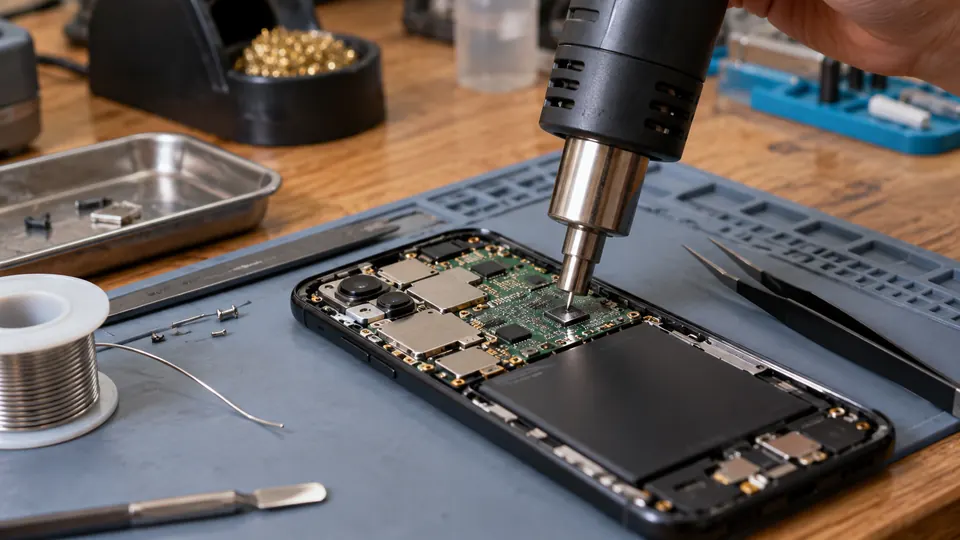
A phone repair bench needs more control than a general-purpose heat gun can provide. Small pads, shielded components, adhesive, connectors, and densely populated boards all respond differently to heat and airflow. A suitable hot air rework station lets you adjust both variables, fit a nozzle to the job, and lift SMD parts without bathing the surrounding board in unnecessary heat.
The headline temperature can be misleading. A station set to 480°C does not make every component reach 480°C, and a higher wattage figure does not automatically mean better control around delicate phone circuitry. Airflow adjustment, nozzle selection, standby behavior, temperature stabilization, and the layout of the handpiece matter just as much. The ATTEN ST-862D stands out overall because its 1000W heating system, 120 L/min maximum airflow, temperature stability specification, quick-access settings, and included nozzles give it the strongest combination for demanding repair work.
The nine stations below cover several practical setups, from compact low-cost tools for occasional connector work to dual-function stations that also include a soldering iron. All are evaluated around phone repair, SMD rework, USB-C port work, and small PCB jobs rather than maximum temperature alone.
Quick Answer
Best Overall: The ATTEN ST-862D offers the most capable hot-air specification here, with 1000W power, up to 120 L/min airflow, a 100°C to 480°C range, temperature stability listed at ±1.0°C, quick-access controls, and four included nozzles.
Best Preset Controls: The WEP 2009D-II is a strong choice for repeated repair tasks because it provides four preset channels, adjustable temperature and airflow, digital calibration, cool-air mode, and a detachable hot air gun.
Best Compact Kit: The WEP 8858-V keeps the footprint small while adding PID control, a built-in holder, three nozzles, and two tweezers.
Best Two-in-One Setup: The YIHUA 8786D I combines hot air with a soldering iron and includes four hot-air nozzles plus ten soldering tips, making it useful for a bench that needs both tools.
Best Hot Air Rework Station for Phone Repair Comparison Table
| Product | Best For | Temperature | Airflow And Controls |
|---|---|---|---|
| ATTEN ST-862D | Overall phone and PCB repair | 100°C to 480°C | Up to 120 L/min, quick-access settings |
| WEP 2009D-II | Repeated jobs and replaceable handpiece | 212°F to 896°F | Airflow 1 to 10, four presets |
| YIHUA 959D | Preset-based SMD work | 212°F to 932°F | Up to 120 L/min, three memories |
| WEP 8858-V | Compact repair benches | Not clearly stated in supplied details | Adjustable temperature and airflow, PID |
| GOORY 8858-V | Small workspaces and starter kits | 212°F to 896°F | 700W, dedicated knobs, calibration |
| LRT 8858 | Low-cost nozzle flexibility | 100°C to 500°C | F1 to F10 airflow, digital control |
| LRT 858D | Phone and USB-C port repair | Not clearly stated in supplied details | 700W, adjustable temperature and airflow |
| TLBZK Hot Air Station | Basic mobile repair setup | 212°F to 932°F | F1 to F10 airflow, sensor handle |
| YIHUA 8786D I | Hot air plus conventional soldering | Not clearly stated in supplied details | PID, cool/hot air conversion, dual display |
The detailed reviews explain how each station handles the small, heat-sensitive jobs that make phone repair different from general PCB work.
1. ATTEN ST-862D — Best Overall
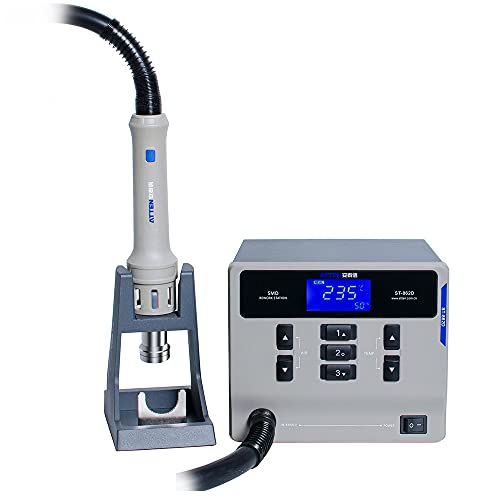
The ST-862D earns the top position through a well-supported set of specifications rather than a single oversized number. Its 1000W rating and listed maximum airflow of 120 L/min give the station substantial heating and air-delivery capacity for larger shields, stubborn connectors, and board areas that absorb heat quickly. The published temperature range runs from 100°C to 480°C, while the listed temperature stability is ±1.0°C. That stability claim does not tell you the exact temperature at a phone component, but it does make the control system more relevant than the maximum setting alone.
Phone repair often involves switching between a broad preheat pattern and a tighter nozzle around a connector or IC. The ST-862D includes four nozzles and three sets of quick temperature and air-volume access keys, so common settings can be reached without repeatedly navigating a menu. Its soft silica-gel cable is also described as remaining flexible in colder conditions. The station is larger and more costly than compact 858D-style units, but its stronger specification set makes it the better fit for regular repair work where recovery and control matter.
Pros
- 1000W heating system gives substantial available heating capacity.
- Published temperature range spans 100°C to 480°C.
- Listed airflow reaches up to 120 L/min with adjustable control.
- Three quick-access groups simplify repeated temperature and airflow changes.
- Includes four nozzles, a bracket, ground wire, and hot air gun.
Cons
- Higher-cost and larger than the compact stations in this comparison.
- The maximum airflow may require careful adjustment around small phone components.
This is the strongest choice for a dedicated bench that handles frequent SMD removal, shield work, and connector replacement. A casual user may find its capacity unnecessary, while someone repairing several phones or working on boards with significant thermal mass will have more room to tune airflow and heat. Use a small nozzle and conservative airflow near fine components, because extra capacity is useful only when controlled.
To buy this product, click here.
2. WEP 2009D-II — Best for Repeated Settings

A phone repair station becomes easier to live with when common jobs can be repeated without starting from scratch. The WEP 2009D-II addresses that directly with four preset channels, adjustable temperature and airflow, and a digital LED display that shows the selected settings and heating status. If you regularly move between a connector profile, a small IC profile, and a broader warming setting, those presets can reduce button pressing and keep the workflow moving.
The hot air gun is detachable, which gives this model a practical service advantage over a sealed handpiece design. The listing describes the gun as replaceable when it or its heating element reaches the end of its service life. Three nozzles, ESD-safe tweezers, and an IC extractor are included. Automatic standby lowers the gun to 212°F when returned to its holder, while cool-air mode can help with manual cooling or board cleanup. The product information does not identify the station’s maximum airflow, so this model ranks below the ATTEN for buyers who need a clearly stated high-capacity air system.
Pros
- Four preset channels support repeatable phone repair workflows.
- Airflow is adjustable from 1 to 10.
- Detachable hot air gun can be replaced without replacing the whole station.
- Includes three nozzles, ESD-safe tweezers, and an IC extractor.
- Offers auto standby, cool-air mode, digital calibration, and Fahrenheit/Celsius conversion.
Cons
- The supplied product information does not clearly specify maximum airflow.
- Only three hot-air nozzles are included.
The 2009D-II suits a repair bench where consistency and maintainability matter more than chasing the highest listed wattage. Presets are particularly useful for repeated port and component work, while the replaceable gun may help extend the station’s practical service life. Choose another model if you need a clearly published 120 L/min airflow figure or a broader included nozzle selection.
To buy this product, click here.
3. YIHUA 959D — Best for Preset SMD Work

The YIHUA 959D is built around three memory channels, a useful feature for anyone who keeps returning to the same types of phone-board work. One setting can be reserved for a small connector, another for broader SMD removal, and a third for heat-shrink or preheating tasks. The station lists a 212°F to 932°F range and up to 120 L/min of airflow. Those figures describe the available settings and air volume, not guaranteed component temperature, so nozzle distance and airflow still need to be managed carefully.
The hot air gun heats when lifted from its holder, and the station includes in-holder standby to cool the handle when it is put down. A brushed aluminum control panel is described as helping prevent accidental burn marks, while the fail-safe function is intended to respond to unusual loss of airflow. Three memory buttons make the controls more practical than a basic dial-only unit. The 110 to 127V requirement is clearly stated, so it belongs on a compatible North American supply rather than a 220V outlet.
Pros
- Three preset channels allow fast changes between common rework profiles.
- Published airflow reaches up to 120 L/min.
- Temperature setting range runs from 212°F to 932°F.
- In-holder standby helps cool the gun between tasks.
- Includes hot-air fail-safe functionality and a 12-month technical coverage claim.
Cons
- 110 to 127V operation limits it to compatible electrical supplies.
- The supplied information does not list included hot-air nozzle sizes or count.
This station is a good middle ground for phone repairers who want strong listed airflow and quick preset access without moving to the ATTEN’s larger 1000W class. It is less compelling if nozzle availability is a major purchasing factor because the supplied listing does not clearly spell out the included hot-air accessories. Check the current package contents before ordering if a specific nozzle profile is required.
To buy this product, click here.
4. WEP 8858-V — Best Compact Kit

A crowded desk can make a full-size rework station feel awkward, especially when the repair area already holds a microscope, mat, power supply, and parts trays. The WEP 8858-V uses a palm-sized main unit with an integrated hot air gun holder and nozzle holder. That arrangement keeps the gun and its accessories in one place, which is a small but useful detail when a phone is open on the bench and loose nozzles are easy to knock aside.
The station uses a PID program that continuously monitors temperature and adjusts power output according to the listing. Its front controls provide separate adjustment for temperature and air volume without requiring a secondary menu. Three nozzles and bent and straight tweezers are included, while digital calibration and Fahrenheit/Celsius conversion add flexibility. The supplied information does not clearly state the temperature range or maximum airflow, so the station is better suited to compact general rework than to buyers comparing high-capacity airflow figures.
Pros
- Palm-sized design suits benches with limited space.
- Integrated holders keep the gun and nozzles organized.
- PID temperature control is included.
- Three nozzles and two tweezer styles come in the kit.
- Offers direct airflow control, digital calibration, and hot-air fail-safe features.
Cons
- The supplied details do not clearly identify the temperature range.
- The supplied details do not state maximum airflow.
The 8858-V makes sense for occasional phone repair, a small home bench, or a portable service setup where storage matters. Its controls are easier to approach than a menu-heavy interface, but the missing airflow and temperature figures make direct performance comparison difficult. Buyers working on large shields or thermally demanding board sections may prefer a station with clearer capacity specifications.
To buy this product, click here.
5. GOORY 8858-V — Best for a Small Workbench

The GOORY 8858-V follows the compact 8858 format but gives the buyer a more complete accessory package. Its listing identifies a 700W ceramic heating core, a 212°F to 896°F adjustment range, PID control, and separate knobs for temperature and airflow. That combination is useful around phone boards because the operator can make a quick airflow change while keeping attention on the nozzle and component rather than working through layered controls.
Four nozzles, two precision tweezers, a desoldering pump, and a nozzle holder are included. Returning the gun to its holder activates standby with cooling and stopped airflow, according to the product information. The listing also identifies a flame-retardant handle and an ETL certification claim. Those features should still be used alongside normal heat and electrical precautions. Its compact body is attractive for a small bench, while the 700W rating places it below the higher-capacity ATTEN in available heating power.
Pros
- 700W ceramic heating core is clearly identified.
- Temperature range spans 212°F to 896°F.
- Dedicated knobs provide direct temperature and airflow adjustment.
- Includes four nozzles, two tweezers, and a desoldering pump.
- Automatic standby activates cooling when the gun returns to its holder.
Cons
- Lower stated power than the 1000W ATTEN station.
- Rated for 110 to 127V operation only.
This unit fits a repairer who wants a tidy, compact kit with the basic tools for connector and SMD work. The extra nozzles and direct knobs make it more immediately useful than a bare station, while its lower power may be adequate for many small boards. If your work regularly involves heavy shielding or broad areas that hold heat, a higher-capacity station is a safer match.
To buy this product, click here.
6. LRT 8858 — Best Nozzle Variety
The LRT 8858 is appealing when nozzle choice matters more than advanced memory functions. Its package includes six precision nozzles in 3, 4, 5, 6, 8, and 10mm sizes, giving the operator more ways to concentrate or spread heat over a phone board. The station lists a 100°C to 500°C range and F1 to F10 airflow adjustment. That broad nozzle selection can help when moving from a small component to a larger shield, provided the user keeps the air stream controlled.
The compact controller includes digital temperature adjustment and an intelligent sleep function that enters cooling mode when the handle is placed in its holder. ESD tweezers and an IC extractor are included as well. The available information describes microprocessor-controlled temperature adjustment, but it does not provide a maximum airflow figure. That makes the LRT attractive as a lower-cost, accessory-rich setup, while leaving less evidence for buyers who need to compare air-delivery capacity directly.
Pros
- Six included nozzles cover 3mm through 10mm sizes.
- Temperature adjustment spans 100°C to 500°C.
- Airflow has ten listed adjustment levels.
- Sleep function starts cooling when the handle is placed in the holder.
- Includes ESD tweezers, an IC extractor, stand, and power cable.
Cons
- Maximum airflow is not clearly stated in the supplied information.
- The kit lacks the soldering iron function found on several two-in-one options.
This model suits a compact phone-repair station where six nozzle sizes will get regular use. It provides more included nozzle flexibility than the WEP 8858-V, but fewer workflow conveniences than stations with presets or detachable handpieces. Select it for straightforward heat-and-air work, and look elsewhere if you need a clearly documented airflow capacity or an integrated soldering iron.
To buy this product, click here.
7. LRT 858D — Best for USB-C Port Work

USB-C port replacement can involve stubborn solder joints and a concentrated work area, so a station needs enough heating capacity without turning the entire board into a hot zone. The LRT 858D lists a 700W heating system, adjustable temperature and airflow, and stable temperature recovery. Its product information specifically names USB-C port replacement, IC removal, BGA rework, SMD soldering, and mobile phone repair among its intended uses.
A brushless fan is identified as part of the design and is described as supporting stable airflow, lower noise, and longer operating life compared with traditional brushed motors. The station also has a digital LED display and an ergonomic hot air handle. The supplied details do not identify the temperature range, nozzle count, or precise airflow capacity, so the LRT 858D is easier to recommend for its stated application fit than for fine specification comparison.
Pros
- 700W heating system is specified.
- Product information directly identifies USB-C port replacement and phone repair.
- Adjustable temperature and airflow support different board tasks.
- Brushless fan is listed for airflow delivery.
- Compact station and ergonomic handle suit bench repair.
Cons
- The supplied information does not clearly state the temperature range.
- Nozzle quantity and sizes are not clearly identified.
The LRT 858D is a practical choice for someone focused on common phone-board repairs and wanting a simple digital station. Its application list is unusually direct about USB-C work, which helps clarify the intended use. Buyers who need exact nozzle sizes or a published airflow maximum should verify those details before purchasing or choose a model with more complete specifications.
To buy this product, click here.
8. TLBZK Hot Air Soldering Station — Best Basic Nozzle Bundle
The TLBZK station keeps its operating concept simple: choose a temperature, set the airflow, lift the handle, and work. Its listing gives a 100°C to 500°C temperature range and F1 to F10 airflow adjustment, with a handle sensor that starts operation when the gun is picked up and stops it when returned to the rack. That automatic response is useful during a repair where the operator frequently pauses to inspect a component or reposition a board.
Eight air nozzles, two anti-static tweezers, and an IC puller are included. The station is described as small, low-noise, and suitable for mobile phone, computer, and electronic component work. The available information does not identify a wattage figure or a maximum airflow volume, so its capacity cannot be compared directly with the ATTEN, YIHUA 959D, or other stations that publish those numbers. The bundle is therefore more compelling for basic bench coverage and nozzle variety than for demanding high-volume repair.
Pros
- Eight air nozzles provide broad included nozzle coverage.
- Temperature range runs from 100°C to 500°C.
- Airflow has ten listed adjustment levels.
- Handle sensor starts and stops operation through the holder system.
- Includes two anti-static tweezers and an IC puller.
Cons
- Wattage is not clearly stated in the supplied information.
- Maximum airflow volume is not identified.
This is a sensible entry point for small repairs where having several nozzle shapes on hand matters. Its automatic handle sensing and compact design make the routine less fussy, but the missing capacity figures leave more uncertainty around larger thermal jobs. Treat it as a basic phone-repair station rather than assuming its 500°C setting reflects superior board performance.
To buy this product, click here.
9. YIHUA 8786D I — Best Two-in-One Station

Some phone repairs need hot air to loosen or lift a component, followed by a conventional iron to clean pads, tin a replacement part, or make a final bridge repair. The YIHUA 8786D I combines both functions in one station, with separate displays and dual power switches. Its PID program is described as monitoring and correcting temperature rapidly, while cool/hot air conversion adds a useful option for cooling or cleaning a board area.
The kit includes four hot-air nozzles, ten soldering iron tips, an IC extractor, a desoldering pump, and a roll of 0.8mm lead-free solder wire. That selection makes the station more immediately useful for mixed phone work than a hot-air-only unit, although included tips should not be confused with every possible compatible option. The product information also identifies an anti-static design and hot-air fail-safe protection. Its hot-air temperature and airflow figures are not clearly supplied, so it ranks below stations with more complete hot-air specifications.
Pros
- Combines hot-air rework and a conventional soldering iron.
- Includes four hot-air nozzles and ten soldering iron tips.
- PID temperature control is listed for the dual system.
- Includes hot-air fail-safe protection and anti-static design claims.
- Kit also includes an IC extractor, desoldering pump, and lead-free solder wire.
Cons
- Supplied information does not clearly state hot-air temperature and airflow ranges.
- Two-in-one layout occupies more bench functions than a dedicated hot-air-only station.
The 8786D I suits a repair bench that needs one enclosure for hot air and contact soldering. It is a practical package for connector replacement, pad cleanup, and general board repair, provided the operator values the second soldering channel. Choose a dedicated station instead if your main concern is comparing airflow capacity, nozzle control, or documented hot-air operating limits.
To buy this product, click here.
Buying Guide
Airflow Control Matters Around Small Components
Airflow moves heat and can also move loose components, solder balls, and nearby parts. A station with adjustable airflow gives you more control than a fixed-output heat gun, especially when a phone board has several small components close together. The ATTEN and YIHUA 959D list airflow up to 120 L/min, while the LRT 8858 and TLBZK use ten-level airflow controls. A higher maximum is useful only when the operator can turn it down for delicate work.
Temperature Settings Are Not Component Temperature
A displayed temperature is a station setting, not a guarantee that the component or solder joint reaches that exact figure. Nozzle size, distance, airflow, board mass, shielding, and heat transfer all affect the result. A broad 932°F setting may be useful for demanding rework, but careful phone repair often depends more on controlled heat and sensible nozzle placement than on reaching the highest number.
Nozzle Selection Changes the Heat Pattern
A narrow nozzle concentrates the air stream around a small part, while a wider nozzle distributes heat over a larger area. The LRT 8858 includes six sizes, the TLBZK includes eight, and the WEP 2009D-II includes three. Check the included sizes against the jobs you expect to perform. A station may support additional nozzles, but support does not mean those accessories are included.
Presets Help With Repeated Phone Repairs
Presets are useful when the same repair appears repeatedly. The YIHUA 959D provides three memory channels, while the WEP 2009D-II provides four. These functions reduce repeated adjustments, but they do not remove the need to watch the board and control the nozzle. A stored setting that works for one board layout may be too aggressive for another.
Standby And Cooling Features Reduce Idle Heat
Automatic standby can cool the handpiece when it returns to the holder. The WEP 2009D-II lowers the gun to 212°F in standby, while the GOORY 8858-V describes cooling and stopped airflow when the handle is returned. These functions make pauses more manageable and may reduce unnecessary heating, but they do not replace a stable holder, heat-resistant work surface, or careful handling.
Decide Whether You Need A Soldering Iron Too
A hot-air-only station keeps the purchase focused and may leave more room for other bench tools. A two-in-one station adds a conventional iron for pad cleanup, wire work, and final solder joints. The WEP 882D and YIHUA 8786D I are built around that combined format, while the other picks focus on hot air. Choose the dual system if both tools will see regular use, rather than treating extra accessories as a substitute for the function you actually need.
Check The Electrical Version Before Ordering
Several products in this comparison are identified for 110 to 127V operation. The WEP 8858-V, GOORY 8858-V, YIHUA 959D, YIHUA 8786D I, and WEP 2009D-II all include voltage warnings in their product information. Confirm that the station matches your outlet before purchase, and do not connect a listed 110 to 127V unit to a 220V supply.
Best Hot Air Rework Station for Phone Repair FAQ
What temperature should I use for phone repair?
There is no single correct setting for every phone board, component, or solder type. Start with a conservative temperature and airflow combination, then adjust based on the workpiece, nozzle, distance, and how the solder responds. The temperature shown on the station is a setpoint, not a direct measurement of the component. Excess heat can damage nearby parts, pads, adhesives, or board materials.
Is higher wattage better for phone repair?
Higher wattage can provide more available heating capacity, which may help with shields, large ground areas, and stubborn connectors. It does not automatically provide better results on small components. Heater design, temperature control, nozzle geometry, airflow adjustment, and technique also affect the work. The 1000W ATTEN offers more capacity than the 700W stations listed here, but that capacity still needs careful control.
How much airflow is suitable for small SMD components?
The correct airflow depends on nozzle size, component size, distance, and the board layout. Small parts near the repair area usually call for lower airflow than a broad shield or large connector. A ten-level control or a station with a clearly adjustable air volume gives you room to tune the stream. More airflow is not automatically better, because a strong stream can shift loose parts or spread heat beyond the target.
Do I need a hot-air station with a soldering iron?
A separate soldering iron is useful for pad cleanup, wire work, tinning, and final connections after hot-air removal. A two-in-one station can save bench space if both functions will be used regularly. If your work is focused on lifting SMD components and connectors, a dedicated hot-air station may be the cleaner choice. The YIHUA 8786D I is aimed at buyers who want both functions in one unit.
Are the included nozzles interchangeable between stations?
Do not assume that nozzles fit across brands or models simply because they look similar. The supplied information identifies included nozzle counts and sizes for several stations, but it does not establish universal compatibility. Check the current listing and the exact model before buying replacement nozzles. Included nozzles are part of the package, while additional compatible sizes may need to be purchased separately.
What does PID control do in a hot air rework station?
PID control is an electronic method used to adjust heating output in response to temperature feedback. Product listings for several stations describe PID programs as helping maintain the selected temperature. That can support more consistent operation, but it does not make the displayed setting equal to the actual component temperature. Nozzle placement, airflow, board mass, and the surrounding layout still matter.
Can a hot air station replace a heat gun?
A hot air rework station is better suited to controlled electronics work because it provides adjustable temperature, adjustable airflow, a handpiece, and small nozzles. A general heat gun usually spreads more heat and offers less control around densely populated phone boards. A rework station still requires careful handling, ventilation, and attention to nearby components.
Final Verdict
The ATTEN ST-862D is the strongest overall choice for phone repair because its 1000W power, listed 120 L/min airflow, 100°C to 480°C range, stated temperature stability, quick-access controls, and four included nozzles give it the most complete hot-air specification set here. It has more capacity than many compact alternatives, which is useful for stubborn connectors and thermally demanding board areas, though that capacity makes careful airflow adjustment especially important.
The WEP 2009D-II is the better alternative for repeatable workflows and replaceable handpiece service, while the WEP 8858-V and GOORY 8858-V suit compact benches. The YIHUA 959D adds three useful memory channels and a published 120 L/min airflow figure. If a conventional iron matters alongside hot air, the YIHUA 8786D I provides the most direct two-in-one route. Match the station to your board size, nozzle needs, workspace, and repair frequency, then verify voltage and included accessories before ordering.

- Jesse
Jesse is the editor behind Soldering Gear, where he covers soldering irons, stations, rework equipment, and the tools that belong on a practical electronics bench. His work focuses on comparing product specifications, features, compatibility, and intended uses so readers can make more informed buying decisions.
- Best Soldering Iron for Phone Repair: 9 Picks in 2026 October 27, 2026
- Best Hot Air Rework Station for Phone Repair: 9 Picks in 2026 October 26, 2026
- Why Is My Soldering Iron Not Melting Solder? October 25, 2026
- Best Portable Solder Fume Extractor: 9 Picks in 2026 October 24, 2026
- Best Desoldering Wick: 9 Picks in 2026 October 23, 2026