Best Desoldering Station: 9 Picks in 2026

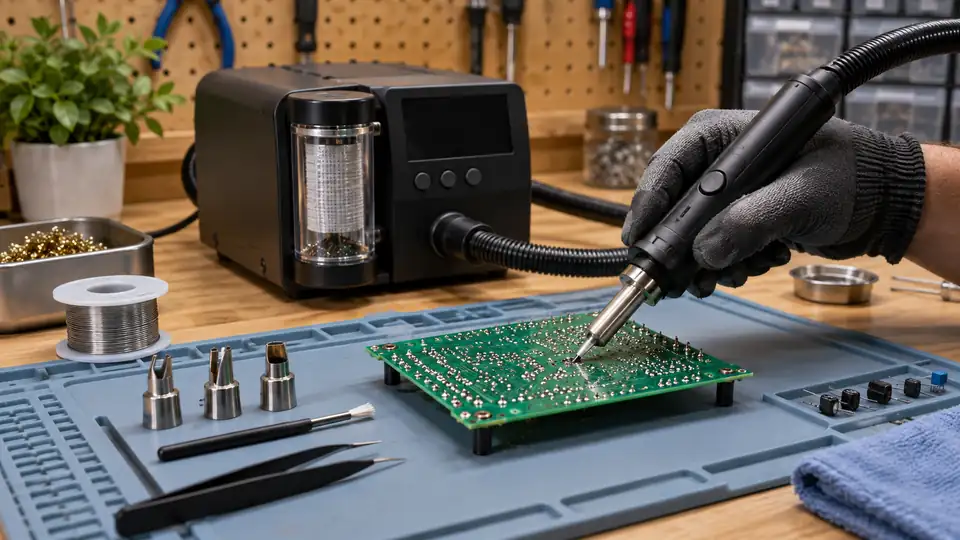
Removing a stubborn row of through-hole solder can turn a five-minute repair into a hot, messy wrestling match. A good desoldering station changes that rhythm by combining a heated nozzle, built-in vacuum, and one-handed trigger control, so the other hand can steady the board or lift the component. The strongest options here are aimed at electronics repair, especially through-hole work on single-sided, double-sided, and multilayer PCBs.
The headline wattage matters, but it does not tell the whole story. Temperature control, nozzle size, thermal mass, filter access, suction behavior, and maintenance all affect whether solder clears cleanly or clogs halfway through a job. A compact portable tool may suit occasional repairs, while a 110W station with presets makes more sense for repeated work on large joints and heat-dissipating boards. A common buying trap is choosing the highest advertised temperature without checking the included nozzles or the station’s cleaning system.
This comparison weighs those practical differences rather than treating every vacuum solder sucker as interchangeable. The YIHUA 948D-I takes the top position because its 110W desoldering system, four nozzle sizes, three presets, and sleep controls create a well-rounded setup for regular through-hole work. The alternatives cover dual-purpose soldering, hot-air rework, portable repairs, and lower-complexity projects.
Quick Answer
Best overall: YIHUA 948D-I for frequent through-hole desoldering, multilayer boards, and buyers who want strong heat capacity with useful presets.
Best 2-in-1: YIHUA 948D III adds a 110W soldering iron, allowing soldering and desoldering work at the same bench.
Best for a broader repair bench: YIHUA 948D IV combines desoldering with microsoldering, hot tweezers, hot air, and a suction pen.
Best portable option: Hakko FR301-03/P puts temperature control and a solder recovery chamber into a handheld desoldering tool.
Best Desoldering Station Comparison Table
| Product | Best For | Desoldering Power | Temperature Control |
|---|---|---|---|
| YIHUA 948D-I | Overall through-hole work | 110W | 716 to 896°F, 3 presets |
| WEP 948D-I | Multilayer PCBs and value | 110W | 716 to 896°F, 3 presets |
| YIHUA 948D III | Soldering and desoldering | 110W desoldering | Desoldering 716 to 896°F |
| YIHUA 948 Standard | Regular through-hole repairs | 80W | 716 to 896°F |
| YIHUA 948D IV | Advanced multi-tool benches | 110W | 716 to 896°F |
| WEP 948D III | Combined soldering and desoldering | 110W desoldering | Desoldering and soldering controls |
| Anesty ZD-915 Pro | Lead-free and DIP work | Built-in vacuum pump | Automatic microprocessor control |
| Hakko FR301-03/P | Portable repairs | Handheld powered tool | Adjustable control in handle |
| YIHUA 948-II | Mixed hot-air and soldering work | 75W desoldering | PID control with digital functions |
The detailed reviews below explain how each station handles heat, suction, maintenance, and the practical trade-offs behind its ranking.
1. YIHUA 948D-I — Best Overall

The YIHUA 948D-I has the combination that makes a powered desoldering station useful beyond occasional rescue work. Its 110W desoldering system is intended for through-hole components and boards that pull heat away quickly, while the adjustable 716 to 896°F range gives the operator room to match the job rather than relying on a fixed setting. That does not guarantee a particular temperature at every solder joint, since nozzle condition, joint size, and board mass still matter, but the control range is appropriate for varied electronics work.
Three stored temperature channels are especially practical when a bench alternates between smaller joints and stubborn multilayer-board connections. The four nozzle sizes, from 0.8mm through 2.0mm, also give the operator a better chance of matching the opening to the component lead. Sleep mode, adjustable from 0 to 120 minutes, followed by automatic standby after extended inactivity, helps reduce idle heater wear. The tilting display is a small touch, yet a screen that faces the operator instead of the ceiling is welcome during a long repair session.
Pros
- 110W desoldering system suits demanding through-hole and heat-dissipating board work.
- Temperature adjusts from 716 to 896°F with three user-configurable presets.
- Includes 0.8mm, 1.0mm, 1.2mm, and 2.0mm nozzles.
- Sleep and automatic standby functions help limit unnecessary heater use.
- Includes filters, cleaning pins, springs, a residue chamber, and a gun retainer.
Cons
- The listing specifically excludes graphics card motherboards.
- It is intended for 110 to 127V operation with a US-style plug.
This is the strongest fit for a repair bench that regularly removes many through-hole joints and needs more headroom than an 80W station. It is also a sensible pick for anyone who prefers single-handed extraction over coordinating a separate iron and manual pump. Occasional users may find the larger station and filter maintenance more equipment than they need, while graphics card repair requires a different solution. For routine PCB repair, however, the nozzle range and preset controls give it a useful edge.
To buy this product, click here.
2. WEP 948D-I — Best Value

For a buyer comparing the core hardware closely, the WEP 948D-I is a direct alternative to the top pick. It uses a 110W desoldering gun, offers a 716 to 896°F adjustment range, and stores three frequently used temperature settings. Those details matter during repetitive work. Instead of stopping to change the control after every few components, the operator can switch between saved settings with a button and keep the board moving across the bench.
The accessory package is well suited to ordinary through-hole maintenance. Four nozzle diameters are included, along with cleaning pins, ceramic filters, filtration adsorbers, filter springs, and a solder storage chamber. A weighted metallic holder is intended to support the gun without tipping, which is useful when the hot handpiece needs to be parked quickly. The station also includes a tilting LCD, sleep mode, automatic standby, and a buzzer setting. Its 110 to 127V requirement remains a firm installation detail, especially for anyone working outside the United States.
Pros
- 110W output is aimed at multilayer boards and joints that need substantial heat capacity.
- Four included nozzles cover 0.8mm, 1.0mm, 1.2mm, and 2.0mm openings.
- Three temperature presets reduce repeated adjustment during batch repairs.
- Heavy metallic holder, cleaning tools, and filters are included.
- Sleep, standby, buzzer, and Fahrenheit/Celsius settings provide useful bench controls.
Cons
- The listing says it is not suitable for graphics card motherboards.
- It requires 110 to 127V US-specification power.
The WEP 948D-I makes sense for frequent board work where the buyer wants the main features of a high-power station without moving into a multi-tool rework system. The included nozzle sizes and maintenance pieces reduce the need to assemble a basic kit separately. It gives up the soldering iron found on the WEP 948D III and the broader tools of the YIHUA 948D IV, so it is less useful as an all-in-one repair platform. As a focused desoldering station, its feature set is unusually complete.
To buy this product, click here.
3. YIHUA 948D III — Best 2-in-1

A desoldering job often turns into a soldering job a few minutes later. A lifted pad may need fresh solder, a replacement component may need attaching, or a large joint may need extra heat before the vacuum gun can clear it. The YIHUA 948D III addresses that workflow with a 110W EVO soldering station alongside its desoldering system. The soldering iron adjusts from 392 to 896°F, while the desoldering gun covers 716 to 896°F.
That two-tool arrangement is more meaningful than a longer accessory list. The operator can use the iron and desoldering gun at the same time, which helps when a joint needs heating from two sides before extraction. The package includes 0.8mm, 1.2mm, and 2.0mm desoldering nozzles, plus ceramic filters, filtration absorbers, cleaning pins, springs, and the solder residue chamber. The supplied information does not list three preset channels for this model, so buyers who value rapid temperature recall may prefer the 948D-I instead.
Pros
- Combines a 110W soldering station and a desoldering station in one unit.
- Both handpieces can support soldering and desoldering work at the same time.
- Soldering iron range spans 392 to 896°F.
- Desoldering gun range spans 716 to 896°F for demanding through-hole joints.
- Includes three nozzle sizes and a useful set of filters and cleaning accessories.
Cons
- The included desoldering nozzle selection omits the 1.0mm size listed with several competing models.
- It requires 110 to 127V US-specification power.
This station suits a repair workspace where desoldering and resoldering happen in the same session. It is a stronger match than a dedicated vacuum station for component replacement, connector repair, and larger joints that need an iron nearby. Buyers focused purely on extraction may prefer a simpler 110W unit with more nozzle sizes or explicit preset controls. The extra soldering handpiece also takes more bench space, but it can eliminate the need for a second station.
To buy this product, click here.
4. YIHUA 948 Standard — Best 80W Station
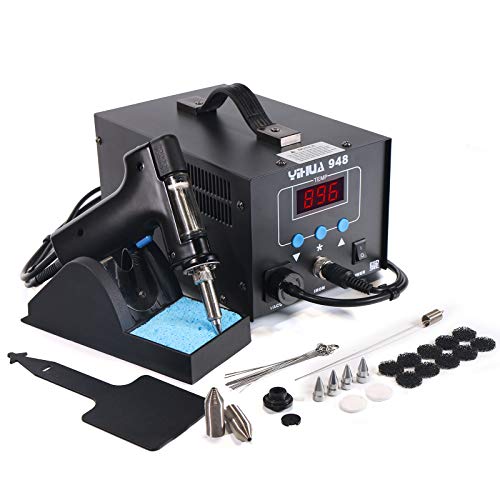
The YIHUA 948 Standard takes a simpler route than the newer 110W stations. Its 80W desoldering system is aimed at continuous through-hole removal, with a temperature range of 716 to 896°F and single-handed operation through the combined heated gun and vacuum mechanism. For a bench that handles ordinary connectors, headers, sockets, and component leads, that arrangement is considerably more convenient than holding a separate iron and pump in two hands.
Its replaceable tube design is the practical detail to watch. The filter tube and related pieces can be cleaned or replaced, giving low-volume users a maintenance path that does not require the same routine as a busy repair bench. The available information does not specify a broad set of included nozzle diameters, so this model is less flexible on paper than the 948D-I. Still, its digital temperature display, sleep function, and automatic shutoff make it a focused option for buyers who want a powered station without the added cost and complexity of a dual-tool system.
Pros
- 80W powered desoldering system is suited to repeated through-hole work.
- Single-handed gun operation leaves the other hand free to handle components.
- Adjustable temperature range runs from 716 to 896°F.
- Filter tube components can be cleaned or replaced.
- Includes sleep function, automatic shutoff, and Fahrenheit/Celsius display.
Cons
- Lower rated desoldering power than the 110W stations in this comparison.
- The available product information does not clearly list multiple included nozzle sizes.
This is a reasonable fit for occasional and moderate through-hole repair where 110W capacity is unnecessary. It offers more control and convenience than a disposable heated solder sucker, while its replaceable tube keeps routine cleanup manageable. Buyers working on large multilayer boards or repeated high-thermal-mass joints should look toward a 110W model. The 948 Standard earns its place through focused simplicity rather than a long list of advanced functions.
To buy this product, click here.
5. YIHUA 948D IV — Best Premium Multi-Tool

The YIHUA 948D IV is aimed at a different bench from a basic vacuum desoldering station. Its five integrated tools include a 110W desoldering gun, C245 microsoldering iron, hot tweezers, a 1000W hot-air rework station, and a suction pen. That mix covers through-hole extraction, small-component work, hot-air reflow, and component pickup without requiring separate primary units for each task.
For desoldering specifically, it provides four nozzle sizes from 0.8mm to 2.0mm and a 716 to 896°F adjustment range. The micro iron and hot tweezers adjust from 194 to 842°F, while the hot-air side includes five quick-change nozzles. Individual power switches and detachable handpieces help separate tools during use, and the aluminum main unit includes dedicated holders. Function lock, password protection, adjustable standby timers, and a desoldering sleep timer add control for a busy workspace, though the full system is a substantial commitment for simple through-hole repairs.
Pros
- Combines a 110W desoldering gun with hot air, microsoldering, hot tweezers, and a suction pen.
- Includes four desoldering nozzles from 0.8mm to 2.0mm.
- 1000W hot-air section includes five quick-change nozzles.
- Individual switches and detachable handpieces support organized multi-tool use.
- Includes C245 soldering tips and C120 hot-tweezer tips.
Cons
- The broad toolset brings more cost and bench complexity than a dedicated station.
- It requires buyers to manage several handpieces, holders, and accessory systems.
This is the choice for a repair bench that genuinely needs more than vacuum extraction. It can make sense for dense electronics work where hot tweezers, hot air, and a fine iron are used alongside a desoldering gun. A reader repairing a handful of through-hole boards will likely gain little from the extra tools and may prefer the smaller 948D-I. The premium is justified by breadth rather than by a claim that its desoldering function automatically outperforms every dedicated station.
To buy this product, click here.
6. WEP 948D III — Best Dual-Function Alternative

The WEP 948D III pairs a fast-heating desoldering gun with a 110W soldering iron, creating a practical two-handpiece setup for board repair. Its desoldering function is aimed at through-hole components such as sockets, LCD-related joints, and LED or nixie-tube work. The soldering iron adjusts from 392 to 896°F, and its PID control is described as compensating for temperature loss every 20 milliseconds. That published detail points to active temperature management, though actual joint performance still depends on tip geometry and the board itself.
The ability to heat a stubborn joint with the iron while positioning the vacuum gun can be useful on large or heat-dissipating connections. The kit includes 1.0mm, 1.2mm, and 2.0mm desoldering nozzles, three soldering tips, a metallic holder, filters, absorbers, springs, and cleaning pins. Unlike the 110W single-purpose stations above, it gives up the 0.8mm nozzle in the listed package. That is a small but meaningful distinction for very fine through-hole leads.
Pros
- Allows soldering and desoldering operations at the same time.
- 110W soldering iron covers larger joints and demanding rework.
- Desoldering and soldering controls cover broad practical temperature ranges.
- Includes three desoldering nozzles and three soldering tips.
- Metallic holder, filters, absorbers, and cleaning accessories are included.
Cons
- The listed nozzle set starts at 1.0mm rather than including a 0.8mm nozzle.
- The 110 to 127V requirement limits installation to compatible power systems.
Choose this model when the second soldering handpiece will see regular use. It is particularly practical for component removal followed by immediate replacement, where reaching for another iron would slow the job. A dedicated 110W desoldering station remains a cleaner purchase for extraction alone, and the nozzle selection deserves a quick check before ordering if small through-hole work dominates. Its dual-function layout gives it a clear reason to exist beside the single-purpose options.
To buy this product, click here.
7. Anesty ZD-915 Pro — Best for Lead-Free DIP Work

The Anesty ZD-915 Pro places its emphasis on lead-free desoldering and DIP component removal. Its built-in vacuum pump, single-hand gun, and automatic microprocessor control create the familiar powered extraction workflow: heat the joint, pull the trigger, and collect the softened solder in the gun’s system. The listing describes a PTC heating element and a sensor at the desoldering tip, a combination intended to regulate heat quickly and accurately.
That focus makes the ZD-915 Pro attractive for through-hole boards where lead-free solder can be less forgiving than older, lower-melting solder. The product information also describes use on single- and double-sided PCBs and highlights strong absorbing power, but it does not provide a wattage figure, temperature range, nozzle sizes, or a detailed filter package. Those omissions make direct specification comparisons harder. The station’s value lies in its clear application focus rather than a long list of adjustable controls.
Pros
- Built-in vacuum pump supports one-handed solder removal.
- Product information specifically identifies lead-free desoldering as an intended use.
- PTC heating element and tip sensor support automatic temperature control.
- Designed for DIP components and single- or double-sided PCBs.
- Microprocessor-controlled desoldering gun simplifies operation.
Cons
- The available information does not state the station’s wattage or temperature range.
- Nozzle sizes and the complete included maintenance kit are not clearly identified.
This model suits a buyer who wants a dedicated vacuum tool and places particular emphasis on lead-free DIP work. It is less suitable for someone comparing stations by precise heat settings, nozzle variety, or documented filter accessories. Before purchasing, confirm the current listing for consumables and replacement parts, since those details are less clear here than on the YIHUA and WEP models. Its compact feature story is appealing, but the missing specifications should temper expectations.
To buy this product, click here.
8. Hakko FR301-03/P — Best Portable Tool

The Hakko FR301-03/P takes the station concept and compresses it into a handheld powered desoldering tool. Temperature adjustment is built into the handle, so there is no separate bench control box to place beside the board. That layout can be useful for field repairs, crowded workspaces, or a technician who prefers moving the tool to the board rather than bringing every board to a full station.
A quick-release nozzle system supports nozzle changes, and the solder recovery chamber is intended to simplify cleanup and reduce waste. The closed-loop sensor integrated into the heating system is a meaningful control feature because it monitors the heating process rather than relying on a fixed-temperature element. The listing identifies the tool as non-ESD, however, which matters for static-sensitive electronics. It also does not list a wattage, temperature range, or included nozzle sizes, so its direct comparison with the 110W bench stations is limited.
Pros
- Handheld format is convenient for portable or space-constrained repair work.
- Temperature control is built into the handle.
- Closed-loop sensor heating system supports controlled operation.
- Quick-release design allows nozzle changes without a lengthy disassembly.
- Easy-clean solder recovery chamber helps contain removed solder.
Cons
- The product is identified as non-ESD.
- The available information does not specify wattage, temperature range, or included nozzle sizes.
The FR301-03/P is the better match for portability than for high-volume bench production. Its handheld layout is less cluttered than a full station, and the recovery chamber keeps cleanup close to the work. Static-sensitive boards call for caution because the listed tool is non-ESD, while buyers tackling large multilayer joints may prefer a documented 110W station. It is a specialized choice with a clear advantage for mobility.
To buy this product, click here.
9. YIHUA 948-II — Best Multi-Station for Mixed Rework

The YIHUA 948-II combines a 75W desoldering station with a 650W hot-air rework station, a 60W soldering station, and a suction pen. It ranks below the focused 110W stations for demanding through-hole extraction, but it brings a wider range of repair tools into one unit. That can be handy when a board repair moves from removing a through-hole component to warming an SMD part or picking up a loosened component.
PID heat control, Fahrenheit/Celsius display, hot-air automatic and manual modes, cool-air switching, and digital temperature calibration give the system more control than a basic vacuum gun. The internal detection system can display codes such as “S-E” and “F-1/F-2,” according to the product information, which may help identify certain operating issues. The listing does not provide the desoldering station’s nozzle selection, and the 75W rating is below the high-power options here. Its appeal is breadth, not maximum desoldering capacity.
Pros
- Combines desoldering, hot air, soldering, and suction pickup in one unit.
- Includes a 75W desoldering station for general through-hole work.
- 650W hot-air section broadens the station’s rework capability.
- Offers PID control, digital calibration, and Fahrenheit/Celsius display.
- Hot-air automatic/manual modes and cool-air switching add operating flexibility.
Cons
- Its 75W desoldering section has less stated power than the 110W alternatives.
- The available product information does not clearly list included desoldering nozzle sizes.
This station belongs on a mixed rework bench where a single-purpose desoldering tool would leave too many gaps. It is a reasonable fit for repairs involving through-hole parts, SMD rework, soldering, and component pickup in the same workspace. If the job is primarily removing large numbers of joints from multilayer boards, a dedicated 110W station is the more direct answer. The 948-II earns its ranking through the useful combination of tools and controls.
To buy this product, click here.
Buying Guide
110W Gives More Heating Headroom, But It Is Not the Whole Story
The 110W stations in this comparison are better positioned for multilayer boards and joints that pull heat away quickly. More available power can help the nozzle recover as it contacts a substantial joint, but wattage alone does not determine the result. Heater design, nozzle mass, temperature sensing, solder condition, and contact with the joint all matter. An 80W station can still be a sensible choice for ordinary through-hole repairs, especially when its smaller size and lower equipment burden are more useful.
Match Nozzle Diameter to the Component Lead
A nozzle that is too small may struggle to surround the lead and transfer heat, while an oversized opening can make positioning less controlled. The YIHUA 948D-I, WEP 948D-I, and YIHUA 948D IV list four sizes spanning 0.8mm to 2.0mm. The dual-function WEP 948D III lists 1.0mm, 1.2mm, and 2.0mm, so check the package carefully if fine leads are common on your boards. Included nozzles are different from nozzles that may be available as replacements.
Temperature Control Is More Useful Than a High Maximum
Most of the dedicated stations here list a maximum setting around 896°F, but that number should not be treated as proof of superior thermal performance. The actual solder joint temperature changes with board mass, lead size, tip condition, and contact time. Presets are valuable because they make repeatable adjustment quicker, while PID control can help the station respond to heat loss. Set the tool according to the solder and joint, then work with the board’s heat sensitivity in mind.
Plan for Filters, Cleaning Pins, and Solder Debris
Vacuum desoldering systems move molten solder through a heated passage, so residue management is part of ownership. Filter absorbers, ceramic filters, springs, cleaning pins, and a removable collection chamber all affect how easy routine maintenance will be. A clogged passage can ruin the smooth rhythm of a repair. The YIHUA and WEP 110W stations list more maintenance accessories than the less-documented models, while the YIHUA 948 Standard emphasizes a tube that can be cleaned or replaced.
Decide Whether You Need a Second Handpiece
A dedicated station is the cleanest choice when the job is mainly removing solder. A 2-in-1 model becomes more appealing when the same repair frequently requires adding solder, reheating a pad, or replacing a component. The YIHUA 948D III and WEP 948D III both let the user keep a soldering iron and desoldering gun available at the same bench. The additional handpiece uses space and adds another set of consumables, so it should solve a real workflow problem rather than serve as decoration.
Check Voltage and ESD Details Before Ordering
Several products in this roundup are identified for 110 to 127V US-style power. That is a purchasing requirement, not a minor footnote. The Hakko FR301-03/P is identified as non-ESD, while several YIHUA and WEP stations are described as ESD-safe in their product information. Those labels should be read alongside your own static-control procedures. No station feature replaces suitable grounding, handling practices, ventilation, eye protection, or the operating instructions.
Best Desoldering Station FAQ
What Is the Best Desoldering Station for Most Electronics Repair?
The YIHUA 948D-I is the strongest overall match here for regular through-hole work. Its 110W system, adjustable 716 to 896°F range, three presets, four listed nozzle sizes, and maintenance accessories cover a broad range of PCB repair tasks. Buyers who also need a soldering iron should look at the YIHUA 948D III or WEP 948D III instead.
Is a 110W Desoldering Station Better Than an 80W Model?
A 110W station offers more stated heating capacity and is generally the better fit for multilayer boards, large joints, and workpieces that draw heat away quickly. It does not automatically produce better results on every board. An 80W station can be appropriate for ordinary through-hole repairs, especially when the workload is moderate and the buyer values a simpler setup.
What Temperature Should a Desoldering Station Use?
Use a setting appropriate for the solder, joint size, board, and component sensitivity. The stations in this guide provide adjustable ranges, but the selected number is a tip or station setting rather than a guarantee of the exact temperature at the joint. Start with a controlled setting, allow the joint to liquefy fully, and avoid prolonged heating that can damage pads or nearby parts.
Are Desoldering Stations Suitable for Multilayer PCBs?
Several 110W models in this comparison are specifically described for multilayer or heat-dissipating boards. Their extra heating capacity can make it easier to bring a large joint to a workable state. Results still depend on the board design, solder type, nozzle fit, and technique. The YIHUA 948D-I and WEP 948D-I are the clearest matches for this use.
Why Do Desoldering Stations Need Cleaning?
Extracted solder travels through the gun and can harden in the passage or collect in filters and springs. Regular use of the supplied cleaning pin, replacement of saturated filter material, and emptying of the residue chamber help maintain airflow. Follow the product instructions, and let the heated parts cool before changing a nozzle or handling maintenance components.
Should I Buy a 2-in-1 Soldering and Desoldering Station?
A 2-in-1 station is useful when repairs often involve removing a component and installing another immediately afterward. It can also help when a joint needs a soldering iron and vacuum gun at the same time. If you only remove solder, a dedicated station may provide a simpler bench and a more focused accessory package.
Are These Stations Suitable for Graphics Card Motherboards?
The product information for the YIHUA 948D-I and WEP 948D-I specifically says they are not suitable for graphics card motherboards. Do not assume that a high wattage rating makes a station appropriate for every board. Graphics card repair can involve dense layouts, sensitive components, and specialized techniques that require a more specific setup.
Final Verdict
The YIHUA 948D-I is the strongest overall choice for regular electronics desoldering. Its 110W system, three temperature presets, four nozzle sizes, tilting display, and clearly listed maintenance supplies give it a balanced position between basic powered solder suckers and much larger multi-tool stations. The WEP 948D-I is a close alternative for buyers who want similar high-power specifications and a substantial accessory kit. Both are aimed at through-hole work where heat capacity and consistent cleanup matter.
For a combined repair bench, the YIHUA 948D III and WEP 948D III make more sense because they keep a soldering iron beside the vacuum gun. The YIHUA 948D IV is the premium route for users who also need hot air, microsoldering, and hot tweezers. Buyers who value mobility should look at the Hakko FR301-03/P, while moderate workloads may fit the YIHUA 948 Standard. Match the station to your boards, nozzle needs, maintenance habits, and power system rather than choosing by wattage alone.

- Jesse
Jesse is the editor behind Soldering Gear, where he covers soldering irons, stations, rework equipment, and the tools that belong on a practical electronics bench. His work focuses on comparing product specifications, features, compatibility, and intended uses so readers can make more informed buying decisions.
- Best Soldering Iron for SMD: 9 Picks in 2026 October 15, 2026
- Best Hot Air Rework Station for SMD: 9 Picks in 2026 October 14, 2026
- What Tools Do You Need for Soldering Electronics? October 13, 2026
- Best USB-C Soldering Iron: 9 Picks in 2026 October 12, 2026
- How to Choose Solder for Electronics October 11, 2026