Best Soldering Iron for SMD: 9 Picks in 2026

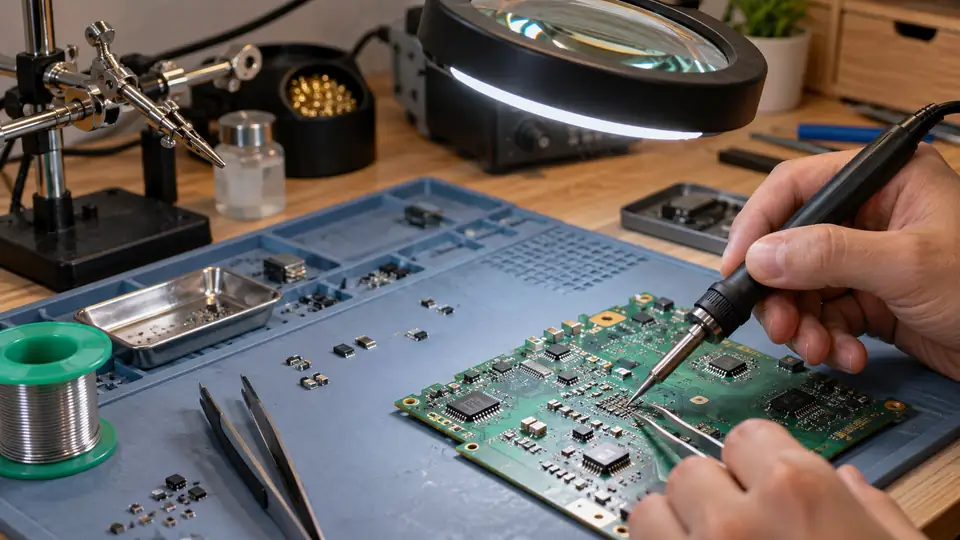
Small SMD joints expose weak soldering tools quickly. A tip that is too broad can bridge neighboring pads, a sluggish heater can make you hold heat on a board too long, and a vague temperature dial leaves you guessing while a tiny component sits under your tweezers. The best soldering iron for SMD work needs controlled heat, a fine and suitable tip system, comfortable handling, and enough recovery for the board and joint in front of you.
Headline wattage tells only part of the story. A 100W pencil iron may heat rapidly, yet a compact cartridge system can offer more useful control around small pads. Hot-air capability can be valuable for removing SMD parts, although it also takes bench space and adds another heating method to manage. Portability matters too. A repairer working away from a full bench may prefer the cordless Fanttik, while repeated board work favors a temperature-controlled station or the SEQURE HT140 with its iron and hot-tweezer modes.
This comparison weighs the supplied temperature controls, tip or cartridge systems, heating claims, SMD-oriented features, included accessories, power arrangements, and practical limitations. The SEQURE HT140 package with its PD adapter earns the strongest overall position because it combines a fine cartridge iron with hot tweezers, calibration, presets, and flexible power input.
Quick Answer
Best Overall: The SEQURE HT140 2-IN-1 Portable Hot Tweezers Soldering Iron Kit is the most focused choice for SMD work. Its C210 iron cartridges, C120 hot-tweezer compatibility, OLED display, temperature calibration, and included PD 65W adapter give it a strong blend of precision and convenience.
Best Bench Alternative: The YIHUA 862BD+ is better suited to a fixed electronics bench where hot-air rework matters alongside iron soldering.
Best Cordless Option: The Fanttik T1 Max brings a built-in battery, C210 tips, and a compact stand for repairs away from a conventional station.
Best Soldering Iron for SMD Comparison Table
| Product | Best For | Temperature Control | Tip System or Added Function |
|---|---|---|---|
| SEQURE HT140 With PD Adapter | Overall SMD work | 122 to 932°F, OLED, calibration | C210 iron, C120 tweezers |
| SEQURE HT140 Tool-Only Set | Portable precision work | 122 to 932°F, presets | C210 iron, C120 tweezers |
| YIHUA 862BD+ | Bench rework | 392 to 896°F, PID | Iron plus hot air |
| WEP 882D | Value hot-air station | 392 to 896°F iron, PID | Iron plus hot air |
| WEP 8786D-I SE | Rework and desoldering | 392 to 896°F iron, PID | Iron plus hot air |
| Fanttik T1 Max | Cordless SMD repairs | Six levels, 390 to 840°F | C210 tips, built-in battery |
| YIHUA 926 III | Compact starter bench | 194 to 896°F, PID | Conventional tips, helping hands |
| 100W Digital Soldering Iron Kit | Low-cost general repairs | 356 to 932°F, calibration | Plug-in ceramic heater |
| 80W LCD Digital Soldering Iron Kit | Basic PCB work | 356 to 896°F | Ceramic heater, LCD |
The detailed reviews below show where each iron or station fits, along with the compromises that matter around small SMD pads.
1. SEQURE HT140 2-IN-1 Portable Hot Tweezers Soldering Iron Kit — Best Overall

The HT140 is unusually well matched to SMD work because it handles two jobs without requiring a separate hot-tweezer station. Used as an iron, it accepts C210 cartridge tips. Used as tweezers, it supports C120 hot-tweezer cartridges for lifting or heating two ends of a small component. That arrangement can make a crowded board feel less like a wrestling match, especially during removal work.
Its OLED display covers 122 to 932°F, while the listing describes temperature calibration, compensation, three preset temperatures, and a turbo boost mode. The claimed two-second tip heating is a listing specification rather than an independent measurement, but the feature set is clearly aimed at quick transitions between small soldering tasks. This package also includes a PD 65W adapter, removing a major setup question from a portable tool that can otherwise accept several power arrangements.
Pros
- Combines a C210 soldering iron with C120 hot tweezers.
- OLED display covers 122 to 932°F.
- Supports calibration, compensation, presets, and turbo boost.
- Includes a PD 65W adapter.
- Accepts USB-C and DC5525 input arrangements.
Cons
- Cartridge tips must match the supported C210 and C120 families.
- The compact control unit still depends on an external power connection.
This is the strongest fit for fine board work, component removal, and mobile repair where a full station feels excessive. Buyers who already own a suitable PD supply may prefer the less expensive tool-only version, but the included adapter makes this package easier to deploy without guessing about power. Confirm the current adapter and tip details before ordering if your work depends on a particular cartridge shape.
To buy this product, click here.
2. SEQURE HT140 2-IN-1 Portable Hot Tweezers Soldering Iron Kit — Best Portable Value

This version carries the same core HT140 concept into a leaner package. The adjustable range, OLED readout, three temperature presets, sleep behavior, and support for C210 and C120 cartridges make it highly relevant to SMD work. A technician moving between a small repair mat and a larger bench can use one tool for both single-tip soldering and two-sided component heating.
The major distinction is easy to miss in a long product title: this set does not include a power adapter and is not cordless. Its Type-C and DC5525 inputs provide flexibility, but the buyer must already have a suitable supply or purchase one separately. That trade-off makes sense for someone with compatible PD equipment in a drawer, while it weakens the plug-and-play appeal compared with the first-ranked package.
Pros
- Offers both soldering iron and hot-tweezer operation.
- Provides a 122 to 932°F adjustment range.
- Supports C210 and C120 cartridge families.
- Includes temperature presets and calibration support.
- Accepts Type-C and DC5525 power input.
Cons
- Power adapter is not included.
- It is portable but not cordless, so a suitable power source remains necessary.
Choose this model over the adapter bundle when you already have compatible power equipment and want the HT140 functions without duplicating a charger. It is a particularly sensible option for a travel kit built around a known PD supply. A buyer starting from zero should add the cost and compatibility of that supply before treating this as the lower-cost choice.
To buy this product, click here.
3. YIHUA 862BD+ 2-in-1 Soldering and Hot Air Rework Station — Best Bench Rework Station
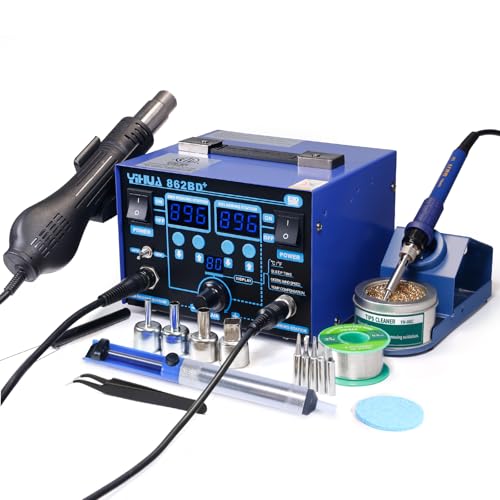
A small SMD board often needs more than a pointed iron. The YIHUA 862BD+ pairs a soldering station with hot air, giving the bench a way to heat and remove components across several pads. Its iron temperature is adjustable from 392 to 896°F, and the listing describes PID control that checks and corrects the heating element at short intervals. That is more useful context than the maximum number alone.
The station includes five soldering tips, four hot-air nozzles, tweezers, a desoldering pump, brass wool, a sponge, lead-free solder, and an IC popper. The accessories make the first session easier, although fine SMD work still depends on choosing the right tip and controlling heat around nearby components. Three displays show soldering temperature, hot-air temperature, and simulated air volume, while adjustable sleep timing can reduce idle heating.
Pros
- Combines a soldering iron and hot-air rework station.
- Offers PID temperature control for the iron.
- Includes five soldering tips and four hot-air nozzles.
- Provides three digital parameter displays.
- Includes useful desoldering and cleaning accessories.
Cons
- It is a larger bench setup than a portable cartridge iron.
- The supplied information specifies 110 to 127V operation with a US plug.
This station suits a workspace where SMD removal, hot-air work, and ordinary iron soldering share the same bench. It is less attractive for a repair bag or a reader who wants the lightest possible tool. The hot-air setting should be treated as a control value, not a guarantee of the actual component temperature, so board protection and careful technique still matter.
To buy this product, click here.
4. WEP 882D 2-in-1 Soldering and Hot Air Rework Station — Best Value Station

The WEP 882D takes a compact bench approach to SMD work. Its iron adjusts from 392 to 896°F, while the hot-air side spans 212 to 896°F with variable air volume. Separate LED displays and dedicated controls make the two functions easier to read than a single shared interface, especially when a board is sitting under a bright lamp and the work is moving quickly.
Its feature list is well aimed at repeated board work: PID control, iron sleep mode, hot-air standby, automatic shutdown, temperature calibration, and Celsius/Fahrenheit conversion. The package includes five soldering tips, three hot-air nozzles, two solder-wire spools, tweezers, a desoldering pump, and brass wool. Those inclusions are useful for getting started, but the listing does not establish that every supplied tip is ideal for the smallest package sizes.
Pros
- Provides separate controls and displays for iron and hot air.
- Includes PID control and temperature calibration.
- Offers variable hot-air volume.
- Includes five tips, three nozzles, and two solder-wire spools.
- Has sleep, standby, and automatic shutdown functions.
Cons
- The product is limited to 110 to 127V US specifications.
- Its conventional station format is less portable than the HT140 or Fanttik.
This is a practical pick for a home electronics bench that needs both contact soldering and hot-air access without moving into a more elaborate setup. It gives up the HT140’s cartridge hot-tweezer arrangement, yet gains a dedicated hot-air handpiece and a broad accessory bundle. Choose it for bench versatility, not for carrying between repair locations.
To buy this product, click here.
5. WEP 8786D-I SE 2-in-1 Hot Air Soldering Iron Station — Best for Rework and Desoldering
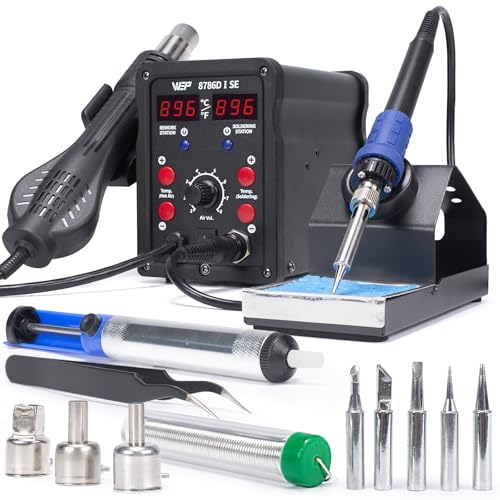
The WEP 8786D-I SE earns its place through a clear two-tool layout. The iron provides adjustable 392 to 896°F control with PID stabilization, while the hot-air section adds adjustable temperature and air volume. For a board with a small connector, shield, or multi-pin package, having contact heat and flowing air nearby can save a frustrating change of tools.
Standby behavior is a useful detail here. The hot-air handpiece cools to 212°F when placed in its holder and stops heating, while the soldering iron enters a 10-minute sleep mode. The kit includes five iron tips, three nozzles, lead-free solder wire, tweezers, and a desoldering pump. The supplied information identifies 110 to 127V operation, so this is a US-bench purchase rather than a universal travel tool.
Pros
- Combines contact soldering and hot-air rework.
- Offers adjustable air volume for hot-air work.
- Uses PID stabilization for both heating functions.
- Includes five iron tips and three hot-air nozzles.
- Provides iron sleep and hot-air standby modes.
Cons
- 110 to 127V US operation limits regional flexibility.
- The station needs more bench room than a single portable iron.
Pick this model when desoldering and SMD rework are regular tasks, rather than occasional extras. The WEP 882D offers a similar category of functionality, so the choice should follow the included kit and interface details that matter more to your bench. Neither station replaces careful airflow control around neighboring components.
To buy this product, click here.
6. Fanttik T1 Max Cordless Soldering Iron Kit — Best Cordless Option

The T1 Max feels at home beside a field-repair case rather than a permanent station. Its built-in 2600mAh battery supplies a listed maximum DC output of 12W, with up to 60 minutes claimed at 840°F. In wired mode, the listing gives a maximum 16W output through a Type-C power source. Those figures explain the appeal and the boundary: the tool is easy to carry, but it does not offer the same power class as the larger bench stations.
Four included C210 tips, including fine I and IS shapes plus two K tips, give the tool a cartridge-style path into small-joint work. Six temperature levels span 390 to 840°F, and gravity sensing lowers the temperature after 30 seconds of inactivity before reheating when the handle is lifted. The aluminum stand and compact body help keep a small repair area tidy, with no cord snaking across the board.
Pros
- Supports cordless and Type-C wired operation.
- Includes four C210 soldering tips.
- Provides six temperature levels from 390 to 840°F.
- Uses automatic sleep and lift-to-reheat sensing.
- Includes a compact aluminum storage stand.
Cons
- The listed 12W cordless output is below the power class of the bench stations.
- Temperature adjustment uses six levels rather than a fully numeric display.
This is the strongest option for repairs in awkward spaces, quick connector work, or a kit that must leave the bench. It is less compelling for sustained work on large ground planes or heavy thermal loads, where the lower cordless output may matter. The runtime is a published claim, so plan charging around the actual job rather than assuming uninterrupted work.
To buy this product, click here.
7. YIHUA 926 III 60W Digital Display Soldering Iron Station — Best Compact Starter Station
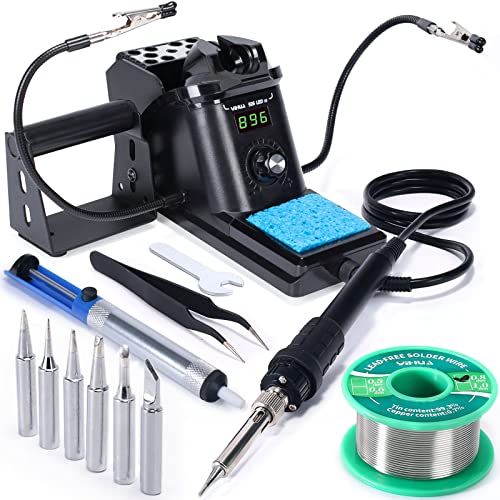
The YIHUA 926 III is a conventional station with a useful electronics-work layout. Its temperature range runs from 194 to 896°F, and the listing describes PID stabilization, digital calibration, and selectable sleep periods of 5, 10, or 30 minutes. Those controls are easier to repeat than a basic dial, which matters when moving between delicate pads and larger solder joints during the same afternoon.
The package includes six soldering tips from the YIHUA #1200/900M series, lead-free solder, a solder sucker, stainless-steel tweezers, a sponge, a wire dispenser, and two helping hands. The helping hands can steady a board while a small component is positioned, although the product information does not specify their board capacity or adjustment range. An integrated holder and rear protective mesh keep the station relatively orderly on a crowded bench.
Pros
- Offers a broad 194 to 896°F temperature range.
- Includes PID stabilization and digital calibration.
- Provides adjustable sleep timing.
- Includes six tips and two helping hands.
- Has an integrated holder and tip storage mesh.
Cons
- It uses a conventional station and tip format rather than a compact cartridge system.
- The supplied information does not specify the helping-hand adjustment capacity.
This makes sense for a first fixed bench where board support and ordinary soldering accessories matter as much as the iron itself. It lacks the hot tweezers of the HT140 and the hot-air handpiece of the WEP and YIHUA rework stations, but its controls are more deliberate than a simple pencil iron. Check replacement-tip availability for the exact #1200/900M series before committing to long-term use.
To buy this product, click here.
8. 100W LED Digital Soldering Iron Kit — Best Low-Cost High-Power Pencil Iron

This pencil-style kit targets buyers who want a simple plug-in iron with more control than a fixed-temperature tool. The listing gives a 356 to 932°F adjustment range, a 15-second heating claim, temperature calibration, and a switch between Celsius and Fahrenheit. A ceramic heating core and four ventilation holes are intended to move heat toward the tip while keeping the handle cooler.
For occasional PCB repairs, the included stand, solder wire, sponge, flux paste, wick braid, and tips make the package approachable. A child-lock password feature adds a control safeguard, but it does not remove the need for a heat-safe work area or proper storage. The 100W label should be read as available electrical power, not proof that every small SMD joint will receive ideal heat control.
Pros
- Provides adjustable 356 to 932°F temperature control.
- Includes temperature calibration and dual-unit display.
- Uses a plug-in ceramic heating core.
- Includes tips, wick braid, solder, sponge, flux paste, and stand.
- Offers a password child-lock setting.
Cons
- It lacks the cartridge and hot-tweezer system found on the HT140.
- The listing does not identify the included tip family in the supplied information.
Choose this iron for straightforward board repairs where a station is unnecessary and budget matters. It can cover a broad range of general soldering jobs, yet readers doing dense SMD placement may prefer a finer, clearly identified cartridge ecosystem. Verify the tip shapes and replacement options before treating it as a long-term microsoldering platform.
To buy this product, click here.
9. 80W LCD Digital Adjustable Temperature Soldering Iron Kit — Best Basic Budget Pick

The 80W LCD kit is the simplest route into adjustable-temperature PCB soldering in this group. Its ceramic core has a listed 10-second heat-up claim, and the temperature range runs from 356 to 896°F with Celsius/Fahrenheit switching. The LCD display makes the selected setting visible instead of leaving the user to estimate heat from a dial position.
Automatic sleep behavior lowers the temperature after five minutes on the stand, and the memory function can restore a previous setting after power-off. The kit also includes a stand, five tips, solder wire, sponge, and flux paste. Those details are useful for a first repair box, but the supplied information does not identify a specialized SMD cartridge family, so it ranks below the tools built around C210 or C120 systems.
Pros
- Offers a 356 to 896°F adjustable range.
- Includes an LCD temperature display.
- Provides automatic sleep and temperature memory.
- Includes five interchangeable tips.
- Comes with a stand, solder wire, sponge, and flux paste.
Cons
- The supplied information does not identify a specialized SMD cartridge system.
- It is a basic pencil kit without hot air or hot-tweezer capability.
This is suitable for occasional repairs, practice boards, and larger SMD work where a low-cost adjustable iron is enough. It is a weaker match for dense micro-soldering that benefits from cartridge tips and precise accessory planning. The clear display and automatic sleep function make it more manageable than a fixed-temperature iron, but the tool still requires careful tip selection and heat control.
To buy this product, click here.
Buying Guide: Choosing a Soldering Iron for SMD
Fine Tips Are Useful Only With Suitable Heat Control
A narrow tip can reach a small pad, but tip width alone does not determine whether the joint will form cleanly. Cartridge systems such as the HT140 and Fanttik T1 Max identify their C210 family, giving the buyer a clearer starting point for fine work. Conventional kits may include several tips, yet the supplied information may not identify their exact geometry or replacement path. Look for a tip system that matches the component scale and remains available for the repairs you expect to perform.
Wattage Does Not Tell the Whole Heating Story
The 60W, 80W, and 100W labels describe power classes, not guaranteed joint performance. Heater design, sensor placement, tip mass, control behavior, and the board’s thermal load all affect how an iron behaves. A high-power pencil tool may be useful for a larger ground plane, while a lower-output cordless tool may be more convenient for a small connector in a tight location. Treat advertised heat-up speed as a listing claim rather than a substitute for thermal recovery data.
Cartridge Compatibility Affects Long-Term Use
The HT140 supports C210 soldering tips and C120 hot-tweezer cartridges, while the Fanttik listing identifies four C210 tips. That is different from a kit that merely includes interchangeable tips without naming the family. Compatible does not mean included, and a tip that looks similar may not fit the handpiece. Check the exact cartridge or tip designation before buying replacements.
Hot Air Helps With Removal, But Adds Control Decisions
A hot-air station can warm several solder joints at once, which is useful for SMD removal and rework. The YIHUA 862BD+, WEP 882D, and WEP 8786D-I SE each combine an iron with hot air and provide adjustable air controls or nozzles. Their temperature setting is a control target, not the actual temperature at the component. Airflow, nozzle distance, board layout, and nearby parts still require careful handling.
Portability Requires a Power Plan
The Fanttik T1 Max has a built-in battery and can operate in wired Type-C mode, while both HT140 versions accept Type-C and DC5525 inputs. The adapter-equipped HT140 is easier to deploy immediately. The tool-only HT140 does not include a power adapter, and the Fanttik’s listed cordless output is lower than the bench stations. Match the iron to the location first, then verify the charger or power source rather than assuming every USB-C supply is suitable.
Sleep Modes Protect Idle Tools, Not Active Boards
Automatic sleep can reduce unnecessary heating while you reach for tweezers or inspect a joint. The products here use different timing and trigger arrangements, including stand detection, inactivity periods, and gravity sensing. These functions are convenient, but they do not replace switching off a hot tool, using its stand, or following safe handling practices. A sleep setting also says little about actual soldering performance during an active joint.
Best Soldering Iron for SMD FAQ
What makes a soldering iron suitable for SMD work?
Look for controllable temperature, an appropriate fine tip or cartridge system, manageable handpiece dimensions, and enough heating capacity for the board. Hot tweezers can help remove two-terminal components, while hot air can assist with multi-pin packages. A huge temperature range is less useful than a system with suitable tips and predictable control.
Is a higher wattage better for SMD soldering?
Not automatically. Higher available power can help an iron recover on a thermally demanding joint, but small SMD work also benefits from a suitable tip, accurate control, and careful heat transfer. The 100W pencil iron and 140W-capable HT140 should not be judged by wattage alone.
Are C210 tips good for SMD work?
C210 is a cartridge family identified by the HT140 and Fanttik T1 Max listings. Those products include or support C210 tips, which gives buyers a defined accessory path. Check the exact shapes supplied and the replacement cartridges needed for the components you plan to solder.
Should I choose a hot-air station or a soldering iron?
Choose a hot-air station if component removal and multi-pin SMD rework are regular tasks. A soldering iron is simpler for pad repair, wire work, and placing individual components. The YIHUA 862BD+, WEP 882D, and WEP 8786D-I SE combine both functions, though they require more bench space than the portable irons.
Is the cordless Fanttik T1 Max powerful enough for every SMD job?
The listing gives the T1 Max a maximum cordless output of 12W and a maximum wired output of 16W. That makes it attractive for portable repairs and smaller joints, but it is not presented as a replacement for every higher-power bench station. Larger thermal loads may call for a corded tool with more available heating power.
Does a USB-C soldering iron work with any USB-C charger?
No. The connector alone does not establish that a charger can provide the required voltage or power profile. The HT140 listing identifies support for several PD and QC standards, while the Fanttik listing describes Type-C wired operation. Verify the product’s power requirements and the charger’s output before connecting them.
What temperature should I use for SMD soldering?
There is no single setting for every board, alloy, tip, and joint. The products provide adjustable ranges or levels, but the displayed value is a setpoint rather than a guarantee of exact joint temperature. Begin with a suitable setting for the solder and component, use flux appropriately, and avoid holding heat on a pad longer than needed.
Final Verdict
The SEQURE HT140 package with the PD adapter is the strongest overall choice here for SMD work. Its iron and hot-tweezer modes address two common precision tasks, while the OLED display, calibration support, presets, C210 and C120 compatibility, and flexible input options give it more relevant control than the basic pencil kits. The included adapter also removes a setup hurdle that affects the otherwise similar tool-only version.
For a fixed bench, the YIHUA 862BD+ is the more capable alternative because it adds hot-air rework and a broad accessory package. The Fanttik T1 Max is the better cordless route, while the WEP stations suit buyers who want combined iron and hot-air functions at a lower bench-oriented tier. Match the tool to the board work you actually perform. Fine tips and controlled heat matter more than a large wattage number, and a suitable power source or replacement-tip path can shape the ownership experience as much as the iron itself.

- Jesse
Jesse is the editor behind Soldering Gear, where he covers soldering irons, stations, rework equipment, and the tools that belong on a practical electronics bench. His work focuses on comparing product specifications, features, compatibility, and intended uses so readers can make more informed buying decisions.
- Best Soldering Iron for SMD: 9 Picks in 2026 October 15, 2026
- Best Hot Air Rework Station for SMD: 9 Picks in 2026 October 14, 2026
- What Tools Do You Need for Soldering Electronics? October 13, 2026
- Best USB-C Soldering Iron: 9 Picks in 2026 October 12, 2026
- How to Choose Solder for Electronics October 11, 2026