Best Hot Air Rework Station: 9 Picks in 2026

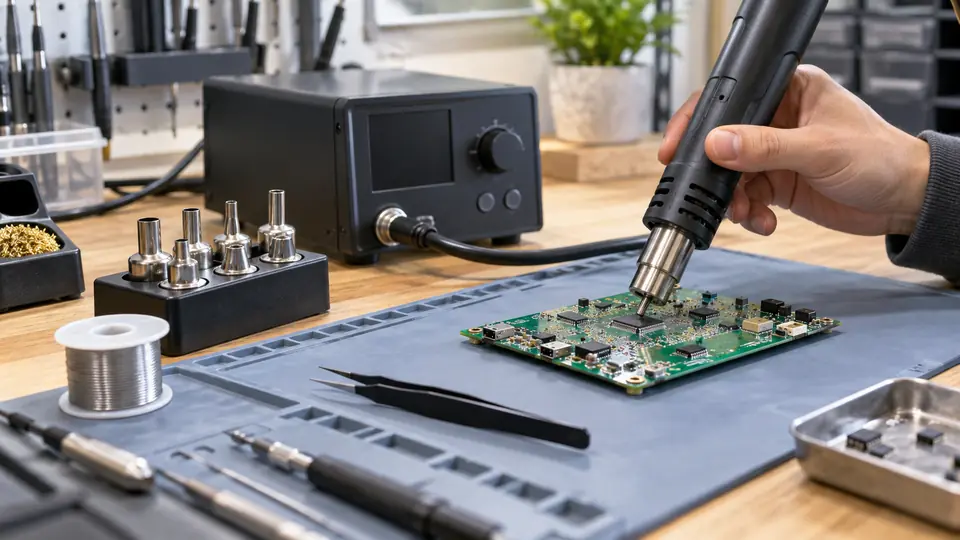
A hot air rework station earns its place on an electronics bench when a soldering iron cannot reach beneath a fine-pitch IC, loosen a stubborn connector, or warm several SMD joints evenly. The useful choice is rarely the unit with the biggest temperature number printed on the box. Airflow control, nozzle selection, temperature regulation, standby behavior, and the way the handpiece handles around a crowded PCB matter far more once a small component is surrounded by sensitive parts.
There is also a sharp difference between a dedicated hot air station and a 2-in-1 unit. A dedicated model gives all its controls and bench space to hot air work, while a combined station can be a smarter fit if you regularly switch between reflow and conventional soldering. The YIHUA 959D stands out as the strongest general-purpose choice here because it combines adjustable airflow, a broad listed temperature range, three memory channels, standby cooling, and a fail-safe function without adding a second soldering iron station.
The products below range from compact lower-cost tools to higher-output stations built for demanding PCB work. Their rankings weigh the supplied temperature and airflow controls, included nozzles, safety functions, accessories, and practical fit for SMD repair. Every model listed is intended for a 110 to 127V U.S. setup unless its own product information says otherwise.
Quick Answer
Best Overall: YIHUA 959D Digital Hot Air Rework Station offers three memory channels, adjustable airflow up to 120L/min, standby cooling, and a listed temperature range of 212°F to 932°F.
Best Premium Option: ATTEN ST-862D is the more specialized pick, with a 1000W rating, 120L/min maximum airflow, menu-style controls, fast-access settings, and a listed temperature stability of ±1.0°C.
Best 2-in-1: YIHUA 862BD+ combines hot air and a soldering station with PID control, four nozzles, five soldering tips, and a broad accessory kit.
Best Compact Budget Choice: WEP 8858-V keeps the footprint small while providing adjustable airflow, PID temperature control, three nozzles, and an integrated holder.
Best Hot Air Rework Station Comparison Table
| Product | Best For | Temperature | Airflow / Key Feature |
|---|---|---|---|
| YIHUA 959D | Overall SMD rework | 212°F to 932°F | 120L/min, 3 memories |
| ATTEN ST-862D | High-output bench work | 100°C to 480°C | 1000W, 120L/min |
| YIHUA 862BD+ | Hot air plus soldering | 212°F to 896°F hot air | 2-in-1, 4 nozzles |
| WEP 882D | Complete starter setup | 212°F to 896°F hot air | 2-in-1, PID control |
| YIHUA 8786D I | Accessory-rich electronics work | Hot air range listed with digital control | 4 nozzles, 10 iron tips |
| WEP 8858-V | Compact workspaces | Adjustable digital control | Integrated holder, 3 nozzles |
| YIHUA 959D I | Dedicated SMD repair | 212°F to 896°F | 120L/min, 3 nozzles |
| SUGON 8620DX | High-power rework | 212°F to 845°F | 1300W, 4 memories |
| YIHUA 853D | Integrated electronics bench | 212°F to 896°F hot air | Hot air, iron, DC supply |
The detailed reviews explain where each station gains an advantage and which trade-offs deserve attention before ordering.
1. YIHUA 959D Digital Hot Air Rework Station — Best Overall

The YIHUA 959D has the control layout that makes repeated SMD work less fiddly. Its product information lists a 212°F to 932°F temperature range, adjustable airflow reaching 120L/min, and three memory channels. Those presets are useful when a bench job involves moving between a broad connector, a smaller IC, and a low-airflow touch-up, since the operator can return to stored settings rather than rebuilding them each time.
Its handpiece enters standby behavior in the holder and cools toward 212°F, while the listing also describes a hot-air fail-safe function. That combination addresses two ordinary bench annoyances, a hot handle sitting idle and unnecessary heater operation between parts. The brushed aluminum control panel is another practical detail because it is less vulnerable to accidental heat marks than a basic plastic face, although the listed 110 to 127V requirement limits it to the appropriate U.S. electrical setup.
Pros
- Three preset channels make repeated temperature and airflow changes quicker.
- Listed airflow reaches 120L/min for a broad range of rework tasks.
- Temperature range extends from 212°F to 932°F.
- Holder standby cooling reduces unnecessary heating while the handpiece rests.
- Includes a listed hot-air fail-safe function and 12-month technical coverage.
Cons
- This is a dedicated hot air station, so it does not include a conventional soldering iron.
- The product is specified for 110 to 127V U.S. power.
The 959D is the sensible first choice for a bench that needs dedicated hot air control without stepping into a larger premium station. It is especially well suited to users who value presets and want enough airflow range for both small SMD parts and broader rework. Buyers needing an integrated iron or a DC bench supply should look lower in the ranking instead.
To buy this product, click here.
2. ATTEN ST-862D — Best Premium Option
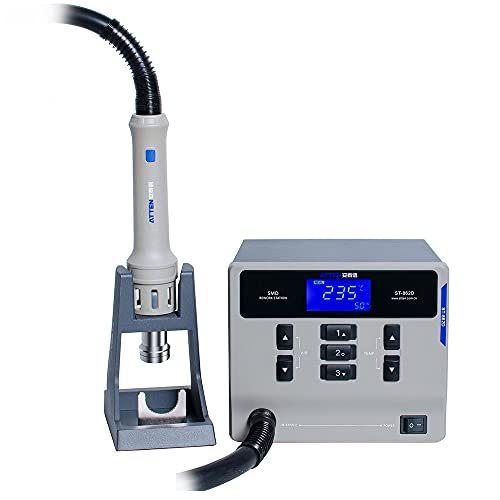
The ATTEN ST-862D is aimed at buyers who want a more substantial dedicated hot air station for PCB and SMD work. Its listed 1000W rating, 100°C to 480°C temperature range, and maximum airflow of 120L/min put it in a higher-output class than the compact stations here. The product information also gives a temperature stability figure of ±1.0°C, a specification that speaks more directly to control than a large maximum temperature alone.
Three fast-access temperature and air-volume keys make sense for a busy bench where common settings are used repeatedly. The menu-style operation may appeal to users who prefer organized controls, while the silica-gel cable is described as remaining flexible in colder conditions. Four nozzles and a ground wire are included, though this model gives up the soldering iron and broad starter accessory bundle supplied with several 2-in-1 alternatives.
Pros
- 1000W rating provides a substantial dedicated hot air platform.
- Listed airflow reaches 120L/min.
- Published temperature stability is ±1.0°C.
- Three fast-access keys simplify frequent setting changes.
- Includes four nozzles, a bracket, and a ground wire.
Cons
- It does not include a conventional soldering iron station.
- Its premium-oriented design may be more equipment than occasional users need.
This station fits a workbench where hot air is a primary tool rather than an occasional accessory. The stability specification and fast-access controls are meaningful advantages for repeatable work, while the larger power class may be unnecessary for light hobby repairs. Choose it over the YIHUA 959D when the higher-output design and stated stability matter more than memory presets and a lower-cost footprint.
To buy this product, click here.
3. YIHUA 862BD+ — Best 2-in-1
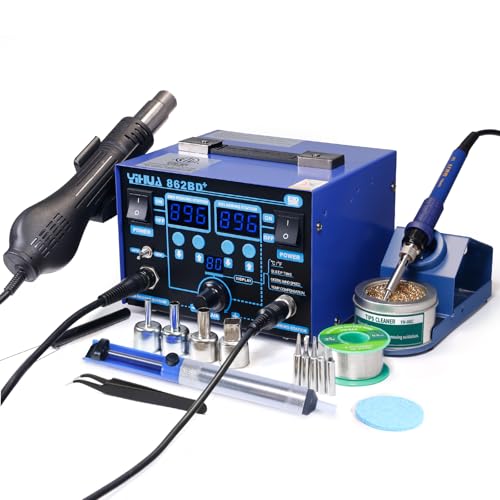
A combined station makes a strong case for a small electronics bench because one enclosure handles hot air and conventional soldering. The YIHUA 862BD+ lists a 212°F to 896°F hot air range, a 392°F to 896°F soldering range, PID temperature control, and three digital displays for the main settings. That means a connector can be heated with air, then touched up with the iron without reaching for a separate machine.
The included package is unusually useful for immediate setup. It lists four hot air nozzles, five soldering tips, lead-free solder, ESD-safe tweezers, a desoldering pump, brass wool, a sponge, and an IC popper. The 0 to 99-minute adjustable sleep mode adds a practical pause function, and detachable handpieces can be replaced according to the product information. Still, combined units occupy a compromise space, with less dedicated hot air emphasis than the ATTEN.
Pros
- Combines a hot air station and soldering iron in one unit.
- PID control is listed for the soldering iron temperature.
- Includes four hot air nozzles and five soldering tips.
- Includes lead-free solder, tweezers, pump, brass wool, and sponge.
- Offers an adjustable sleep mode from 0 to 99 minutes.
Cons
- The hot air maximum is lower than the dedicated YIHUA 959D listing.
- It requires bench space for a combined station even when only one tool is being used.
The 862BD+ is a practical choice for electronics repair that moves between hot air and iron work in the same session. Its accessory bundle reduces the number of immediate add-on purchases, while PID control and separate displays keep the setup understandable. Select a dedicated model instead if hot air rework is the central task and the second soldering channel would sit unused.
To buy this product, click here.
4. WEP 882D — Best Complete Starter Setup

The WEP 882D is built around convenience. Its compact body houses separate hot air and soldering controls, each with its own display and power switch. The listing gives the hot air range as 212°F to 896°F and the iron range as 392°F to 896°F, with variable air volume and PID control for both channels. That is a useful arrangement for a reader who wants one box for board heating, component removal, and ordinary joint work.
The accessory selection is aimed at a first electronics setup: two solder wire spools, five iron tips, three hot air nozzles, tweezers, brass wool, and a desoldering pump. Sleep mode for the iron, hot air standby, automatic shutdown, and calibration functions add more control than the low-cost label might suggest. The trade-off is familiar with kits, the included tips and nozzles provide a starting point, but long-term replacement compatibility should be confirmed before ordering.
Pros
- Independent controls and displays simplify two-tool operation.
- Lists PID temperature control for both channels.
- Includes two solder wire spools, five iron tips, and three nozzles.
- Provides hot air standby and soldering iron sleep functions.
- Includes calibration and automatic shutdown functions.
Cons
- The hot air temperature range stops at 896°F, below some dedicated options.
- The supplied product information does not identify a maximum airflow figure.
This is a sensible package for a small repair bench that needs both tool types and a useful collection of consumables from the start. It makes more sense than buying a dedicated station plus a separate iron for occasional board repair. Buyers focused on precise airflow comparisons should favor a model with a clearly listed airflow specification.
To buy this product, click here.
5. YIHUA 8786D I — Best Accessory-Rich 2-in-1

The YIHUA 8786D I takes the combined-station approach and puts much of its appeal in the included equipment. The package lists 10 soldering tips, four hot air nozzles, an IC extractor, a desoldering pump, and a 35g roll of 0.8mm lead-free solder. For someone assembling a repair drawer from scratch, that mix is more immediately useful than a station that arrives with only one nozzle.
Its dual display and dual power switches keep the iron and hot air functions separate, while the listing describes PID temperature control, cool and hot air conversion, sleep operation, and an anti-static design. A fail-safe function is also described, cutting power to the heating element if the gun stops producing air unusually. The supplied information does not state a maximum airflow figure, so this model is easier to judge by its controls and accessories than by air-delivery comparisons.
Pros
- Includes 10 soldering tips and four hot air nozzles.
- Includes an IC extractor, pump, and lead-free solder wire.
- Provides separate displays and power switches.
- Lists PID temperature control and cool/hot air conversion.
- Includes anti-static and hot-air fail-safe functions.
Cons
- The product information does not clearly state a maximum airflow figure.
- Its included accessories may matter less to buyers who already own a soldering kit.
This station suits a new bench where both hot air and iron work are expected, especially if a broad assortment of tips is more valuable than a dedicated airflow specification. Existing users with their own tips and pumps may prefer the simpler YIHUA 959D. The 8786D I earns its position through a practical kit and safety-oriented controls rather than headline output.
To buy this product, click here.
6. WEP 8858-V — Best Compact Option

A crowded workbench changes the buying decision, and the WEP 8858-V addresses that with a palm-sized main unit, an integrated hot air holder, and a built-in nozzle holder. Those details keep the gun and its accessories from wandering across the bench while leaving more room for a PCB, magnifier, or fume-control setup. Its panel uses a straightforward temperature control and a separate air-volume knob.
The listing describes quick heating, PID temperature monitoring, digital calibration, Celsius/Fahrenheit conversion, and a hot-air fail-safe. Three nozzles and two tweezers are included, covering basic component removal and lifting tasks. This is a dedicated hot air tool, so the compact footprint comes without a conventional soldering iron, and the product information does not provide a specific airflow maximum for direct comparison with the 120L/min models.
Pros
- Palm-sized main unit suits space-limited benches.
- Integrated holder and nozzle storage reduce loose accessories.
- Provides separate temperature and air-volume adjustment.
- Lists PID control, calibration, and Celsius/Fahrenheit conversion.
- Includes three nozzles and two tweezers.
Cons
- It does not include a conventional soldering iron.
- The supplied information does not state a maximum airflow figure.
The 8858-V is a good fit for occasional SMD repair, apartment workspaces, or benches where every inch matters. Its control arrangement is more useful than an oversized specification sheet for small jobs, but users handling larger boards may want a station with a published airflow capacity. It is also a stronger choice than a 2-in-1 if the iron function would simply take up unused space.
To buy this product, click here.
7. YIHUA 959D I — Best Simple Dedicated Station

The YIHUA 959D I keeps the central hot air functions clear and uncomplicated. It lists a 212°F to 896°F adjustable temperature range, up to 120L/min of airflow, real-time temperature display, and PID compensation intended to reduce overshoot. For SMD repair, that combination gives the operator control over both heat and air rather than relying on a fixed blast.
Standby operation cools the gun toward 212°F when it is placed in the holder, then returns it to the set temperature when picked up. Three nozzles, sized at 5mm, 8mm, and 10mm, are included, along with two ESD-safe tweezers. Compared with the closely related 959D ranked first, this version has a lower listed maximum temperature and does not mention memory channels, so it suits users who prefer a straightforward station over stored presets.
Pros
- Adjustable airflow is listed up to 120L/min.
- Temperature range covers 212°F to 896°F.
- Includes 5mm, 8mm, and 10mm nozzles.
- Includes two ESD-safe tweezers for component handling.
- Provides holder standby cooling and real-time display.
Cons
- The listed maximum temperature is lower than the YIHUA 959D.
- The product information does not mention preset memory channels.
This model works well for a reader who wants a dedicated SMD station with the core controls visible and little interest in a combined iron. It gives up the first-place model’s memory feature, but retains the useful 120L/min airflow listing and standby behavior. Choose it when the lower maximum temperature still covers the intended work and the simpler layout is preferable.
To buy this product, click here.
8. SUGON 8620DX — Best High-Power Station

The SUGON 8620DX takes a high-output approach, with a listed 1300W rating, adjustable temperature from 212°F to 845°F, and airflow control from 1 to 200. The product information describes a brushless scroll fan and applications ranging from phones and laptops to SOIC, QFP, PLCC, BGA, and cable connectors. That broad application list suggests a station aimed at users who want substantial control over air delivery across different board tasks.
Four memory stores, three temperature displays, automatic sleep, Celsius/Fahrenheit conversion, and calibration support make the control system more capable than a basic low-cost station. Six nozzles and a quick-change high-temperature nozzle bracket add convenience when moving between component sizes. Its maximum listed temperature is lower than several models here, showing why wattage and temperature range should be read separately rather than treated as the same measure of rework performance.
Pros
- 1300W rating places it in the highest power class in this selection.
- Airflow adjustment is listed from 1 to 200.
- Includes six nozzles and a quick-change nozzle bracket.
- Provides four memory stores and three temperature displays.
- Lists automatic sleep, calibration, and high-airflow cooling functions.
Cons
- The listed maximum temperature is 845°F, below several lower-wattage choices.
- It may be more output and control than small, delicate jobs require.
The 8620DX makes sense for a bench that regularly shifts between small SMD components and larger connectors or assemblies. Its airflow scale and nozzle system are the main attractions, while the lower maximum temperature may matter to buyers who specifically need the widest temperature range. Choose it for control over air delivery and rapid setting changes, not simply because 1300W sounds larger.
To buy this product, click here.
9. YIHUA 853D — Best Integrated Electronics Workstation

The YIHUA 853D is unusual in this group because hot air is one part of a three-function electronics workstation. It combines a soldering station, hot air rework station, and adjustable DC power supply with a voltmeter mode. The hot air channel is listed from 212°F to 896°F with airflow up to 120L/min, while the supply provides 0 to 15V and 0 to 2A output or measures up to 35V DC.
That arrangement suits a repair bench where a board may need hot air, iron work, and controlled power testing during one project. A 5V USB port rated at 0.5A is also listed, and both the iron and hot air channels use PID temperature stabilization. The cost of this flexibility is a larger, more specialized unit, and the product information does not list the same hot air memory functions found on the top-ranked YIHUA 959D.
Pros
- Combines hot air, soldering, and a DC power supply.
- Hot air airflow is listed up to 120L/min.
- DC output is adjustable from 0 to 15V and 0 to 2A.
- Provides voltage measurement up to 35V DC.
- Includes PID stabilization and a 5V USB port.
Cons
- Its added power-supply functions make the unit less focused than a dedicated station.
- The product information does not list hot air nozzles or soldering tips included in the package.
This is the right kind of purchase for a repair bench that genuinely needs a small DC source and voltage testing beside hot air work. It is less appealing for someone who wants the simplest possible rework tool or already owns a bench supply. The 853D earns its place through integration, not because its hot air channel is more capable on paper than the dedicated leaders.
To buy this product, click here.
Buying Guide
Airflow Control Matters for Small SMD Components
Airflow determines how broadly heat spreads around the target. A high maximum can help with larger parts, but excessive air can disturb nearby components or blow light solder and flux across the board. Models with adjustable airflow, such as the YIHUA 959D, ATTEN ST-862D, and SUGON 8620DX, give more room to match the air stream to the nozzle and component size.
A Temperature Setting Is Not the Same as Component Temperature
The number on the display describes the station setting, not a guaranteed temperature at the solder joint. Nozzle distance, airflow, component mass, board copper, and the joint itself all affect heating. PID control and temperature stability can support more consistent operation, but they do not remove the need for sensible settings and careful observation.
Choose Dedicated Hot Air or a 2-in-1 Station
A dedicated station is the cleaner choice if hot air rework is the main job. A 2-in-1 model becomes more attractive when the same session includes conventional soldering, desoldering, and tip work. The YIHUA 862BD+ and WEP 882D include useful iron accessories, while the YIHUA 959D and ATTEN ST-862D devote their controls to hot air.
Nozzles Shape the Work Area
A narrow nozzle concentrates heat around a small package, while a larger nozzle can spread warmth across a broader component. Included nozzle sizes vary considerably, from three-piece sets to the SUGON’s listed six-nozzle package. Check the included sizes against the parts you expect to handle, and do not assume that nozzles from another model will fit.
Standby and Cooling Functions Are Practical Features
Hot air handles become inconvenient when they stay at working temperature between tasks. Standby systems that cool the handle in its holder can reduce idle heating and make the bench easier to manage. The YIHUA 959D, YIHUA 959D I, WEP 882D, and several other models list standby or cooling functions. These features support safer handling, but they do not replace a heat-resistant workspace or the supplied instructions.
Check the Electrical Version Before Ordering
Most products in this roundup are listed for 110 to 127V U.S. power. That detail matters more than a polished control panel because using the wrong electrical supply can damage equipment or create a hazard. Confirm the voltage requirement for the exact listing before placing an order, especially if the station will be used outside the United States.
Best Hot Air Rework Station FAQ
What Temperature Range Should a Hot Air Rework Station Have?
A broad range gives more adjustment room, but the highest number is not a direct measure of rework quality. The YIHUA 959D lists 212°F to 932°F, while many 2-in-1 models list a hot air range up to 896°F. The useful setting depends on the solder, component, board, nozzle, airflow, and distance from the work.
Is Higher Wattage Better for Hot Air Rework?
Higher wattage may provide more available heating power, but it does not automatically mean better control or a higher operating temperature. The SUGON 8620DX lists 1300W and a maximum temperature of 845°F, while the YIHUA 959D lists a lower overall power description and a 932°F maximum. Heater design, airflow, regulation, and the workpiece all affect practical results.
Is a 2-in-1 Station Better Than a Dedicated Hot Air Station?
It depends on the bench. A 2-in-1 station saves space and provides a soldering iron for touch-ups, while a dedicated model focuses its controls and enclosure on hot air. Choose a combined station such as the YIHUA 862BD+ if both tools will be used regularly. Choose the YIHUA 959D or ATTEN ST-862D if hot air is the primary requirement.
What Nozzles Are Useful for SMD Repair?
Small nozzles help concentrate heat around smaller packages, while larger nozzles distribute heat across wider parts and connectors. The correct size depends on the component and board layout. A station with several included nozzles gives a better starting point, but compatibility should be confirmed for replacement nozzles.
Can a Hot Air Rework Station Replace a Soldering Iron?
Hot air can loosen and reflow many surface-mount components, but it does not replace the control of a conventional iron for individual joints, through-hole work, wire connections, or fine touch-ups. A 2-in-1 station handles both tasks, while a dedicated hot air unit requires a separate iron.
Are Preset Memories Worth Having?
Presets are useful when the same few temperature and airflow combinations are used repeatedly. The YIHUA 959D lists three memory channels, and the SUGON 8620DX lists four memory stores. They save adjustment time, but they do not guarantee the same result on every board because component size, copper area, nozzle distance, and airflow still change the heating behavior.
What Safety Features Matter?
Holder standby, automatic cooling, fail-safe functions, automatic shutdown, and stable handpiece storage can make bench use more manageable. Several stations list these features, but they do not replace ventilation, eye protection, careful heat handling, or the instructions for the exact unit. Keep hot air away from flammable materials and sensitive parts until the process is understood.
Final Verdict
The YIHUA 959D is the strongest overall choice because it keeps the central hot air task in focus while offering a useful combination of adjustable airflow, three memory channels, standby cooling, fail-safe protection, and a 212°F to 932°F listed range. It is a better-balanced recommendation than simply choosing the station with the largest wattage figure. For a premium-oriented bench, the ATTEN ST-862D brings higher listed power, 120L/min airflow, fast-access controls, and stated temperature stability.
Buy the YIHUA 862BD+ if a soldering iron and a broad starter kit are as important as hot air. The WEP 8858-V is the more compact route, while the YIHUA 853D is the specialized pick for a bench that also needs a DC supply and voltage testing. Before ordering, match the station to the work area, nozzle sizes, airflow range, and U.S. voltage requirement. The best result comes from controlled heat and appropriate technique, not from chasing the biggest number on the display.

- Jesse
Jesse is the editor behind Soldering Gear, where he covers soldering irons, stations, rework equipment, and the tools that belong on a practical electronics bench. His work focuses on comparing product specifications, features, compatibility, and intended uses so readers can make more informed buying decisions.
- Best Cordless Soldering Iron: 9 Picks in 2026 September 28, 2026
- Best Portable Soldering Iron: 9 Picks in 2026 September 27, 2026
- What Temperature for Soldering Electronics? September 26, 2026
- Best Soldering Station for Beginners: 9 Picks in 2026 September 25, 2026
- Best Solder Fume Extractor: 9 Picks in 2026 September 24, 2026