Best Solder Fume Extractor: 9 Picks in 2026

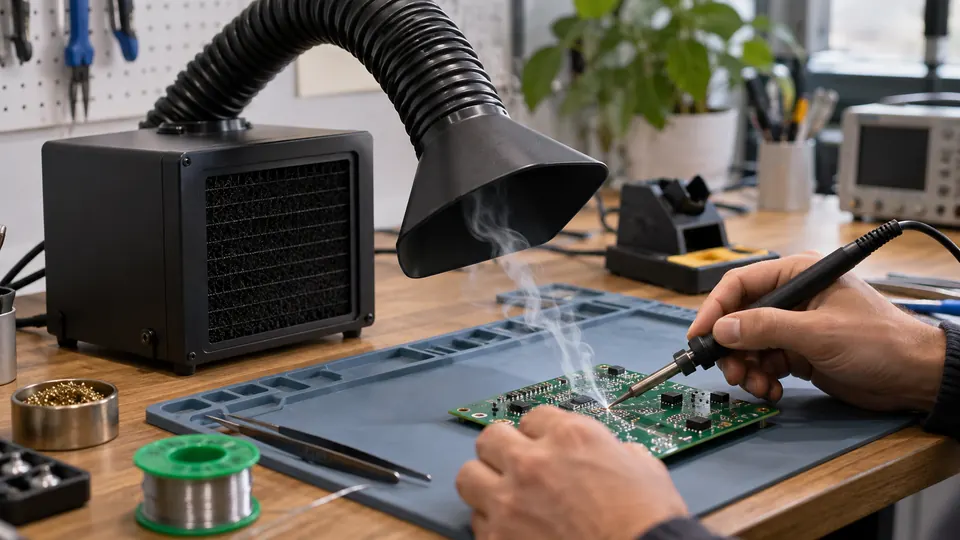
Rosin smoke curls upward fast, often reaching your face before you finish feeding solder into a joint. A good solder fume extractor keeps that plume closer to the source, where filtration can do useful work instead of letting it drift across a small bench. The real choice is between a simple carbon smoke absorber, a directional unit with a flexible hood, and a multi-stage machine with HEPA filtration.
Airflow numbers deserve context. A strong fan placed several inches away may be convenient, but precise capture depends on hood position, filter design, and the distance between the intake and the solder joint. Basic models suit occasional PCB repairs, while a filtered extractor with adjustable suction makes more sense for long sessions, shared rooms, or varied work such as jewelry soldering and light fabrication. The FumeClear FC-2001A stands out overall because it combines a metal housing, H13 HEPA filtration, activated carbon, and a stated 120 to 180 m³/h purification range.
This comparison weighs capture style, filtration, positioning, airflow control, maintenance, voltage, and workspace fit. Some products are compact smoke absorbers with replaceable carbon filters. Others use a gooseneck hose that lets you place the hood directly beside the joint. Match the extractor to your bench rather than chasing the biggest number on the box.
Quick Answer
Best Overall: The FumeClear FC-2001A offers the most complete filtration and capture package for regular bench soldering.
Best Value: The KQZ B1 adds H13 HEPA filtration, activated carbon, a flexible hose, and a 168 m³/h airflow rating without the footprint of a larger extractor.
Best Compact Choice: The NT-M1 is a practical fit for a crowded desk because its small body, adjustable suction, and retaining hose are easy to position around a PCB.
Best Simple Smoke Absorber: The KOTTO Solder Smoke Absorber keeps the setup straightforward with a 3000 RPM fan, carbon filter, rubber feet, and carrying handle.
Best Solder Fume Extractor Comparison Table
| Product | Best For | Filtration And Airflow | Capture Design |
|---|---|---|---|
| FumeClear FC-2001A | Regular bench soldering | H13 HEPA and activated carbon, 120 to 180 m³/h | Direct desktop intake |
| KQZ B1 | Flexible filtered extraction | H13 HEPA and carbon, 168 m³/h | 360-degree gooseneck hose |
| DX50 | Adjustable light-duty work | HEPA and activated carbon, 180 m³/h | 20-inch gooseneck hose |
| NT-M1 | Small workbenches | H13 HEPA and carbon, 168 m³/h | 25.6-inch flexible hose |
| FumeClear FC-100A | Extended small-bench use | Three-stage filtration, up to 200 m³/h | Bench extraction |
| YIHUA 948DQ-I | Tiltable desktop extraction | Front and rear filter absorbers | 30-degree stand and fenders |
| Upgraded ToolBud | Portable hobby setups | Replaceable carbon filters | Removable magnetic flaps |
| Buhobha Solder Fume Extractor | Soldering with component support | Dual-side filtration | Adjustable bracket, LED, helping hands |
| MUIN Solder Fume Extractor | Compact multi-purpose use | Three-stage filtration | Desktop fan intake |
The detailed reviews below show how each extractor handles placement, filtration, noise, maintenance, and the practical limits of its design.
1. FumeClear FC-2001A — Best Overall

The FC-2001A is the strongest all-round choice for a bench where soldering happens regularly rather than once in a blue moon. Its all-metal housing contains a True H13 HEPA filter and activated carbon stage, giving it a more substantial filtration setup than the small fan-style absorbers that sit directly beside a PCB. The listing gives a purification capacity of 120 to 180 m³/h and describes an effective working range of up to 15 cm, which gives you a little more freedom when a hand, fixture, or component blocks the ideal position.
Its brushless motor and wide 110 to 220V support also make the design more adaptable across workspaces. The activated carbon is listed with an iodine value of 600 to 800 mg/g, while the product information describes a high dust-holding capacity and a filter life claim of three times that of comparable compact units. Those are listing claims rather than independent measurements, so filter replacement still depends on usage, dust, and odor buildup. For a crowded electronics bench, though, this is the kind of extractor that feels more deliberate than a loose fan with a carbon pad.
Pros
- Combines H13 HEPA and activated carbon filtration.
- All-metal housing suits a fixed bench setup.
- Published airflow range is 120 to 180 m³/h.
- Stated effective capture distance reaches 15 cm.
- Supports 110 to 220V operation.
Cons
- Its larger filtration system may take more bench space than a basic absorber.
- The listing does not clearly state replacement-filter pricing or availability.
Choose the FC-2001A for regular PCB repair, soldering classes, and workspaces where odor and fine particles deserve more attention than bare-minimum smoke movement. A tiny occasional-use station may need less machine, while a high-volume industrial extraction system requires a different class of equipment altogether. Keep appropriate room ventilation in place, since a desktop extractor should not be treated as a complete substitute for local exhaust controls.
To buy this product, click here.
2. KQZ B1 Solder Fume Extractor — Best Value

The KQZ B1 brings a more controlled capture method to a compact desktop format. Its 66 mm gooseneck hose rotates through 360 degrees, so the hood can sit beside a solder joint instead of forcing the whole machine into the perfect spot. Picture a small repair board under a bright lamp, with the hose bent around a helping hand and aimed at the fresh rosin plume. That setup is far easier to manage than sliding a flat fan back and forth every few minutes.
The product information lists 168 m³/h airflow, a 9 mm pre-filter, and an H13 HEPA cartridge with coal-based activated carbon. Five replacement pre-filters and one efficiency filter are included according to the listing, which gives maintenance a clearer starting point than products that arrive with a single filter and little guidance. Its 110 to 220V design is useful for varied electrical environments, though buyers should still confirm the correct plug and local setup before ordering.
Pros
- Uses a flexible 360-degree gooseneck hose for precise placement.
- Lists 168 m³/h airflow.
- Combines a 9 mm pre-filter with H13 HEPA and activated carbon.
- Includes five pre-filters and one efficiency filter.
- Uses a compact metal body with wide-voltage support.
Cons
- The hood and hose require more setup space than a flat absorber.
- The listing uses strong filtration percentages that are not independently verified here.
This is a sensible middle path for a shared home office, maker bench, or repair table where flexible positioning matters. It offers a more complete filter arrangement than basic carbon units without moving into the larger footprint of a dedicated shop extractor. Buyers who want the simplest possible plug-in fan may find the filter stack and hose more involved, but those details are precisely why the B1 ranks near the top.
To buy this product, click here.
3. DX50 Solder Fume Extractor — Best Adjustable Airflow

The DX50 earns attention through control. Its three airflow levels let you use a gentler setting for a small through-hole joint or increase the pull when a larger area produces more smoke. The listing gives a stable 180 m³/h airflow rating from a 7,500 RPM motor, along with a metal housing and side exhaust. Side exhaust can be convenient on a narrow desk because it keeps discharged air from fighting the intake path beneath the machine.
A 20-inch gooseneck hose holds its position and bends through 360 degrees, allowing the hood to hover close to the work without covering the view. The filter assembly combines five pre-filters with an integrated HEPA and activated-carbon filter. Product information identifies the unit as suitable for light-duty desktop soldering and PCB repair, while cautioning that it is not intended for high-volume laser engraving. That boundary is useful. It tells you this is a bench tool for controlled tasks, not a substitute for a larger extraction system.
Pros
- Offers three adjustable airflow levels.
- Lists 180 m³/h airflow from a 7,500 RPM motor.
- Includes five pre-filters.
- Uses an integrated HEPA and activated-carbon filter.
- Includes a 20-inch, 360-degree gooseneck hose.
Cons
- Intended for light-duty desktop work rather than high-volume extraction.
- The listing does not identify exact replacement-filter costs.
The DX50 fits someone who wants a directional hood and adjustable suction without giving up multi-stage filtration. Three levels are particularly handy when the extractor sits close to delicate work and you want to manage airflow rather than run maximum pull constantly. Choose another style if you prefer a tiny, flat absorber with no hose to reposition, but for a flexible PCB repair bench this layout is more useful.
To buy this product, click here.
4. NT-M1 Desktop Solder Fume Extractor — Best Compact Design
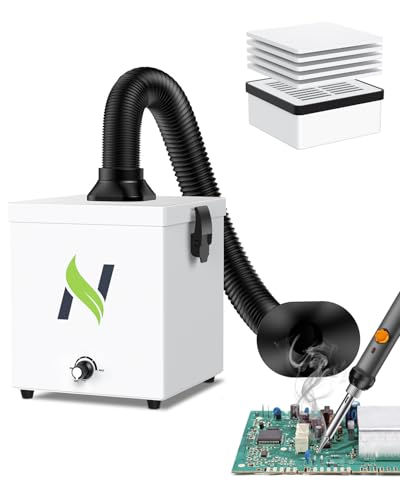
A tight workbench changes the fume-extractor decision. The NT-M1 measures 5.1 by 5.1 by 6.3 inches and weighs 3 pounds according to the product information, so it can sit beside a small soldering mat without swallowing the useful part of the desk. That makes it appealing for an apartment workstation, a folding table, or a repair corner that gets packed away after each session.
Inside, the listing identifies a centrifugal motor, 168 m³/h airflow, a 10 mm pre-filter, H13 HEPA filtration, and evenly distributed carbon powder for light odor reduction. A stepless rotary control lets you dial the fan up or down, while the retaining hose extends to 25.6 inches and bends through 360 degrees. The hose length is generous for a compact body, although a longer arm can also need careful routing so it does not crowd the soldering hand.
Pros
- Compact 5.1 by 5.1 by 6.3-inch footprint.
- Weighs 3 pounds according to the listing.
- Lists 168 m³/h airflow with H13 HEPA filtration.
- Includes a 10 mm pre-filter.
- Provides stepless fan-speed adjustment and a 25.6-inch hose.
Cons
- Its compact format is better suited to bench-scale work than larger extraction tasks.
- The carbon stage is described for light odor reduction rather than a detailed chemical-filtration specification.
The NT-M1 is the easy recommendation for a cramped electronics corner where every inch matters. It gives you a directional hose and adjustable speed without demanding a large base. A roomier bench may justify the broader filtration design of the FC-2001A or DX50, but this unit makes a strong case for small-space usability. Place the hood close to the smoke source and keep the extractor out of the path of your wrist.
To buy this product, click here.
5. FumeClear FC-100A — Best For Extended Small-Bench Use
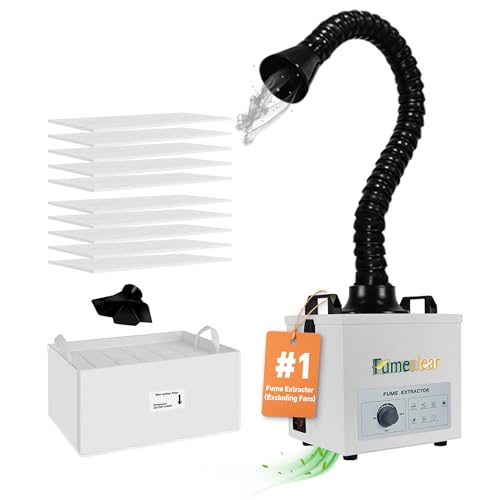
The FC-100A is aimed at small bench soldering but uses a more substantial three-stage filtration concept than basic smoke traps. Its product information lists up to 200 m³/h suction, a combined HEPA and carbon main filter, and 10 pre-filters for larger particles. That combination should appeal to someone who spends long stretches repairing boards and wants a filter arrangement that separates larger dust from the primary filtration stage.
FumeClear also lists high-iodine activated carbon and an expected service life of up to 3,000 hours for the main carbon filter. Treat that as a published product claim rather than a guarantee, since actual replacement timing depends on what enters the filter and how often the machine runs. The listing specifically says the FC-100A is for small bench soldering and is unsuitable for large laser engravers. That defined use case helps place it: capable for a dedicated electronics bench, but not a general industrial air system.
Pros
- Uses a three-stage filtration design.
- Lists up to 200 m³/h suction.
- Includes 10 pre-filters for larger dust particles.
- Combines HEPA and high-iodine activated carbon in the main filter.
- Product information gives an expected main-filter life of up to 3,000 hours.
Cons
- Specified for small bench soldering and not large laser-engraving extraction.
- The published filter-life figure is an expectation, not a guaranteed replacement interval.
Select the FC-100A if filter staging and longer service intervals matter more than a minimal footprint. It is a better fit for a stationary bench than a portable kit that moves between rooms. The FC-2001A offers a broader overall package and clearer stated capture distance, while the FC-100A remains attractive for buyers focused on small-bench filtration and a supply of pre-filters.
To buy this product, click here.
6. YIHUA 948DQ-I — Best Tiltable Smoke Absorber

The YIHUA 948DQ-I takes the familiar flat smoke absorber and gives it more control over angle and airflow boundaries. Its stand tilts through 30 degrees, while two side fenders help reduce disruptive crossflow around the intake. That layout can be handy when a board is propped at an angle or when the extractor needs to sit slightly below the work rather than directly behind it.
The product includes eight filtration absorbers, divided between front and rear positions, plus the two fenders and tiltable stand. A five-blade fan is described as relatively quiet and intended for soldering, wood burning, and similar tasks. The unit is designed for 110 to 127V with a US-standard plug, so it is less flexible than the wide-voltage models in this roundup. Its stated effective distance is 10 cm, which means placement remains important even with the adjustable stand.
Pros
- Includes eight filtration absorbers.
- Offers a 30-degree tiltable stand.
- Side fenders help limit disruptive airflow.
- Five-blade fan is described as relatively quiet.
- Includes a 12-month US manufacturer technical coverage claim.
Cons
- Designed for 110 to 127V with a US-standard plug.
- Its stated effective extraction distance is limited to 10 cm.
This model suits a maker who wants simple operation with more physical positioning control than a fixed box provides. It is also a reasonable choice for mixed soldering and wood-burning tasks, provided the intake stays close to the source. Buyers wanting HEPA filtration, a hose, or wide-voltage operation should step up to another design. For a straightforward US bench, the included filters and tilting frame are the main attractions.
To buy this product, click here.
7. Upgraded ToolBud Solder Fume Extractor — Best Portable Basic Model
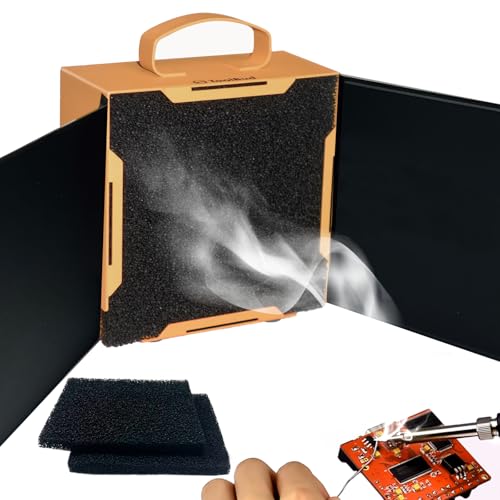
ToolBud focuses on the small, movable end of the category. Its compact body is easy to store between repair sessions, and two detachable magnetic wings expand the capture area when a solder joint sends smoke sideways. Imagine working on a tiny board at the corner of a dining table, then clearing the whole setup away before dinner. A lightweight absorber is much less troublesome in that situation than a hose-based machine with a separate hood.
The listing describes a low-noise motor and includes two filters, with a detachable filter system intended to simplify cleaning or replacement. The carbon filter approach is straightforward, but the available product information does not give a HEPA stage or a quantified airflow figure. That makes it better suited to occasional soldering and light DIY work than to a busy repair station where filter performance and airflow control deserve more documentation.
Pros
- Compact design is easy to move and store.
- Removable magnetic wings widen the capture area.
- Includes two filters.
- Uses a detachable filter system for maintenance.
- Product information describes the motor as low noise.
Cons
- The listing does not identify a HEPA filter or quantified airflow.
- Requires close placement because the stated capture range is not specified.
ToolBud makes sense for occasional PCB repairs, light soldering, and benches that need to disappear after use. It avoids the cost and setup of a larger extractor, but its simpler filtration information leaves less room for confident comparison with the HEPA-equipped units above. Place it close to the smoke source and keep general room ventilation active, particularly during longer sessions.
To buy this product, click here.
8. Buhobha Solder Fume Extractor — Best Integrated Soldering Station

The Buhobha takes a different route by combining fume absorption with two useful bench accessories. A built-in LED illuminates the joint, while two flexible helping hands hold components with alligator clips. For a small repair job, that can mean fewer loose tools scattered around the mat and less time trying to hold a wire, board, and soldering iron at once.
Its dual-side filtration design creates a broader intake area, and the motor is listed at 2,400 to 2,700 RPM with a stated capture range of 5 to 6 inches. The adjustable-angle bracket lets you aim the absorber, while the articulated clips can be repositioned and locked. The trade-off is filtration depth. The product information describes a dual-side system but does not identify HEPA filtration or provide a measured airflow figure, so its main appeal is integrated convenience rather than advanced air cleaning.
Pros
- Combines a fume absorber, LED light, and two helping hands.
- Dual-side filtration creates a wider capture area.
- Adjustable bracket changes the intake angle.
- Flexible alligator clips hold components in place.
- Operates from standard 110V AC power.
Cons
- The listing does not identify HEPA filtration.
- No quantified airflow rating is provided.
Pick the Buhobha if your biggest annoyance is a cluttered little work area rather than a need for the most documented filtration system. The light and clips can be genuinely handy for basic electronics assembly, especially where a separate helping-hands tool would take up the remaining desk space. For long soldering sessions or stronger odor control, a dedicated HEPA and carbon extractor is a better match.
To buy this product, click here.
9. MUIN Solder Fume Extractor — Best Multi-Purpose Compact Option

MUIN is built around a small desktop footprint and broad hobby use. The product information describes three-stage filtration for solder, flux, chemicals, and odors, with applications that include wood burning, stained glass, jewelry making, and crafting. That range makes it attractive for a multipurpose room where the extractor may spend Saturday beside a soldering iron and Sunday near a pyrography project.
The fan is described as producing strong suction from roughly 4 to 5 inches with slight noise, but the listing does not provide a quantified airflow rate or detailed filter-stage breakdown. Its ABS construction keeps the unit portable and storage-friendly. That simplicity is the selling point, while the absence of HEPA identification and a flexible hose limits how precisely you can position the intake around a busy PCB.
Pros
- Uses a three-stage filtration design.
- Supports soldering, wood burning, stained glass, and jewelry work.
- Compact body takes little desktop storage space.
- Product information describes low-noise operation.
- Carbon filtration is intended to reduce fumes and odors.
Cons
- The listing does not identify HEPA filtration.
- No airflow rating or flexible extraction hose is specified.
MUIN is a practical lower-complexity choice for light, varied craft work where portability matters. It can sit close to the source and help intercept smoke, but it should not be treated as equivalent to a hose-based HEPA extractor. Choose it for an uncluttered occasional-use setup, then move toward the KQZ B1, DX50, or FumeClear models if your sessions become longer or your filtration requirements become more demanding.
To buy this product, click here.
Buying Guide
Capture Distance Matters More Than Fan Speed Alone
Smoke needs to enter the intake before it spreads across the room. A stated 3000 RPM fan does not tell you how effectively the extractor captures a plume at your actual working distance. Flat absorbers such as the KOTTO and YIHUA work best with the joint kept close to the filter face. Hose-based units such as the KQZ B1, DX50, and NT-M1 let you bring the hood beside the joint, which can make positioning easier around a PCB or fixture.
Choose Filtration Based On The Workload
Activated carbon is useful for odor and gas adsorption, while a HEPA stage is intended to capture fine particles. Products with both stages, such as the FC-2001A, KQZ B1, DX50, FC-100A, and NT-M1, provide more filtration detail than basic carbon absorbers. A compact smoke trap may still suit occasional work, but longer sessions and shared indoor spaces favor a documented multi-stage design.
Prefilters Affect Maintenance
Rosin smoke is not the only material that can reach a filter. Dust, flux splatter, and workshop debris can load the first stage before the main filter does its job. The DX50 includes five pre-filters, the KQZ B1 lists five pre-filters plus an efficiency filter, and the FC-100A includes 10 pre-filters. Check replacement-filter availability before buying, since a capable extractor becomes less convenient if its consumables are difficult to source.
Adjustable Airflow Helps With Different Joints
A small PCB joint and a larger soldered connection do not produce the same smoke plume. The DX50 provides three airflow levels, while the NT-M1 uses a stepless rotary control. Adjustable suction also lets you reduce fan noise when the smoke load is light. Fixed-speed units can work well, but they give you less control over the balance between capture and a quiet bench.
Match The Extractor To The Bench Layout
Measure the open area beside your soldering mat, then think about where the exhaust will discharge. A compact body such as the NT-M1 or MUIN is easier to store. A hose unit needs room for the arm and hood, but it gives more precise placement. An integrated design such as the Buhobha saves space by adding helping hands and a light, while a larger metal extractor may occupy more room in exchange for a more substantial filter system.
Keep Ventilation In The Safety Plan
A desktop fume extractor can reduce smoke near the joint, but it should not be treated as a complete replacement for suitable room ventilation or workplace controls. Follow the extractor instructions, replace filters when needed, avoid blocking the intake, and use sensible hygiene practices when working with solder that contains lead. A filter machine is one part of a clean soldering setup, not the whole setup.
Best Solder Fume Extractor FAQ
What Is The Best Solder Fume Extractor?
The FumeClear FC-2001A is the strongest overall choice in this comparison because it combines an all-metal body, H13 HEPA filtration, activated carbon, and a stated 120 to 180 m³/h purification range. Its stated 15 cm working range also gives more placement flexibility than a basic flat absorber. The KQZ B1 is a strong alternative for buyers who prefer a compact machine with a flexible hose and included pre-filters.
Is A Carbon Filter Enough For Solder Fumes?
A carbon filter can help adsorb odors and some gases, but filter arrangements vary considerably. Several compact absorbers in this comparison identify activated carbon without identifying HEPA filtration or giving detailed airflow information. A unit with both HEPA and activated carbon provides a more complete documented filtration approach, although it still needs correct placement, maintenance, and room ventilation.
Should The Hood Touch The Soldering Joint?
The intake should be close enough to intercept smoke at the source, but it should not interfere with the iron, solder wire, or your hands. Hose-based extractors let you position the hood beside the joint, while flat units often require the work to sit within a stated range of the filter face. Follow the product instructions and keep the intake unobstructed.
Are More RPM And Higher Airflow Always Better?
No. Fan speed and airflow ratings describe different parts of the system, and neither alone proves effective capture at your bench. A fast fan placed too far away may miss the smoke plume, while a hose positioned close to the joint can capture more effectively at a lower setting. Adjustable airflow is useful because it lets you adapt the machine to the task and noise level.
How Often Should A Solder Fume Extractor Filter Be Replaced?
There is no single replacement schedule for every model. Usage, smoke volume, dust, filter size, and the type of work all affect service life. Some listings provide expected figures, such as the FC-100A’s stated expectation of up to 3,000 hours, while others simply include replacement filters. Watch for reduced airflow, increased odor, visible loading, or the replacement guidance supplied with the exact model.
Can A Solder Fume Extractor Replace Room Ventilation?
No. A desktop extractor captures smoke near the soldering point, but it should not be treated as a complete replacement for appropriate ventilation or workplace safety controls. Keep the machine correctly positioned, maintain its filters, and follow safe handling practices for solder, flux, heat, and electrical equipment.
What Is Better For A Small Desk, A Hose Unit Or A Flat Absorber?
A flat absorber takes less setup and can be easy to store, while a hose unit offers more precise placement around a PCB. The NT-M1 is a compact hose-based option, and the ToolBud, MUIN, and YIHUA models offer simpler desktop formats. Your available hand clearance and storage space matter as much as the extractor’s headline airflow.
Final Verdict
The FumeClear FC-2001A is the strongest overall pick for regular soldering because its H13 HEPA and activated-carbon system, metal housing, stated airflow range, and broader capture distance create the most complete package here. It is a better fit for a dedicated bench than a tiny occasional-use absorber. The KQZ B1 is the practical alternative for buyers who want a flexible gooseneck hood, 168 m³/h airflow, and a useful supply of pre-filters in a smaller format.
For a compact workstation, the NT-M1 offers an appealing balance of 168 m³/h airflow, adjustable suction, H13 HEPA filtration, and a small footprint. The DX50 is the better route for three-level airflow control and a longer gooseneck setup. Lower-complexity choices such as the YIHUA, ToolBud, Buhobha, and MUIN make sense for lighter use, but their filtration details are less extensive. Whichever model you choose, keep the intake close to the smoke source, plan for replacement filters, and maintain suitable room ventilation alongside the extractor.

- Jesse
Jesse is the editor behind Soldering Gear, where he covers soldering irons, stations, rework equipment, and the tools that belong on a practical electronics bench. His work focuses on comparing product specifications, features, compatibility, and intended uses so readers can make more informed buying decisions.
- Best Cordless Soldering Iron: 9 Picks in 2026 September 28, 2026
- Best Portable Soldering Iron: 9 Picks in 2026 September 27, 2026
- What Temperature for Soldering Electronics? September 26, 2026
- Best Soldering Station for Beginners: 9 Picks in 2026 September 25, 2026
- Best Solder Fume Extractor: 9 Picks in 2026 September 24, 2026