What Is Flux in Soldering?

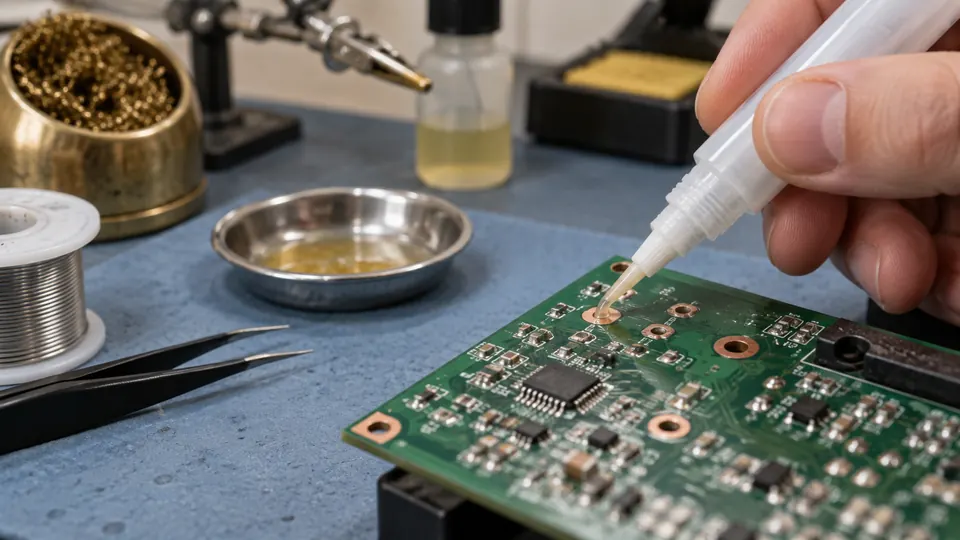
What is flux in soldering? Flux is a chemical preparation that helps molten solder bond to metal surfaces. As the joint is heated, flux removes or disrupts surface oxides, limits further oxidation, and promotes wetting. Without effective flux, solder may bead up, pull away from the joint, or cling to the iron instead of spreading across the intended surfaces.
Flux is available inside flux-cored solder wire and as a separate liquid, gel, paste, or solid product. The correct chemistry depends on the metals, solder alloy, process, and cleaning requirements.
What Flux Does During Soldering
Most solderable metals react with oxygen and develop an oxide layer. That layer may be extremely thin, but it can prevent molten solder from making direct contact with the underlying metal. Heat can accelerate oxidation, so simply raising the iron temperature rarely solves the problem.
When heated into its active range, a suitable flux performs several related functions:
- It acts on surface oxides. Flux chemically disrupts or removes oxides that interfere with solder bonding.
- It protects the heated surface. The flux layer reduces contact between the metal and surrounding air while the joint is hot.
- It improves wetting. Molten solder can spread across compatible, oxide-free metal instead of forming isolated beads.
- It supports heat transfer. Liquid flux and a small amount of molten solder can improve thermal contact between the tip and joint, though flux cannot make an undersized tip supply more heat than the joint requires.
Flux generally does not lower the melting point of the solder. Its main role is preparing and protecting the metal interface so the molten alloy can wet it properly.
Why Solder Contains Flux
Electronics solder wire commonly has one or more flux cores. As the wire melts, fresh flux reaches the heated joint with the solder. This is convenient for many through-hole connections, wires, terminals, and routine repairs.
The core supply may be insufficient in some situations. Old or oxidized leads, desoldering and rework, larger terminals, solder wick, and fine-pitch surface-mount work often benefit from compatible external flux. Separate flux can be placed directly where wetting is needed, providing more control than relying entirely on the solder wire.
Flux-cored wire still requires reasonably clean surfaces. Grease, dirt, heavy corrosion, old adhesive, and some conformal coatings should be addressed with an appropriate preparation method before soldering. Flux should not be treated as a general-purpose cleaner.
Common Types of Soldering Flux
Fluxes vary in activity, residue behavior, activation range, and compatibility. Product labels and technical data should guide selection because broad category names do not describe every formulation precisely.
| Flux category | Typical use | Residue considerations |
|---|---|---|
| Rosin-based | Electronics assembly, wiring, repair, and rework | Residue requirements depend on activity and the application. Some residues may remain, while others should be removed. |
| No-clean | Electronics work where minimal residue and limited cleaning are desired | Residue may be acceptable under the specified process, but sensitive circuits, coating, inspection, or rework can still make cleaning necessary. |
| Water-soluble or organic-acid | Electronics processes needing stronger oxide removal | Residues commonly require thorough cleaning using the method specified for the product. |
| Inorganic or acid flux | Plumbing, sheet metal, and other non-electronic metalwork | Often highly active and potentially corrosive. Plumbing flux is generally unsuitable for circuit boards and electronic components. |
Rosin and Rosin-Based Flux
Rosin flux is widely associated with electronics soldering. Different formulations provide different activity levels, so terms such as mildly activated or activated matter. More active chemistry can handle heavier oxidation, but the resulting residue may demand closer attention.
Labels such as R, RMA, and RA have historically described rosin activity. Modern products may use other classification systems. Checking the product documentation is more reliable than selecting by color or texture.
No-Clean Flux
No-clean flux is formulated to leave a relatively small amount of residue that can remain under defined processing and service conditions. The name does not mean its residue is invisible or suitable for every assembly.
Cleaning may still be appropriate before applying conformal coating, working on high-impedance circuitry, inspecting closely spaced connections, or performing further rework. Residue can also interfere with test probes or create cosmetic concerns. Any cleaning solvent must be compatible with the flux, board, components, markings, plastics, and coatings.
Water-Soluble Flux
Water-soluble electronics flux is often more active than common rosin or no-clean formulations. It can be useful on surfaces that are difficult to wet, but remaining residue usually needs prompt and complete removal. Water alone is not automatically an adequate cleaning process. Product instructions may specify water quality, temperature, cleaning equipment, or drying requirements.
Plumbing and Acid Flux
Flux intended for copper pipe, roofing, stained glass, or sheet metal can contain aggressive chemistry suited to those materials. Such products can damage circuit boards, component leads, traces, and connectors if used for electronics. A label that simply says “soldering flux” does not establish electronics compatibility.
Flux Forms and Where They Are Useful
- Flux-cored wire: Supplies flux as solder is fed into the heated joint. It is sufficient for many clean, straightforward connections.
- Liquid flux: Flows into small gaps and can cover a broad area. Applicators help prevent unnecessary flooding.
- Gel or tacky flux: Stays where placed and is useful for localized rework, drag soldering, and some surface-mount tasks.
- Flux paste: A thicker flux preparation used in certain assembly, tinning, and metalworking processes. Its composition must match the application.
- Solder paste: A mixture of tiny solder-alloy particles and flux. It is a solder material used mainly for reflow and some repair methods, rather than flux by itself.
How Flux Is Used in Practice
For a basic iron-soldered joint, the flux inside solder wire activates as the wire melts against the heated connection. Solder should be fed to the joint area rather than melted exclusively on the tip. This allows the flux and solder to contact both surfaces that need to bond.
External flux can be applied before heating when the joint needs added help. Use enough to wet the working area without coating unrelated parts of the board. Excess flux creates more residue and fumes, and it can obscure the joint during inspection.
As the joint reaches an effective working temperature, the solder should begin spreading over compatible metal surfaces. Persistent beading or refusal to wet can suggest:
- oxidized, dirty, or unsolderable surfaces
- spent, overheated, or incompatible flux
- insufficient heat reaching the joint
- poor tip contact or unsuitable tip geometry
- a joint with greater thermal mass than the equipment can handle effectively
- solder or flux that does not match the materials
Adding more flux can help when oxide removal is the limiting factor. It cannot correct every wetting problem. Repeated heating can damage pads, traces, insulation, connectors, or temperature-sensitive components. If fresh compatible flux does not improve wetting promptly, stop and check the surface condition, tip contact area, equipment capability, and material compatibility.
Choosing a Flux for the Job
The choice should start with the application rather than the flux form. For electronics, select a product explicitly identified as compatible with electronic assembly or repair. Then consider:
- the solder alloy and process temperature
- the metals and surface finishes being joined
- the amount of oxidation present
- whether the assembly can be cleaned effectively
- electrical sensitivity and conductor spacing
- later processes such as coating, testing, or rework
- the flux already present in solder wire or solder paste
Mixing flux chemistries without compatibility information can produce unpredictable residues or cleaning results. For critical assemblies, use the solder, flux, and cleaning process specified by the assembly documentation or material manufacturer.
Flux Residue and Cleaning
Whether residue must be removed depends on its chemistry, how fully the flux was activated, the circuit, and the assembly’s service conditions. Residue that is acceptable on one repair may be unsuitable around high-impedance nodes, fine-pitch components, test contacts, or areas receiving a protective coating.
Avoid assuming that any clear residue is harmless or that every residue dissolves in isopropyl alcohol. Some water-soluble residues need an aqueous cleaning process, while certain no-clean residues are difficult to remove with common solvents. Partial cleaning can spread contamination across a larger area.
Follow the flux manufacturer’s cleaning guidance where available. If cleaning is required, remove residue with a compatible method, prevent liquid from becoming trapped under components or inside connectors, and allow the assembly to dry fully before power is applied.
Flux Fumes and Safe Handling
Heating flux produces fumes and airborne process materials. These fumes are primarily associated with the heated flux rather than vaporized lead from solder. Work with suitable ventilation or fume extraction for the workspace and process, and avoid positioning your face directly above the joint.
Keep flux containers closed when they are not in use, follow the product’s handling information, and wash hands after soldering. Lead-containing solder calls for careful hygiene, especially before eating or touching the face. Fluxes may also be flammable or irritating in their unheated form, so storage and use should follow the product label and safety documentation.

- Jesse
Jesse is the editor behind Soldering Gear, where he covers soldering irons, stations, rework equipment, and the tools that belong on a practical electronics bench. His work focuses on comparing product specifications, features, compatibility, and intended uses so readers can make more informed buying decisions.
- Best Cordless Soldering Iron: 9 Picks in 2026 September 28, 2026
- Best Portable Soldering Iron: 9 Picks in 2026 September 27, 2026
- What Temperature for Soldering Electronics? September 26, 2026
- Best Soldering Station for Beginners: 9 Picks in 2026 September 25, 2026
- Best Solder Fume Extractor: 9 Picks in 2026 September 24, 2026