Best Desoldering Pump: 9 Picks in 2026

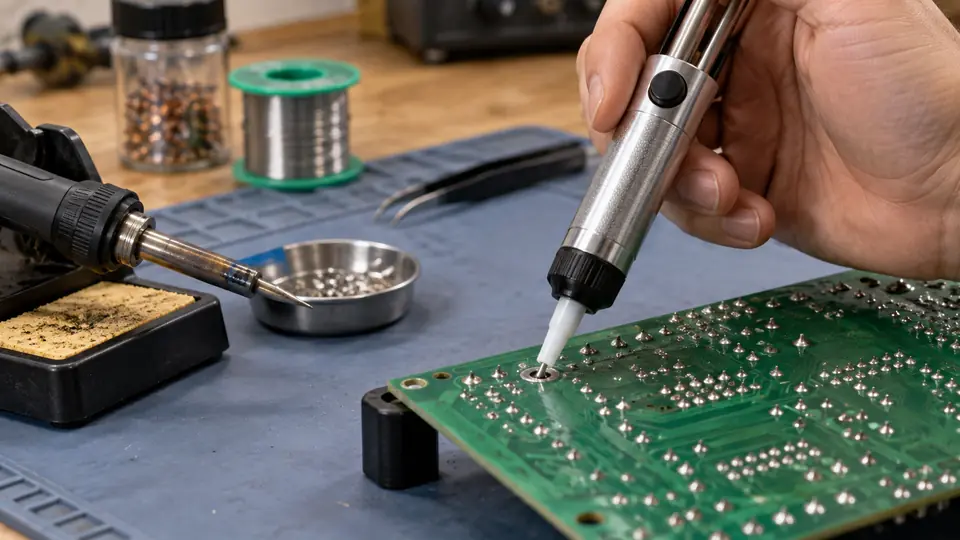
A desoldering pump earns its place beside a soldering iron the moment a component refuses to leave a circuit board cleanly. Heat loosens the joint, the spring-loaded plunger snaps, and the molten solder disappears with that satisfying little pop. The best desoldering pump makes through-hole repair, pin removal, and solder-bridge cleanup easier without forcing you to juggle a board, iron, and tool with both hands.
The useful differences are more practical than flashy. A soft silicone nozzle can sit closer to the iron tip, while a metal or nylon tip may offer a different balance of heat resistance and durability. One-handed resetting matters during board repair, and self-cleaning or anti-clogging designs can save repeated pauses. Electric models add heating and suction in one tool, but they also bring a fixed temperature, a power cord, and more maintenance than a manual solder sucker.
Different work deserves different equipment. A repair bench may benefit from the close-fitting silicone nozzle on the ENGINEER SS-03, while occasional hobby work may call for a lower-cost aluminum pump or a kit that includes solder wick. This comparison weighs suction design, nozzle details, cleaning, one-handed use, included extras, and the type of work each product suits.
Quick Answer
- Best Overall: ENGINEER SS-03, for close nozzle placement, one-handed use, and a self-cleaning shaft.
- Best Powered Option: YIHUA 929D-V, for repeated through-hole desoldering with integrated heating and suction.
- Best Premium Alternative: VAMPLIERS Professional Grade Solder Sucker, with a Japanese-made aluminum body and silicone nozzle.
- Best Kit: AUSTOR Desoldering Sucker and Wick Set, for small PCB jobs that also need braid for leftover solder.
Best Desoldering Pump Comparison Table
| Product | Best For | Mechanism | Notable Feature |
|---|---|---|---|
| ENGINEER SS-03 | Overall PCB repair | Manual spring-loaded | Silicone nozzle and self-cleaning shaft |
| YIHUA 929D-V | Repeated through-hole work | Electric heated pump | 1.0 mm and 1.2 mm nozzles |
| VAMPLIERS Professional Grade | Frequent bench use | Manual spring-loaded | Made-in-Japan aluminum construction |
| Solder Sucker No-Clog Tool | Portable electronics repair | Manual spring-loaded | Eight replacement silicone tips |
| Weller 7874B | Simple circuit repair | Manual pump | Aluminum body with ESD-safe listing claim |
| Kaisi No-Clog Solder Sucker | Low-maintenance manual use | Manual spring-loaded | Soft silicone tip and spare tubing |
| AUSTOR Sucker and Wick Set | Small boards and cleanup | Manual pump | Three braid widths included |
| Teenitor Three-Pack | Shared toolboxes and spares | Manual spring-loaded | Three pumps in one pack |
| MOGAOPI Desoldering Pump | General electronics repair | Manual spring-loaded | Spare replacement nozzle |
The detailed reviews below explain how each pump handles nozzle contact, repeated use, cleanup, and the awkward moments that separate a convenient solder sucker from a frustrating one.
1. ENGINEER Solder Sucker Professional Grade Aluminum Desoldering Pump SS-03 — Best Overall

The SS-03 focuses on the part of desoldering that matters most during a cramped repair: getting the nozzle close to the molten solder before the joint cools. Its silicone nozzle is intended to sit nearer to the soldering iron tip than a rigid tube, helping the pump pull solder from a through-hole joint with less residue left behind. The aluminum body keeps the tool compact, and the listing specifically describes one-handed operation, a useful trait when your other hand is holding the board or iron.
Repeated cleanup is another strong point. The built-in self-cleaning shaft is intended to reduce clogging during continuous work, while the nozzle material is listed as heat resistant to direct contact with a soldering iron up to 350°C. Two replacement silicone tubes are included, one with a 4 mm outer diameter and another with a 3 mm outer diameter. That gives the repairer some flexibility in choosing the contact size, although the supplied information does not identify every compatible replacement option.
Pros
- Silicone nozzle allows close placement beside the soldering iron tip.
- Compact aluminum body supports one-handed operation.
- Self-cleaning shaft is intended to reduce clogging during repeated use.
- Listing states that the nozzle tolerates direct iron contact up to 350°C.
- Includes 3 mm and 4 mm replacement silicone tubes.
Cons
- Manual operation still requires the solder joint to be properly heated first.
- The supplied information does not specify a broader replacement-tip ecosystem.
This is the strongest fit for regular PCB repair, especially where clean nozzle placement matters more than having an electrically heated all-in-one tool. It suits through-hole component removal, board rework, and solder-bridge cleanup without adding a cord or a separate heating element. Someone who wants the pump itself to melt stubborn solder should look at the YIHUA instead, but for a conventional soldering iron and a well-built manual tool, the SS-03 has the most balanced feature set here.
To buy this product, click here.
2. YIHUA 929D-V Electric Desoldering Soldering Iron — Best Powered Option

The YIHUA 929D-V takes a different route from every manual solder sucker here. It combines a heated desoldering iron and a pump in one corded tool, so the operator can heat the joint and trigger suction without changing grip positions. That arrangement is particularly useful for repeated through-hole work, where a board may have many pins to clear and the rhythm of heat, trigger, and release matters more than compact storage.
Two interchangeable nozzles are included, sized at 1.0 mm and 1.2 mm for different through-hole components. The solder waste collects in a removable storage tube, and the listing describes cleaning with the included pin to help keep the passage clear. Temperature regulation is automatic and fixed rather than adjustable, and the tool requires roughly three to five minutes of preheating according to the product information. It operates on 110 to 127 volts with a US-style plug, so it is a distinctly different choice from a cordless manual pump.
Pros
- Integrates heating and solder suction in one handpiece.
- Supports continuous single-handed through-hole desoldering.
- Includes 1.0 mm and 1.2 mm interchangeable nozzles.
- Removable storage tube simplifies removal of collected solder.
- Includes a cleaning pin and a heat deflector for repeated work.
Cons
- Fixed temperature means there is no user-adjustable heat setting.
- Requires 110 to 127 volt power and a three-to-five-minute preheat period.
This is the practical pick for a bench covered with through-hole boards, relays, connectors, or older components. It gives up the quiet simplicity and portability of a manual pump, yet it can reduce the juggling that makes repeated desoldering tiring. Choose it over the manual models when integrated heat and suction matter more than portability. For occasional repairs or tiny jobs, the added warm-up and cord may feel like extra ceremony.
To buy this product, click here.
3. VAMPLIERS Professional Grade Solder Sucker — Best Premium Manual Pump

VAMPLIERS builds this pump around a close-fitting elastic silicone nozzle and a compact body intended for one-handed use. The nozzle can contact the soldering iron tip directly, with the listing giving a maximum of 350°C. That arrangement is useful when a rigid tip leaves a thin ring of solder around a component lead. The pump also uses a self-cleaning shaft, so the internal path is intended to shed solder rather than become a clogged little tunnel after every few joints.
The body and internal components are described as heavy-duty aircraft-grade aluminum, and the product is identified as made in Japan. Two spare silicone tubes are included, one 4 mm and one 3 mm, each 50 mm long and cuttable to the desired length. The product information also lists an automatic four-year warranty with purchase and a five-year warranty after registration on the company website. Those warranty details are useful for frequent bench work, though registration terms should be confirmed before ordering.
Pros
- Elastic silicone nozzle can sit close to the iron tip.
- Made-in-Japan aluminum construction is specified in the listing.
- Self-cleaning shaft supports repeated manual desoldering.
- Includes spare 3 mm and 4 mm silicone tubes.
- Product information lists extended warranty coverage.
Cons
- It remains a manual pump and depends on a separate heated soldering iron.
- Warranty registration details require confirmation before purchase.
Frequent repair work is where this pump makes the most sense. It offers much of the practical appeal of the ENGINEER, with the same kind of silicone-tip approach and self-cleaning emphasis, while adding stated warranty coverage. The two are close in purpose, so the choice may come down to the warranty terms, current availability, and which body or nozzle arrangement feels more suitable for the bench. Buyers seeking a cheaper spare pump can spend less elsewhere without losing the basic spring-loaded function.
To buy this product, click here.
4. Solder Sucker No-Clog Silicone-Tip Manual Desoldering Pump — Best for Portable Repair
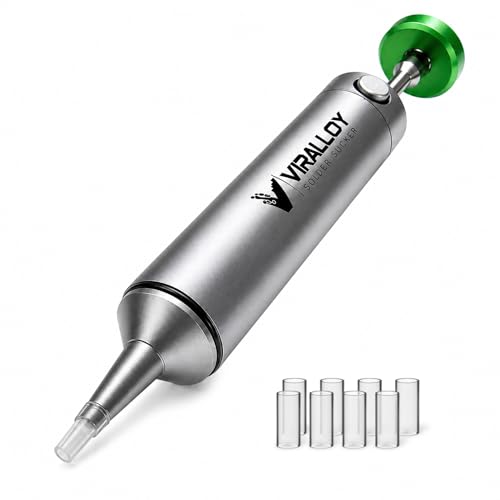
This manual pump is aimed at repairers who want a portable tool with a generous supply of replacement tips. Its high-tension spring produces a single-trigger suction action, and the self-cleaning design is intended to eject waste when the plunger resets. The aluminum body is described as aircraft-grade and CNC-machined, while the flexible nozzle is listed as heat resistant to 350°C. Together, those details make it a sensible companion for a small electronics kit that travels between a home bench, classroom, or repair bag.
The product information specifically describes compatibility with Pine64 and Pinecil V2 irons, a useful pairing for cordless soldering setups. Eight replacement tips are included, and the nozzle unit can be quickly released for disassembly. Maintenance still matters: the listing recommends wiping residue from the cylinder, cleaning the internal parts, and applying grease after the spring and nozzle assembly are removed. That is a reasonable routine for a mechanical pump, but it means “no clog” should be read as a design goal rather than a promise that cleaning is never needed.
Pros
- One-handed spring-loaded operation keeps the other hand available for the workpiece.
- Flexible silicone nozzle is listed for contact up to 350°C.
- Includes eight replacement tips.
- Aluminum body is described as CNC-machined and corrosion resistant.
- Product information identifies Pinecil V2 compatibility.
Cons
- Regular internal cleaning and lubrication are still recommended.
- Compatibility is specifically identified for Pinecil V2, not every soldering iron.
This option suits mobile electronics work particularly well. The spare tips reduce the sting of losing or wearing one, and the one-hand trigger works nicely when a small board is balanced in the other hand. It ranks below the ENGINEER because the supplied product information is more focused on accessories and maintenance than on a clearly defined nozzle-size pair. Still, it is a strong choice for a portable kit built around a Pinecil V2 or similar compact setup.
To buy this product, click here.
5. Weller Manual ESD-Safe Desoldering Pump 7874B — Best Simple Bench Choice

The Weller 7874B takes a stripped-down approach. Its product information identifies an aluminum body, a soldering bulb, and use alongside a soldering iron for printed-circuit repair and cleaning. That is the whole appeal: there is no heater to adjust, no power cord to route across the bench, and no collection of electronic controls to learn. Heat the joint with your iron, position the pump, and trigger the solder-removal action.
The listing describes the pump as ESD-safe, which may matter in a workspace handling static-sensitive components. The available information does not provide a nozzle diameter, replacement-tip details, spring design, or a specific maintenance system, so this model is easier to assess as a straightforward manual tool than as a highly specified precision pump. Its aluminum construction gives it a more substantial body than the cheapest plastic designs, but the sparse specifications leave less guidance for matching it to unusually tight or delicate joints.
Pros
- Aluminum body provides a clearly identified metal construction.
- Manual operation requires no batteries, charger, or electrical outlet.
- Product information identifies it for printed-circuit repair and cleaning.
- Listing describes the pump as ESD-safe.
- Simple design fits a conventional soldering bench.
Cons
- The available information does not specify nozzle size or replacement-tip options.
- It lacks the integrated heating and nozzle-focused details of the higher-ranked models.
The 7874B is a sensible choice for someone who wants a recognizable, basic manual pump for ordinary board repair and does not need a long feature list. It may be less appealing for detailed comparison shopping because the listing leaves important fit and maintenance questions unanswered. Choose it for straightforward use beside a soldering iron, but select the ENGINEER or VAMPLIERS if close silicone-nozzle contact is central to the job.
To buy this product, click here.
6. Kaisi Solder Sucker No-Clog Desoldering Pump — Best Low-Maintenance Manual Option

Kaisi pairs an aluminum body with a soft, high-temperature-resistant silicone tip that can contact the soldering iron tip. That soft contact point is useful over a flat PCB because it can form a closer seal around the joint than a hard, narrow nozzle. The pump is intended for one-handed operation, with the plunger within reach while the other hand manages the iron or board. For a small repair involving a few stubborn pins, that arrangement keeps the sequence quick and tidy.
The no-clog design is supported by a self-cleaning tip concept, while a replaceable silicone tube is included and can be cut to the desired length. The listing also explains a maintenance routine involving removal of the nozzle unit and spring, cleaning the cylinder, and applying grease to internal parts. That guidance is useful because even a pump built to resist blockage can accumulate cooled solder. The available information does not identify a precise suction measurement, so its practical advantage lies in the nozzle and maintenance design rather than a claimed vacuum figure.
Pros
- Soft silicone tip can contact the soldering iron tip directly.
- Aluminum body is described as sturdy and lightweight.
- One-handed plunger placement leaves the other hand free.
- Includes a replaceable silicone tube that can be cut to length.
- Product information gives a clear cleaning and lubrication routine.
Cons
- Routine internal cleaning and lubrication remain part of ownership.
- The listing does not provide a numerical suction specification.
Kaisi is a useful middle ground for someone who wants a silicone-tip aluminum pump without moving into the higher-priced Japanese-made models. It should suit hobby electronics, through-hole component work, and general PCB maintenance. Buyers who want several spare tips straight out of the package may prefer the no-clog silicone-tip tool above, while those wanting the clearest premium construction details may lean toward ENGINEER or VAMPLIERS.
To buy this product, click here.
7. AUSTOR Desoldering Sucker and Solder Braid Wick Set — Best for Cleanup Flexibility

AUSTOR makes the case for carrying two removal methods in the same kit. The manual sucker uses a double-ring body and a vacuum-release button for one-handed operation, while the included copper braid handles the thin film of solder that often remains after a pump clears a through-hole. That combination is handy during small PCB repair, where a pump can remove the bulk and braid can tidy a pin or pad before a replacement component goes in.
The kit includes six lengths of rosin-treated copper braid in three widths: 2.0 mm, 2.5 mm, and 3.0 mm, with two pieces of each size. The pump body is described as ABS with a non-slip sponge and nylon nozzle, and the listing identifies the materials as anti-static and heat resistant. The product is therefore more about a complete cleanup routine than a premium metal pump. Braid needs to be used with suitable heat and care around pads, and the kit does not provide the close silicone-nozzle style found on the top-ranked models.
Pros
- Includes one manual desoldering sucker and six solder-wick pieces.
- Provides three braid widths for different solder-cleanup tasks.
- One-handed trigger design is identified in the listing.
- Non-slip sponge and nylon nozzle are included in the pump design.
- Useful for removing bulk solder and then cleaning remaining residue.
Cons
- The pump uses an ABS body rather than the aluminum construction found on higher-ranked options.
- Solder wick requires separate heat and careful handling around PCB pads.
This is the best pick for a toolbox that needs more than a single suction stroke. A repairer working on small boards can use the pump for a large joint, then select a narrow braid for the last trace of solder. Someone who already owns a spool of wick may prefer a better-built standalone pump, but the AUSTOR set gives occasional repair work a practical two-step cleanup path without requiring separate purchases.
To buy this product, click here.
8. Teenitor Solder Sucker Three-Pack — Best Budget Pack
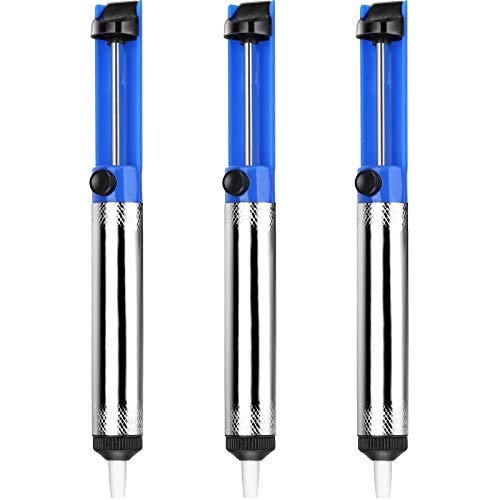
Teenitor keeps the design familiar: heat the solder, press the release, and let the spring-loaded pump pull the molten material away. The listing describes a compact, lightweight body with one-handed use and a non-slip handle. That is enough for the basic rhythm of removing a through-hole component, especially if the work happens occasionally and the tool needs to live in a general-purpose toolbox rather than on a dedicated repair bench.
The main practical advantage is quantity. Three pumps are included, so one can stay beside the main iron, another can live in a travel kit, and a third can serve as a spare. The product information also describes a heat-resistant nozzle and use for circuit-board work. It gives fewer details about nozzle replacement, internal cleaning, or body material than the premium aluminum pumps, so the value here comes from having multiple simple tools available rather than from specialized nozzle engineering.
Pros
- Three desoldering pumps are included in the pack.
- One-handed operation is supported by the compact design.
- Non-slip handle is identified in the product information.
- Heat-resistant nozzle is intended for solder removal work.
- Useful for circuit-board maintenance and occasional repairs.
Cons
- The listing provides limited detail about nozzle replacement and internal maintenance.
- It lacks the silicone-tip and self-cleaning features specified for the higher-ranked pumps.
Teenitor makes sense for classrooms, shared workspaces, or anyone who wants backups scattered across several toolboxes. It is less compelling for daily bench work where a closer silicone seal and defined replacement parts can matter. Choose it for quantity and basic access, not for the most detailed control over difficult solder joints.
To buy this product, click here.
9. MOGAOPI Solder Sucker Desoldering Pump — Best Straightforward Replacement-Nozzle Option

MOGAOPI keeps its product focused on the fundamentals of electronics repair. The pump uses a spring-loaded suction mechanism, a strong aluminum body, and a heat-resistant nozzle tip. The listing identifies PCB work, component replacement, and general soldering maintenance as intended uses, which places it comfortably in the manual solder-sucker category rather than the powered desoldering-tool group.
A spare replacement nozzle is included, and that detail matters more than it may seem. The nozzle is the part that sits nearest to heat and solder, so having a replacement available can keep a basic pump in service longer. The available information does not state the spare nozzle’s dimensions, tip material beyond the general heat-resistant description, or a self-cleaning mechanism. That makes the product easy to understand, but it also means buyers should confirm the current listing if a specific nozzle fit is important.
Pros
- Spring-loaded mechanism supports one-handed solder removal.
- Aluminum body is identified as durable construction.
- Heat-resistant nozzle tip is intended for electronics repair.
- Spare replacement nozzle is included.
- Product information specifically mentions PCB and component-replacement work.
Cons
- The listing does not specify nozzle dimensions or a broader tip system.
- No self-cleaning design is identified in the available product information.
MOGAOPI is a reasonable lower-cost bench spare for straightforward desoldering jobs. It gives more useful detail than the most basic generic pumps because the replacement nozzle is clearly identified, though it does not offer the nozzle-size information or self-cleaning design of the leaders. Keep it in a secondary toolbox, classroom drawer, or repair kit where a simple aluminum pump is more useful than a highly specialized one.
To buy this product, click here.
Buying Guide
Manual or Electric Changes the Entire Workflow
A manual solder sucker depends on a separate iron to melt the joint, then removes the solder with a spring-loaded plunger. That arrangement is compact, quiet, and easy to carry. It also lets you choose the iron temperature and tip shape separately. The ENGINEER, VAMPLIERS, and Kaisi models fit this style, with silicone nozzles that can be brought close to the heated joint.
An electric model such as the YIHUA 929D-V combines the heater and pump. This can simplify repeated through-hole work because the same handpiece heats and extracts solder. The trade-off is a cord, a preheat period, a fixed temperature, and a stated 110 to 127 volt operating range. Decide whether you need a portable accessory or a dedicated powered desoldering tool before comparing smaller details.
Silicone Nozzles Affect Contact With the Joint
A nozzle that can sit close to the soldering iron tip helps reduce the distance between melting and suction. Silicone also has some flexibility, which can help it conform to the area around a through-hole joint. The ENGINEER SS-03 and VAMPLIERS pumps specifically emphasize this arrangement, while the Kaisi and other models also identify soft or flexible silicone tips.
Do not assume that every silicone tube fits every pump. Some products include defined tube sizes, such as the ENGINEER’s 3 mm and 4 mm options, while others provide spare tubing without clearly stating every dimension. If a narrow opening is important for small pads, check the exact replacement details rather than relying on a similar-looking nozzle.
Self-Cleaning Does Not Mean Maintenance-Free
Molten solder becomes a stubborn plug as it cools inside a pump. A self-cleaning shaft or anti-clog tip can help eject waste during the reset stroke, which is especially useful across a row of component pins. The leading manual models emphasize this feature, but their product information still recommends cleaning internal residue.
Periodic maintenance usually means opening the nozzle assembly, removing the spring, wiping the cylinder, and applying suitable grease where the product instructions call for it. A pump that can be disassembled is easier to keep working than one that becomes disposable after a blockage. Treat anti-clogging as a convenience, not permission to ignore buildup.
One-Handed Operation Leaves Room for Better Control
Desoldering often requires three actions in a tight space: hold the board, heat the solder, and trigger the pump. A one-handed reset reduces the juggling. Compact manual pumps such as the ENGINEER, VAMPLIERS, Kaisi, and Teenitor models are built around that arrangement, while the YIHUA integrates heat and suction into one handpiece.
The right choice depends on which hand needs to remain free. If the board is loose or the component needs to be pulled at the same moment, a manual one-handed pump beside a separate iron may work well. If repeated joints are the priority, an integrated electric tool may reduce grip changes.
Match the Tool to Through-Hole Scale
Desoldering pumps are primarily useful for removing molten solder from through-hole joints and larger solder deposits. Nozzle size matters because a very large opening may not seal well around a small joint, while a narrow opening can be restrictive around a large pin. The YIHUA includes 1.0 mm and 1.2 mm nozzles, while several manual models include replaceable silicone tubing.
For thin residue on a pad or pin, solder wick can finish the job. The AUSTOR kit includes 2.0 mm, 2.5 mm, and 3.0 mm braid widths, giving it a different role from a pump alone. Do not press a pump hard against a hot pad or drag braid aggressively across delicate board traces. Heat, timing, and light contact protect the board better than brute force.
Check Voltage and Included Parts
The YIHUA 929D-V is specified for 110 to 127 volt operation with a US-standard plug. That detail matters because a powered desoldering tool is tied to its electrical setup, unlike a manual pump that can travel in a small pouch. The YIHUA also includes its nozzles and cleaning pin, while several manual pumps include spare tubes or tips.
Included accessories should be separated from compatible accessories. A pump may support a replacement tube without including every size, and a product may mention a compatible soldering iron without including that iron. Read the exact listing details before assuming a particular nozzle, tube, charger, or replacement part will be in the package.
Best Desoldering Pump FAQ
What does a desoldering pump do?
A desoldering pump removes molten solder from a joint after a soldering iron heats it. The spring-loaded plunger creates a quick suction stroke, pulling solder into the pump’s internal chamber. This is especially useful for through-hole components, connector pins, and clearing solder bridges.
Are manual solder suckers better than electric desoldering pumps?
Neither type is universally better. Manual pumps are portable, inexpensive to operate, and compatible with the soldering iron you already own. Electric tools such as the YIHUA 929D-V combine heating and suction, which can be more convenient across many repeated through-hole joints. They also require power, preheating, and maintenance specific to the powered design.
Can a desoldering pump damage a circuit board?
Damage usually comes from excessive heat, force, or repeated attempts after a joint has cooled, rather than suction alone. Use the iron only long enough to melt the joint, keep the pump nozzle clean, and avoid levering the component against the pad. Follow the soldering iron and pump instructions for temperature and cleaning.
What is the advantage of a silicone nozzle?
A silicone nozzle can flex slightly and sit close to the soldering iron tip. That may help form a closer seal around a joint and reduce the amount of solder left behind. Silicone tips also need replacement eventually, so check whether the product includes spare tubes or identifies compatible replacements.
How do you prevent a solder sucker from clogging?
Empty the collection chamber regularly and remove solder residue before it builds up. Models with self-cleaning shafts or anti-clogging tips can make this easier, but they still benefit from periodic disassembly and cleaning. The Kaisi listing, for example, describes removing the spring and nozzle assembly, wiping the cylinder, and applying grease to internal parts.
Is solder wick better than a desoldering pump?
Solder wick and pumps solve slightly different problems. A pump removes a larger amount of molten solder quickly, while wick can clean the thin layer that remains on a pad or pin. Many repairers use a pump first and braid second, which is why the AUSTOR kit can be useful for small PCB cleanup.
What should I look for in a desoldering pump?
Look for a one-handed trigger, a nozzle that suits the joint size, a body that can tolerate regular handling, and a cleaning method you will actually use. Replaceable silicone tubing is useful for close contact, while a self-cleaning shaft can reduce interruptions. For repeated through-hole work, an integrated heated pump may be worth the added power requirements.
Final Verdict
The ENGINEER SS-03 is the strongest overall choice in this group because it combines a compact aluminum body, one-handed operation, close-fitting silicone nozzles, a self-cleaning shaft, and two replacement tube sizes. It stays focused on the job a manual desoldering pump should do, without adding a cord or fixed heating system. The VAMPLIERS Professional Grade pump is the closest premium alternative, especially for buyers who value its made-in-Japan construction and stated warranty coverage.
The YIHUA 929D-V deserves the powered recommendation for repeated through-hole work, where integrated heating and suction can save grip changes across a long repair session. For a lower-cost setup, Kaisi, Teenitor, and MOGAOPI cover the basic manual role, while AUSTOR is the better fit if solder wick is also needed for final cleanup. Match the pump to the joint size, your existing iron, your tolerance for maintenance, and the number of boards you expect to repair. A precise nozzle and good timing usually matter more than an inflated suction claim.

- Jesse
Jesse is the editor behind Soldering Gear, where he covers soldering irons, stations, rework equipment, and the tools that belong on a practical electronics bench. His work focuses on comparing product specifications, features, compatibility, and intended uses so readers can make more informed buying decisions.
- Best Soldering Iron for SMD: 9 Picks in 2026 October 15, 2026
- Best Hot Air Rework Station for SMD: 9 Picks in 2026 October 14, 2026
- What Tools Do You Need for Soldering Electronics? October 13, 2026
- Best USB-C Soldering Iron: 9 Picks in 2026 October 12, 2026
- How to Choose Solder for Electronics October 11, 2026