Best PCB Holder for Soldering: 9 Picks in 2026

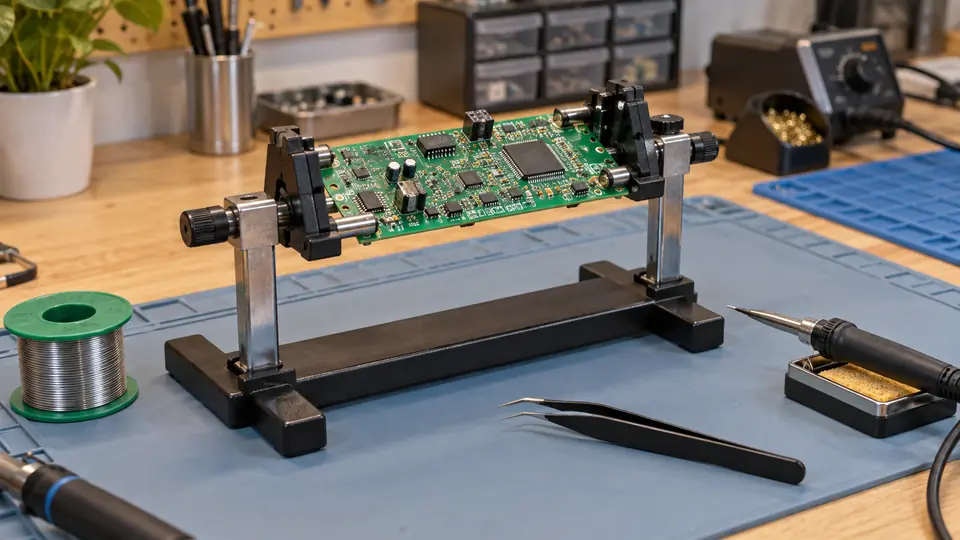
A PCB holder earns its keep the first time a board shifts as a soldering iron touches a joint. A loose circuit board can turn a clean repair into a frustrating balancing act, especially when one hand is holding the board, another is guiding solder, and the iron is already hot. The best PCB holder for soldering should keep the workpiece steady, allow access to both sides, and accommodate the board sizes you actually handle.
The biggest differences are found in the clamping method and base design. A rotating frame is usually better for turning a board over, while magnetic holders give you more freedom to position several contact points around an irregular board. Helping-hands stations can be useful for wires and connectors, but their flexible arms may not hold a larger PCB as evenly as a dedicated frame. Board capacity, jaw protection, adjustment range, rotation, and bench stability matter far more than a long feature list.
This comparison weighs those practical details across nine PCB holders and soldering aids. The QWORK Adjustable PCB Holder Frame takes the top spot because its metal frame, dual clamps, 360-degree rotation, and stated support for boards up to 7.75 inches wide create a balanced setup for routine repair and assembly work.
Quick Answer
- Best Overall: QWORK Adjustable PCB Holder Frame for a dedicated rotating PCB frame with broad board support.
- Best Premium-Style Magnetic Option: EOOKU Circuit Board Holder with Heavy Base for adjustable aluminum construction, sliding clamps, and magnetic stability.
- Best for Flexible Positioning: NOEVSBIG 6-Piece Magnetic PCB Holder Set for arranging multiple magnetic supports around different board shapes.
- Best Budget Frame: MAGIKON PCB Holder for a straightforward adjustable metal clamp for smaller boards.
Best PCB Holder for Soldering Comparison Table
| Product | Best For | Board Capacity or Setup | Standout Feature |
|---|---|---|---|
| QWORK Adjustable PCB Holder Frame | Overall PCB repair and soldering | Up to 7.75 in wide, 0.12 in thick | 360-degree rotating metal frame |
| EOOKU Circuit Board Holder with Heavy Base | Stable bench work | Adjustable sliding clamps | Magnetic base and aluminum build |
| Noah Adjustable PCB Holder | Large boards on a budget | Up to 20 × 14 cm | 360-degree rotation |
| QYQRQF Adjustable PCB Holder Frame | General repair setups | Up to 20 cm opening | Four thickness positions and pen racks |
| NOEVSBIG 6-Piece Magnetic PCB Holder Set | Irregular boards and portable work | Six individual magnetic holders | Three positioning methods |
| Helping Hands Dual-Clamp Stand | PCB and wire work together | Two adjustable clamps | Quick-release dual-clamp design |
| SN-390 Adjustable PCB Holder | Boards needing a pen rest | Up to 200 mm wide, five thickness settings | Removable soldering pen holder |
| SainSmart Magnetic Adjustable Holder | Compact magnetic PCB work | Up to 150 mm wide and 4 mm thick | Stainless steel guide rail |
| MAGIKON PCB Holder | Small boards and simple repairs | Up to 4.6 × 3 in | Retractable metal clamp |
The detailed reviews below show how each clamp, frame, magnetic base, and adjustment system behaves on paper, along with the trade-offs that may matter at your bench.
1. QWORK Adjustable PCB Holder Frame — Best Overall

A dedicated frame is often the cleanest answer for PCB soldering, and the QWORK model has the right basic arrangement. Its dual clamps hold the board within a metal frame, while the frame rotates through 360 degrees. That matters during through-hole assembly or repair because you can turn the board over without releasing it and rebuilding the setup from scratch.
The listing states that the holder accommodates circuit boards up to 7.75 inches wide and 0.12 inches thick. Side knobs adjust the width and gripping force, giving you a more controlled fit than a loose pair of alligator clips. Four rubber feet support the metal base and help resist sliding across the bench, so the holder is aimed at steady, repeatable work rather than occasional balancing of a tiny board.
Pros
- Supports circuit boards up to 7.75 inches wide and 0.12 inches thick, according to the listing.
- Dual clamps rotate through 360 degrees for access to both PCB sides.
- Metal frame provides a dedicated structure for board support.
- Side knobs adjust board width and grip strength.
- Four rubber feet help keep the holder from sliding.
Cons
- The stated thickness and width limits may exclude unusually large or thick boards.
- The frame layout is less adaptable than separate magnetic supports for irregular shapes.
Choose the QWORK when your projects usually involve conventional rectangular circuit boards and you want the board to remain captured while you change angles. It is a stronger fit than a basic helping-hands station for two-sided soldering, though a modular magnetic set may suit odd shapes better. The listed capacity also gives it a useful margin for many hobby and repair boards without making the setup overly complicated.
To buy this product, click here.
2. EOOKU Circuit Board Holder with Heavy Base — Best for Stable Bench Work

For a crowded repair bench, the EOOKU holder takes a compact approach built around a heavy magnetic base and sliding clamps. The product information describes an aluminum construction with two metal alligator clips, dual-joint positioning, and rails that let the clamps move smoothly. That arrangement should appeal to anyone who frequently changes board widths instead of working on one fixed project.
Its 360-degree adjustment lets you set the PCB at a more comfortable angle for soldering or inspection. The magnetic base is intended to resist movement on a suitable metal surface, while the heavy iron base adds support. The listing does not clearly state a maximum board width or thickness, so buyers with large boards should confirm the current product details before ordering rather than assume that “universal fit” covers every PCB.
Pros
- Aluminum construction combines with a heavy base for a compact bench setup.
- Two metal alligator clips provide separate gripping points.
- Sliding rails allow the clamps to be repositioned for different board sizes.
- 360-degree adjustment helps expose both sides and different working angles.
- Magnetic base is useful on compatible metal work surfaces.
Cons
- The available product information does not clearly specify maximum board dimensions.
- Magnetic positioning depends on having a suitable metal surface or the base remaining stable on the bench.
This EOOKU is a sensible pick for someone who values compact storage and adjustable positioning more than a clearly stated large-board capacity. It has more positioning flexibility than a basic fixed clamp and a more organized footprint than separate loose helping hands. Skip it if exact board limits are central to your purchase and the listing still leaves those measurements unclear.
To buy this product, click here.
3. Noah Adjustable PCB Holder — Best for Larger Boards on a Budget

The Noah holder keeps the design familiar: a metal base, adjustable PCB clamps, and a rotating frame that turns through 360 degrees. Its stated maximum holding size is 20 by 14 centimeters, which gives the product a clear place for repair work involving medium-sized boards. That measurement is useful because it lets shoppers compare the holder against their actual PCB rather than relying on a vague claim of broad compatibility.
Four anti-slip bumper feet are intended to keep the base in position as you solder, desolder, or inspect. The rotating structure also means the board can stay clamped while you reach the underside. The product information mentions one year of after-sales support, but it does not provide detailed jaw materials or a separate thickness range, so extra care is sensible with delicate or unusually thick boards.
Pros
- Stated maximum holding size of 20 × 14 cm suits medium-sized circuit boards.
- Metal base provides a dedicated support platform.
- 360-degree rotation allows access to both PCB sides.
- Four anti-slip feet help reduce movement during work.
- Suitable for soldering, desoldering, and rework tasks.
Cons
- The listing does not clearly state a maximum PCB thickness.
- Jaw protection and clamp material are not clearly identified in the available information.
The Noah is a practical choice for someone who wants a rotating frame and needs a clearly stated 20 × 14 cm working envelope. It fits routine board repair better than a flexible-arm station, especially when flipping the PCB is part of the job. Buyers working with thin, fragile, or unusually thick boards should verify how the clamps contact the workpiece before committing.
To buy this product, click here.
4. QYQRQF Adjustable PCB Holder Frame — Best for a General Repair Bench

The QYQRQF frame focuses on straightforward adjustment and a few useful bench details. Its metal frame uses sliding ABS side stands, four anti-slip rubber feet, and a rotating handle that gives access around both sides of the circuit board. The listing states a maximum opening width of up to 20 cm, which places it in the same general size class as several medium-board repair frames.
Four thickness positions are provided for different PCB sizes, although the available information does not identify the exact thickness values. Two iron pen racks are included in the design, giving the soldering iron a defined resting place instead of leaving it across the work surface. That is a modest feature, yet it can make a small repair area feel less cluttered while the board is clamped in place.
Pros
- Maximum adjustable opening is listed as up to 20 cm.
- 360-degree rotating handle provides access to both PCB sides.
- Four thickness positions accommodate different board formats.
- Metal frame and four rubber feet support bench stability.
- Two iron pen racks are built into the holder.
Cons
- The exact measurements for the four thickness positions are not provided.
- ABS sliding side stands may feel less substantial than an all-metal adjustment system.
This model suits a general-purpose repair station where board size varies and a soldering iron rest is welcome. It gives you more structure than flexible gooseneck arms, while the 20 cm opening keeps it useful for many medium boards. Buyers who want highly modular positioning or a magnetic base will find other designs more adaptable.
To buy this product, click here.
5. NOEVSBIG 6-Piece Magnetic PCB Holder Set — Best for Flexible Positioning

A fixed rectangular frame works beautifully until the board has an awkward outline, a connector near the edge, or a shape that does not sit neatly between two jaws. The NOEVSBIG set takes a different path with six separate magnetic circuit-board holders. The product information describes three flexible positioning methods, allowing the supports to be arranged around different board sizes and shapes.
Each holder is listed with up to 3.3 pounds of magnetic pull force, and the set is intended for soldering, assembly, inspection, jewelry, and craft work. That modular layout can be handy for a repair station that changes from a narrow board one day to a wider assembly the next. The main limitation is that the magnetic bases need a compatible metal work surface or a stable arrangement on the bench, and the listing does not provide a single maximum PCB size.
Pros
- Six separate holders can be arranged around irregular PCB shapes.
- Each magnetic base is listed with up to 3.3 pounds of pull force.
- Three positioning methods support different layouts.
- Compact format is convenient for storage and portable work.
- Supports hands-free soldering, desoldering, assembly, and inspection.
Cons
- The listing does not state one maximum board width or thickness.
- Magnetic placement depends on a suitable metal surface and careful positioning.
Pick this set when adaptability matters more than turning a board inside a single frame. It can support a board from several points and leave room around a connector or component cluster, which is useful for unusual layouts. A conventional rotating holder remains easier for quick board flipping, while this set is more appealing for modular bench work and mixed project shapes.
To buy this product, click here.
6. Helping Hands Dual-Clamp Stand — Best for PCB and Wire Work
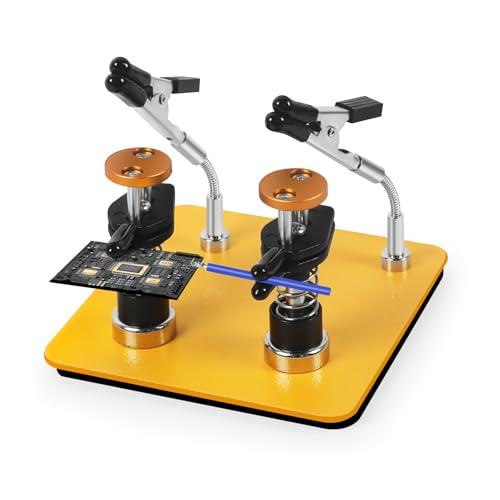
Many soldering jobs involve more than the circuit board. A wire, connector, lead, or small component may need to stay fixed while the PCB remains in position. This dual-clamp stand addresses that situation with two clamps, a quick-release mechanism, and rotating adjustment. One clamp can hold the board while the other holds the wire, giving the setup a more useful role than a single-purpose board frame.
The product information describes rubber-coated jaws, a 3.94-by-3.94-inch iron base, and a non-slip pad. Those details point toward a compact station for small workspaces or portable repair kits. The listing does not state a maximum PCB size, so it is better suited to smaller boards and component-level tasks where the second clamp adds real value rather than to large motherboard-style assemblies.
Pros
- Dual clamps can hold a PCB and a wire or component at the same time.
- Quick-release mechanism speeds up attachment and removal.
- Rubber-coated jaws help reduce marks on boards, wires, and small parts.
- Rotating arms allow the clamping position to be adjusted.
- Compact iron base and non-slip pad suit crowded benches.
Cons
- The listing does not specify maximum PCB dimensions.
- Its small base and dual-arm format are less suitable for large boards.
This stand makes sense for wiring repairs, small electronic assemblies, and jobs where a second hand must hold a loose lead. It is more task-flexible than a simple two-sided PCB frame, but less predictable for large or heavy boards. Choose it for the extra clamp and quick release, not as a substitute for a large dedicated PCB fixture.
To buy this product, click here.
7. SN-390 Adjustable PCB Holder — Best with a Removable Iron Rest

The SN-390 combines the familiar rotating PCB frame with a detail that can be surprisingly handy: a detachable soldering pen holder. Its metal base uses four non-slip rubber pads, while the ABS side stand slides to adjust the board width. The product information gives a maximum adjustable width of 200 mm and identifies five thickness settings at 1.2, 1.8, 2.0, 3.0, and 4.0 mm.
Those measurements make this one of the easier holders to match against a particular PCB. A 360-degree rotating design lets you reach the underside without removing the board, and the detachable pen rest helps keep the hot tool in a predictable location during pauses. The ABS adjustment components may not feel as substantial as a full metal rail system, but the layout is practical for household electronics, mobile-device repairs, computers, and small electronic toys.
Pros
- Maximum adjustable width is listed as 200 mm.
- Five stated thickness settings cover 1.2 to 4.0 mm boards.
- 360-degree rotation gives access to both sides of the PCB.
- Detachable soldering pen holder adds bench organization.
- Metal base and four rubber pads support steady positioning.
Cons
- ABS side stands are less robust in material than a fully metal rail system.
- The detachable pen holder adds convenience but does not replace a dedicated iron stand for every setup.
The SN-390 is a strong match for anyone who wants precise board-size information and a place to set the soldering pen. Its 200 mm width is useful for many medium boards, while the thickness settings reduce guesswork during setup. It may be less appealing if your bench already has a preferred iron stand or if you need a modular holder for irregular board shapes.
To buy this product, click here.
8. SainSmart Magnetic Adjustable Circuit Board Holder — Best Compact Magnetic Frame

The SainSmart holder combines a compact frame with a magnetic base and a stainless steel guide rail. Its two clamps rotate through 360 degrees, and the listing states that the retractable design accommodates cards up to 150 mm wide and 4 mm thick. That gives the product a more defined working range than many flexible helping-hands stations, while the guide rail is intended to keep clamp movement controlled.
The aluminum-alloy construction is listed as heat resistant and resistant to scratching, though those descriptions should be read as product information rather than independent test results. The holder is ready to use without assembly and can be removed from an iron platform for storage. Its magnetic design is especially useful for a compatible metal work surface, but buyers working on a nonmetallic bench should confirm how they plan to keep the unit stable.
Pros
- Two clamps rotate through 360 degrees.
- Stated capacity reaches 150 mm wide and 4 mm thick.
- Stainless steel guide rail supports controlled clamp positioning.
- Magnetic base can be positioned on a suitable iron platform.
- Integrated design requires no assembly according to the listing.
Cons
- Its stated width limit is smaller than several 200 mm-class frames.
- Magnetic performance depends on a compatible iron or steel work surface.
This SainSmart model is a good fit for compact electronics benches where a defined board capacity is more useful than a large open frame. The guide rail and magnetic base give it a tidy, controlled feel on the right surface, while the 4 mm thickness limit covers many ordinary boards. Larger PCBs or users without a metal work platform may be better served by a rubber-footed frame.
To buy this product, click here.
9. MAGIKON PCB Holder — Best Budget Option for Small Boards

Some repair jobs do not need a magnetic base, multiple arms, or an elaborate rotating frame. The MAGIKON holder keeps the idea simple with an adjustable retractable metal clamp for boards up to 4.6 by 3 inches. Its painted metal construction provides a defined place for small circuit boards during soldering, rework, and assembly.
The compact capacity is its clearest strength and its clearest boundary. A small control board or practice PCB can sit securely without taking much room, making this style useful for a basic electronics bench. The available information does not mention 360-degree rotation, thickness settings, or a specific jaw material, so this is better treated as a straightforward small-board clamp than a fully adjustable workstation fixture.
Pros
- Adjustable retractable design accommodates boards up to 4.6 × 3 inches.
- Metal construction provides a dedicated support structure.
- Compact format fits small work areas.
- Suitable for soldering, rework, assembly, and prototyping.
- Simple clamp layout is easy to understand and set up.
Cons
- Its stated board capacity is smaller than the other frame-style options here.
- The available information does not identify rotation, thickness settings, or jaw protection.
MAGIKON is the sensible low-cost choice for small PCBs and uncomplicated repair work. It avoids the adjustment complexity of a modular magnetic set, but that simplicity means less flexibility with board orientation and size. Pick it for a compact starter fixture, and move up to a rotating frame if you regularly work on boards near or beyond its 4.6-by-3-inch limit.
To buy this product, click here.
Buying Guide
Choose a Frame When Board Flipping Is Routine
A rotating PCB frame keeps the board captured while you move from the component side to the solder side. That is useful for through-hole work, connector replacement, and inspection where repeatedly unclamping the board wastes time. QWORK, Noah, QYQRQF, SN-390, and SainSmart all describe 360-degree rotation, but their stated board limits differ, so measure the longest board dimension before ordering.
Match the Stated Board Capacity to Your Largest PCB
Board width is only half of the fit question. Thickness also matters because a holder may accept a wide PCB yet fail to grip a thicker assembly securely. The QWORK lists support up to 7.75 inches wide and 0.12 inches thick. Noah lists a 20-by-14-centimeter maximum holding size, while the SN-390 states a 200 mm width and five thickness settings. SainSmart lists 150 mm wide and 4 mm thick. Those are useful reference points, but they should be compared with the exact board, including connectors or attached hardware that may interfere with the jaws.
Magnetic Bases Need the Right Work Surface
A magnetic holder can be wonderfully quick to reposition, but its stability depends on the surface beneath it. SainSmart is described for use on an iron platform, and the EOOKU and NOEVSBIG products also emphasize magnetic support. A metal workbench or compatible steel plate can make those designs convenient. On a wood, plastic, or silicone work mat, the magnetic feature may contribute little, so a rubber-footed frame may be the safer choice.
Separate Modular Supports Suit Odd Shapes
A six-piece magnetic set can be more adaptable than a two-jaw frame when the PCB has an unusual outline, a large connector, or a component that blocks one edge. Separate supports can be positioned around the obstruction and moved as the project changes. The trade-off is setup time. A dedicated frame is faster for ordinary rectangular boards, while modular holders reward a more deliberate arrangement.
Protect the Board at the Clamp Points
A rigid metal jaw can hold firmly, but the contact point still deserves attention around finished surfaces, traces, and delicate components. The Helping Hands Dual-Clamp Stand specifically lists rubber-coated jaws, which gives it a clearer protection feature than products whose jaw materials are not identified. Do not assume every clamp is ESD-safe or scratch-free unless the product information says so. If the board surface is especially delicate, check the jaw shape and contact pressure before applying force.
Think About the Tool Rest and the Rest of the Job
A PCB holder solves board movement, yet soldering often involves a wire, connector, or loose lead that also needs support. The dual-clamp helping-hands stand is useful for that two-part setup, while QYQRQF includes two iron pen racks and SN-390 includes a detachable soldering pen holder. These details can reduce bench clutter, but they do not automatically replace a stable, heat-resistant soldering iron stand. Keep the holder’s main job clear: secure the PCB first.
Best PCB Holder for Soldering FAQ
What makes a PCB holder useful for soldering?
A useful PCB holder keeps the circuit board stable while leaving both hands available for the iron, solder, tweezers, or wire. A rotating frame adds access to both sides, while adjustable clamps help fit different board widths and thicknesses. Base stability matters because even a well-fitting clamp becomes frustrating if the entire fixture slides across the bench.
Is a rotating PCB holder better than helping hands?
It depends on the task. A rotating PCB frame is usually better for turning a board over while keeping it clamped. Helping hands are often more flexible for holding a wire, connector, or small component beside the board. A dual-clamp station can cover both jobs, but it may not support a larger rectangular PCB as evenly as a dedicated frame.
How large a circuit board can these holders support?
The limits vary by model. QWORK lists support for boards up to 7.75 inches wide and 0.12 inches thick. Noah lists a maximum holding size of 20 × 14 cm, SN-390 lists up to 200 mm wide with five thickness settings, and SainSmart lists up to 150 mm wide and 4 mm thick. Several products do not clearly state a maximum size, so check the current listing when exact dimensions matter.
Are magnetic PCB holders stable on every workbench?
No. Magnetic support is most useful on a compatible iron or steel surface. On a wooden, plastic, or nonmagnetic bench, the magnets may not anchor the holder as intended. A model with rubber feet or a heavy standalone base may be a better fit for a conventional workbench.
Can a PCB holder be used for desoldering?
Yes, provided the clamp can hold the board securely against the pressure created by the desoldering tool. The Noah, QYQRQF, and SN-390 listings specifically describe soldering and desoldering or rework use. For stubborn through-hole components, keep the board supported near the work area without placing force on delicate components or exposed traces.
Should a PCB holder be ESD-safe?
That depends on the board and work environment, but none of the reviewed product information establishes an ESD-safe rating. Metal construction, rubber feet, or a magnetic base should not be treated as proof of ESD protection. If ESD control is required, verify the holder’s documented properties and use the rest of the appropriate ESD-safe setup.
What should I use for an irregularly shaped PCB?
A modular set with several separate magnetic supports can be easier to arrange around unusual edges, connectors, or components. The NOEVSBIG set is built around six individual holders and three positioning methods. A conventional two-jaw frame is quicker for rectangular boards, but it may place pressure in inconvenient locations on an irregular assembly.
Final Verdict
The QWORK Adjustable PCB Holder Frame is the strongest overall choice in this group because it combines a dedicated metal frame, dual adjustable clamps, 360-degree rotation, rubber feet, and a clearly stated capacity up to 7.75 inches wide and 0.12 inches thick. It is the most balanced option for routine PCB soldering, inspection, and repair where a board needs to remain captured while you work on both sides.
EOOKU’s heavy-base holder is the better alternative for a compact magnetic setup with sliding clamps, while NOEVSBIG offers more freedom for irregular boards and changing layouts. SN-390 is especially useful if the stated thickness settings and removable pen holder match your bench. For smaller boards and a simpler budget setup, MAGIKON keeps the fixture uncomplicated. Match the holder to your largest PCB, working surface, board shape, and need for rotation before ordering, because the most elaborate clamp is not automatically the most useful one at your bench.

- Jesse
Jesse is the editor behind Soldering Gear, where he covers soldering irons, stations, rework equipment, and the tools that belong on a practical electronics bench. His work focuses on comparing product specifications, features, compatibility, and intended uses so readers can make more informed buying decisions.
- Best Soldering Iron for SMD: 9 Picks in 2026 October 15, 2026
- Best Hot Air Rework Station for SMD: 9 Picks in 2026 October 14, 2026
- What Tools Do You Need for Soldering Electronics? October 13, 2026
- Best USB-C Soldering Iron: 9 Picks in 2026 October 12, 2026
- How to Choose Solder for Electronics October 11, 2026