Best Soldering Station: 9 Picks in 2026

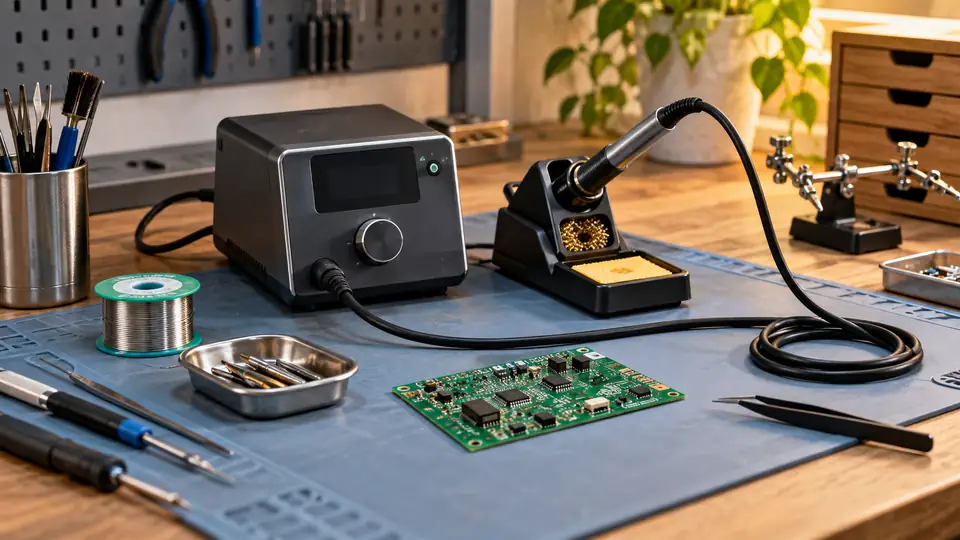
A good soldering station should make heat predictable, adjustment easy, and repeated joints less frustrating. That matters whether you are attaching wires to a connector, repairing a circuit board, or learning how different tips change the shape of a solder joint. The strongest choices combine useful temperature control with a handpiece and stand that fit the way you work. A high wattage number can help, but it does not tell the whole story by itself.
The most useful comparison is between a focused soldering station and a broader rework setup. A compact station such as the Weller WE1010NA keeps the controls and workflow straightforward, while a unit such as the YIHUA 853D adds hot air, a DC power supply, and voltage measurement. Accessory-heavy kits can be attractive for a first bench because they include tips, solder, tweezers, and helping hands, although replacement-tip availability and voltage requirements deserve a close look before ordering.
This guide weighs temperature control, usable power, included equipment, bench footprint, accessory support, and the practical trade-offs behind each specification. The Weller WE1010NA earns the strongest overall position for regular electronics work, while the YIHUA 926 III and WEP 927-IV offer more accessories for less demanding budgets.
Quick Answer
- Best Overall: Weller WE1010NA, a focused 70W station with temperature stability, temperature lock, standby functions, and a clear electronics-oriented setup.
- Best Accessory Kit: YIHUA 926 III, which includes six tips, helping hands, lead-free solder, a solder sucker, tweezers, and calibration support.
- Best for a More Complete Repair Bench: YIHUA 853D, with soldering, hot air, a variable DC power supply, and voltage test functions in one unit.
- Best High-Power Option: FNIRSI DWS-200, offering 200W, dual handles, a large display, preset functions, and support for both precision and higher-power work.
Best Soldering Station Comparison Table
| Product | Best For | Power And Control | Included Equipment |
|---|---|---|---|
| Weller WE1010NA | Regular electronics work | 70W, 350°F to 850°F, temperature stability listed at ±4°F | WEP70 iron, safety rest, sponge, tip |
| YIHUA 926 III | First complete bench kit | 60W, 194°F to 896°F, PID control and calibration | Six tips, helping hands, solder, pump, tweezers |
| 100W Digital Station Kit | Low-cost general repairs | 100W, 356°F to 896°F, adjustable sleep timer | Five tips, solder, pump, cleaner, helping hands |
| WEP 927-IV | Preset temperatures and magnified work | 110W, 194°F to 896°F, three presets | Five tips, LED magnifier, helping hands, solder |
| FNIRSI DWS-200 | High-power and precision work | 200W, 212°F to 842°F, dual handles and presets | F210 and F245 handles, nine tips, helping hands |
| WEP 926LED V3 | Compact low-cost setup | 130W maximum, 392°F to 896°F, PID control | Five tips, solder, tweezers, pump, cleaner |
| Hakko FX888DX-010 | Simple branded station controls | Digital adjustment with rotary encoder | Product information provides limited accessory detail |
| YIHUA 939D+ | Metal-bodied everyday station | 75W equivalent, 392°F to 896°F, temperature calibration | Standalone metal stand and soldering handpiece |
| YIHUA 853D | Electronics repair bench | Soldering to 896°F, hot air to 896°F, 0 to 15V DC supply | Soldering station, hot air, power supply, voltage meter |
The detailed reviews below show where each station fits, what its specifications mean at the bench, and which compromises are easiest to live with.
1. Weller WE1010NA — Best Overall
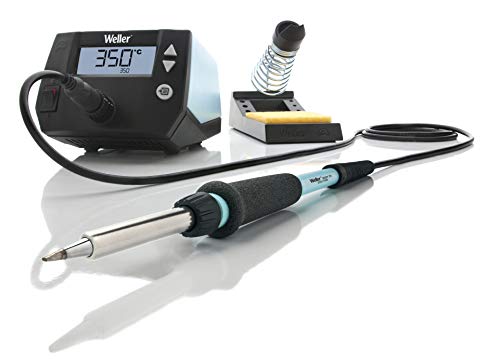
The Weller WE1010NA takes the sensible route for a general electronics bench. Its 70W station and WEP70 handpiece give it more heating capacity than a small entry-level iron, while the listing identifies temperature stability of ±4°F, or ±2°C. That published stability figure matters more than a dramatic maximum-temperature claim because consistent heat makes repeated joints easier to manage and helps reduce needless adjustment during a repair.
The controls are aimed at repeatable work rather than accessory overload. Temperature lock can help preserve a chosen setting, while standby and automatic setback reduce the time the tip sits at full heat. The kit includes a safety rest with sponge and a 1.6 mm screwdriver tip, so the basic setup is ready for ordinary through-hole and general board work. A reader repairing a loose wire one evening and assembling a small circuit the next will likely appreciate the focused layout more than a pile of extras.
Pros
- 70W station provides a useful power class for regular electronics work.
- Published temperature stability is listed at ±4°F, or ±2°C.
- Temperature lock helps preserve a selected setting during repeated work.
- Standby and automatic setback can reduce unnecessary tip and heater wear.
- Includes a WEP70 iron, safety rest, sponge, and 1.6 mm screwdriver tip.
Cons
- The package is more focused on the station than on a large accessory assortment.
- The supplied product information does not clearly describe a broad included tip selection.
This is the strongest fit for someone who wants a recognizable, dedicated station for recurring soldering rather than a combined repair platform. It is also a better match for a tidy bench than for someone who needs hot air, a power supply, or several helping-hand accessories in the same box. The main trade-off is simple: you are paying for a focused control system and documented temperature stability instead of a long list of bundled tools.
To buy this product, click here.
2. YIHUA 926 III — Best Accessory Kit
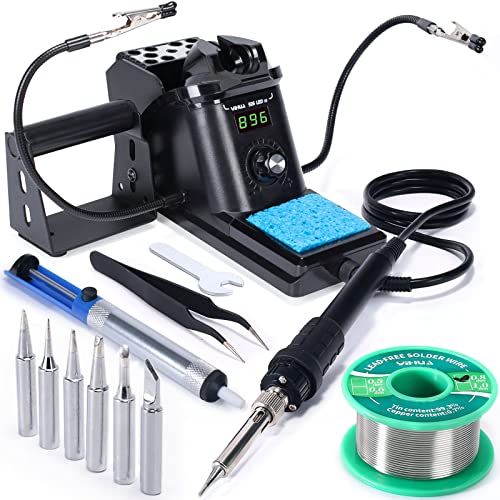
A bare station can leave a new bench looking strangely incomplete. The YIHUA 926 III addresses that problem with a compact 60W unit and a long list of practical extras. The package includes two helping hands, six YIHUA 1200/900M-series tips, a 35g roll of lead-free solder, a solder sucker, stainless-steel tweezers, a wire dispenser, and a cleaning sponge. That bundle is useful for a small electronics project where the board, wire, and solder need to stay in place while both hands work.
Temperature adjustment runs from 194°F to 896°F, and the listing describes PID stabilization, digital calibration, and selectable sleep intervals of 5, 10, or 30 minutes. The control arrangement uses a master knob and digital display, which keeps basic changes fairly direct. Its integrated holder and rear mesh protector also help preserve desk space. The 110 to 127V specification is a firm boundary, so this model belongs on a compatible US-standard circuit rather than a universal-voltage bench.
Pros
- Includes six soldering tips for the listed 1200/900M-series system.
- Two helping hands provide support for holding components or small boards.
- Offers PID temperature stabilization and digital temperature calibration.
- Adjustable sleep mode includes 5, 10, and 30-minute settings.
- Compact station integrates the iron holder and tip storage area.
Cons
- The unit is specified for 110 to 127V operation with a US-standard plug.
- A 60W rating gives it less stated power than the larger stations in this comparison.
Choose this station when the first job is building a usable bench without buying every small accessory separately. The included helping hands and solder sucker are particularly handy for through-hole projects and basic repairs. Someone already equipped with quality clamps, tips, and cleaning tools may find the bundle less compelling, and buyers should verify that replacement tips match the listed 1200/900M family before adding more.
To buy this product, click here.
3. 100W Digital Soldering Station Kit — Best Budget Kit

This generic 100W digital station is aimed at buyers who want a complete starting box without moving into a more elaborate repair platform. The listing gives a 356°F to 896°F adjustment range, a digital display, Celsius and Fahrenheit conversion, and a calibration function. It also describes a sleep timer adjustable from 0 to 600 seconds. That broad timer range can be useful if the iron spends long stretches resting between joints, although the setting is a convenience feature rather than proof of superior thermal control.
The package is generous for basic repairs. It includes two helping hands, five tips, solder wire, a dispenser, a cleaning sponge, a tip cleaner, elbow tweezers, a solder sucker, a screwdriver, and a mini wrench. The silicone-sheathed handle and ventilated steel-pipe design are presented as comfort and cooling features. Since the supplied information does not identify a brand or a wider replacement-tip ecosystem, this station makes the most sense for occasional projects where the included parts do much of the work.
Pros
- 100W listed station rating gives it a higher power class than several compact kits.
- Temperature range covers 356°F to 896°F with Celsius and Fahrenheit conversion.
- Includes an adjustable sleep timer from 0 to 600 seconds.
- Package includes five tips, helping hands, solder, tweezers, and a solder sucker.
- Integrated accessories support a small repair or craft workspace.
Cons
- The supplied information does not clearly identify a brand or replacement-tip system.
- The broad accessory bundle may be less useful to buyers who already own bench tools.
Its appeal is immediate: open the box and you have the basic hardware for wires, simple boards, and household electronics repairs. The uncertainty sits further down the ownership path, where tip sourcing and long-term replacement support matter more than the initial bundle. Pick it for a low-cost, occasional-use bench, but confirm the current listing details and tip availability before treating it as a long-term platform.
To buy this product, click here.
4. WEP 927-IV — Best for Presets and Magnified Work
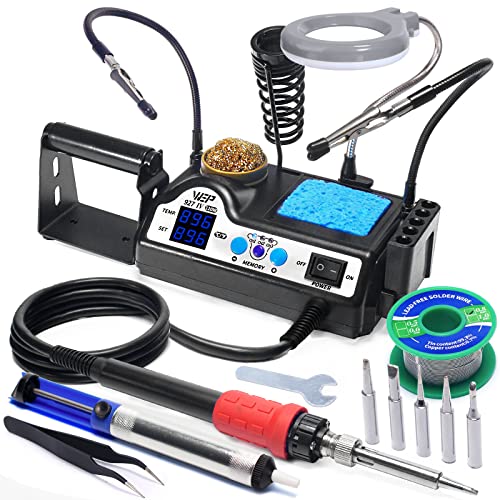
The WEP 927-IV brings a 110W heating element, three preset channels, and a double numerical display that shows the set and actual temperatures at the same time. Presets are especially useful for a bench that moves between different jobs, such as a lower setting for delicate board work and a higher setting for larger connectors. They do not guarantee that every joint reaches the displayed value, but they reduce the small, repetitive chore of dialing in familiar settings.
Its integrated magnifier with LED lighting gives the station a practical angle for small components, while two helping hands can hold a part from different directions. The package also includes five extra tips, a tip cleaner, a solder wire dispenser, tip storage, lead-free solder, and tweezers. The listed temperature range is 194°F to 896°F, and the sleep timer can be set from 0 to 99 minutes. The WEP #1400 tip requirement deserves attention because a large number of included tips does not mean every future tip will fit.
Pros
- Three preset channels make repeated temperature changes quicker.
- Double display shows set temperature and actual temperature together.
- Integrated LED magnifier assists with smaller components and joints.
- Includes five extra tips, two helping hands, solder, cleaner, and tweezers.
- 110W heating element and a 194°F to 896°F adjustment range suit varied tasks.
Cons
- Uses WEP #1400 soldering iron tips, so tip selection should be checked before purchase.
- The integrated magnifier and accessories take up bench space compared with a bare station.
This is a thoughtful choice for a crowded hobby bench where lighting, holding, and tip storage are constant annoyances. The presets give it a more organized feel than a basic knob-only station, while the magnifier can help with inspection. Skip it if you prefer a separate magnifier or already have a well-equipped workholding setup, since the bundled structure is a major part of what makes this model distinctive.
To buy this product, click here.
5. FNIRSI DWS-200 — Best High-Power Option

The DWS-200 stands apart with its listed 200W rating and two different handles. The F245 handle is described for SMD and higher-power work, while the F210 precision handle is intended for smaller jobs. That arrangement is more meaningful than simply advertising a large wattage number because handle choice and tip geometry can change how practical the station feels across different joint sizes. The supplied information gives a 212°F to 842°F adjustment range, which is lower at the top end than several other stations here.
A 2.8-inch TFT screen provides temperature value, temperature curve, or combined display modes, and three preset functions store commonly used settings. The package also includes nine soldering tips and two helping hands with 360-degree adjustable alligator clips. Its built-in pure copper transformer supports 100 to 240V input according to the listing, making it the most flexible power-input option in this group. The broad feature set will appeal to a busy repair bench, although buyers should still match the selected handle and tip to the actual joint rather than relying on 200W alone.
Pros
- 200W listed station rating provides substantial available heating power.
- Includes F210 precision and F245 higher-power handles for different work scales.
- 2.8-inch TFT screen offers temperature, curve, and combined display modes.
- Three preset functions support quick access to recurring temperature settings.
- Supports 100 to 240V input according to the supplied product information.
Cons
- Its 842°F listed upper temperature is lower than the 896°F maximum shown by several alternatives.
- The extra power and dual-handle design may be more station than a simple repair bench requires.
This model makes sense for someone who regularly moves between fine SMD work and joints that demand more thermal capacity. The two-handle approach gives it a useful range, and the display is more informative than a simple numerical readout. A small hobby station may be easier to live with, especially if storage and simplicity matter more than switching handles or watching temperature curves.
To buy this product, click here.
6. WEP 926LED V3 — Best Compact Budget Station

The WEP 926LED V3 keeps the footprint compact by integrating the iron holder into the station body. That layout can be handy when the work surface is a narrow desk rather than a spacious electronics bench. Its temperature control uses a knob and digital display, with a listed range from 392°F to 896°F and a Celsius/Fahrenheit toggle. The listing also describes PID compensation, which is intended to help the iron respond to temperature changes during use.
For a low-cost kit, the included equipment is practical rather than decorative. There is a spool of solder wire, five extra tips, tweezers, a desoldering pump, and a tip cleaner. The sleep function activates after more than 10 minutes of inactivity according to the listing, lowering the idle temperature to reduce wear. It is specified for 110 to 127V operation, so that detail belongs near the top of the shopping checklist, especially for anyone setting up a bench with mixed-voltage equipment.
Pros
- Compact body integrates the soldering iron holder.
- Includes five extra tips, solder wire, tweezers, pump, and tip cleaner.
- Digital temperature display supports Celsius and Fahrenheit readings.
- PID temperature compensation is listed as part of the control system.
- Sleep mode reduces idle temperature after more than 10 minutes of inactivity.
Cons
- The station is rated for 110 to 127V US-standard operation.
- The 130W maximum label does not by itself establish better thermal recovery than the lower-wattage alternatives.
This is a sensible pick for a first compact station, especially when the budget must also cover solder, cutters, or a fume-control setup. Its included accessories lower the number of immediate add-on purchases, while the integrated holder keeps the bench visually tidy. Buyers doing frequent demanding work may prefer a station with more clearly documented stability or a broader handpiece ecosystem.
To buy this product, click here.
7. Hakko FX888DX-010 — Best for Straightforward Digital Adjustment

The main supplied detail for the Hakko FX888DX-010 is its revised digital interface with a rotary encoder. That is a meaningful distinction for someone who dislikes repeatedly pressing small buttons to change temperature. A rotary control gives the adjustment process a more direct, physical feel, although the available product information does not provide a full specification set for wattage, temperature range, included tips, or accessory contents.
Because the listing data is limited, this station should be approached for its control layout rather than with assumptions about performance figures that are not stated here. A reader who already owns a suitable stand, cleaner, and preferred tips may be comfortable with that narrower package. Someone buying a complete bench in one order should verify exactly what comes in the box and which tip system the specific FX888DX-010 configuration uses before ordering.
Pros
- Rotary encoder provides a direct method for digital temperature adjustment.
- Product information identifies it as a dedicated digital soldering station.
- Its revised interface is intended to improve adjustment over the earlier FX888D control approach.
- Compact station format should suit a focused soldering bench.
- Brand and model identification make it easier to distinguish from generic station kits.
Cons
- The supplied product information does not clearly specify wattage or temperature range.
- Included tips and other accessory details are not fully identified in the available listing data.
This model suits shoppers who place a high value on a cleaner control interface and who are prepared to confirm the package details before purchase. It is a less comfortable recommendation for someone comparing stations strictly by documented power, stability, and included accessories. The trade-off is clear: the rotary encoder is the known attraction, while several specifications that normally shape a station comparison require verification from the current listing.
To buy this product, click here.
8. YIHUA 939D+ — Best Metal-Bodied Everyday Station

The YIHUA 939D+ focuses on a solid, separate-station layout. Its product information lists 75W-equivalent performance, a 392°F to 896°F adjustment range, a built-in transformer, and temperature control that monitors and compensates at 20-millisecond intervals according to the listing. Those details point toward a station intended for regular use, where a clear display and predictable adjustment matter more than a giant accessory pile.
The brushed-aluminum control panel and standalone metal-alloy iron stand give the setup a more substantial bench presence. Automatic handle detection, temperature calibration, and a Celsius/Fahrenheit display add useful control without requiring a multi-station chassis. The model is specified for 110 to 127V operation, and the product information describes it as ESD-safe and suitable for lead-free work. Those claims belong to the listing, so users should still follow appropriate grounding and handling procedures rather than treating a label as a replacement for bench practice.
Pros
- Lists 75W-equivalent performance with a 392°F to 896°F adjustment range.
- Built-in transformer and handle detection are included in the product design.
- Temperature calibration support allows adjustment beyond the basic control knob.
- Brushed-aluminum panel and metal-alloy stand provide a durable-feeling station structure.
- Clear digital display supports Celsius and Fahrenheit readings.
Cons
- The station is specified for 110 to 127V US-standard operation.
- The package provides fewer clearly listed accessories than the larger all-in-one kits.
This is a good middle ground for a workbench that needs a dedicated station with a standalone holder and simple digital controls. It will appeal more to someone who already has solder, tweezers, and board supports than to a first-time buyer seeking every accessory in one package. Choose it over the compact kits for the metal-bodied layout and calibration support, but choose the Weller if documented temperature stability is the deciding factor.
To buy this product, click here.
9. YIHUA 853D — Best Complete Electronics Repair Platform

The YIHUA 853D is much broader than a conventional soldering station. It combines a soldering iron, hot-air rework station, and DC power supply with voltage test functions. The soldering section adjusts from 392°F to 896°F, while the hot-air section covers 212°F to 896°F with listed air volume up to 120L/min. The DC section provides 0 to 15V and 0 to 2A output, or measurement up to 35V DC, which can be useful when a repair involves powering and checking a circuit alongside soldering.
Both the soldering and hot-air sections are described with PID temperature stabilization, and the three stations can operate independently or simultaneously according to the listing. A 5V USB port rated at 0.5A adds a small testing or powered-device function. Sleep mode and automatic shutdown address idle operation, while the 110 to 127V specification sets the required electrical environment. This is a compelling platform for electronics repair, but its larger collection of functions also means more controls and a higher chance that a simple two-wire repair will feel over-equipped.
Pros
- Combines soldering, hot air, and a DC power supply in one station.
- DC output covers 0 to 15V and 0 to 2A according to the listing.
- Voltage test mode measures up to 35V DC according to the supplied information.
- Hot-air temperature and air volume are adjustable, with listed airflow up to 120L/min.
- Soldering and hot-air sections include listed PID temperature stabilization.
Cons
- The unit is specified for 110 to 127V operation with a US-standard plug.
- Its larger multi-function design is unnecessary for buyers who need only a soldering iron station.
Choose this unit when the bench regularly crosses from soldering into SMD rework, circuit testing, or powered troubleshooting. It saves space compared with purchasing three separate pieces of equipment, although it still requires a sensible workspace and careful use of heat around components. For ordinary solder joints, the Weller or YIHUA 939D+ offers a simpler path, while the 853D earns its place through the repair functions surrounding the iron itself.
To buy this product, click here.
Buying Guide
Wattage Does Not Tell the Whole Heating Story
Station wattage indicates available electrical power, but it does not independently prove faster recovery or better solder joints. A 200W station can be useful for larger thermal loads, yet tip geometry, heater design, control behavior, and contact with the joint still matter. For small PCB work, excessive power can also be awkward if the control and tip combination are poorly matched. Treat wattage as one part of the comparison rather than a finish line.
Temperature Stability Matters More Than a Huge Maximum
A broad temperature range is useful, but most routine joints occupy a much smaller working window. Stability and control affect whether the iron stays close to the selected setting as heat leaves the tip and enters the joint. The Weller WE1010NA publishes a ±4°F stability figure, while several YIHUA and WEP models describe PID control or calibration. Those features are more informative than simply seeing 896°F printed on a product page.
Match the Tip System Before You Buy
Tips are consumable working parts, and the included tip count does not tell you how easy future replacements will be to source. The YIHUA 926 III lists 1200/900M-series tips, while the WEP 927-IV specifically identifies WEP #1400 tips. Check the exact family before ordering extras. A tip that looks similar can still be incompatible with a particular handpiece, and included tips should not be confused with every tip the station may support.
Decide Whether You Need a Complete Kit
Helping hands, tweezers, solder, a pump, and a cleaner can make a first project much smoother. The YIHUA 926 III and WEP 927-IV are strong examples of accessory-rich packages, while the Weller WE1010NA concentrates on the station, handpiece, rest, sponge, and one listed tip. If your drawer already contains clamps and solder, a focused station may be better. If you are starting with an empty desk, the bundle can reduce immediate shopping.
Use Sleep and Standby Functions as Maintenance Features
Sleep mode lowers idle heat after a period of inactivity, and automatic setback can reduce time spent at full temperature. That may help limit unnecessary wear on tips and heating elements. It does not replace a stable stand, careful handling, or switching the station off when the work is finished. Timer behavior varies widely, from the YIHUA 926 III’s selectable intervals to the generic station’s 0 to 600-second range, so check how the setting fits your working rhythm.
Know When a Combined Rework Station Makes Sense
A unit with hot air or a DC supply can be valuable for board repair, but those functions add controls, footprint, and operating complexity. The YIHUA 853D combines three functions, while the regular stations here concentrate on contact soldering. Hot air can help with suitable SMD rework, yet its temperature setting is not the same thing as the component’s actual temperature. Choose the broader platform because you need those tasks, rather than because a longer specification list looks automatically better.
Check Voltage Before Ordering
Several stations in this guide specify 110 to 127V operation with a US-standard plug. The FNIRSI DWS-200 listing identifies 100 to 240V input, which gives it a different power-input profile. Voltage is a practical compatibility requirement, not a minor footnote. Confirm the current listing and your local electrical setup before purchase, particularly if your bench includes equipment from different regions.
Best Soldering Station FAQ
What wattage is suitable for a soldering station?
There is no single wattage that fits every joint. A 60W to 75W station can suit general electronics work, while higher ratings may provide more available heating power for larger connections or demanding workpieces. The Weller WE1010NA uses 70W, the YIHUA 926 III uses 60W, and the FNIRSI DWS-200 lists 200W. Compare wattage alongside temperature control, tip design, handpiece choice, and the type of joints you plan to make.
Is a higher maximum temperature better?
No. A higher setting expands the available adjustment range, but it does not automatically mean better thermal recovery or safer work on small components. Excessive heat can damage pads, insulation, or components when used carelessly. A controllable station with suitable tips is generally more useful than one selected only for its highest advertised temperature.
Are the included tips interchangeable between stations?
Do not assume that they are. The YIHUA 926 III lists 1200/900M-series tips, while the WEP 927-IV identifies WEP #1400 tips. Those product families should be treated as separate unless compatibility is explicitly confirmed. Check the exact handpiece and tip family before buying replacements.
Should a first station include helping hands and solder?
They can be useful if your bench is empty. Helping hands can hold wires or components while both hands work, and a solder sucker helps correct through-hole mistakes. Accessory kits such as the YIHUA 926 III and WEP 927-IV also include solder and cleaning equipment. If you already own those tools, a focused station such as the Weller may give you a cleaner setup with fewer duplicate accessories.
What does PID temperature control do?
PID control is a feedback method that adjusts heater output in response to temperature changes. In a soldering station, that can help the iron respond as heat moves into a joint. Product listings for several YIHUA and WEP models describe PID stabilization, but the presence of PID alone does not establish a particular real-world recovery time or guarantee a precise joint temperature.
Is a combined hot-air and soldering station better than a standard station?
It is better suited to a wider repair workflow, not automatically better for every soldering task. The YIHUA 853D adds hot air, DC output, and voltage testing, which can be useful around circuit boards. A standard station takes less explaining and may be easier to use for routine wire and PCB joints. Choose based on the work you actually expect to perform.
What voltage should I check before buying?
Look for the station’s specified input range and plug configuration. Many models in this comparison identify 110 to 127V US-standard operation. The FNIRSI DWS-200 listing identifies 100 to 240V input. Never infer universal-voltage operation from a product’s appearance or brand name, and verify the current listing before connecting equipment.
Does a sleep mode replace switching the station off?
No. Sleep mode is an idle-management feature that lowers temperature after a delay. It can reduce unnecessary heat exposure while you pause, but switching the station off after work remains the clearer shutdown practice. A stable safety rest and careful cable placement are still important parts of a safe setup.
Final Verdict
The Weller WE1010NA is the strongest overall choice for regular electronics soldering because it keeps the central job in focus. Its 70W rating, listed ±4°F temperature stability, temperature lock, standby functions, and included safety rest create a balanced station rather than a specification race. It does not include the broad accessory collection found with several lower-cost kits, but that restraint can be useful on a bench where predictable control matters more than extra tweezers and clamps.
The YIHUA 926 III is the better budget-oriented starting package, while the WEP 927-IV adds useful presets and an LED magnifier for small work. The FNIRSI DWS-200 suits buyers who need dual handles and substantial listed power, and the YIHUA 853D is the more capable choice for a repair bench that also needs hot air and DC testing. Match the station to your joint sizes, tip needs, voltage, and workspace before chasing the largest wattage number. A focused station that fits your actual projects will usually be easier to use and maintain than an oversized setup collecting dust beside the solder spool.

- Jesse
Jesse is the editor behind Soldering Gear, where he covers soldering irons, stations, rework equipment, and the tools that belong on a practical electronics bench. His work focuses on comparing product specifications, features, compatibility, and intended uses so readers can make more informed buying decisions.
- Best Cordless Soldering Iron: 9 Picks in 2026 September 28, 2026
- Best Portable Soldering Iron: 9 Picks in 2026 September 27, 2026
- What Temperature for Soldering Electronics? September 26, 2026
- Best Soldering Station for Beginners: 9 Picks in 2026 September 25, 2026
- Best Solder Fume Extractor: 9 Picks in 2026 September 24, 2026