Best Hot Air Rework Station for PCB Repair: 9 Picks in 2026

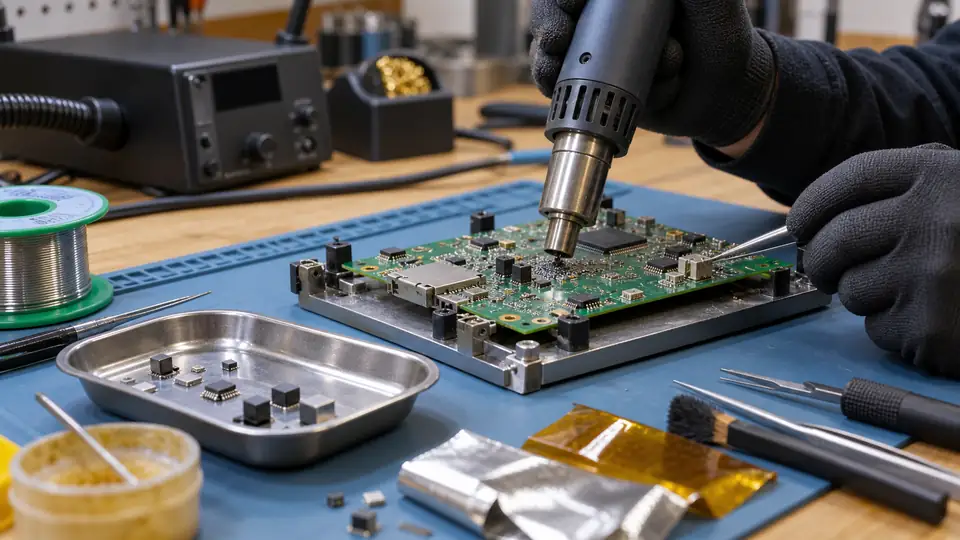
A hot air rework station for PCB repair has to do more than blow very hot air. It needs controllable temperature, adjustable airflow, useful nozzles, and a handpiece that lets you work around small SMD parts without turning the board into a toasted pancake. The right station can make USB-C connector replacement, IC removal, heat-shrink work, and reflow tasks far more manageable, while a poor match may deliver too much air, vague controls, or limited support for delicate boards.
The headline temperature is only part of the decision. A station with a 500°C setting is not automatically better than one rated at 480°C, because actual results also depend on airflow, heater control, nozzle size, component mass, and the distance between the nozzle and PCB. Buyers should also check whether the unit includes the nozzle sizes they need, whether it has standby or cooling functions, and whether the 110 to 127V requirement fits their workspace. For most PCB repair benches, the WEP 2009D-II offers the most balanced blend of control, presets, calibration, replaceable handpiece design, and practical accessories.
The nine options below range from compact stations for occasional board work to higher-powered equipment aimed at repeated rework. Some prioritize a small footprint, while others add soldering irons, preset channels, stronger airflow, or more advanced controls. The comparison weighs those differences against real PCB repair tasks rather than treating wattage or maximum temperature as the whole story.
Quick Answer
Best Overall: The WEP 2009D-II Hot Air Soldering Station is the strongest all-around choice for PCB repair because it combines PID temperature stabilization, four preset channels, adjustable airflow, digital calibration, cool-air mode, and a detachable hot air gun.
Best Premium: The ATTEN ST-862D brings 1000W of power, a listed maximum airflow of 120L/min, and stated temperature stability of ±1.0°C / 3°F for demanding bench work.
Best 2-in-1: The WEP 882D adds a separate soldering station, tips, solder wire, tweezers, and a desoldering pump, making it useful for a board repair setup that needs both hot air and an iron.
Best Compact Kit: The GOORY 8858-V keeps the main unit, gun holder, and nozzle storage together in a small package while adding PID control, auto standby, calibration, and four nozzles.
Best Hot Air Rework Station for PCB Repair Comparison Table
| Product | Best For | Temperature | Airflow And Controls |
|---|---|---|---|
| WEP 2009D-II | Best overall PCB repair | 212 to 896°F | Air volume 1 to 10, PID, 4 presets |
| ATTEN ST-862D | High-demand rework | 100 to 480°C | 120L/min maximum, quick-access keys |
| YIHUA 959D | Preset-driven workflows | Up to 932°F | 120L airflow, 3 memories |
| WEP 882D | Hot air plus soldering iron | Hot air up to 896°F | Variable air, PID, dual displays |
| WEP 8858-V | Compact controlled rework | Not clearly stated in supplied data | Adjustable air, PID, calibration |
| LRT 858D | Frequent SMD and phone work | Not clearly stated in supplied data | Digital temperature and airflow control |
| LRT 8858 | Low-cost precision kit | 100 to 500°C | F1 to F10 airflow, sleep cooling |
| GOORY 8858-V | Organized small workbenches | 212 to 896°F | PID, auto standby, calibration |
| Digital 650W Rework Station | Basic PCB and DIY repairs | 100 to 480°C | Dual knobs, digital display, auto sleep |
The detailed reviews explain how each station handles temperature, airflow, nozzle selection, workspace demands, and the trade-offs that matter during PCB repair.
1. WEP 2009D-II Hot Air Soldering Station — Best Overall

A PCB repair bench often involves a familiar little dance: set the heat, adjust the airflow, lift the gun, pause, then repeat the same settings on the next board. The WEP 2009D-II is built for that rhythm. Its four preset channels can store commonly used settings, while the digital display shows temperature, air volume, selected channel, unit, and heating status. That matters during repeated work because fewer menu adjustments mean more attention stays on the board and component alignment.
The station lists a temperature range of 212 to 896°F, air volume from 1 to 10, PID stabilization, cool-air mode, and digital temperature calibration. The detachable R118B hot air gun is a particularly useful distinction. If the handpiece or heating element eventually reaches the end of its service life, the listing says it can be replaced without replacing the entire station. The package includes three nozzles, bent and straight ESD-safe tweezers, and an IC extractor, giving a repair setup more practical board-level tools from the start.
Pros
- PID program supports controlled temperature adjustment.
- Four preset channels speed up repeated repair tasks.
- Air volume is adjustable from 1 to 10.
- Detachable hot air gun can be replaced separately according to the listing.
- Includes three nozzles, two tweezers, and an IC extractor.
Cons
- Rated for 110 to 127V, so it is not intended for direct connection to a 220V outlet.
- The included nozzle selection is useful, but smaller or specialized nozzle shapes may require separate sourcing.
This is the strongest fit for a repairer who wants a station that can move from occasional connector work to repeated SMD rework without relying on a single temperature knob. The presets, calibration function, standby cooling, and replaceable handpiece give it more long-term flexibility than a bare-bones compact station. A buyer who wants the smallest possible unit or a built-in soldering iron may prefer another option, but for focused hot-air PCB repair, the WEP 2009D-II presents the most complete balance.
To buy this product, click here.
2. ATTEN ST-862D Lead-Free Hot Air Rework Station — Best Premium
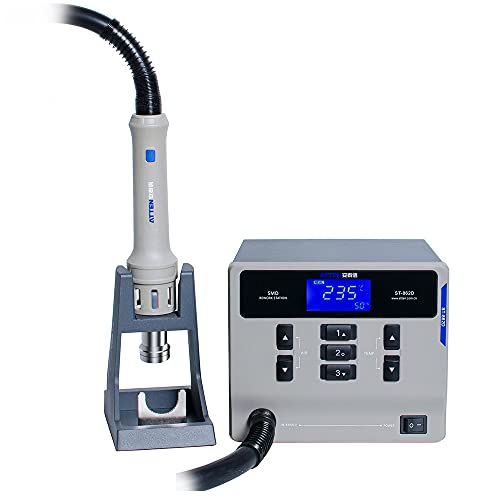
The ATTEN ST-862D takes a more equipment-oriented approach than the compact stations in this group. Its listed 1000W power rating and maximum airflow of 120L/min give it a specification profile aimed at demanding SMD, BGA, QFP, and other chip work. A large board or a component with substantial thermal mass can require more available heat and air, although those headline figures still do not guarantee a particular joint temperature or removal time.
Control is the main reason to look at this model. The listing describes temperature stabilization of ±1.0°C / 3°F, three sets of quick temperature and air-volume access keys, and menu-style operation. That arrangement can be useful if a repair bench cycles among a few familiar settings. The station also includes four nozzles, a bracket, a ground wire, and a hot air gun with a soft silicone cable that remains flexible in colder conditions according to the product information.
Pros
- 1000W power rating is suited to demanding rework tasks.
- Published maximum airflow is 120L/min.
- Listing states temperature stability of ±1.0°C / 3°F.
- Three quick-access key groups simplify repeated temperature and air changes.
- Includes four nozzles and a ground wire.
Cons
- Its premium-priced positioning may be excessive for occasional home repairs.
- Rated for 110V operation, so voltage compatibility needs careful attention before ordering.
The ST-862D is best suited to a bench where hot-air work is frequent and the operator values fast access to stored operating choices. Its power and stated stability give it a stronger case for larger or stubborn components than small entry-level units. It may be more station than a casual user needs, and the listing does not describe a detachable replacement handpiece, so buyers should weigh the higher initial commitment against their expected workload.
To buy this product, click here.
3. YIHUA 959D Digital Hot Air Rework Station — Best for Preset Workflows

Some repairs feel like a string of small repeats: warm the board, remove one component, switch to another setting, and return to a familiar airflow for the next step. The YIHUA 959D addresses that pattern with three preset channels. A single press can bring back a saved temperature and airflow combination, which is more convenient than turning two controls until the display looks right every time.
The listing gives the station a maximum stabilized temperature of 932°F and airflow of 120L, along with rapid heating and an in-holder standby function. It also describes a brushed aluminum control panel, a hot-air fail-safe function, and a 110 to 127V US-standard power design. The fail-safe feature is presented as a way to reduce fire risk if the gun stops producing air, but it should complement safe bench practices rather than replace them.
Pros
- Three preset channels support repeatable workflows.
- Published airflow capacity reaches 120L.
- Maximum stabilized temperature is listed at 932°F.
- In-holder standby helps cool the gun during pauses.
- Includes a hot-air fail-safe function according to the listing.
Cons
- Only three preset channels are available, fewer than the WEP 2009D-II.
- The 110 to 127V requirement limits direct use on incompatible power systems.
This station makes sense for someone who works through recurring repair routines and wants memory buttons without stepping up to a large premium unit. The three channels are especially useful for keeping separate settings for small SMD parts, connector work, and preheating. Buyers who need a detachable handpiece or a second soldering iron will find the WEP 2009D-II or WEP 882D more suitable, while the YIHUA remains a focused hot-air option with practical workflow controls.
To buy this product, click here.
4. WEP 882D 2-in-1 SMD Hot Air Rework Station — Best 2-in-1

A hot-air station can remove a connector, but many repairs still finish with a conventional soldering iron. The WEP 882D addresses both jobs in one compact body, with separate LED displays, power switches, temperature controls, and air-volume adjustment for the two systems. That makes it a practical choice for a bench where the same board may need hot air to loosen a part and an iron to clean pads or touch up a connection.
The hot-air side is adjustable from 212 to 896°F with variable air volume, while the iron is listed from 392 to 896°F. The built-in PID program applies temperature control to both systems, and the station adds soldering-iron sleep mode, hot-air standby, automatic shutdown, calibration, and Celsius/Fahrenheit conversion. The kit includes two solder wire spools, five soldering tips, three hot-air nozzles, brass wool, tweezers, and a desoldering pump. Those items are included in this package, rather than merely described as compatible accessories.
Pros
- Combines a hot-air station and conventional soldering station.
- Separate displays and controls keep the two functions distinct.
- PID control is listed for both the iron and hot-air system.
- Includes five soldering tips, three hot-air nozzles, and a desoldering pump.
- Offers sleep, standby, automatic shutdown, and calibration functions.
Cons
- The 2-in-1 design occupies a larger functional footprint than a hot-air-only unit.
- Rated for 110 to 127V USA specifications and unsuitable for a 220V outlet.
The WEP 882D is the sensible pick for a repairer who wants one station to cover the full soldering sequence. Its extra accessories reduce the need to assemble a separate iron setup, though buyers focused exclusively on hot-air rework may prefer a dedicated station with more specialized airflow controls. It earns this ranking through workflow coverage rather than the highest hot-air power rating.
To buy this product, click here.
5. WEP 8858-V Hot Air Rework Station Kit — Best Compact Controlled Station

Bench space disappears quickly once a PCB, tweezers, solder spool, microscope, and fume control are all in place. The WEP 8858-V responds with a palm-sized main unit and integrated holders for the hot-air gun and nozzles. That storage arrangement keeps the hot handpiece from rolling across the work surface and makes the station easier to pack away after a short repair session.
Its control panel uses a separate temperature adjustment and a simple air-volume knob, so airflow changes do not require navigating a secondary menu. The product information lists a PID program, digital temperature calibration, Celsius/Fahrenheit conversion, and a hot-air fail-safe. Three nozzles and a pair of bent and straight tweezers are included. The supplied information does not clearly state a full temperature range, so buyers who need a particular setpoint should confirm the current listing before ordering.
Pros
- Palm-sized station suits crowded repair benches.
- Integrated holders organize the gun and nozzles.
- PID control and digital calibration support more controlled adjustment.
- Dedicated air-volume knob allows direct airflow changes.
- Includes three nozzles and two different tweezer styles.
Cons
- The available product information does not clearly state the complete temperature range.
- Only three hot-air nozzles are included.
This is a good fit for small electronics work where the station must share a crowded table with other tools. The controls are more direct than menu-heavy designs, and the integrated storage is a useful everyday detail rather than a decorative extra. Buyers handling larger thermal loads may prefer a station with clearly published airflow and power figures, while compact-work users will appreciate the tidy footprint.
To buy this product, click here.
6. LRT 858D 700W Digital Hot Air Rework Station — Best for Frequent SMD Repairs

The LRT 858D is aimed squarely at electronics work, with the listing naming PCB repair, IC removal, BGA rework, SMD soldering, USB-C port replacement, phone repair, and laptop maintenance. Its 700W heating system is described as fast-heating with stable temperature recovery, giving it more stated capacity than the smallest compact units. Power alone does not tell the whole thermal story, but it is relevant when a repair involves a connector or board area that pulls heat away from the work zone.
Digital temperature monitoring and adjustable airflow give the operator separate control over the two variables that shape hot-air work. The station also uses a brushless fan, which the listing describes as quieter and longer-lasting than a traditional brushed motor. An ergonomic hot air handle and compact station body should suit longer repair sessions, although the supplied product information does not identify the complete temperature range or included nozzle count.
Pros
- 700W heating system is specified for repeated electronics repair.
- Digital display provides temperature monitoring.
- Adjustable temperature and airflow suit varied SMD tasks.
- Brushless fan is listed for stable, lower-noise operation.
- Product information specifically names USB-C, phone, laptop, BGA, and PCB work.
Cons
- The supplied information does not clearly state the full temperature range.
- The included nozzle selection is not clearly identified in the available product details.
This LRT station belongs on a repair bench where the intended jobs extend beyond occasional heat-shrink tubing. Its stated applications line up closely with board-level repair, and the brushless fan adds a useful distinction for repeated use. Buyers who need a known nozzle assortment or preset memory should look toward the WEP 2009D-II or YIHUA 959D, while this model remains a straightforward choice for adjustable hot air and electronics-focused tasks.
To buy this product, click here.
7. LRT 8858 Hot Air Rework Station — Best Low-Cost Precision Kit
The LRT 8858 keeps the station itself compact, then makes the kit more useful with six nozzles in 3, 4, 5, 6, 8, and 10mm sizes. That spread gives the operator more ways to direct heat around different component footprints, though nozzle diameter alone does not determine the correct setting. A small nozzle can concentrate heat, while the right temperature, airflow, and working distance still depend on the board and component.
The listing specifies a 100 to 500°C temperature range and F1 to F10 airflow adjustment. It also describes a microprocessor-controlled digital heat system and an intelligent sleep function that switches the handle into cooling mode when placed in the holder. ESD tweezers and an IC extractor are included alongside the nozzles, making this a useful starting kit for small SMD work rather than a station sold with only the gun and stand.
Pros
- Temperature range is listed from 100 to 500°C.
- F1 to F10 airflow adjustment allows fine output changes.
- Six nozzle diameters provide broader included coverage.
- Holder-triggered cooling function reduces idle heating.
- Includes ESD tweezers and an IC extractor.
Cons
- The compact design may provide less workflow memory and display functionality than higher-ranked stations.
- The supplied information does not specify a maximum airflow volume.
This station suits someone who wants a broad nozzle assortment and basic digital control without moving to a larger premium model. The F1 to F10 scale is easy to understand during hands-on adjustment, and the cooling function is helpful when the gun is repeatedly returned to its stand. Buyers doing larger board assemblies or demanding high-throughput work may prefer the published airflow figures and preset controls found on the ATTEN, YIHUA, or WEP 2009D-II.
To buy this product, click here.
8. GOORY 8858-V Hot Air Rework Station Kit — Best Organized Compact Kit

The GOORY 8858-V is built around tidy storage and direct operation. Its palm-sized unit includes holders for the hot-air gun and nozzles, a small detail that becomes surprisingly useful when the work surface is crowded with a PCB, solder wire, and hand tools. Dedicated temperature and airflow knobs keep adjustments visible, while the display can show either Fahrenheit or Celsius.
The product information lists a PID-controlled 700W ceramic heating core, a 212 to 896°F temperature range, auto standby, and a calibration function. Returning the gun to its holder triggers cooling and stops the airflow according to the listing. Four nozzles, a desoldering pump, two precision tweezers, and a nozzle holder are included. The listing also identifies a flame-retardant handle and ETL listing, though buyers should still follow the instructions and use appropriate heat and electrical precautions.
Pros
- Compact housing includes storage for the gun and nozzles.
- 700W ceramic heating core is paired with PID control.
- Temperature range is listed from 212 to 896°F.
- Auto standby activates when the gun returns to its holder.
- Includes four nozzles, a desoldering pump, and two tweezers.
Cons
- Maximum airflow volume is not clearly stated in the supplied information.
- Rated for 110 to 127V and unsuitable for a 220V outlet.
The GOORY is a practical match for a compact electronics bench, especially where storage is as valuable as raw output. Its published temperature range and PID control give the user more useful information than a simple heat gun, while the included pump and tweezers reduce the number of separate tools needed for basic board work. A buyer seeking preset channels, a detachable handpiece, or published airflow volume should step up to another model.
To buy this product, click here.
9. Digital 650W Hot Air Rework Station — Best for Basic PCB Repair

For a first station, the appeal of this 650W model is easy to understand. It uses separate knobs for temperature and airflow, shows the temperature on an LED display, and includes a stand, three interchangeable nozzles, a power cord, and a manual. That setup covers the basic pieces needed to start working on SMD parts, connectors, heat-shrink tubing, and similar jobs without building a tool collection one item at a time.
The listing gives a 100 to 480°C temperature range and describes an auto-sleep function that activates during idle periods. It also identifies an ESD anti-static design and a compact, portable body. Those features are useful for a small home bench or mobile repair setup, though the product information does not provide a numerical airflow range, nozzle dimensions, or a temperature-stability figure. The dual-knob layout is simple, but it lacks the presets, calibration depth, and replaceable handpiece described by higher-ranked stations.
Pros
- 650W heating system is specified for PCB and SMD work.
- Temperature range is listed from 100 to 480°C.
- Separate temperature and airflow knobs simplify operation.
- Auto-sleep function is included for idle periods.
- Includes three nozzles, a stand, power cord, and manual.
Cons
- The supplied information does not state a numerical airflow range.
- There is no listed preset memory or detachable handpiece.
This is a sensible lower-cost starting point for occasional PCB repair, especially if a small footprint and uncomplicated controls matter more than advanced workflow features. It can cover common rework tasks, but the lack of published airflow details makes it harder to compare for delicate component work. Buyers planning frequent phone repairs, repeated connector replacement, or heavier board-level work will gain more control from the WEP 2009D-II, LRT 858D, or ATTEN ST-862D.
To buy this product, click here.
Buying Guide
Airflow Control Matters Around Small SMD Parts
Temperature and airflow work as a pair. A narrow stream aimed at a small component can concentrate heat, while excessive air may disturb nearby parts or move loose solder across the board. Stations such as the WEP 2009D-II offer air volume from 1 to 10, the LRT 8858 uses F1 to F10 adjustment, and the ATTEN lists a maximum airflow figure of 120L/min. A larger maximum does not mean every repair should use the highest setting. The useful feature is controllable output that lets the operator match the air stream to the component and nozzle.
A Wide Temperature Range Does Not Guarantee Better Rework
A station rated to 500°C may look stronger on paper than one rated to 480°C, but the setpoint is not the same as the temperature reaching a component. Heater design, sensor placement, nozzle size, airflow, distance, and PCB thermal mass all affect the work area. For PCB repair, stable adjustment and repeatable control usually matter more than chasing the highest number. PID systems, calibration functions, and clear displays can be more useful during real rework than a few extra degrees at the top of the range.
Nozzle Selection Changes How Heat Reaches the Board
Nozzles focus and shape the airflow. The LRT 8858 includes six sizes from 3 to 10mm, the GOORY 8858-V includes four, and the WEP 2009D-II includes three. A smaller nozzle may suit a concentrated area, while a larger one can warm a broader region. The correct nozzle still depends on the component and board layout, so included sizes should be treated as a starting assortment. Confirm that replacement nozzles are available for the exact station before assuming the included set can be expanded.
Standby And Cooling Functions Protect The Workflow
Hot-air guns are often lifted and returned to their holders many times during a repair. Auto standby, sleep, or cooling functions reduce unnecessary heating during those pauses. The WEP 2009D-II cools when placed in the holder, the YIHUA 959D offers in-holder standby, and the GOORY and LRT 8858 describe automatic cooling or sleep behavior. These functions do not remove the need for a clear work area and careful handling, but they make pauses more manageable and can reduce wear on the heating system.
Presets Help With Repeated Repairs
Memory channels are useful when a bench repeatedly handles similar boards. The WEP 2009D-II provides four preset channels, while the YIHUA 959D offers three. A preset can save a familiar temperature and airflow combination, but it should not be treated as a universal recipe. The same setting may behave differently with a small resistor, a large connector, or a multilayer board. Presets are best viewed as a convenient starting point that still requires attention to the actual component and surrounding PCB.
Check Voltage Before Ordering
Several stations in this group are rated for 110 to 127V, and the ATTEN ST-862D listing identifies a 110V design. A plug shape alone does not establish electrical compatibility. Check the station’s voltage requirement against the outlet and any workplace power equipment before purchase. Connecting a unit to an incompatible 220V outlet can damage the equipment and create an electrical hazard.
Decide Whether You Need A Soldering Iron Too
A hot-air station handles many removal and reflow tasks, but an iron remains useful for pad cleanup, wire work, and final touch-ups. The WEP 882D combines both systems and includes soldering tips, solder wire, brass wool, tweezers, and a desoldering pump. That convenience comes with a broader station footprint. If the bench already has a reliable iron, a dedicated hot-air model may keep the controls and layout more focused.
Best Hot Air Rework Station for PCB Repair FAQ
What Temperature Should A Hot Air Rework Station Use For PCB Repair?
There is no single setting that suits every PCB or component. The correct starting point depends on the solder, component size, board construction, nozzle, airflow, and distance from the work area. A station’s displayed temperature is a control setting, not a guarantee of the actual component temperature. Begin conservatively, use suitable airflow, and adjust while watching the solder and nearby parts rather than relying on the maximum setting.
Is Higher Wattage Better For Hot-Air PCB Rework?
Higher wattage can provide more available heating power, which may help with larger connectors or boards that absorb heat. It does not automatically produce better results for small SMD parts. Heater design, temperature regulation, airflow control, nozzle geometry, and technique also matter. The 1000W ATTEN ST-862D is aimed at demanding work, while a 650W or 700W station may be more manageable for lighter repairs.
How Important Is Adjustable Airflow?
Adjustable airflow is very important because different components need different heat delivery. Too much air can move small parts, spread molten solder, or heat nearby components unnecessarily. A lower setting can provide a more controlled stream for delicate work, while a higher setting may help warm a larger area. Look for a station with a clearly adjustable airflow control rather than relying on a single fixed output.
Are More Hot-Air Nozzles Always Better?
No. More nozzles provide more starting options, but the correct size and shape still depend on the component and board. The LRT 8858 includes six sizes, while other models include three or four. Nozzle quantity should be balanced against temperature control, airflow adjustment, and replacement availability. A station with fewer useful nozzles and better control may be more practical than one with a larger but poorly matched assortment.
Do I Need A PID-Controlled Hot Air Station?
PID control can help a station adjust its heating output around a selected temperature, which may support more consistent operation. It does not eliminate variables such as airflow, nozzle distance, board thermal mass, or sensor limitations. PID is a useful feature, particularly for repeated repair work, but it should be judged alongside the station’s controls, standby functions, nozzle options, and application fit.
Is An ESD Feature Important For PCB Repair?
ESD protection can matter around sensitive electronic components, but product descriptions use different wording and do not always provide detailed performance information. Treat an ESD claim as one part of a broader setup that may include grounding practices, an appropriate work surface, and careful handling. Do not assume that a station’s anti-static description replaces all other ESD precautions.
Should I Choose A 2-in-1 Station With A Soldering Iron?
A 2-in-1 station is useful if the same repair often involves hot-air removal followed by iron touch-up. The WEP 882D includes both systems and several related accessories. A dedicated hot-air station may be preferable if bench space is tight or an existing soldering iron already meets your needs. The choice depends on whether combined convenience outweighs the broader footprint and additional controls.
Final Verdict
The WEP 2009D-II is the strongest overall choice for PCB repair in this group. Its combination of PID temperature control, air-volume adjustment, four preset channels, cool-air mode, calibration, auto standby, and detachable hot air gun gives it a useful balance for both occasional and repeated work. The included nozzles, tweezers, and IC extractor also make the initial setup practical without confusing accessory compatibility with accessories that are actually in the box.
For demanding bench work, the ATTEN ST-862D offers the highest listed power and airflow profile, while the WEP 882D is the better route for anyone who wants a soldering iron and hot-air station together. The YIHUA 959D suits preset-driven workflows, and the GOORY 8858-V or LRT 8858 makes more sense for a compact setup. Match the station to the board sizes, component types, nozzle needs, voltage, and repair frequency on your bench. A controllable, appropriately sized air stream is usually more useful than a dramatic maximum-temperature number.

- Jesse
Jesse is the editor behind Soldering Gear, where he covers soldering irons, stations, rework equipment, and the tools that belong on a practical electronics bench. His work focuses on comparing product specifications, features, compatibility, and intended uses so readers can make more informed buying decisions.
- Best Soldering Iron for Microsoldering: 9 Picks in 2026 November 10, 2026
- Best Soldering Station for PCB Repair: 9 Picks in 2026 November 9, 2026
- How to Desolder Electronics November 8, 2026
- Best Hot Air Rework Station for PCB Repair: 9 Picks in 2026 November 7, 2026
- Soldering Iron Tip Shapes Explained November 6, 2026