Best Stereo Microscope for Soldering: 9 Picks in 2026

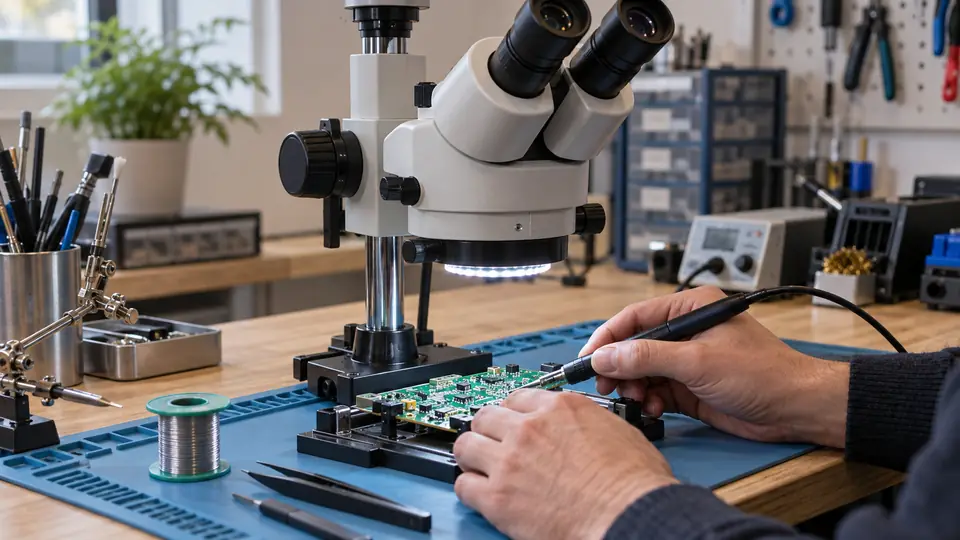
A soldering microscope has one job that a bench magnifier cannot quite manage: give you a clear, three-dimensional view of a small joint while leaving enough room for a soldering iron, tweezers, and both hands. For PCB repair, fine-pitch components, connector work, and inspection after reflow, the useful comparison is less about the biggest magnification number and more about working distance, field of view, stand stability, illumination, and how naturally you can move around the board.
Optical stereo models and digital microscopes take very different approaches. A trinocular stereo microscope usually gives the most natural depth perception and tool clearance, while a digital model can be easier to share, record, or view on a larger screen. A common trap is treating digital magnification such as “2000x” as equivalent to optical magnification. It is not. For hands-on soldering, a moderate optical range with a steady stand can be far more useful than an enormous digital number, and the Kaisi Professional model offers one of the strongest combinations of working space, stereo viewing, lighting, and solder-fume accessories.
The products below range from compact digital inspection tools to substantial trinocular boom-stand systems. Rankings weigh the supplied optical details, workspace, focus and stand design, lighting, camera support, and practical suitability for soldering rather than headline magnification alone.
Quick Answer
Best overall: The Kaisi Professional Stereo Microscope is the most complete soldering-focused package, with 7x to 50x zoom, wide-field eyepieces, a solder fan, LED ring light, and a work floor with a silicone mat and parts trays.
Best budget optical option: The Kaisi TX350E keeps the same useful 7x to 50x range and adds a solder fan, LED lighting, and a practical work floor at a lower-cost position.
Best digital option: The Andonstar AD249S-M Plus is the better fit for readers who want a built-in 10.1-inch display, HDMI output, 2160P recording, multiple lenses, and a broad soldering accessory package.
Best premium optical alternative: The AmScope SM-3T provides a long-reach boom stand, 7x to 45x continuous zoom, 10x wide-field eyepieces, and a rotating trinocular head for demanding bench work.
Best Stereo Microscope for Soldering Comparison Table
| Product | Type | Optical Range | Stand and Workspace | Best For |
|---|---|---|---|---|
| Kaisi Professional Stereo Microscope | Trinocular stereo | 7x to 50x | Work floor, mat, parts trays | Complete soldering setup |
| Kaisi Trinocular Stereo Microscope | Trinocular stereo | 6.5x to 65x | Telescopic stand, oversized floor | Large boards and adjustable clearance |
| Kaisi TX350E | Trinocular stereo | 7x to 50x | Work floor with three positions | Lower-cost optical setup |
| Aikokkl 5-inch LCD Digital Microscope | Digital | Up to 1000x digital | C-clamp and flexible arm | Basic PCB inspection |
| Vision Scientific Double-Arm Microscope | Trinocular stereo | 3.5x to 90x | Double-arm boom, steel base | Wide positioning range |
| ZTEEERS Professional Stereo Microscope | Trinocular stereo | 3.5x to 90x | 18-pound steel base, boom arm | Stable general bench work |
| Andonstar AD249S-M Plus | Digital, three-lens | 15x to 240x on HDMI output | Boom stand, extension base | Screen viewing and recording |
| AmScope SM-3T | Trinocular stereo | 7x to 45x | 16-inch adjustable boom | Long-reach optical work |
| SWIFT S7 | Trinocular stereo | 7x to 45x | Single-arm boom, 56-bulb light | Camera-ready electronics work |
The detailed reviews explain how each viewing system handles tool clearance, focus, lighting, camera use, and the physical demands of soldering.
1. Kaisi Professional Stereo Microscope — Best Overall

The Kaisi Professional earns the top spot by treating soldering as a complete bench activity rather than a bare inspection task. Its 0.7x to 5x zoom objective produces a listed 7x to 50x range, giving the user room to begin with a broader board view and move toward small joints without changing the main optical assembly. The supplied WF10x23 eyepieces have a wider stated field of view than conventional WF10x20 eyepieces, which should make it easier to keep nearby pads, traces, and component leads visible while the iron moves in.
Its work area is especially relevant here. The 14.9 by 10-inch floor includes a 7.4 by 4.7-inch silicone soldering mat and three small silicone trays for parts. A solder fan and LED ring light are also listed, so the package addresses two everyday bench annoyances: smoke drifting across the objective and shadows hiding a joint. The trinocular design is described as allowing simultaneous observation through the eyepieces and camera path without losing the left eyepiece view, though a camera is not identified as included. That combination makes this a strong starting point for board repair, inspection, and documentation.
Pros
- Continuous 7x to 50x optical zoom range.
- Wide-field WF10x23 eyepieces with adjustable eye distance.
- Includes an LED ring light and soldering exhaust fan.
- Work floor includes a silicone mat and three parts trays.
- Trinocular design supports simultaneous viewing and camera use according to the listing.
Cons
- The correct working position changes with the standard and Barlow-lens configurations.
- A camera is not identified as included, so imaging may require an additional purchase.
This model makes the most sense for someone building a dedicated electronics bench and wanting optical stereo viewing without assembling every supporting accessory separately. It is more substantial than a small screen microscope, yet its 7x starting point remains useful for locating a board section before moving closer. Buyers who already own a stable boom stand or need a very long reach may prefer a larger industrial-style option, but the Kaisi package is unusually aligned with the actual motions of soldering, where space around the board matters as much as magnification.
To buy this product, click here.
2. Kaisi Trinocular Stereo Microscope for Professional Repairer Soldering — Best for Large Workspaces

A large PCB can make a cramped microscope feel like a fence around the work. This Kaisi model addresses that with a listed 19.69 by 14.96-inch work floor, embedded high-temperature-resistant silicone soldering pads, and a telescopic stand that can move and extend within the workspace. That physical adjustability is more meaningful for soldering than a dramatic maximum-magnification claim because it helps position different board sizes and keeps the handpiece from colliding with the stand.
The optical system offers continuous 6.5x to 65x magnification through adjustable WF10x22 eyepieces. The extra range at the top can help with close inspection, while the lower end keeps the view useful for larger components and board sections. The snap-on LR2 LED ring light has adjustable brightness, and the listing describes an oil-resistant mirror intended to protect the microscope from dust, oil, and smoke. A solder fan is included as well. The package is a compelling choice for repair benches that need room to shift between boards, though the more involved stand and accessory arrangement may take more setup space than a compact digital unit.
Pros
- Continuous 6.5x to 65x magnification range.
- Large work floor with integrated high-temperature-resistant silicone pads.
- Telescopic stand allows movement within the work area.
- Adjustable LED ring light and solder fan are included.
- Adjustable eyepiece design supports different viewing positions.
Cons
- The larger floor and telescopic structure require substantial bench space.
- Adding a Barlow lens requires a specific light-source removal and reinstallation sequence.
Choose this version over the top pick if a wide work envelope and stand movement matter more than a compact arrangement. It suits repair sessions involving larger PCBs, mechanical parts, or frequent repositioning, while the 65x ceiling gives extra inspection range. A small desk with limited clearance may make its oversized floor awkward, and the product information does not identify a camera as included. For a spacious bench, however, the combination of optical depth, adjustable reach, lighting, and smoke management is highly practical.
To buy this product, click here.
3. Kaisi TX350E Professional Soldering Microscope — Best Value Optical Setup

The TX350E follows a familiar optical-soldering formula, but its practical details make it more useful than a generic inspection microscope. The 0.7x to 5x zoom objective provides a stated 7x to 50x range, while WF10x23 eyepieces offer a broad viewing area and adjustable eye distance. That is a sensible range for electronics work: low magnification helps locate the target and high magnification supports inspection of solder bridges, leads, and connector contacts without forcing the user into a narrow digital image.
Its 14.7 by 9.6-inch work floor has three hole positions for adjusting the microscope location, and the listed primary working distance is 10 centimeters. The package also includes a solder exhaust fan and LED ring light. Those additions matter when the microscope shares a bench with a hot-air tool, where smoke and bulky boards quickly expose a weak layout. The listing also identifies installation and use demonstration material, which may help with eyepiece adjustment and initial setup. It does not have the oversized floor of the second Kaisi model, but that smaller footprint can be an advantage on a crowded electronics desk.
Pros
- 7x to 50x continuous optical magnification.
- WF10x23 wide-field eyepieces with adjustable eye distance.
- Includes a solder exhaust fan and LED ring light.
- Work floor offers three microscope-positioning holes.
- Published primary working distance is 10 centimeters.
Cons
- Working distance and focus position change with auxiliary-lens configuration.
- The product information does not identify a camera as included.
The TX350E is a good fit for someone who wants the depth and hand control of optical stereo viewing without stepping immediately into a larger boom system. Its floor gives more organization than a bare stand, and the included fan and light reduce the need for immediate add-ons. Buyers handling very large boards may want a longer-reach arm, while those who need screen-based viewing should look at the digital choices below. For conventional PCB soldering and inspection, this is a balanced lower-cost route.
To buy this product, click here.
4. Aikokkl 5-inch LCD Digital Soldering Microscope — Best Budget Digital Option

For a small repair desk, a 5-inch screen and flexible arm can be less intimidating than a full trinocular stand. The Aikokkl uses a C-clamp and multi-angle gooseneck arm, so it can fit into tighter spaces and adjust around irregular objects. Its listed magnification reaches 1000x digitally, but the more useful detail is how focus works: the user changes the lens-to-object distance with the arm and then turns the focus wheel. That means the advertised maximum should be treated as a digital viewing claim, not as an optical equivalent to a 50x stereo microscope.
The screen can display the work directly, and the listing describes plug-and-play PC camera operation through the built-in Camera app on Windows or Photo Booth on Mac. It supports 1080P repair video recording, but a Micro SD card up to 32GB is required and is not included. For someone checking solder joints, documenting a repair, or wanting to avoid looking through eyepieces, that screen-based workflow is straightforward. The flexible arm and C-clamp can also be repositioned quickly, although they do not provide the same optical depth or broad hands-on clearance as a dedicated stereo boom stand.
Pros
- 5-inch IPS display provides direct screen viewing.
- Flexible arm and C-clamp suit compact workspaces.
- PC camera mode is described as working without additional software.
- Supports 1080P repair video recording.
- Digital focus and magnification are straightforward to adjust physically.
Cons
- Micro SD card for saving photos and videos is not included.
- Digital magnification does not provide the optical depth of a stereo microscope.
This is the sensible pick for occasional PCB inspection, documentation, and screen-first viewing. It can be easier to share with another person across a bench, and the clamp avoids the footprint of a metal microscope base. It is less suitable for demanding microsoldering where natural depth perception and generous tool clearance are central. Buyers should also leave room for the arm and confirm that the desk edge can accept the clamp before ordering.
To buy this product, click here.
5. Vision Scientific Trinocular Stereo Zoom Microscope — Best Double-Arm Stand

Some soldering work becomes easier when the microscope can swing into position and then move away without dismantling the bench. This Vision Scientific model uses a double-arm boom stand with a solid-steel rectangular base, giving it a more substantial positioning system than a basic pillar stand. The product information describes ball-bearing movement along with a heavy-duty rack-and-pinion focus mechanism, so the design is aimed at controlled adjustment around larger objects and boards.
Optically, the standard 7x to 45x range expands to 3.5x to 90x with the included 0.5x and 2x auxiliary lenses. The listed 65mm field of view and parfocal optical design are valuable details for soldering because they speak to maintaining a useful view while changing magnification. The 45-degree trinocular head rotates 360 degrees, includes adjustable interpupillary distance and diopters, and accepts a camera or HD touch screen through the trinocular port. A 144-LED ring light with intensity control completes the setup. The trade-off is a larger, heavier bench presence than compact models.
Pros
- 3.5x to 90x range with included auxiliary lenses.
- Double-arm boom stand provides broad positioning flexibility.
- Published 65mm field of view supports wider board viewing.
- Parfocal optical design is listed across the magnification range.
- Includes a dimmable 144-LED ring light.
Cons
- Double-arm construction and steel base require substantial bench space.
- Camera or HD touch screen is supported through the port but is not identified as included.
The Vision Scientific is aimed at a permanent workbench where reach and movement matter more than compact storage. Its low-end 3.5x setting can open the view around a larger board, while the 90x upper range is available for close inspection with the auxiliary lens. It may be more microscope than a casual repairer needs, and the extra lenses require sensible setup changes, but the double-arm stand is a real advantage for moving between inspection and hands-on work.
To buy this product, click here.
6. ZTEEERS Professional Trinocular Stereo Zoom Microscope — Best Stable Boom-Stand Setup

The ZTEEERS model is built around a heavy-duty solid-steel rectangular base listed at 18 pounds. That mass can be useful during soldering, where a small bump to the bench or a push against the board can expose an unstable stand. Its single-arm boom uses ball-bearing movement and offers a long working distance, while the fixed 45-degree head rotates through 360 degrees for repositioning or shared viewing.
The optical package covers 7x to 45x through the zoom objective and extends to 3.5x to 90x with the included 0.5x and 2x auxiliary lenses. WF10x eyepieces have adjustable interpupillary spacing and diopters, and the listing describes simultaneous observation through the eyepieces while a digital camera is in use. A dimmable 56S LED ring light provides adjustable illumination. This is a conventional optical bench microscope rather than a soldering-specific workstation, so it does not list a solder fan, silicone work floor, or parts trays, but the stable base and camera-ready head make it a capable foundation.
Pros
- Heavy-duty solid-steel base is listed at 18 pounds.
- 3.5x to 90x range with included 0.5x and 2x auxiliary lenses.
- Single-arm boom provides long and flexible working distance.
- Trinocular head rotates 360 degrees and supports camera viewing.
- Dimmable 56S LED ring light is included.
Cons
- The package does not list a solder fan, silicone mat, or parts trays.
- Its heavy base takes more dedicated bench space than a clamp-mounted digital microscope.
Pick the ZTEEERS when stand stability and a traditional stereo image matter more than included soldering accessories. It is a strong platform for a bench that already has a mat, fume solution, and parts organization in place. The broad magnification range is useful, but the 90x figure comes through the auxiliary-lens arrangement, so users should set the lens and working distance around the actual job rather than chase maximum magnification.
To buy this product, click here.
7. Andonstar AD249S-M Plus 3 Lens Digital Microscope — Best for Screen Viewing and Recording

The Andonstar takes a different route from the optical models by putting a 10.1-inch display at the center of the bench. Its Lens L is listed for soldering and repair, with the supplied information giving 60x to 240x on an external HDMI display and a lower range on the microscope screen. The system also includes lenses for broader inspection and biological slides, although those extra applications are secondary for this roundup. The key benefit for soldering is a large shared image that can be recorded or sent to a larger monitor.
Its accessory package is unusually focused on bench organization. The listing includes a boom arm, extension base, component storage boxes, tool holder, soldering helping hands, soldering mat, clips, tweezers, and a 32GB Micro SD card. HDMI output supports 2160P video capture, and the product information describes Windows measurement, photo, and video software. Digital zoom and screen magnification should not be confused with optical stereo magnification, so this will feel different from a binocular microscope when judging depth or moving an iron around a joint. Still, for demonstrations, documentation, and screen-first repair, it is a well-equipped option.
Pros
- 10.1-inch display provides a large direct viewing area.
- Lens L is identified for soldering and repair.
- HDMI output supports 2160P video capture according to the listing.
- Includes a 32GB Micro SD card for image and video storage.
- Package includes helping hands, tool holder, mat, storage boxes, and extension base.
Cons
- Digital magnification does not provide the same depth perception as optical stereo viewing.
- Changing lenses and adjusting object distance adds steps compared with a continuous optical zoom system.
This is the strongest fit for a repairer who wants other people to see the work, plans to record procedures, or prefers a monitor over eyepieces. The included accessories can reduce the amount of bench hardware needed at the start. Those who perform delicate work where depth cues and unobstructed hand movement are decisive should favor a stereo model instead, while anyone choosing this system should reserve room for the display, boom, and extension base.
To buy this product, click here.
8. AmScope SM-3T Professional Trinocular Stereo Zoom Microscope — Best Long-Reach Optical Alternative

Large boards, housings, and awkward assemblies need clearance in more than one direction. The AmScope SM-3T uses a single boom arm with a listed 8-inch vertical working distance and adjustable 16-inch reach across the bench. That arrangement is useful when the board cannot simply be placed under a short pillar, and it allows the microscope to move along the X and Y axes while the work stays in place.
The 0.7x to 4.5x zoom objective supplies continuous 7x to 45x magnification, and the trinocular head has 10x super-widefield eyepieces, a 45-degree viewing angle, and 360-degree rotation. The product information describes ambient lighting rather than an included powered ring light, which simplifies the power arrangement but places more responsibility on the bench lighting. It is a focused optical platform with fewer soldering-specific extras than the Kaisi systems. That makes it attractive for a buyer who already has illumination and workspace accessories but wants a long-reach stereo microscope.
Pros
- Continuous 7x to 45x optical zoom range.
- Listed 8-inch vertical and 16-inch boom-arm working dimensions.
- 10x super-widefield eyepieces support broad viewing.
- Rotating 45-degree trinocular head supports shared positioning.
- Ambient lighting does not require a separate microscope light power connection.
Cons
- The product information does not list an included LED ring light.
- It does not include the solder fan, silicone mat, or parts trays listed with the Kaisi soldering packages.
The SM-3T suits a permanent bench where reach is the deciding factor. It can work around larger circuit boards and objects without forcing the operator to lift or rotate the work repeatedly. A separate light may be needed for consistently shadow-free soldering, and buyers seeking a ready-made repair station will find the package less complete. Its value lies in the mechanical reach and straightforward optical layout.
To buy this product, click here.
9. SWIFT S7 Trinocular Stereo Microscope — Best for a Camera-Ready Bench
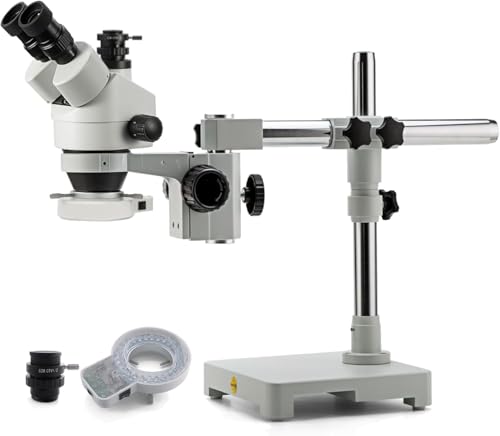
The SWIFT S7 keeps the optical arrangement familiar and adds a useful camera connection detail. Its 0.7x to 4.5x objective provides continuous 7x to 45x magnification, while the 45-degree trinocular head includes a third port and an included 0.5x C-mount adapter. That adapter widens the camera view and reduces magnification, which can be helpful when a camera needs to show more of a circuit board rather than a tightly cropped joint.
A single-arm boom stand and sturdy metal base provide room for larger objects, and the listing describes a 56-bulb LED ring light for shadow-free illumination. The wide-field 10x eyepieces include diopter adjustment, giving each eye a way to be matched during setup. Compared with soldering-specific Kaisi packages, the S7 does not list a solder fan, work floor, or parts trays, so it is better understood as an optical microscope foundation. For a bench that already has a mat and smoke-control arrangement, the camera adapter and boom stand are the features that give this model its identity.
Pros
- Continuous 7x to 45x optical magnification.
- Includes a 0.5x C-mount adapter for a wider camera view.
- 56-bulb LED ring light is included.
- Single-arm boom stand provides clearance for larger objects.
- Adjustable diopters and 45-degree trinocular head support comfortable viewing.
Cons
- The package does not list a solder fan, soldering mat, or parts trays.
- A camera is supported through the trinocular port but is not identified as included.
The S7 is a sensible choice for someone who wants a conventional stereo image now and plans to add camera documentation later. Its optical range is well suited to board inspection, and the included C-mount adapter avoids needing to source that particular interface separately. It ranks below the soldering-focused packages because the bench accessories are more limited, but its camera-ready layout and boom clearance make it a capable choice for an established electronics workspace.
To buy this product, click here.
Buying Guide
Working Distance Is More Important Than a Huge Magnification Number
A soldering microscope must leave room for a hot iron, tweezers, and the operator’s fingers. A high magnification setting becomes frustrating if the objective sits too close to the board or if the stand blocks the approach angle. The Kaisi TX350E lists a 10-centimeter primary working distance, while the AmScope SM-3T gives specific boom dimensions and the Kaisi models emphasize longer working clearance. Those details are more useful than a headline digital figure because they describe the space available around the joint.
Optical Stereo and Digital Viewing Feel Different
Optical stereo microscopes use separate viewing paths to create depth perception, which helps when a solder tip approaches a pad or when a component lead stands above a board. Digital microscopes show the work on a screen and can make recording or group viewing easier. The Aikokkl and Andonstar are convenient in that respect, but their digital magnification should not be compared directly with the optical ranges of the trinocular models.
Choose a Stand That Matches the Board
A compact C-clamp works well for a small desk and occasional inspection. A pillar or single-arm boom offers more structure, while a double-arm or telescopic system can be easier to position around large PCBs. The Kaisi Trinocular model has an oversized floor and telescopic stand, the Vision Scientific model uses a double-arm boom, and the ZTEEERS model emphasizes a heavy steel base. Stability and reach affect whether the image stays settled when the board or tool moves.
Lighting Should Reveal the Joint Without Creating Glare
Ring lights are common because they surround the viewing area and reduce harsh shadows. Adjustable brightness is useful when shiny solder reflects too strongly or when a recessed connector needs more light. The Vision Scientific and SWIFT models list 144-LED and 56-bulb ring lights respectively, while the Kaisi models pair LED lighting with solder-fume accessories. Ambient lighting, as listed for the AmScope SM-3T, can work, but it requires a suitable bench-light arrangement.
Trinocular Ports Do Not Mean a Camera Is Included
A trinocular microscope can support a camera or display through its third optical path, but the camera may be an additional purchase. The supplied information specifically identifies an included C-mount adapter with the SWIFT S7, while several other products describe camera support without listing a camera in the package. Check the exact listing before assuming that live capture, HDMI output, or a monitor is ready on day one.
Plan for Smoke and Parts Organization
A microscope objective positioned over a soldering joint can sit directly in the path of rising smoke. The Kaisi soldering models include solder fans, and some provide silicone mats and small trays. Those features do not replace appropriate ventilation or safe soldering practices, but they can make the bench easier to manage. Optical models without a fan may still be excellent microscopes, yet buyers should budget space for a separate fume-control arrangement.
Set Up Auxiliary Lenses Carefully
Several optical microscopes reach 90x only with additional 0.5x and 2x lenses. Those lenses change the viewing scale and working arrangement, so the user may need to refocus or reposition the microscope. The Kaisi Professional listing specifically warns that the standard and Barlow configurations use different installation positions. A lower magnification view with more clearance can be the better choice for actual soldering, while a higher setting may be reserved for final inspection.
Best Stereo Microscope for Soldering FAQ
Is a stereo microscope better than a digital microscope for soldering?
A stereo microscope usually offers more natural depth perception and a direct view through eyepieces, which can help while moving a soldering iron around a joint. A digital microscope may be easier for recording, teaching, or sharing the image on a larger display. The better choice depends on whether hands-on depth cues or screen-based convenience matters more in the workspace.
What magnification is useful for PCB soldering?
The products in this comparison generally begin around 3.5x to 7x and extend much higher. Lower magnification helps locate a board section and keep nearby components visible, while higher magnification helps inspect small joints. A continuous optical zoom is usually more practical than selecting one extreme magnification, since the ideal view changes from board navigation to solder-joint inspection.
Why does working distance matter?
Working distance is the space between the objective and the viewed work. More space makes it easier to approach with an iron, tweezers, or hot-air tool. A microscope with a very close objective can produce a large image but leave little room for the hands. Boom reach, auxiliary lenses, and stand position can all change the usable clearance.
Does 2000x digital magnification equal 90x optical magnification?
No. Digital magnification enlarges the camera image, while optical magnification changes the image before it reaches the sensor or eyepieces. Digital zoom can help show a detail on a screen, but it does not automatically add optical resolution, depth perception, or better tool clearance. For soldering, the quality of the view and the room around the board matter more than the largest printed number.
Do I need a trinocular microscope for soldering?
No. Binocular viewing can be sufficient for direct repair work. A trinocular system becomes useful when you want to add a camera, record repairs, share the view, or use a display while preserving eyepiece viewing. The camera itself may be optional, so check whether the package includes one or only provides the port and adapter.
Are soldering fans included with every microscope?
No. The Kaisi soldering-focused models list solder fans, but the optical alternatives from Vision Scientific, ZTEEERS, AmScope, and SWIFT do not list the same soldering-fan package. A fan attached to or positioned near a microscope also does not replace suitable room ventilation or other safety controls.
Is a ring light enough for soldering?
A ring light can provide even illumination around the viewing area and reduce shadows, especially when brightness can be adjusted. It may still create reflections on shiny solder or leave difficult angles in deep connectors. Positioning, brightness control, and the board surface all affect the result, so a ring light is helpful rather than a guarantee of perfect illumination.
Should I choose a microscope with 90x magnification?
Choose one if the auxiliary-lens arrangement also leaves enough working space for your projects. The 90x figure on several models comes from adding 0.5x and 2x lenses to a standard zoom system. For active soldering, a lower setting with a wider field and more clearance may be more useful, while the higher setting can help with close inspection after the work is complete.
Final Verdict
The Kaisi Professional Stereo Microscope is the strongest overall choice here because its specifications line up closely with real soldering work. The 7x to 50x optical range, wide-field eyepieces, LED ring light, solder fan, silicone mat, parts trays, and trinocular viewing arrangement create a more complete bench setup than a bare microscope body. The Kaisi TX350E is the better lower-cost optical alternative, with a similar range and soldering accessories in a slightly more compact work-floor arrangement.
For a large workspace, the second Kaisi model adds a broader floor and telescopic stand. For camera-led work, the Andonstar offers a screen, HDMI output, recording, and a generous accessory package, while the AmScope SM-3T is a stronger fit for long-reach optical positioning. Match the choice to the way the bench is used. Prioritize working distance and stand stability for hands-on repair, optical stereo depth for delicate joints, and screen output when documentation or shared viewing is central.

- Jesse
Jesse is the editor behind Soldering Gear, where he covers soldering irons, stations, rework equipment, and the tools that belong on a practical electronics bench. His work focuses on comparing product specifications, features, compatibility, and intended uses so readers can make more informed buying decisions.
- Best Soldering Iron for Microsoldering: 9 Picks in 2026 November 10, 2026
- Best Soldering Station for PCB Repair: 9 Picks in 2026 November 9, 2026
- How to Desolder Electronics November 8, 2026
- Best Hot Air Rework Station for PCB Repair: 9 Picks in 2026 November 7, 2026
- Soldering Iron Tip Shapes Explained November 6, 2026