Best Helping Hands for Soldering: 9 Picks in 2026

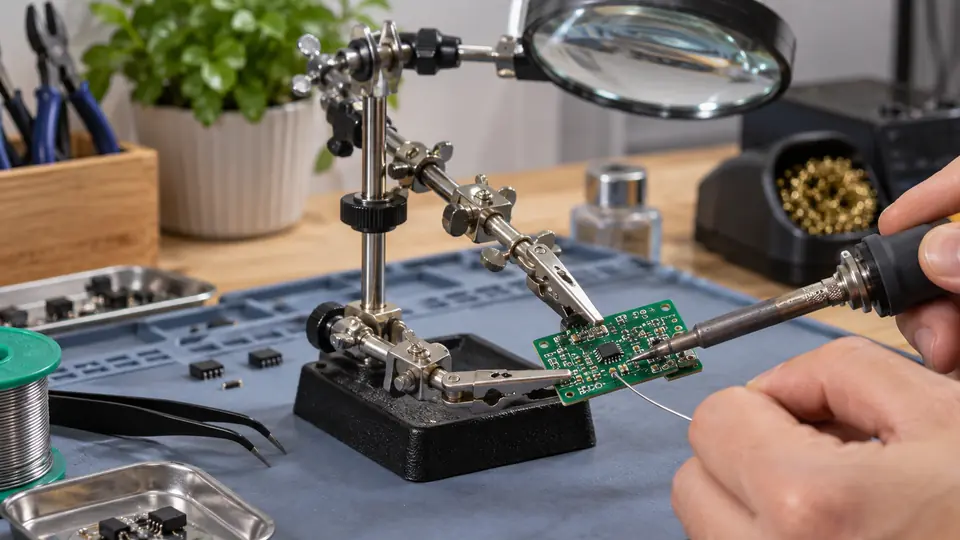
A good helping-hands tool turns a fussy soldering job into a controlled one. Instead of pinning a PCB against a coffee mug or chasing a loose wire across the bench, you can hold the board, wire, connector, or small assembly at a workable angle while both hands stay free. The strongest options balance clamp grip, arm adjustability, base stability, board protection, and useful working clearance.
The headline feature count can be misleading. Four arms are valuable only when they hold their position, and a heavy base matters only when it remains stable as you tighten a clamp. Magnifiers and lights help with small joints, while magnetic systems offer faster repositioning. A compact dual-clamp tool may suit quick repairs better than a large station, while a broad mat-based unit makes more sense for a crowded electronics bench.
This comparison weighs those practical differences rather than treating every third-hand stand as interchangeable. The NOEVSBIG station leads for its large base, movable magnetic arms, PCB holders, and protected clamps. Other picks focus on magnification, portability, a soldering mat, or lower-cost simplicity.
Quick Answer
Best overall: NOEVSBIG Magnetic Helping Hands Soldering Station offers the most adaptable setup, with five repositionable arms, six PCB holders, and a heavy steel base.
Best premium workstation: Magnetic Helping Hands Soldering Third Hand adds a large base, illuminated magnifier, hot-air gun holder, and bench vise.
Best for a protected work surface: Kaisi Helping Hands Soldering Station combines six arms with a broad silicone soldering mat.
Best Helping Hands for Soldering Comparison Table
| Product | Best For | Arm And Clamp Setup | Base Or Visibility Feature |
|---|---|---|---|
| NOEVSBIG Magnetic Helping Hands | Overall bench use | 5 magnetic arms, 6 PCB holders | 11.4 x 7.1-inch, 3.3-pound steel base |
| Magnetic Helping Hands Third Hand | Premium repair stations | 4 magnetic arms, vise, hot-air holder | 3X LED magnifier |
| Kaisi Helping Hands Station | Large protected workspace | 6 flexible arms | 15.7 x 11-inch silicone mat |
| KOTTO Helping Hands | General soldering and crafts | 4 gooseneck arms, 360-degree clamps | Weighted base, rubber feet |
| XYK Helping Hands With Magnifying Light | Close-up illuminated work | 4 flexible arms, protected clips | 3X dimmable, 500-lumen lamp |
| Helping Hands Clamp Metal | Fast PCB and wire holding | Dual quick-release clamps | Compact iron base |
| Kaisiking Helping Hands | Magnified general repairs | 4 gooseneck arms, 4 clips | 2.5X magnifier, steel base |
| XYK Four-Arm Helping Hands | Lower-cost four-arm setup | 4 flexible arms, 360-degree clips | 7.87 x 5.51-inch steel base |
| NEIKO 01902 Adjustable Helping Hand | Simple magnified tasks | 2 adjustable alligator clips | 2X magnifier, cast-iron base |
The detailed reviews below show how each holder handles stability, visibility, adjustment, and the trade-offs that appear on a real soldering bench.
1. NOEVSBIG Magnetic Helping Hands Soldering Station — Best Overall

The NOEVSBIG earns the top position by solving the two frustrations that make basic helping hands annoying: a base that shifts and arms that run out of useful positions. Its powder-coated steel base measures 11.4 by 7.1 inches and weighs more than 3.3 pounds, giving the station a substantial footprint for PCB repair, assembly, and detailed craft work.
Five magnetic gooseneck arms can be repositioned across the base, with two longer 11-inch arms and three shorter 4.7-inch arms. Six magnetic pillar holders and six PCB board fixed clips add several ways to support a board. Stainless steel alligator clamps rotate 360 degrees and include removable silicone protectors, a thoughtful touch for delicate boards and jewelry.
Pros
- Heavy steel base helps resist tipping and sliding.
- Five magnetic arms can be repositioned across the base.
- Includes six PCB board fixed clips.
- 360-degree clamps have removable silicone protectors.
- Mixed arm lengths suit different working angles.
Cons
- Large base needs more bench space than compact stands.
- Magnetic positioning may be less convenient on a nonmetal work surface if the base is moved frequently.
This is the strongest fit for a fixed electronics bench where board position changes from job to job. It gives up the compact simplicity of a two-clip stand, but the extra hardware becomes useful during multi-step repairs. Choose it when stability and flexible positioning matter more than a small footprint.
To buy this product, click here.
2. Magnetic Helping Hands Soldering Third Hand — Best Premium Workstation

This station is aimed at readers who want a broader repair platform rather than a simple pair of clips. Its 11.4 by 7.1-inch powder-coated steel base supports four magnetic flexible arms, four PCB holders, and a separate vise with a stated jaw opening of up to 2.1 inches. The magnetic layout lets components move around the bench without repeatedly unscrewing arm posts.
Close work gets more support from the 3X LED magnifying lamp, which offers three color temperatures and ten brightness levels according to the listing. A 360-degree hot-air gun frame adds another workstation function. The package also includes a 5V/2A power adapter, though the product information does not explain every operating detail of the lamp or holder.
Pros
- Large steel base supports a multi-tool setup.
- Four magnetic arms can be moved to different positions.
- Includes a 3X LED magnifying lamp.
- Includes a rotating hot-air gun frame.
- Separate vise has a stated 2.1-inch jaw opening.
Cons
- More equipment means a larger, less portable setup.
- Higher feature count may be unnecessary for occasional two-wire repairs.
The combination of magnifier, vise, PCB clips, and hot-air holder makes this a strong choice for a dedicated repair area. It is less appealing for a small desk where every inch matters. Buyers should also confirm the current configuration and included accessories before ordering, since complex kits deserve a closer listing check.
To buy this product, click here.
3. Kaisi Helping Hands Soldering Station With Soldering Mat — Best Work-Surface Setup

Kaisi takes a different route from the usual bare steel plate. Its 15.7 by 11-inch base combines an ABS bottom plate with a silicone soldering mat, creating room for the holder, solder, small tools, and parts. The listing states that the mat is rated for temperatures up to 932°F, but that heat claim should not be confused with ESD protection, which is not identified in the product information.
Six gooseneck arms are included, with four listed at 11.22 inches and two at 13.39 inches. Eleven fixing holes allow the arms to be arranged in different positions. Rubber sleeves on the crocodile clips help reduce contact with delicate PCB surfaces, while the generous layout makes this a practical choice for assemblies that need several support points.
Pros
- Large 15.7 by 11-inch working area.
- Includes six flexible gooseneck arms.
- Eleven fixing holes allow multiple arm layouts.
- Silicone mat is listed as heat resistant up to 932°F.
- Clip sleeves help protect boards and jewelry.
Cons
- Large footprint is unsuitable for cramped benches.
- ESD properties are not identified in the supplied information.
Choose Kaisi when the bench needs a protected, organized area around the helping hands. It is especially useful for projects with several loose parts or long wires. Skip it if a compact metal base is easier to store, or if verified ESD characteristics are a requirement.
To buy this product, click here.
4. KOTTO Helping Hands Soldering Tool — Best General-Purpose Four-Arm Stand

KOTTO keeps the familiar helping-hands format useful and straightforward: four adjustable metal gooseneck arms, stainless steel alligator clamps, and 360-degree clamp rotation. That arrangement suits circuit boards, wires, fishing lures, jewelry, and small craft assemblies where the workpiece needs to sit at a particular angle.
The weighted base and anti-slip rubber feet focus on bench stability without adding a magnifier, lamp, or mat. This can be an advantage for people who already have task lighting and prefer fewer parts around the soldering area. The supplied product information also identifies USA-based customer support and a 30-day satisfaction return period from KOTTO.
Pros
- Four adjustable gooseneck arms provide several holding points.
- Stainless steel clamps rotate 360 degrees.
- Weighted base and rubber feet support stable bench use.
- Suitable for electronics, jewelry, crafts, and assembly.
- Listing identifies a 30-day satisfaction return period.
Cons
- No magnifier or work light is included.
- Fixed arm mounting offers less repositioning freedom than magnetic systems.
KOTTO is a sensible middle ground for everyday soldering where a stable four-arm holder matters more than optical assistance. It is less specialized than the large magnetic stations, but that simpler layout can feel cleaner around a soldering iron. Pair it with separate lighting if small joints are difficult to see.
To buy this product, click here.
5. XYK Helping Hands Soldering Station With Magnifying Light — Best Illuminated Option
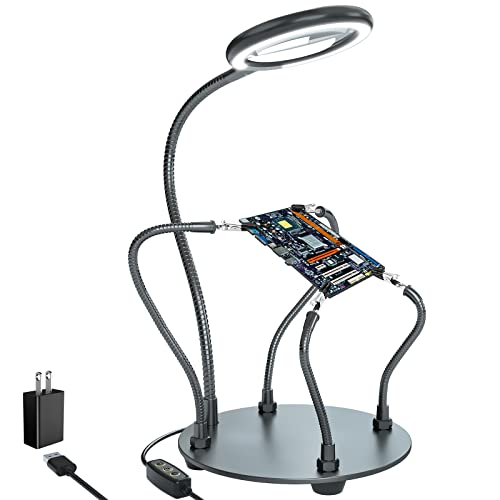
Small solder joints become easier to inspect when the holder brings its own light. This XYK station includes a 3X dimmable magnifying lamp with 28 LED beads, six brightness levels, and a listed 500-lumen illuminance. The lamp sits alongside four flexible arms, so a board can be held while the viewing angle and light position are adjusted separately.
The two 7.5-inch arms and two 5-inch arms provide a mix of reach and compact positioning. Rubber sleeves cover the alligator clips, and the round powder-coated steel base measures 7 inches across. A US plug, mini wrench, screwdriver, and cleaning cloth are listed in the package, giving the setup a more complete feel than a bare clamp stand.
Pros
- 3X magnifying lamp adds close-up visibility.
- Six brightness levels allow lighting adjustment.
- Four arms use different lengths for positioning.
- Protected clips help reduce scratches and shorting risk.
- Includes tools and a US plug according to the listing.
Cons
- Magnifier and lamp increase the station’s setup complexity.
- Shorter arms provide less reach than the largest stations.
This option suits detailed soldering, jewelry work, and repairs performed under uneven room lighting. It is a better fit than a plain stand for readers who frequently lean toward small joints, although the 3X figure alone does not guarantee a perfect view of every board. Keep the lamp and tool clearance in mind before placing it beside a soldering iron.
To buy this product, click here.
6. Helping Hands Clamp Metal — Best for Fast PCB and Wire Holding
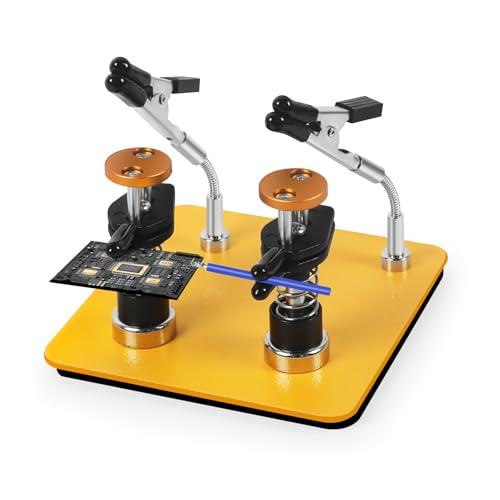
Two clamps can be more useful than four when the job is simple: one holds the PCB and the other holds a wire, lead, or connector. This compact stand adds quick-release operation, allowing components to be attached or removed with a press rather than repeated screw adjustment. That makes it appealing for repairs that involve several similar connections.
The 3.94 by 3.94-inch iron base uses a non-slip pad, while the clamps have soft rubber-coated jaws. The arms rotate for positioning and use screw adjustment to hold their selected angle. Its small footprint also makes it easier to move into a crowded workspace or pack into a repair kit.
Pros
- Dual-clamp layout holds a board and wire together.
- Quick-release mechanism speeds up component changes.
- Rubber-coated jaws help protect delicate parts.
- Compact iron base suits crowded benches.
- Rotating arms support adjustable working positions.
Cons
- Only two clamps are available for multi-point assemblies.
- Small base offers less support area than full-size stations.
This is the efficient choice for repetitive two-part jobs, automotive wiring, and compact electronics repairs. It lacks the magnifier and arm count of larger stations, but fewer parts can mean less fiddling before the soldering begins. Choose it for speed and portability rather than broad project support.
To buy this product, click here.
7. Kaisiking Helping Hands Soldering Station — Best Compact Magnifier Setup

Kaisiking combines four flexible arms with a handheld 2.5X magnifier, giving small repairs a basic optical aid without the larger lamp assembly found on some stations. The 7.87 by 5.51-inch painted steel base is sized for a normal bench, and five anti-slip pads are listed underneath.
The four 8.34-inch gooseneck arms use 360-degree rotating clips with rubber boots. The listing also includes eight Phillips screws, eight anti-slip rubber feet, and a manual. Its adjustment instructions specifically address turning the rotating arm counterclockwise so the screw connection tightens rather than loosens during repositioning.
Pros
- Includes a 2.5X magnifying glass.
- Four arms provide multiple holding points.
- Rubber clip boots help protect boards and jewelry.
- Steel base has five anti-slip pads.
- Includes screws and feet for setup adjustment.
Cons
- Handheld magnifier may occupy one hand when repositioned.
- Arm length is shorter than some large workstation models.
Kaisiking fits buyers who want basic magnification and four-arm support in a moderate-size station. It is easier to place than a mat-based system, though the handheld lens is less convenient than an independently positioned lamp. This works best for occasional inspection and assembly rather than a fully equipped repair bench.
To buy this product, click here.
8. XYK Helping Hands Soldering Station — Best Conventional Four-Arm Value

XYK’s black four-arm station covers the core task without adding a lamp, magnifier, or magnetic base. It uses two 9.44-inch and two 7.08-inch metal gooseneck arms, giving the setup a useful blend of reach and shorter positioning. The arms screw into a 7.87 by 5.51-inch painted steel base.
Each alligator clip rotates 360 degrees and includes a rubber sleeve. That sleeve can help reduce scratches on polished surfaces and contact-related shorting around a PCB. The package includes four screws and a mini Phillips screwdriver, so assembly stays fairly direct for a basic bench holder.
Pros
- Four flexible arms support multi-point holding.
- Two arm lengths provide different reaches.
- 360-degree clips offer broad positioning.
- Rubber sleeves protect surfaces and components.
- Steel base includes four non-slip rubber pads.
Cons
- No magnifier or light is included.
- Arms must be screwed into fixed base positions.
This station makes sense for straightforward soldering, assembly, and hobby projects where a conventional four-arm layout is enough. It gives up the magnetic repositioning of higher-ranked models, but its uncomplicated design keeps the workspace focused on the workpiece. Add separate task lighting for small electronics.
To buy this product, click here.
9. NEIKO 01902 Adjustable Helping Hand — Best Simple Magnified Holder
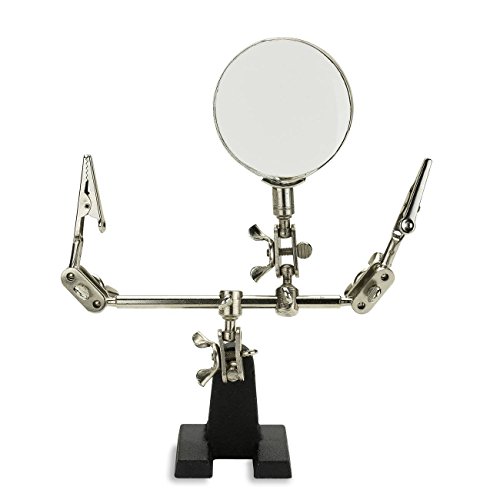
The NEIKO 01902 follows the classic third-hand design with two alligator clips, adjustable wire holders, and a 2X magnifying glass. Ball joints let the clips and lens move to different viewing angles, which is helpful for a small connector, wire splice, jewelry piece, or through-hole component.
A heavy-duty cast-iron base supplies the foundation, while the dual clips hold the workpiece during soldering, gluing, fastening, or assembly. The smaller number of arms limits how many parts can be supported at once, but it also keeps the tool visually simple and easy to understand.
Pros
- Heavy cast-iron base supports stable positioning.
- Includes an adjustable 2X magnifying glass.
- Ball joints allow flexible viewing angles.
- Dual clips suit basic component and wire work.
- Wire holders support soldering and assembly tasks.
Cons
- Two clips provide less capacity than four- or six-arm stations.
- Magnification is lower than the 2.5X and 3X options here.
NEIKO is a sensible pick for occasional small-part work where a heavy base and magnifier matter more than maximum adjustability. It may feel limiting during a complex board repair with several loose wires, but its traditional layout remains useful for simple joints and craft work. Choose a larger station if multiple support points are a regular requirement.
To buy this product, click here.
Buying Guide: What Matters in Helping Hands for Soldering
Base Stability Sets the Working Limit
A holder can have beautifully flexible arms and still be frustrating if the base slides when a clamp is tightened. Heavy steel or cast iron generally gives a more planted foundation, while rubber feet help reduce movement and protect the bench. Large bases take more room, but that extra footprint often matters when a PCB and several wires are being positioned together.
Arm Count Is Useful Only With Good Positioning
Four, five, or six arms create more support points, yet arm count alone does not guarantee a better setup. Fixed screw positions are predictable, while magnetic arms can move across a base quickly. Look at the arm lengths too. Long arms reach around a board, while shorter arms can hold small parts without creating as much clutter.
Protective Clip Covers Matter Around PCBs
Bare alligator clips can mark delicate surfaces or contact conductive areas. Rubber or silicone sleeves provide a buffer, although they do not eliminate the need to position clips carefully. Check whether the covers are included rather than assuming every compatible-looking clip has them.
Magnification and Lighting Solve Different Problems
A magnifier enlarges the view, while a lamp improves contrast and reduces shadows. A 3X lens may be useful for small joints, but the practical result also depends on lens position, working clearance, and whether the tool blocks access for the soldering iron. A separate bench light can be more flexible than a fixed lamp.
Magnetic Bases Trade Speed for Setup Space
Magnetic arms are convenient when a project changes position repeatedly. They can be moved across the plate rather than unscrewed from a fixed hole. That convenience is most useful on a broad steel base. A compact fixed-arm stand may be easier to store and perfectly adequate for repeated tasks with the same arrangement.
Do Not Treat a Soldering Mat as an ESD Mat
Silicone mats can provide heat resistance and compartments for tools, but heat resistance does not establish ESD performance. If static control is required for sensitive electronics, look for explicit ESD information and follow the rest of the handling procedure. The Kaisi mat is listed as heat resistant, but its supplied information does not identify ESD properties.
Best Helping Hands for Soldering FAQ
What are helping hands used for in soldering?
Helping hands hold a PCB, wire, connector, or small assembly while you use both hands for solder, an iron, cutters, or tweezers. They also help keep a joint at a repeatable angle during inspection and assembly.
Are four arms better than two?
Four arms can support a board and several wires at once, which helps with larger or more complicated assemblies. Two arms may be faster for a simple board-and-wire repair and usually occupy less space.
Are magnetic helping hands better?
Magnetic arms make repositioning faster across a compatible steel base. They are especially useful when board layouts change often. Fixed-arm models can be simpler and may suit a repeated setup with limited bench space.
Do silicone clip covers protect circuit boards?
They can reduce scratching and provide a buffer around conductive surfaces, but careful placement is still necessary. Clip covers do not make a holder ESD-safe, and the product information should support any specific ESD claim.
Is a magnifying glass necessary for soldering?
A magnifier helps with small joints, fine wires, and inspection, but it is not required for every project. Good lighting, adequate working clearance, and a stable board often matter just as much for ordinary through-hole work.
What base size should a helping-hands tool have?
Choose a base that fits the bench while leaving room for the soldering iron, solder, and your hands. Larger bases generally give more stability and arm-placement freedom, while compact bases are easier to store and move.
Can helping hands hold large circuit boards?
That depends on the clamp spacing, arm reach, base stability, and board weight. The listed products are intended for small work, PCB repair, electronics, jewelry, and craft tasks. Check the current product details for board-size limits before using an unusually large or heavy assembly.
Final Verdict
The NOEVSBIG Magnetic Helping Hands Soldering Station is the strongest overall choice because its heavy base, five magnetic arms, six PCB holders, and protected 360-degree clamps address the main practical demands of bench soldering. It gives a board more ways to sit still while leaving room to position wires, components, and tools around it.
The larger Magnetic Helping Hands Third Hand is the premium workstation pick for readers who can use its lamp, vise, and hot-air holder. Kaisi is a better match for a broad, mat-based workspace, while the dual-clamp stand suits quick repairs in a tight area. Match the station to the projects in front of you. A stable two-clamp tool is plenty for a wire repair, but multi-arm magnetic support becomes valuable once the bench starts filling with boards and loose leads.

- Jesse
Jesse is the editor behind Soldering Gear, where he covers soldering irons, stations, rework equipment, and the tools that belong on a practical electronics bench. His work focuses on comparing product specifications, features, compatibility, and intended uses so readers can make more informed buying decisions.
- Best Soldering Iron for SMD: 9 Picks in 2026 October 15, 2026
- Best Hot Air Rework Station for SMD: 9 Picks in 2026 October 14, 2026
- What Tools Do You Need for Soldering Electronics? October 13, 2026
- Best USB-C Soldering Iron: 9 Picks in 2026 October 12, 2026
- How to Choose Solder for Electronics October 11, 2026