Best Hot Air Rework Station for SMD: 9 Picks in 2026

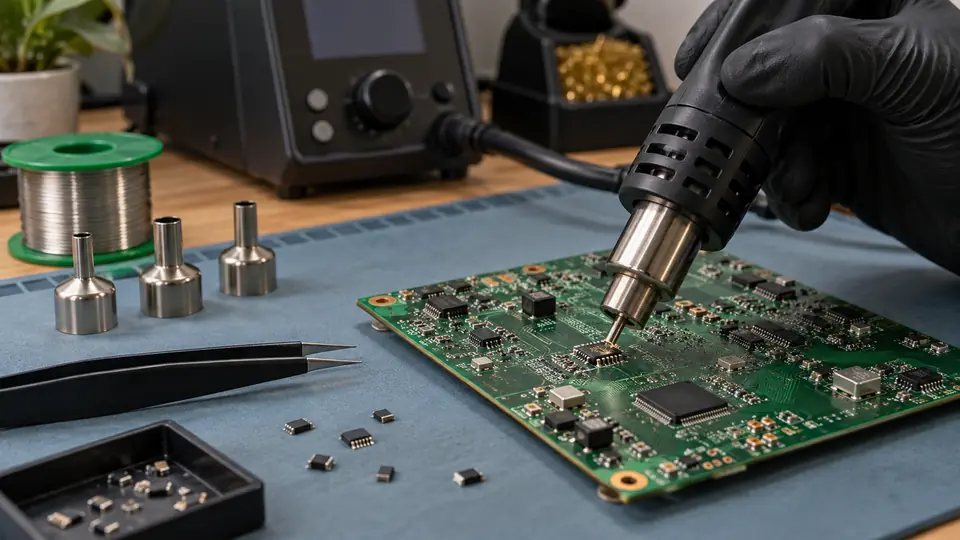
Small SMD parts punish sloppy heat. A nozzle that is too broad can warm neighboring components, while excessive airflow can send a loose resistor skittering across the board. The right hot air rework station gives you adjustable temperature, controllable airflow, and nozzle choices that make chip removal and reflow more deliberate instead of a frantic dance with a heat gun.
Temperature range alone does not tell the whole story. Airflow adjustment matters just as much for small packages, and standby cooling can reduce unnecessary heat buildup between jobs. A separate hot air station may suit someone who already owns a soldering iron, while a 2-in-1 setup makes more sense for a compact repair bench. The WEP 959D stands out overall because it combines adjustable controls, a quick-change nozzle system, calibration functions, and a useful storage arrangement without adding a second soldering station.
This comparison weighs the details that affect SMD work directly, including temperature control, airflow handling, nozzle selection, standby behavior, workspace demands, and whether a product includes a conventional soldering iron. Some models favor compactness, others offer broader bench capability, and the premium picks add power-supply functions or more complete repair kits.
Quick Answer
Best Overall: The WEP 959D offers the most balanced hot air setup for SMD work, with adjustable air volume, a quick-change nozzle system, calibration, a display, and five additional nozzles.
Best Preset Controls: The YIHUA 959D adds three memory channels, a 120 L/min maximum air volume, standby cooling, and a brushed aluminum control panel.
Best Budget Choice: The LRT 8858 keeps the focus on digital temperature control, F1-F10 airflow adjustment, six nozzles, and a compact footprint.
Best Complete Workbench: The YIHUA 853D combines hot air rework, a soldering station, and a variable DC power supply with voltage testing, making it the broadest option here for electronics repair.
Best Hot Air Rework Station for SMD Comparison Table
| Product | Best For | Temperature And Airflow | Standout Feature |
|---|---|---|---|
| WEP 959D | Best overall SMD setup | Adjustable temperature and air volume | Quick-change nozzles, calibration |
| YIHUA 959D | Preset-based bench work | 212°F to 932°F, up to 120 L/min | Three memory channels |
| LRT 858D | Lower-cost PCB repair | Digital temperature and airflow control | 700W heating system, brushless fan |
| WEP 8858-V | Small workbenches | Adjustable temperature and air volume | Palm-sized unit, PID control |
| LRT 8858 | Budget SMD rework | 212°F to 932°F, F1-F10 airflow | Six precision nozzles |
| WEP 858D | Existing soldering stations | 212°F to 896°F, adjustable airflow | Cylindrical ceramic heater |
| YIHUA 959D I | Phone and computer repair | 212°F to 896°F, up to 120 L/min | PID control, three nozzles |
| YIHUA 862BD+ | Complete 2-in-1 repair kits | Hot air and iron temperature control | Three displays, broad accessory kit |
| YIHUA 853D | Full electronics benches | 212°F to 896°F, up to 120 L/min | Hot air, iron, DC supply, meter |
The detailed reviews below show where each station fits, from a compact SMD-only setup to a more complete electronics repair bench.
1. WEP 959D Hot Air SMD Rework Station — Best Overall

The WEP 959D earns the top position by focusing closely on the tasks that make SMD rework frustrating: changing nozzles, dialing in heat, controlling airflow, and keeping the bench organized. Its quick-change nozzle system is paired with five additional nozzles, while the attached holder gives those small metal parts a defined parking spot instead of leaving them scattered beside the board. That combination is especially useful during a repair where a narrow nozzle is needed for a small package and a broader one is preferred for a larger component.
The control set is unusually practical for this class. The station provides an LCD display, adjustable air volume, Celsius and Fahrenheit conversion, temperature calibration, and a buzzer prompt. Calibration does not guarantee a particular component temperature, since board mass, nozzle distance, and airflow still affect the work area, but it gives the user a way to refine the station rather than simply accept the initial setting. The detachable hot air gun and ergonomic handle also suit repeated SMD work, where awkward hand positioning can turn a careful lift into a damaged pad.
Pros
- Quick-change nozzle system speeds up accessory changes.
- Includes five additional hot air nozzles and an attached nozzle holder.
- Adjustable air volume supports finer control around small components.
- Offers Celsius/Fahrenheit conversion, calibration, and a buzzer prompt.
- LCD display and detachable ergonomic hot air gun suit repeated bench work.
Cons
- The station is rated for 110-127V, so it is unsuitable for direct connection to a 220V outlet.
- It is a hot air-focused station, so buyers needing a conventional soldering iron must provide one separately.
This is the strongest fit for someone who already has a soldering iron or wants a dedicated hot air tool for SMD removal, reflow, and related heat work. The nozzle storage and calibration controls give it a more finished feel than a bare controller and gun, while the adjustable airflow keeps it useful across different package sizes. Buyers who want a single box containing both hot air and iron functions should look at the 2-in-1 models below instead.
To buy this product, click here.
2. YIHUA 959D Digital Hot Air Rework Station — Best For Preset Controls

Three preset channels give the YIHUA 959D a useful advantage for a bench that handles the same kinds of parts repeatedly. Instead of tapping through temperature and airflow adjustments every time, a user can save regular settings and recall them with a press. That does not remove the need to judge nozzle distance or protect nearby components, but it can make a sequence of similar repairs less fiddly, especially when a board contains several component sizes.
The listing gives this station a temperature range of 212°F to 932°F and a maximum hot air volume of 120 L/min. Those figures describe the station’s adjustment range and advertised air capacity, not a guaranteed component temperature or an automatic recommendation for every SMD package. Its in-holder standby function cools the gun while it rests, and the fail-safe feature is intended to address hot-air-gun faults. The brushed aluminum control panel adds a practical layer of protection against accidental heat marks on the front of the station.
Pros
- Three preset channels make recurring work easier to set up.
- Published temperature range runs from 212°F to 932°F.
- Advertised maximum air volume reaches 120 L/min.
- In-holder standby cooling reduces unnecessary heating while idle.
- Includes a 12-month US manufacturer technical coverage statement.
Cons
- The listing identifies three memory channels but does not detail how each setting is stored.
- Only three preset nozzles are included, fewer than the WEP 959D’s five additional nozzles.
This model suits a repair bench where repeatability and quick recall matter more than a large accessory bundle. It is a sensible step up from a basic temperature-and-airflow controller for users who often move between a few established settings. A buyer who changes nozzles constantly may prefer the WEP 959D’s quick-change arrangement, while someone who wants iron and hot air together should choose a 2-in-1 station.
To buy this product, click here.
3. LRT 858D 700W Digital Hot Air Rework Station — Best Budget PCB Choice

The LRT 858D keeps its pitch straightforward: a 700W heating system, digital temperature monitoring, adjustable airflow, and a compact station for PCB, IC, SMD, and connector work. The published wattage indicates available electrical heating power, but it should not be treated as a complete measure of rework quality. Heater design, control behavior, nozzle selection, and the thermal mass of the board still influence how easily a component releases.
A brushless fan is the clearest distinction here. The product information associates it with stable airflow, lower noise, and longer operating life than a traditional brushed motor. Those are listing claims rather than independent measurements, but the design choice is still relevant for a station that may spend long periods moving air across a board. The handle is described as ergonomic, and the station is listed for jobs ranging from USB-C port replacement to laptop maintenance, giving it a broad repair focus without adding a soldering iron or a large control suite.
Pros
- 700W heating system is specified for rapid heat-up and temperature recovery.
- Digital display makes the selected temperature easier to monitor.
- Adjustable temperature and airflow support different SMD tasks.
- Brushless fan design is listed for stable, lower-noise airflow.
- Compact format suits PCB repair and small electronics benches.
Cons
- The available information does not specify the included nozzle count or sizes.
- It does not include a conventional soldering iron for joint touch-up.
The LRT 858D is a good match for someone who wants a lower-cost dedicated hot air station and already owns the rest of the hand tools. Its controls cover the basics that matter for SMD, while the brushless fan gives it a more specific mechanical advantage than an anonymous entry-level unit. Buyers who need clearly documented nozzles or a more complete accessory kit may find the WEP and LRT 8858 alternatives easier to match to a particular board.
To buy this product, click here.
4. WEP 8858-V Hot Air Rework Station Kit — Best Compact Kit

The WEP 8858-V is shaped around a crowded workbench. Its palm-sized main unit includes an integrated hot air gun holder and nozzle holder, so the station takes less visual and physical space than a larger repair console. That can matter in a small apartment workspace or a mobile setup where the station is packed away after each board. The controls stay direct, with a simple air-volume knob rather than a menu-heavy interface.
Its PID program is described as continuously monitoring temperature and adjusting power output to maintain consistency. That control approach is useful for SMD because delicate work benefits from a predictable heat source, although the selected temperature remains a starting point rather than a promise about the component itself. The kit includes three additional nozzles plus bent and straight tweezers, and it adds Celsius/Fahrenheit conversion, digital calibration, and a hot-air fail-safe. The package therefore leans toward practical setup convenience rather than maximum airflow specifications.
Pros
- Palm-sized controller fits easily on a compact bench.
- Integrated gun and nozzle holders reduce loose accessories.
- PID temperature control and digital calibration support repeatable adjustments.
- Includes three nozzles plus straight and bent tweezers.
- Air volume is adjusted with an accessible front-panel knob.
Cons
- Only three additional nozzles are included.
- The 110-127V rating limits direct use with 220V power outlets.
This station makes sense for SMD work in which bench space is more precious than a large display or extensive preset system. The included tweezers are useful during component lifting, and the built-in storage helps keep the small kit together. A larger station may be more comfortable for continuous shop use, while the WEP 959D offers a broader nozzle package and more prominent display controls.
To buy this product, click here.
5. LRT 8858 Hot Air Rework Station — Best Budget SMD Kit
The LRT 8858 offers a lot of the basic control an SMD repair setup needs in a small package. Its temperature adjustment runs from 212°F to 932°F, while F1-F10 airflow adjustment gives the operator more than a single low-or-high choice. Fine airflow steps are useful around small packages, where a broad blast can disturb nearby parts or warm a larger region than intended.
The included kit is a strong reason to look at this model. Six precision nozzles are listed in 3, 4, 5, 6, 8, and 10 mm sizes, along with ESD tweezers, an IC extractor, a stand, and a power cable. The product information calls its temperature control microprocessor-controlled and describes an intelligent sleep function that begins cooling when the handle returns to the holder. Those features make the unit easier to use between tasks, though the listing does not provide a detailed airflow volume figure or a separate conventional soldering iron.
Pros
- Temperature adjustment covers 212°F to 932°F.
- F1-F10 airflow levels allow more graduated air adjustment.
- Includes six nozzles from 3 mm through 10 mm.
- Kit includes ESD tweezers, an IC extractor, stand, and power cable.
- Handle cooling mode activates when it is placed in the holder.
Cons
- The listing does not state a maximum airflow volume.
- No conventional soldering iron is included.
This is a practical entry point for someone building a dedicated SMD station on a limited budget. The nozzle spread is particularly useful because it lets the user match the heated area more closely to the package instead of relying on one universal opening. Buyers who want a stronger documented control feature set may prefer the WEP 959D, while those who need through-hole soldering as well should choose a 2-in-1 model.
To buy this product, click here.
6. WEP 858D Hot Air Rework Station — Best For Existing Soldering Benches
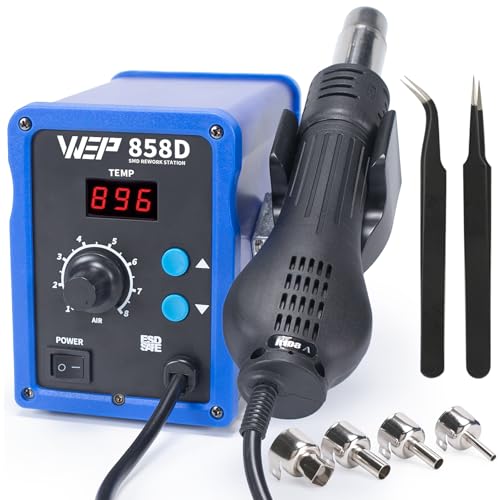
For a bench that already has a reliable soldering iron, the WEP 858D keeps the purchase focused. It is a dedicated hot air station with a digital display, adjustable temperature from 212°F to 896°F, adjustable air volume, and four extra nozzles. That arrangement avoids paying for a second iron while adding the heat source needed for SMD component removal, conformal coating work, heat-shrink tubing, and similar jobs.
The station’s cylindrical ceramic heating element and PID temperature stabilization are presented as the basis for consistent heating and rapid compensation. These are published design claims, not independent measurements, yet they point to the feature that matters most: control should respond as work conditions change. The automatic standby function begins cooling the gun to 212°F when it is returned to the holder, then stops the blower and heating element at that point. It is a useful idle routine for a station that may sit between board repairs.
Pros
- Dedicated hot air design suits benches that already have an iron.
- Adjustable range spans 212°F to 896°F.
- PID temperature stabilization is included in the product design.
- Automatic standby cooling reduces idle heating.
- Four extra nozzles support different component sizes.
Cons
- It does not include a soldering iron or general soldering accessories.
- The station is rated for 110-127V US power.
The WEP 858D is best for a user who wants a clean, dedicated addition to an established electronics bench. It has the core controls needed for SMD work without the bulk of a combined station. The WEP 959D is a better fit for buyers who want calibration and five additional nozzles, while the WEP 858D remains attractive for straightforward hot air work with fewer extras.
To buy this product, click here.
7. YIHUA 959D I Digital Hot Air Rework Station — Best For Phone And Computer Repair
The YIHUA 959D I is aimed at the kind of mixed repair bench where a single day might involve a phone board, a computer component, and a household electronic assembly. Its listed temperature range is 212°F to 896°F, and adjustable airflow reaches a stated maximum of 120 L/min. That broad adjustment envelope gives the operator room to work across component sizes, but the correct setting still depends on the board, nozzle, solder, and distance from the work surface.
PID control monitors and compensates for hot air temperature in real time according to the listing. The station also shows real-time temperature on its display and enters standby mode when the gun is returned to the holder, cooling to 212°F before resuming operation when lifted. Three nozzles, sized at 5 mm, 8 mm, and 10 mm, are included, along with two ESD-safe tweezers. The accessory selection is useful for lifting ICs, though it is narrower than the six-nozzle kit included with the LRT 8858.
Pros
- Adjustable airflow is listed up to 120 L/min.
- PID control is specified for real-time temperature compensation.
- Standby cooling begins when the gun is returned to its holder.
- Includes 5 mm, 8 mm, and 10 mm nozzles.
- Two ESD-safe tweezers are included for lifting components.
Cons
- The included nozzle range is less granular than the LRT 8858 kit.
- It is a hot air-only station without a built-in soldering iron.
This model suits repair work that moves between small boards and somewhat larger components, especially where standby behavior matters during frequent pauses. Its 120 L/min listing gives it a broad airflow ceiling, while the three included nozzles keep the package focused. A buyer needing many nozzle sizes immediately may prefer the LRT 8858, and someone seeking repeat presets should look at the YIHUA 959D.
To buy this product, click here.
8. YIHUA 862BD+ 2-in-1 Rework Station — Best Complete Soldering Kit
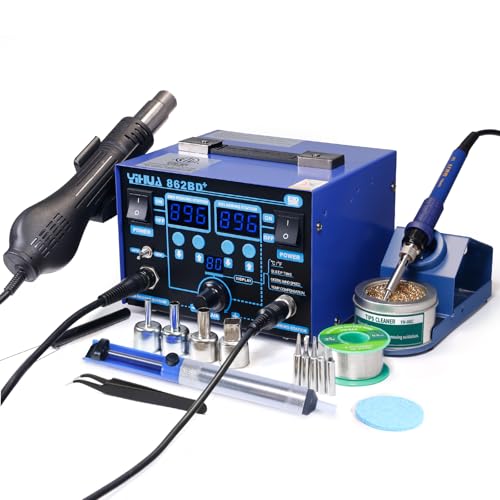
The YIHUA 862BD+ makes sense for someone starting with a bare bench and wanting both hot air and conventional soldering in one station. Its package includes a lead-free solder roll, five soldering tips, four hot air nozzles, ESD-safe tweezers, a desoldering pump, a metallic iron holder, brass wool, a sponge, and an IC popper. That assortment can reduce the number of separate purchases needed for basic board work, although individual accessory quality and long-term replacement availability should still be checked before relying on any one item.
The station uses separate controls for the iron and hot air functions, with three digital displays showing temperature and simulated air volume parameters. The soldering iron is adjustable from 392°F to 896°F, while the hot air side is controlled separately. The product information also lists PID temperature stabilization, an adjustable 0-to-99-minute sleep mode, detachable handpieces, and ESD-safe design. The three-display layout gives more information at a glance than a simple single-gun controller, though the station occupies more bench space than a dedicated hot air unit.
Pros
- Combines a soldering iron and hot air rework station.
- Includes five soldering tips and four hot air nozzles.
- Package includes solder, tweezers, desoldering pump, brass wool, and sponge.
- Three digital displays show separate operating information.
- Offers PID stabilization, adjustable sleep mode, and detachable handpieces.
Cons
- The combined design takes more space than a dedicated hot air station.
- The available product information does not specify the hot air temperature range as clearly as some dedicated models.
This is the better route for a repairer who needs to remove an SMD part with hot air, clean the pads, and install or touch up joints with an iron. The accessory bundle gives the setup a head start, and the separate displays make the two heat sources easier to monitor. Buyers who already own a soldering iron should save space with the WEP 959D or WEP 858D instead.
To buy this product, click here.
9. YIHUA 853D 3-in-1 Rework Station — Best Full Electronics Workbench

The YIHUA 853D goes beyond hot air by adding a soldering station and a variable DC power supply with voltage-test mode. The hot air section is adjustable from 212°F to 896°F with a listed maximum air volume of 120 L/min. The DC section provides 0 to 15V and 0 to 2A output, plus a mode for measuring up to 35V DC, while a 5V USB port is listed for charging or powering compatible small devices. For electronics repair, that combination can turn one station into the center of a much broader bench setup.
Both the hot air and soldering sections use PID temperature stabilization according to the product information. The soldering side adjusts from 392°F to 896°F, and the station includes sleep mode and automatic shutdown functions. The three sections can operate independently or at the same time, which matters when a board needs hot air for component removal while another device is powered or checked. This is a substantial purchase for someone who wants only occasional SMD rework, but its extra capability is difficult to match with a simple hot air controller.
Pros
- Combines hot air rework, soldering, and a DC power supply.
- DC output is adjustable from 0 to 15V and 0 to 2A.
- Includes DC measurement mode up to 35V and a 5V USB port.
- Hot air airflow is listed up to 120 L/min.
- Independent operation, PID control, sleep mode, and automatic shutdown are included.
Cons
- The larger multi-function design is excessive for buyers who need hot air alone.
- The listing does not identify a detailed hot air nozzle assortment.
The 853D is the strongest choice for a serious electronics bench where powering, measuring, soldering, and reworking boards are all part of the routine. The integrated supply can reduce cable clutter and save separate bench space, while the hot air section remains suitable for SMD tasks. A dedicated station will be easier to justify for occasional rework, and the YIHUA 862BD+ is a more compact 2-in-1 choice for users who do not need DC output.
To buy this product, click here.
Buying Guide
Airflow Control Matters Around Small SMD Packages
Airflow determines how broadly heat is distributed and how easily a loose component can move. A station with a simple adjustable air volume is more useful than one that offers only a strong blast, especially around tiny resistors, capacitors, and closely spaced IC pins. The LRT 8858’s F1-F10 adjustment gives it unusually clear step-based control, while the WEP and YIHUA units provide variable airflow through their control systems. More air is not automatically better. A lower setting with a suitable nozzle can give a cleaner lift and reduce heating of nearby parts.
Nozzle Size Changes the Heated Area
A narrow nozzle concentrates hot air around a small component, while a broader opening can warm a larger package more evenly. The LRT 8858 lists six nozzle sizes from 3 mm to 10 mm, and the WEP 959D includes five additional nozzles with a quick-change system. Other stations include three or four sizes. Check the actual included sizes before ordering, since a station may support useful nozzle changes without including every size in the box.
A Temperature Setting Is a Starting Point
The number on a display represents the station’s selected setting, not a guaranteed temperature at the component. Nozzle distance, airflow, board thickness, solder type, copper area, and nearby thermal mass all affect the result. PID control and calibration can help create a more controlled process, but they do not replace gradual heating and careful observation. Avoid choosing solely by the highest advertised temperature. Most of the stations here reach a range broad enough for common SMD rework, so control and airflow are often more useful differentiators.
Standby Cooling Is Useful Between Repairs
Hot air guns often sit in their holders while the operator checks a board, reaches for tweezers, or cleans pads. Automatic cooling or standby behavior reduces the time the heating element and blower operate at full heat. The WEP 858D, YIHUA 959D, YIHUA 959D I, and LRT 8858 all list cooling or standby functions, while other models focus more on direct control and accessory storage. These features do not eliminate safe handling requirements, so the gun should still be placed in its holder carefully and allowed to cool as directed.
Dedicated Hot Air Versus 2-in-1
A dedicated station is a cleaner choice if you already own a soldering iron. It usually takes less space than a combined unit and keeps the controls focused on airflow and hot air temperature. The WEP 959D and WEP 858D fit that role well. A 2-in-1 station becomes more attractive if the same bench handles component removal, pad cleanup, soldering, and touch-up. The YIHUA 862BD+ includes a broad accessory kit, while the YIHUA 853D adds a DC supply and voltage testing for a more complete electronics setup.
Check Voltage Before Ordering
Several stations in this roundup are rated for 110-127V or 110V, 60Hz operation. That rating matters more than a familiar model name or a universal-looking plug. The WEP 959D, WEP 8858-V, WEP 858D, YIHUA 959D, YIHUA 959D I, YIHUA 862BD+, and YIHUA 853D list US-oriented voltage requirements. Confirm the current product details and your workspace supply before connecting a station, particularly if the bench uses 220V mains.
Best Hot Air Rework Station for SMD FAQ
What Temperature Should I Use For SMD Rework?
There is no single setting that suits every board or component. Start with the solder and component requirements, then adjust temperature and airflow while keeping the nozzle moving appropriately. A station’s displayed setting is not the same as the actual component temperature. Board copper, package size, nozzle diameter, and distance from the board all change how heat reaches the joint.
Is Higher Wattage Better For Hot Air SMD Work?
Higher wattage can indicate more available heating power, but it does not automatically mean better rework. Heater design, temperature control, airflow, nozzle shape, and thermal recovery also matter. The LRT 858D lists 700W, while other products emphasize PID control, ceramic heating elements, or maximum airflow. Compare the complete control system instead of ranking stations by wattage alone.
Do I Need A Separate Soldering Iron?
Only if you choose a dedicated hot air station and do not already own an iron. Dedicated models such as the WEP 959D and WEP 858D are useful additions to an existing bench. The YIHUA 862BD+ combines hot air and a soldering iron, while the YIHUA 853D adds a soldering section plus a DC power supply and meter.
How Many Nozzles Should A Hot Air Station Include?
There is no universal number. A useful kit should offer sizes that match the packages you expect to rework. Smaller nozzles can concentrate heat on small parts, while larger openings can cover broader packages. The LRT 8858 lists six sizes, and the WEP 959D includes five additional nozzles. Check the actual diameter range rather than counting accessories without knowing their sizes.
Are Hot Air Rework Stations Suitable For Phone Repair?
Several products are listed for phone and computer repair, including the LRT 858D and YIHUA 959D I. Suitability still depends on the board, component, nozzle, airflow, and operator technique. Dense phone boards leave little room for careless heat, so adjustable airflow, careful temperature selection, and suitable tweezers are valuable.
What Does PID Temperature Control Do?
PID control is a feedback approach that monitors temperature and adjusts power to approach or maintain a selected setting. Product listings for several stations describe PID stabilization or compensation. It can support more consistent heat control, but it does not guarantee a fixed temperature at the component because the board and airflow conditions keep changing.
Do Hot Air Stations Need Calibration?
Calibration can be useful if a station provides that function, as the WEP 959D and WEP 8858-V do. It gives the operator a way to refine the control reference. Calibration is still different from measuring the exact temperature at every component, so it should be used alongside sensible nozzle distance, airflow, and heat application.
Final Verdict
The WEP 959D is the strongest overall choice for SMD rework because it balances the details that matter at the board: adjustable airflow, an LCD display, quick nozzle changes, five additional nozzles, calibration, and a dedicated hot air format. It is a particularly sensible pick for a bench that already has a soldering iron. The YIHUA 959D is the better alternative for users who rely on three repeatable preset channels and want a stated 120 L/min maximum air volume, while the LRT 8858 is the budget-oriented option with six listed nozzles and F1-F10 airflow adjustment.
Choose a 2-in-1 station if you are building a first repair bench and need an iron alongside hot air. The YIHUA 862BD+ supplies a broad starter kit, while the YIHUA 853D is the premium-style workbench choice because it adds a variable DC supply and voltage testing. Before ordering, verify the voltage rating, nozzle sizes, included accessories, and the amount of space available beside your board. A station with the highest temperature number is rarely the automatic winner. Controlled airflow, sensible nozzle selection, standby behavior, and a setup that matches the rest of your tools will matter more once the board is on the mat.

- Jesse
Jesse is the editor behind Soldering Gear, where he covers soldering irons, stations, rework equipment, and the tools that belong on a practical electronics bench. His work focuses on comparing product specifications, features, compatibility, and intended uses so readers can make more informed buying decisions.
- Best Soldering Iron for SMD: 9 Picks in 2026 October 15, 2026
- Best Hot Air Rework Station for SMD: 9 Picks in 2026 October 14, 2026
- What Tools Do You Need for Soldering Electronics? October 13, 2026
- Best USB-C Soldering Iron: 9 Picks in 2026 October 12, 2026
- How to Choose Solder for Electronics October 11, 2026