Best Budget Soldering Station: 9 Picks in 2026

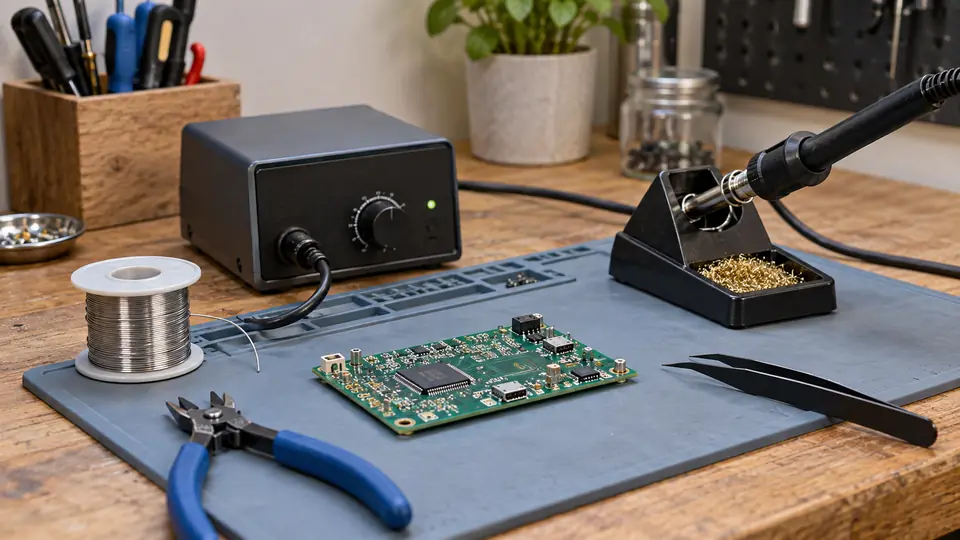
A budget soldering station should give you controlled heat, a usable stand, and enough thermal capacity for ordinary electronics work without turning a small bench into a crowded repair shop. The hard part is separating useful temperature control from impressive-looking numbers. A station with a broad temperature range may still be a poor choice if its tip system is inconvenient, its controls are awkward, or its included accessories do little to support real projects.
Wattage deserves a careful reading too. A 130W maximum claim does not automatically mean better soldering than a well-controlled 60W station, since heater design, tip size, temperature regulation, and the workpiece all affect the joint. Sleep modes, calibration functions, helping hands, and replacement-tip availability can matter more during a long evening of circuit-board repairs. The WEP 927-IV stands out for combining useful presets, a double temperature display, lighting, and bench accessories in one compact package.
The choices below range from simple stations for occasional repairs to sturdier models suited to frequent electronics work. I weighed temperature control, included tips, bench organization, voltage requirements, accessory usefulness, and the trade-offs behind each listing rather than ranking by wattage alone.
Quick Answer
Best Overall: The WEP 927-IV offers the most complete budget-oriented station setup, with three temperature presets, separate set and actual temperature displays, two helping hands, an LED magnifier, and a 110W heating element.
Best Lower-Cost Station: The WEP 926LED V3 keeps the footprint compact and includes the basics needed for getting started, including five tips, solder wire, tweezers, and a desoldering pump.
Best for Regular Electronics Work: The YIHUA 939D+ brings a built-in transformer, metal construction, temperature calibration, and a 75W-equivalent design to a more substantial bench setup.
Best for Hot-Air Rework: The WEP 882D adds a separately controlled hot-air tool, making it more suitable for SMD work than a conventional iron alone.
Best Budget Soldering Station Comparison Table
| Product | Best For | Temperature Range | Standout Feature |
|---|---|---|---|
| WEP 927-IV | Best overall | 194°F to 896°F | Presets and double display |
| YIHUA 939D+ | Frequent bench use | 392°F to 896°F | Built-in transformer |
| YIHUA 926 III Digital | Organized starter setup | 194°F to 896°F | Helping hands and calibration |
| WEP 926LED V3 | Compact budget setup | 392°F to 896°F | Integrated holder |
| Weller WE1010NA | Stable temperature control | Not specified in supplied information | Temperature lock |
| 100W Digital Soldering Station | Small workspaces | 356°F to 896°F | Long adjustable sleep timer |
| WEP 882D | Iron and hot-air work | 392°F to 896°F iron | Three hot-air nozzles |
| 8586D 2-in-1 Station | Dual-tool flexibility | 356°F to 932°F iron | Adjustable air speed |
| YIHUA 926 III LED | Accessory-rich setup | 194°F to 896°F | 15 listed extras |
The detailed reviews explain how each station handles temperature control, workspace organization, included tools, and the compromises behind its ranking.
1. WEP 927-IV: Best Overall
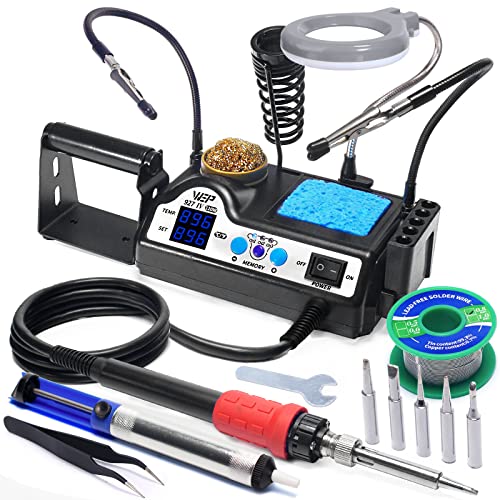
A crowded repair bench can become a tangle of loose tips, clipped wires, and a magnifier that keeps sliding away. The WEP 927-IV addresses that familiar mess with an integrated holder, tip storage slots, solder wire dispenser, two helping hands, and an LED magnifier. Those details make the station especially appealing for through-hole work, small circuit boards, and repairs where holding a component steady matters as much as heating the joint.
The station lists a 110W heating element and a temperature range from 194°F to 896°F. Its double numerical display shows the set temperature and actual temperature at the same time, while three preset channels reduce repeated knob adjustments. That combination is more useful than a large maximum-temperature figure alone. A user can keep separate settings for different soldering tasks and switch between them without starting from scratch. The WEP #1400 tip family is specified for this model, so future tip purchases should be matched carefully.
Pros
- Three preset channels make repeated temperature changes quicker.
- Double display shows the set and actual temperature together.
- Includes two helping hands and an LED magnifier.
- Integrated storage keeps tips and solder wire close to the work area.
- Sleep timing can be set from 0 to 99 minutes.
Cons
- It uses WEP #1400 tips, so tip compatibility should be checked before ordering replacements.
- The 110-127V requirement limits use with incompatible power systems.
This is the strongest match for someone who wants a complete station rather than a bare iron and stand. The lighting and helping hands are handy for small assemblies, while the presets suit projects that alternate between leaded and lead-free soldering temperatures. Buyers who already own a strong magnifier or prefer a simple, uncluttered bench may find the built-in accessories less valuable, but the combination is difficult to match at this level.
To buy this product, click here.
2. YIHUA 939D+: Best for Regular Bench Use

The YIHUA 939D+ takes a more traditional station approach. Its published information describes a 75W-equivalent system with a built-in transformer, a brushed-aluminum control panel, and a separate metal-alloy iron stand. That layout suits a bench where the iron holder can sit beside the control box instead of consuming space on top of it. The result is less of an all-in-one kit and more of a focused soldering station for repeated work.
Temperature adjustment runs from 392°F to 896°F, with a digital Celsius and Fahrenheit display, calibration support, and automatic handle detection. The listing describes a control program that compensates for temperature changes, but the supplied information does not provide independent testing data. Still, the feature set points toward steadier operation than a fixed-temperature iron. It includes fewer workholding accessories than the WEP 927-IV, so the value here rests more on station construction and control than on extras.
Pros
- Built-in transformer is specified for contact-safe low-voltage output.
- Brushed-aluminum control panel and metal-alloy stand suit regular bench use.
- Temperature calibration support allows adjustment of the control setting.
- Automatic handle detection adds a useful control feature.
- Displays temperature in either Celsius or Fahrenheit.
Cons
- The 392°F minimum is higher than several competing stations in this group.
- It includes fewer workholding and desoldering accessories than the kit-focused options.
Choose this model if the station itself matters more than receiving a box full of small tools. It makes sense for someone building a dedicated electronics bench and expecting to solder often. A first-time buyer who still needs helping hands, multiple tips, solder wire, and a pump may get more immediate utility from the WEP 927-IV or YIHUA 926 III.
To buy this product, click here.
3. YIHUA 926 III Digital: Best Starter Station Kit
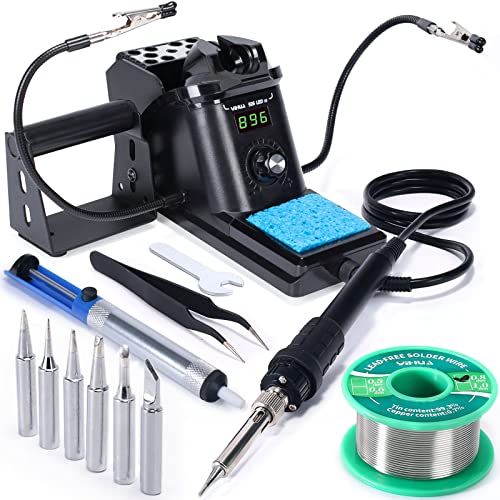
The YIHUA 926 III is aimed at the buyer who wants to open the package and begin assembling rather than shop for every supporting tool separately. It includes two helping hands, six YIHUA #1200/900M series tips, lead-free solder wire, a solder sucker, tweezers, a wire dispenser, and a cleaning sponge. On a small desk, the integrated holder and rear mesh tip storage keep much of that equipment within arm’s reach.
The station offers a 194°F to 896°F range, PID temperature stabilization, Celsius and Fahrenheit conversion, digital calibration, and sleep settings of 5, 10, or 30 minutes. Those controls give it a broader low-end range than the WEP 926LED V3. The supplied information identifies this exact model as a 60W station for 110-127V operation. It is a sensible fit for circuit boards, hobby repairs, and learning projects, although buyers should confirm replacement-tip availability for the specified tip family.
Pros
- Includes two helping hands for holding components and boards.
- Six listed tips cover several soldering shapes and tasks.
- Offers digital calibration and adjustable sleep timing.
- Temperature range starts at 194°F, giving more low-temperature flexibility.
- Includes a solder sucker, tweezers, solder wire, and cleaning sponge.
Cons
- The 60W rating provides less listed power than the higher-power stations here.
- The included lead-free solder may require different settings and technique than leaded solder.
This station is a strong choice for a first organized setup, especially if a bare iron would leave you buying accessories one by one. Its 60W rating is adequate for many ordinary electronics jobs, but large metal connectors or heavy ground planes can demand more patience and careful tip selection. Pick it over the WEP 926LED V3 when the helping hands, six tips, and lower temperature range matter more than the lowest initial cost.
To buy this product, click here.
4. WEP 926LED V3: Best Compact Budget Station

A narrow desk benefits from a station that does not scatter its holder, sponge, and tools across the work surface. The WEP 926LED V3 builds the iron holder into the station body and includes five extra tips, solder wire, tweezers, a desoldering pump, and a tip cleaner. That arrangement gives occasional repair work a tidy starting point without requiring a separate iron stand.
The listing gives a 392°F to 896°F adjustment range and describes PID control that compensates for temperature changes. Its display shows the current temperature, while sleep mode activates after more than 10 minutes of inactivity. The product is rated for 110-127V operation. The advertised 130W maximum should be read as available power information, not a guarantee that every joint heats faster than a lower-wattage station, since tip geometry and workpiece mass still matter.
Pros
- Integrated holder saves space on a compact workbench.
- Includes five extra tips, solder wire, tweezers, and a desoldering pump.
- PID temperature control is listed for compensation during use.
- Sleep mode reduces idle heating after more than 10 minutes.
- Temperature display can switch between Fahrenheit and Celsius.
Cons
- The minimum listed temperature is 392°F, higher than some alternatives.
- The supplied information does not identify a calibration function for this model.
For a small electronics corner, this is an efficient package. It gives you the station, holder, consumables, and basic desoldering tools in one compact footprint. The WEP 927-IV offers more control through presets and a double display, while the YIHUA 926 III offers a lower listed temperature range. This WEP model earns its place for buyers who want a straightforward, space-conscious setup.
To buy this product, click here.
5. Weller WE1010NA: Best for Temperature Stability
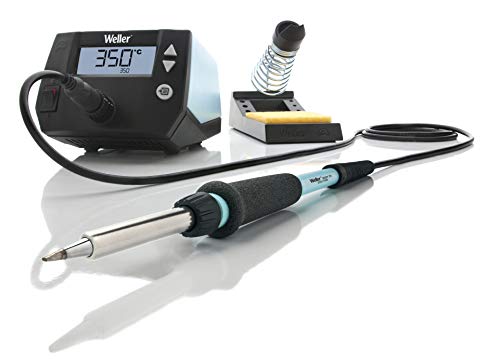
The Weller WE1010NA takes a more focused approach than the accessory-heavy kits. It includes a 70W station, WEP70 iron, PH70 safety rest with sponge, tip retainer, and a 1.6 mm screwdriver tip. The listing emphasizes temperature stability of plus or minus 4°F, or 2°C, along with a temperature lock intended to protect settings and components. For repeatable bench work, those controls may matter more than receiving a solder sucker and spare tweezers in the box.
Its standby mode and auto setback address the familiar moment when an iron sits hot beside a half-finished board. Password protection helps preserve settings, while the heat-resistant silicone cable is intended to make the handpiece easier to manage. The supplied information does not state the station’s full adjustment range, so it is harder to compare directly with the other models by temperature span. It also sits at a higher price tier, making the value question more about control and brand-specific equipment than a complete beginner kit.
Pros
- Published temperature stability is listed at plus or minus 4°F, or 2°C.
- Temperature lock helps prevent unintended setting changes.
- Includes a heat-resistant silicone cable on the handpiece.
- Standby and auto-setback functions reduce idle heating.
- Password protection helps preserve station settings.
Cons
- The supplied information does not state the full temperature adjustment range.
- The package includes fewer general-purpose accessories than the kit-style competitors.
This is the pick for a buyer who values controlled, repeatable operation and is willing to pay more for a focused station. It is less appealing for a first project box that needs helping hands, solder wire, and a pump immediately. The included 1.6 mm screwdriver tip is a practical general-purpose starting point, but additional tip needs should be checked against the WEP70 system before purchase.
To buy this product, click here.
6. 100W Digital Soldering Station: Best for Workspace Organization

This compact green station is built around a practical bundle: two helping hands, five tips, a solder sucker, tweezers, a solder wire dispenser, a sponge, a tip cleaner, and small tools. Imagine a repair session where the board stays clipped in place and the pump is already beside the iron. That is the convenience this package is trying to provide, especially for home electronics repairs and small DIY jobs.
The temperature range is listed as 356°F to 896°F, with Celsius and Fahrenheit conversion and calibration support. Its sleep timer can be set from zero to 600 seconds, and the product information also lists an on/off switch. The four-vent steel-pipe design is described as helping cool the iron during interruptions, while the silicone-sheathed handle is intended to improve handling. The listing does not provide a named tip family, so replacement-tip research should happen before the included five tips wear out.
Pros
- Includes two helping hands for holding components during soldering.
- Offers temperature calibration and Celsius/Fahrenheit conversion.
- Sleep timer can be adjusted from 0 to 600 seconds.
- Includes five tips, a pump, tweezers, wire dispenser, and tip cleaner.
- Compact design suits workbenches with limited room.
Cons
- The supplied information does not identify the replacement-tip family.
- The minimum listed temperature is 356°F, which may be higher than needed for some delicate tasks.
This station suits someone who wants a broad accessory package and a clear digital control panel without moving up to a more specialized bench unit. The uncertain tip-family information is the main ownership detail to resolve. Buyers who expect regular tip replacement should confirm availability, while those focused on occasional repairs may find the included tools more valuable than a larger replacement ecosystem.
To buy this product, click here.
7. WEP 882D: Best Two-in-One Rework Station

A conventional iron handles many through-hole joints, but SMD work can call for warm air and a nozzle that spreads heat across several connections. The WEP 882D combines a soldering station and hot-air rework station in one compact body, with separate LED displays, controls, and power switches. That makes it a useful step up for board work involving small surface-mounted parts, provided the user understands that hot-air settings do not equal exact component temperature.
The iron adjusts from 392°F to 896°F, while the hot-air tool adjusts from 212°F to 896°F with variable air volume. Three hot-air nozzles, five iron tips, two solder spools, brass wool, tweezers, and a desoldering pump are included. Sleep mode for the iron, standby for the hot-air tool, automatic shutdown, and calibration add control. Its 110-127V rating remains a practical limitation for anyone using a different electrical system.
Pros
- Combines conventional soldering and hot-air rework in one station.
- Includes three hot-air nozzles and five soldering tips.
- Hot-air temperature and air volume are separately adjustable.
- Includes two solder spools, brass wool, tweezers, and a pump.
- Lists sleep, standby, automatic shutdown, and calibration functions.
Cons
- The iron’s minimum listed temperature is 392°F.
- A two-tool station takes up more functional complexity than a basic iron-only setup.
Choose the WEP 882D if hot-air work is part of the plan rather than an occasional curiosity. It gives a much broader repair toolkit than a standard station, but the extra controls and handpieces add another layer to setup and safe handling. For simple through-hole soldering, the WEP 927-IV is easier to justify. For SMD-oriented repair, this two-in-one layout is the more capable budget direction.
To buy this product, click here.
8. 8586D 2-in-1 Station: Best for Adjustable Airflow

The 8586D follows the same broad idea as the WEP 882D, pairing an iron with hot air, but its listing gives extra attention to airflow adjustment. The hot-air air-speed setting runs from 10 to 99, and the station uses separate displays, controls, and switches for the two tools. For a board with nearby plastic connectors or small components, the ability to work with gentler airflow can be more useful than simply turning the temperature higher.
The soldering iron range is listed as 356°F to 932°F, while the hot-air tool spans 212°F to 932°F. The package includes three air nozzles, five iron tips, solder wire, a desoldering pump, tweezers, and a sponge pad. An intelligent sensor puts the hot-air handle into sleep mode when it is placed down, then returns it to working status when lifted. The available information does not provide a measured airflow volume, so the numerical air-speed range should be treated as a control setting rather than a direct performance measurement.
Pros
- Provides adjustable hot-air speed from 10 to 99.
- Includes three air nozzles and five soldering tips.
- Separate displays and controls simplify switching between the two tools.
- Hot-air handle sleep mode activates when the handle is placed down.
- Includes a pump, tweezers, solder wire, and sponge pad.
Cons
- The supplied information does not state a measured airflow volume.
- The dual-tool design is unnecessary for buyers who only perform ordinary iron soldering.
This model is a reasonable alternative to the WEP 882D for users who care about adjustable air delivery. The 932°F upper setting should not be treated as proof of better rework, since nozzle choice, distance, airflow, and board design all affect the workpiece. It belongs on a bench where hot-air capability will see real use, not in a drawer reserved for occasional wire repairs.
To buy this product, click here.
9. YIHUA 926 III LED: Best Accessory-Rich Alternative
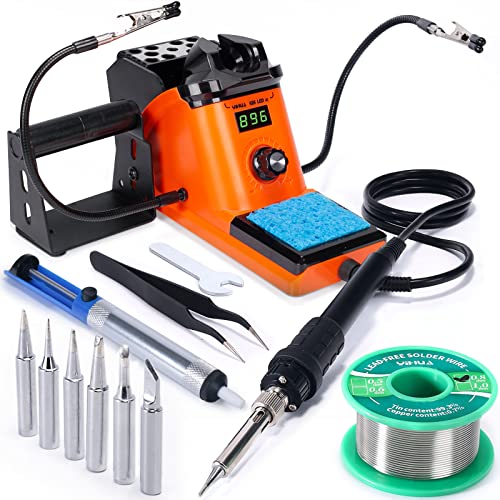
The YIHUA 926 III LED is closely related in purpose to the digital-display version, but the listing emphasizes a 15-piece accessory package and an LED display. It includes two helping hands with alligator clips, six tips, lead-free solder wire, a solder wire bracket, tweezers, a solder sucker, sponge, manual, and a spanner for detaching the helping hands. That is a useful collection for a bench where small tools have a habit of disappearing under scraps of wire.
The station lists PID heat control, a 194°F to 896°F range, temperature calibration, and sleep settings of 0, 5, 10, or 30 minutes. The single control knob also acts as a menu button, keeping the front panel less crowded. Like the other YIHUA 926 III listing, this model is intended for 110-127V with a US-style plug. The central trade-off is that it offers a broad, practical kit but only 60W of listed station power.
Pros
- Includes six tips and two helping hands with alligator clips.
- Lists PID heat control and temperature calibration support.
- Sleep settings include 0, 5, 10, and 30 minutes.
- Includes a wire bracket, solder sucker, tweezers, sponge, and helping-hand spanner.
- Single knob and menu control keep operation relatively straightforward.
Cons
- The station is listed at 60W, below the higher-power models in this comparison.
- The included solder is lead-free, which may require different working temperatures than leaded solder.
This is a sensible choice for a buyer who wants the YIHUA 926 III format and values the accessory bundle. It sits below the WEP 927-IV because it lacks three preset channels and a simultaneous set-and-actual display, but its lower temperature range and included tools remain useful. For modest PCB repairs, hobby projects, and a neatly organized first station, it offers a balanced starting point.
To buy this product, click here.
Buying Guide
Temperature Control Matters More Than the Maximum Number
Most of these stations list upper settings near 896°F, while the 8586D reaches 932°F. That difference does not decide the ranking by itself. Soldering depends on the tip, joint size, board thermal mass, solder alloy, and how well the station regulates heat. A clear display and usable adjustment control are more helpful than chasing the largest number printed in the listing.
Wattage Is Available Heating Power, Not a Complete Performance Rating
The comparison includes stations listed from 60W to 130W maximum, plus dual-tool units with separate heating systems. More available power can help a station recover when a large joint draws heat away, but the listing data does not provide a standardized recovery test. For small PCB work, tip geometry and controllability may matter more than the headline rating. For large connectors or ground planes, a higher-power station may offer more margin.
Check the Tip Family Before You Need Replacements
The WEP 927-IV specifically uses WEP #1400 tips, while the YIHUA 926 III listings identify YIHUA #1200/900M series tips. Other products list included tips without clearly naming a replacement family. Included tips are useful at setup, but they do not guarantee that every shape you want will be easy to source. Match the exact model and tip system before ordering extras.
Decide Whether Accessories Save You Money or Desk Space
Helping hands, a solder sucker, tweezers, tip cleaner, and a wire dispenser can make a first setup much more convenient. The WEP 927-IV and YIHUA 926 III models go furthest in this direction. The Weller WE1010NA and YIHUA 939D+ are more focused station packages with fewer general-purpose tools. If the bench already has these items, spending more on station control may make better sense.
Sleep Mode Protects Against an Iron Left Sitting Hot
Sleep and standby features lower idle heat after a period of inactivity, according to the supplied product information. The timing differs by model. Some offer fixed or limited choices, while the WEP 927-IV allows a 0 to 99-minute timer and the 100W station lists 0 to 600 seconds. These features are useful habits, but they do not replace switching off the station and handling a hot iron carefully.
Two-in-One Stations Are for a Different Kind of Bench
The WEP 882D and 8586D add hot-air rework alongside conventional soldering. That can help with SMD tasks and component removal, but it also brings nozzles, airflow settings, a second handpiece, and additional heat into the workspace. If your projects involve wires, through-hole components, and ordinary PCB joints, a single iron station is simpler. If surface-mounted parts are central to the work, the added capability may justify the larger learning curve.
Best Budget Soldering Station FAQ
What temperature range should a budget soldering station have?
A broad range is useful, but there is no single correct setting for every joint. The stations here list ranges from 194°F to 896°F or higher. Lead-free solder often calls for a different setting than leaded solder, and large joints draw more heat than small component pads. Start with the solder manufacturer’s guidance when available, then adjust carefully for the tip and workpiece.
Is a 60W soldering station enough for electronics?
A 60W station can suit many ordinary electronics repairs, especially with suitable tip geometry and controlled contact time. Large connectors, heavy ground planes, and substantial metal parts can require more available heat. The YIHUA 926 III models are better suited to modest bench work than demanding high-mass joints, while the WEP 927-IV and 100W station offer higher listed power.
Are more included soldering tips always better?
More tips give you more starting shapes, but usefulness depends on whether the tips fit the handpiece and suit your work. A fine tip can help with small pads, while a broader tip transfers heat more effectively to larger joints. Replacement availability matters after the included set wears out, so check the exact tip family rather than counting accessories alone.
Do I need a soldering station with helping hands?
Helping hands are useful for holding a board, wire, or connector while one hand controls the iron and the other feeds solder. They are especially helpful during through-hole assembly and repairs involving loose wires. They are less important if you already own a PCB holder or work mostly on parts that can rest securely on the bench.
Are the WEP 882D and 8586D suitable for phone repair?
Both include a soldering iron and hot-air tool, plus nozzles and adjustable hot-air controls. That makes them more relevant to SMD rework than an iron-only station. The supplied information does not provide measured airflow, board-specific guidance, or component-temperature testing, so do not treat either model as a guarantee of safe phone repair. Nozzle choice, air distance, shielding, and practice remain important.
What does temperature calibration do?
Calibration support lets the user adjust the station’s control behavior if the displayed setting does not correspond closely enough to the working tip temperature. It does not make every joint reach the same temperature, since tip condition, contact, solder type, and workpiece mass still affect the result. Models with calibration listed include the YIHUA 926 III versions, YIHUA 939D+, WEP 882D, and the 100W digital station.
Can these stations be used outside the United States?
Several listings specify 110-127V or 110-127V US operation, including the YIHUA and WEP models in this comparison. The Weller listing identifies a 120V station. Check the electrical requirements for the exact model before connecting it to another power system. A plug adapter does not change voltage compatibility.
Final Verdict
The WEP 927-IV is the strongest overall choice for a budget-conscious electronics bench because it combines useful temperature control with practical bench support. Its three presets, separate set and actual displays, helping hands, LED magnifier, and 110W listing give it a more complete working setup than a simple iron-and-stand package. The WEP #1400 tip requirement is the main ownership detail to check before buying replacements.
For a lower-cost compact station, the WEP 926LED V3 keeps the essentials close at hand. The YIHUA 926 III models are appealing if a 194°F minimum, six tips, and helping hands matter more than maximum listed power. Buyers who solder regularly may prefer the YIHUA 939D+ or Weller WE1010NA for their more focused station designs and control features, while SMD-focused users should look at the WEP 882D or 8586D. Match the station to the joints, tips, accessories, and voltage available at your bench rather than choosing by wattage alone.

- Jesse
Jesse is the editor behind Soldering Gear, where he covers soldering irons, stations, rework equipment, and the tools that belong on a practical electronics bench. His work focuses on comparing product specifications, features, compatibility, and intended uses so readers can make more informed buying decisions.
- Best Soldering Iron for SMD: 9 Picks in 2026 October 15, 2026
- Best Hot Air Rework Station for SMD: 9 Picks in 2026 October 14, 2026
- What Tools Do You Need for Soldering Electronics? October 13, 2026
- Best USB-C Soldering Iron: 9 Picks in 2026 October 12, 2026
- How to Choose Solder for Electronics October 11, 2026