Best Portable Solder Fume Extractor: 9 Picks in 2026

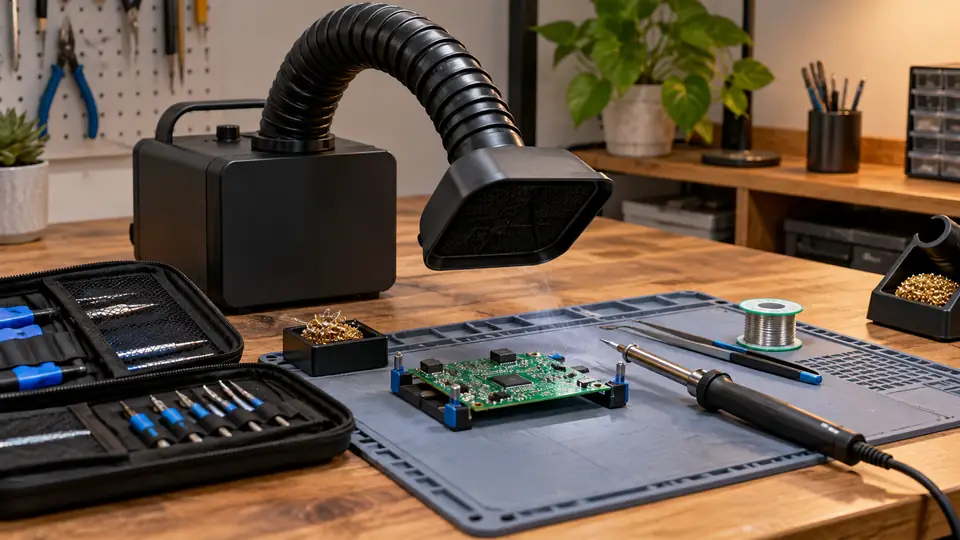
Soldering smoke has a way of drifting straight toward your face, settling over the bench as a sharp chemical haze while you work. A portable solder fume extractor can pull that smoke toward a filter before it spreads across a small electronics workspace, but the products in this category vary widely. Some are compact carbon-filter fans meant to sit beside a soldering iron, while others use a flexible hood, prefilter, HEPA stage, and activated carbon cartridge for more controlled capture.
The biggest buying mistake is judging these units by fan speed or a bold “smoke absorber” label alone. Capture distance, intake direction, filter construction, replacement options, noise, power source, and how precisely the unit can be aimed often matter more. A cordless extractor may be ideal for phone repair at a temporary workstation, while a desktop unit with a hose and multi-stage filtration makes more sense for regular bench work. Portable does not mean every model is equally convenient, either. A compact fan is easy to move, but a targeted hood can do a better job of staying close to the solder joint.
This comparison focuses on products that genuinely fit portable solder-fume control, from simple activated-carbon absorbers to more structured filtration systems. The KQZ B1 earns the strongest overall position because its 168 m³/h airflow, H13 HEPA and coal-based activated-carbon filter, flexible gooseneck, and included replacement prefilters give it a more complete setup than most compact alternatives. The other picks make their case through lower cost, cordless operation, flexible mounting, generous filters, or a smaller footprint.
Quick Answer
Best overall: The KQZ B1 Solder Fume Extractor is the strongest all-around choice for a portable electronics bench. Its centrifugal motor, listed 168 m³/h airflow, adjustable gooseneck hose, H13 HEPA stage, activated carbon, and included filter supplies give it the most complete capture and filtration arrangement here.
Best premium alternative: The FumeClear FC-2001S adds a three-stage system, extendable hose, H12 HEPA filtration, and high-iodine activated carbon for buyers who want a more structured bench extractor.
Best cordless option: The TBK F001 Mini is easier to carry between work areas because it uses a rechargeable Type-C design and offers three fan speeds.
Best for flexible mounting: The SainSmart Portable Fume Extractor stands out with its magnetic cone base, clamp, long gooseneck, and integrated adjustable lighting.
Best Portable Solder Fume Extractor Comparison Table
| Product | Best For | Filtration Or Capture | Power And Portability |
|---|---|---|---|
| KQZ B1 Solder Fume Extractor | Best overall bench use | Prefilter, H13 HEPA, activated carbon | 110 to 220V, gooseneck hood |
| FumeClear FC-2001S | Premium filtration setup | Prefilter, H12 HEPA, high-iodine carbon | 110 to 220V, extendable hose |
| SainSmart Portable Fume Extractor Fan | Flexible mounting and lighting | Activated carbon filter cotton | Magnetic base, clamp, gooseneck |
| TBK F001 Mini Solder Fume Extractor | Cordless mobile work | Replaceable activated carbon filter | Rechargeable Type-C, three speeds |
| YIHUA 948DQ-I | Low-maintenance filter supply | Front and rear filter adsorbers | 110 to 127V, tilts 30 degrees |
| KOTTO Solder Smoke Absorber | Simple desktop extraction | 0.4-inch activated carbon filter | 120V, carrying handle |
| Upgraded ToolBud Solder Fume Extractor | Compact budget setups | Carbon filter with magnetic flaps | Portable desktop design |
| MUIN Solder Fume Extractor | Small craft and soldering benches | Three-stage filter | Compact ABS desktop unit |
| DIYPHONE Portable Solder Fume Extractor | Phone repair and cordless use | Activated carbon filter | Built-in 1200mAh battery, three speeds |
The detailed reviews explain how each extractor handles capture, filtration, positioning, power, maintenance, and the trade-offs that matter at a real soldering bench.
1. KQZ B1 Solder Fume Extractor — Best Overall

The KQZ B1 is the most complete portable extraction setup in this group because it brings the intake closer to the solder joint. Instead of relying on a broad tabletop fan, it uses a 66 mm adjustable gooseneck hose and hood that can be aimed toward the smoke source. That distinction matters during PCB work, where a small plume can rise and drift away in seconds. The listed 168 m³/h airflow also places it in a different class from the smaller desktop absorbers.
Filtration is the other reason it ranks first. The product information lists a 9 mm prefilter followed by an H13 HEPA filter with coal-based activated carbon. It also includes five replacement prefilters and one efficiency filter, which gives the owner useful maintenance supplies from the start. The metal body is described as compact and portable, while the 110 to 220V design broadens its power compatibility. It remains important to aim the hood correctly and maintain the filters, but the setup is unusually well matched to close-range soldering capture.
Pros
- Listed 168 m³/h airflow supports strong close-range capture.
- Uses a prefilter, H13 HEPA stage, and coal-based activated carbon.
- Adjustable 360-degree gooseneck and hood allow targeted placement.
- Includes five replacement prefilters and one efficiency filter.
- Wide 110 to 220V design and compact metal body suit varied work areas.
Cons
- More involved than a simple tabletop carbon-filter fan.
- The product information does not clearly state the operating noise level.
The KQZ B1 suits regular bench soldering, repair work, and other tasks where directing the intake matters more than having the smallest possible footprint. Its stronger filtration layout gives it an edge over basic smoke absorbers, though filter maintenance becomes part of ownership. Buyers who want a cordless unit or a very simple plug-in fan may find it more equipment than they need, while anyone working close to a solder joint gets the clearest benefit.
To buy this product, click here.
2. FumeClear FC-2001S Solder Fume Extractor — Best Premium

FumeClear takes a more formal filtration approach with the FC-2001S. Its listed airflow range reaches 128 to 168 m³/h, and the three-stage system combines a prefilter, H12 HEPA filter, and high-iodine activated carbon. The carbon is described as coconut-shell material with an iodine value of 500 to 700 mg/g. Those details matter because the unit is intended to handle particles and odors through separate filtration stages rather than depending on one carbon panel.
The extendable hose gives this extractor practical flexibility on a crowded bench. A user repairing a board under a task light can place the hose near the joint while leaving the main body farther away, which may make the workspace feel less cramped. Universal 110V and 220V operation adds travel flexibility, although a buyer should still confirm the correct regional setup before ordering. The listing also describes a compact form factor, but it does not provide a detailed noise rating or filter replacement schedule.
Pros
- Three-stage filtration uses a prefilter, H12 HEPA filter, and activated carbon.
- Listed airflow of 128 to 168 m³/h supports targeted solder-fume capture.
- Extendable hose helps position the intake near the smoke source.
- High-iodine coconut-shell activated carbon is specified in the product information.
- 110V and 220V operation offers broader electrical compatibility.
Cons
- Higher-priced than the compact carbon-filter absorbers in this comparison.
- Noise level and exact replacement-filter details are not clearly stated.
This is a strong choice for a dedicated electronics bench where filtration structure matters more than cordless convenience. It gives up some simplicity and likely requires more attention to filter replacement than a basic absorber. Buyers who regularly solder near their face or work in a compact room may appreciate the hose and layered design, while occasional users may find a smaller unit easier to justify.
To buy this product, click here.
3. SainSmart Portable Fume Extractor Fan — Best for Flexible Mounting

A typical desktop absorber has to occupy valuable bench space, but the SainSmart model offers more ways to get the intake where it belongs. Its magnetic cone base can attach to a vertical metal surface, and the included clamp provides another mounting route where a magnet will not work. The 400 mm stainless-steel gooseneck is described as retaining its shape when extended, so the fan head can remain positioned near the soldering area rather than drooping halfway through a repair.
The extractor also combines smoke absorption with adjustable lighting. Its LED can be set to 3000K, 4500K, or 6000K, giving a phone-repair station or dim workbench more control over illumination. The listing gives a 3700 RPM fan and claims an effective smoke-absorber distance of up to 10 inches, though that distance should be treated as a listing claim rather than an independent measurement. Filtration uses activated carbon filter cotton, and the product information does not identify a HEPA stage.
Pros
- Magnetic base supports mounting on vertical metal surfaces.
- Included clamp provides a mounting option for nonmetal work areas.
- 400 mm stainless-steel gooseneck is intended to hold its shape.
- Three selectable LED color temperatures improve bench visibility.
- Activated carbon filter cotton targets solder smoke and odors.
Cons
- Filtration is described as activated carbon rather than a multi-stage HEPA system.
- Best placement depends on having a suitable surface or clamp position nearby.
SainSmart makes the most sense for repair benches that change shape from project to project. A technician moving between a laptop, a phone, and a small circuit board can reposition the gooseneck without dragging a large extractor across the table. It is less compelling for buyers seeking the strongest documented filtration arrangement, but its mounting flexibility and light make it unusually practical for close, detailed work.
To buy this product, click here.
4. TBK F001 Mini Solder Fume Extractor — Best Cordless Option

The TBK F001 is built around mobility. Its rechargeable Type-C design removes the power cord from a small repair station, and the product information lists a charge time of about 2.5 hours using a Type-C adapter. That makes it useful for a bench that gets packed away after each job, a temporary work surface, or a repair setup where cords become a nuisance. The listing does not specify battery capacity or runtime, so buyers should treat portability as the clear strength rather than assume a particular working duration.
Three fan-speed settings give it more control than a fixed-speed mini absorber. The unit also includes an LED ring around the air inlet and a curing light at the outlet, which may be handy during small repairs, although those lights do not replace a dedicated task lamp. A 10,000 RPM brushless motor and replaceable high-density activated-carbon filters are listed, alongside low-noise operation. Its small body is convenient, but the available information does not identify airflow volume or a HEPA stage.
Pros
- Rechargeable Type-C design supports cordless portable work.
- Three fan speeds allow adjustment for different soldering tasks.
- Replaceable high-density activated-carbon filters are listed.
- Built-in LED ring helps illuminate the intake area.
- Compact body suits tight benches, home labs, and mobile setups.
Cons
- Battery capacity and runtime are not clearly specified.
- The product information does not list airflow volume or HEPA filtration.
Choose the TBK F001 for convenience first. It is a better fit for someone who carries a soldering kit between rooms than for a fixed bench that needs the most comprehensive filtration possible. The ability to vary fan speed is useful, and the cordless layout keeps a small board-repair area tidy, but long sessions require attention to charging and filter condition.
To buy this product, click here.
5. YIHUA 948DQ-I Solder Fume Extractor Fan — Best Filter Supply

YIHUA gives this compact absorber a useful maintenance advantage by including eight filtration adsorbers, two side fenders, and a tiltable stand. The filters work at the front and rear, while the fenders help limit disruptive airflow around the capture area. For someone soldering a few inches from the unit, that arrangement can create a more controlled zone than an open fan face sitting alone on the bench.
The stand tilts through 30 degrees, allowing the intake angle to be adjusted without stacking the extractor on books or parts boxes. The listing describes a five-blade fan with relatively low noise and effective adsorption within a straight-line distance of 10 cm. That stated distance is fairly close, so placement remains important. This model is designed for 110 to 127V operation with a US-standard plug, which makes it less flexible than the universal-voltage alternatives.
Pros
- Includes eight filtration adsorbers for extended initial use.
- Front and rear filtration supports two-sided smoke capture.
- 30-degree tiltable stand helps aim the unit at the work area.
- Side fenders help reduce airflow disruption around the intake.
- Compact five-blade fan design is intended for relatively low noise.
Cons
- 110 to 127V US operation limits international power flexibility.
- Listed effective adsorption distance is only 10 cm, so close placement is needed.
The YIHUA 948DQ-I is a sensible pick for a fixed US bench where inexpensive filter changes and a simple angled stand matter. It is less suited to a travel setup or a large work area where the extractor must sit farther away. The generous filter supply helps reduce immediate maintenance shopping, while the close-range design encourages the placement discipline that small absorbers need.
To buy this product, click here.
6. KOTTO Solder Smoke Absorber — Best Simple Desktop Pick
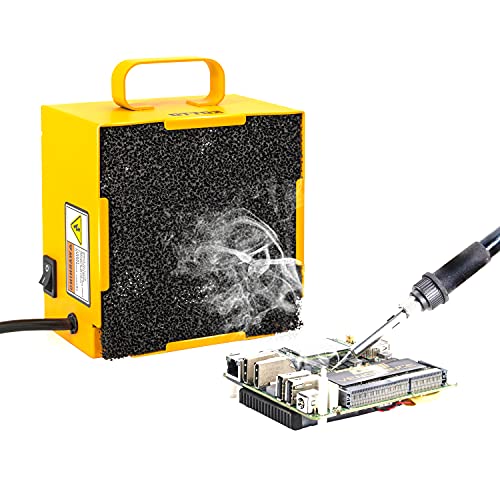
KOTTO keeps the layout familiar: a desktop fan, a thick activated-carbon filter, rubber feet, and a carrying handle. The listed 0.4-inch filter sits in front of a 3000 RPM fan, and the product information gives a recommended extraction distance of roughly 5 to 6 inches. That makes it a straightforward choice for a soldering iron used in one predictable spot, especially when a hood or hose would add clutter.
The four heavy-duty rubber feet are a small but useful detail on a busy bench. They help the unit stay planted while wires, boards, and tools move around it, and the handle makes it easier to shift between storage and work. It uses 120V power and consumes 30W, so this is a plug-in desktop solution rather than a cordless extractor. One replacement filter is included, and the listing describes the filter as easy to replace.
Pros
- 0.4-inch activated-carbon filter is specified for smoke and odor capture.
- Listed 5 to 6-inch extraction distance suits close desktop work.
- Four rubber feet help stabilize the unit on a workbench.
- Carrying handle improves storage and portability.
- Includes one replacement smoke-trap filter.
Cons
- Fixed 120V operation is less flexible than rechargeable or wide-voltage designs.
- It does not include a hose or HEPA filtration stage in the listed configuration.
This KOTTO model fits someone who wants a basic absorber that can be switched on beside a soldering station without assembling a hose system. Its limits are clear, so it should be placed close to the smoke source and used alongside sensible room ventilation. Buyers seeking multi-stage particle filtration or remote intake positioning should move higher in the rankings.
To buy this product, click here.
7. Upgraded ToolBud Solder Fume Extractor — Best Budget Design
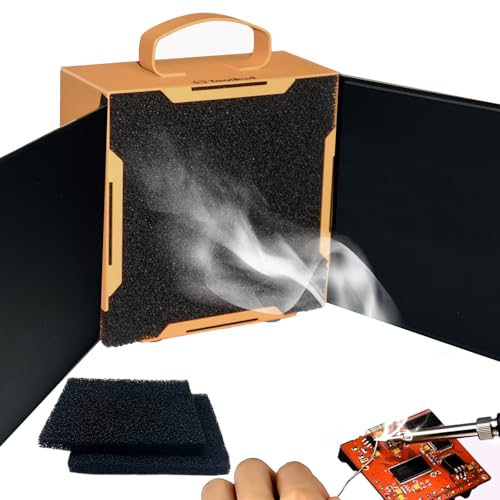
ToolBud takes a small desktop absorber and adds removable magnetic flaps to widen the area around the intake. That feature is useful when smoke does not rise in a perfectly straight column, such as during a board repair where the iron, solder wire, and component leads force the work to happen at different angles. The flaps can be removed when the bench is tight, giving the unit a little more flexibility than a completely fixed housing.
The compact body is aimed at small workspaces, labs, and home use. The product information lists a low-noise motor, two filters, and a detachable filter system that can be cleaned or replaced. It does not provide airflow, voltage, extraction distance, or a HEPA designation, so the comparison should focus on its physical convenience rather than assume commercial-grade filtration. At its lower-cost positioning, the practical appeal is the wider capture shape and easy storage.
Pros
- Removable magnetic flaps expand the smoke-capture area.
- Includes two filters for initial replacement needs.
- Compact format fits small workbenches and storage spaces.
- Low-noise motor is listed for quieter operation.
- Detachable filter system simplifies cleaning and replacement.
Cons
- Airflow and extraction distance are not clearly specified.
- The listing does not identify a HEPA filtration stage or voltage details.
ToolBud is a reasonable lower-cost choice for occasional soldering where space and price matter more than detailed airflow specifications. The magnetic flaps are its useful differentiator, particularly for a small repair table where smoke can slip around a narrow intake. Buyers with heavier daily soldering demands should favor the KQZ or FumeClear systems, which provide clearer filtration and airflow information.
To buy this product, click here.
8. MUIN Solder Fume Extractor — Best for Compact Craft Benches

MUIN is aimed at small, multipurpose work areas where the same table may host soldering, wood burning, stained glass, jewelry work, or craft projects. Its listed three-stage filter is intended to absorb fumes and odors, while the compact ABS body takes up less room than a hose-based extractor. The product information describes useful capture from roughly 4 to 5 inches away, which points to a close-placement setup beside the joint.
The low-noise description may appeal to someone working in a shared room, though no measured sound level is supplied. Storage is another clear focus. A small extractor can disappear into a drawer after a project, unlike a larger machine that claims permanent bench territory. The trade-off is that the listing does not specify airflow volume, individual filter materials, or a HEPA stage, so this unit should be viewed as a compact smoke absorber rather than a documented high-capacity local exhaust system.
Pros
- Three-stage filtration is listed for solder and craft fumes.
- Compact housing helps preserve limited desktop space.
- Suitable for several listed activities, including wood burning and stained glass.
- Close-range capture is specified at roughly 4 to 5 inches.
- ABS construction supports a lightweight portable format.
Cons
- Airflow volume and individual filter-stage materials are not stated.
- The short listed capture distance requires careful placement near the work.
MUIN is best for occasional soldering and craft work where the extractor must pack away easily after use. It offers a more structured filter description than some basic fans, but the missing airflow details make it difficult to compare directly with the KQZ or FumeClear. Keep it close to the joint, replace filters as needed, and maintain general ventilation rather than treating the small unit as the only air-control measure.
To buy this product, click here.
9. DIYPHONE Portable Solder Fume Extractor Fan — Best for Phone Repair Mobility

The DIYPHONE model is built for a compact repair station where every tool needs to earn its space. It combines smoke extraction, cooling, and lighting in one small unit, with a built-in 1200mAh battery for wireless use. Three fan speeds, two timing settings, a 360-degree rotating design, and a four-level power display give it more control than a basic fixed desktop fan. The listing also says that a charging cable is not included, so the owner must provide a suitable cable.
An activated-carbon filter handles the smoke-absorption function, while the cooling feature may be useful around a tight phone-repair workspace. The product information does not give airflow volume, filter efficiency, runtime, or a HEPA stage, so its strongest case is convenience rather than documented filtration depth. The compact wireless design can be handy for moving between devices, but filter replacement details are not clearly identified in the listing.
Pros
- Combines smoke extraction, cooling, and lighting in one compact unit.
- Built-in 1200mAh battery supports wireless operation.
- Three fan speeds provide adjustable airflow control.
- 360-degree rotation helps aim the unit around a repair area.
- Four-level power display and timing functions support portable use.
Cons
- Charging cable is not included according to the product information.
- Airflow, runtime, filter efficiency, and replacement-filter details are not clearly stated.
This DIYPHONE extractor suits mobile phone repair and small board work where lighting and cordless operation are more valuable than a larger filtration system. It is a convenient accessory for a compact kit, but buyers handling frequent soldering sessions should look carefully at the higher-ranked units with published airflow and multi-stage filtration. The missing runtime figure also makes it difficult to plan extended cordless work.
To buy this product, click here.
Buying Guide
Capture Distance Matters More Than Fan Speed Alone
Smoke needs to reach the intake before it spreads through the room. A high-speed fan placed too far away may perform less usefully than a moderate fan positioned close to the solder joint. The KQZ and FumeClear models address this with hoses and hoods, while the KOTTO, MUIN, and YIHUA units expect close desktop placement. Measure the space around your board, iron, and hands before choosing a model with a fixed intake.
Match Filtration to the Workload
Activated carbon is useful for odor and vapor adsorption, but the products use very different filtration arrangements. Basic absorbers list carbon filters, while the KQZ adds a prefilter and H13 HEPA stage, and the FumeClear FC-2001S lists a prefilter, H12 HEPA filter, and high-iodine activated carbon. A layered system may better suit frequent bench use, but it also creates more filter components to monitor and replace.
Portable Does Not Always Mean Cordless
A unit with a handle or compact body can be portable while still requiring wall power. KOTTO, MUIN, and YIHUA fall into that category. TBK F001 and DIYPHONE add rechargeable operation, which is useful for a temporary repair station, but the supplied information does not give complete runtime figures. If you solder for long sessions, a corded model may be more predictable than relying on a battery.
Check Voltage Before Ordering
The products differ in electrical flexibility. KQZ and FumeClear list 110 to 220V operation, while KOTTO lists 120V and YIHUA identifies 110 to 127V with a US plug. Portable work does not remove the need to match the extractor to the available supply. Confirm the current listing details, especially if the unit will travel between countries or operate from a converted power source.
Filter Replacement Is Part of the Ownership Cost
A fume extractor is only useful when its filter remains serviceable. KQZ includes five replacement prefilters and one efficiency filter, YIHUA includes eight filtration adsorbers, and several compact models list replaceable or easy-to-change carbon filters. The exact replacement schedule is not provided for every product, so check filter availability before committing to a model. A low-cost extractor can become inconvenient if its consumables are difficult to locate.
Lighting and Mounting Can Improve Small Repairs
Small phone boards and crowded PCBs leave little room for a bulky extractor. SainSmart addresses this with a magnetic base, clamp, gooseneck, and three-color LED. DIYPHONE combines lighting with cordless extraction, while TBK includes an LED ring around the intake. These features do not prove stronger filtration, but they can make positioning and visibility easier during detailed work.
Use an Extractor Alongside Sensible Ventilation
A small tabletop smoke absorber should not be treated as a complete substitute for appropriate room ventilation or engineered local exhaust. Keep the intake near the smoke source, maintain filters, follow the tool and solder instructions, and use suitable eye and hand protection. Products with HEPA and carbon stages offer more documented filtration structure, but no listing here supports treating any unit as a guarantee of complete contaminant removal.
Best Portable Solder Fume Extractor FAQ
What Is The Best Portable Solder Fume Extractor Overall?
The KQZ B1 is the strongest overall option in this comparison. It combines listed 168 m³/h airflow with a prefilter, H13 HEPA filter, coal-based activated carbon, an adjustable gooseneck, and a hood. That combination gives it more targeted capture and more detailed filtration information than the compact carbon-only absorbers.
Are Portable Solder Fume Extractors Worth Using?
They can help capture smoke close to the soldering point and reduce the amount that drifts across a small workbench. Their effectiveness depends heavily on placement, filter condition, and the extractor’s capture design. A portable unit should support appropriate ventilation and safe work practices rather than replace them.
Is Activated Carbon Enough For Solder Fumes?
Activated carbon is used to adsorb odors and certain vapors, but the products in this roundup do not all use the same filter construction. A carbon-filter absorber is different from a unit with a prefilter, HEPA stage, and carbon layer. Buyers who want a more layered setup should look at the KQZ or FumeClear rather than assume every carbon filter provides the same result.
Should The Extractor Sit Beside The Soldering Iron?
Place the intake close to the point where smoke is produced, without allowing it to interfere with the iron, solder wire, or your hands. Models with goosenecks or hoses make that easier because the main body can remain farther away. Fixed desktop units require closer positioning, and the listed capture distances for several models are only a few inches.
Which Portable Extractor Is Best For Phone Repair?
The DIYPHONE model is tailored toward mobile phone and PCB repair with wireless operation, three fan speeds, rotation, cooling, and lighting. SainSmart is another useful choice if mounting flexibility and adjustable LED lighting matter more than a built-in battery. For heavier or more frequent work, KQZ provides a more substantial filtration arrangement.
Do These Extractors Need Replacement Filters?
Yes. Filter condition affects the usefulness of any smoke absorber, and the products list different replacement arrangements. KQZ includes replacement prefilters and an efficiency filter, YIHUA includes eight filtration adsorbers, and several compact models use replaceable carbon filters. Confirm the correct replacement part before ordering and follow the product’s maintenance instructions.
Are Cordless Fume Extractors Better Than Plug-In Models?
Cordless models are easier to move and useful for temporary work areas, but the supplied information does not provide complete runtime details for the TBK F001 or DIYPHONE. Plug-in models avoid battery charging and may suit longer sessions. The better choice depends on whether mobility or predictable continuous operation matters more for your bench.
Final Verdict
The KQZ B1 is the strongest overall choice for most portable solder-fume extraction setups. Its adjustable hood brings the intake toward the smoke source, while the listed 168 m³/h airflow, prefilter, H13 HEPA stage, and activated carbon provide the clearest filtration structure in the group. The included replacement filters also make the initial setup more practical. It is larger and more involved than a small tabletop absorber, but that trade-off is justified for regular electronics work.
FumeClear FC-2001S is the premium alternative for buyers who want a three-stage system and extendable hose. SainSmart is better for flexible mounting and integrated lighting, while TBK F001 is the convenient cordless pick. YIHUA, KOTTO, ToolBud, MUIN, and DIYPHONE each make more sense in specific compact or budget-oriented situations. Choose based on capture distance, filtration stages, power source, filter availability, and bench layout. Keep the intake close to the joint, maintain the filter, and use the extractor as one part of a sensible ventilation and soldering-safety setup.

- Jesse
Jesse is the editor behind Soldering Gear, where he covers soldering irons, stations, rework equipment, and the tools that belong on a practical electronics bench. His work focuses on comparing product specifications, features, compatibility, and intended uses so readers can make more informed buying decisions.
- Best Soldering Iron for Phone Repair: 9 Picks in 2026 October 27, 2026
- Best Hot Air Rework Station for Phone Repair: 9 Picks in 2026 October 26, 2026
- Why Is My Soldering Iron Not Melting Solder? October 25, 2026
- Best Portable Solder Fume Extractor: 9 Picks in 2026 October 24, 2026
- Best Desoldering Wick: 9 Picks in 2026 October 23, 2026