Best Lead-Free Solder: 9 Picks in 2026

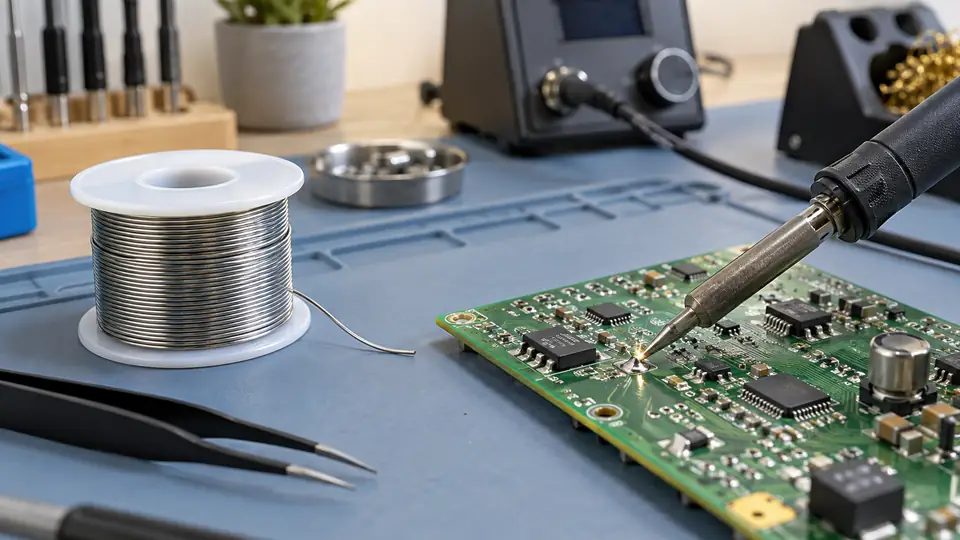
Lead-free solder is a broad category, and the right spool depends heavily on what sits at the end of your iron. Fine PCB work calls for a narrower wire that feeds in controlled amounts, while stained glass rewards a thicker diameter, smooth flow, and a bead that stays bright across longer seams. Plumbing alloys bring a different set of requirements altogether. Choosing by “lead-free” on the label alone can leave you with wire that melts at the wrong temperature, contains the wrong flux, or feels awkward on the joint in front of you.
Alloy, diameter, flux core, melting behavior, and application fit deserve more attention than a flashy product title. A 0.6mm wire can make tiny electronic joints far easier to meter, while a 3.0mm solid wire is more practical for broad stained-glass seams but requires separate flux. Rosin-core options simplify many electrical repairs, though the flux chemistry and cleanup expectations still matter. For a balanced mix of clean flow, useful temperature information, and broad craft suitability, AIM Artist Pure Lead-Free Stained Glass Solder is the strongest overall choice in this selection.
The products below span electronics solder, stained-glass wire, jewelry-friendly alloys, and multipurpose options. That variety matters because lead-free solder is a process material, not a one-size-fits-all consumable. The best pick for a circuit board may be a poor choice for copper foil, so the rankings weigh each alloy against the work it is intended to handle.
Quick Answer
Best Overall: AIM Artist Pure Lead-Free Stained Glass Solder offers a silver-bearing alloy, a stated 407°F to 439°F eutectic melting range, and a strong focus on smooth, bright beads for stained glass, jewelry, crafts, and general soldering.
Best for Electronics: Kester K100LD Lead-Free No-Clean Wire Solder provides a clearly identified 0.031-inch diameter, 3.3% flux content, and no-clean flux designation for controlled electrical work.
Best Fine Wire: 0.6mm Lead-Free Rosin-Core Solder Wire is easier to meter onto small components and narrow pads than thicker wire, with an Sn99 Ag0.3 Cu0.7 alloy and a listed 419°F melting point.
Best for Stained Glass on a Budget: 3.0mm Lead-Free Solid-Core Solder Wire gives glass crafters a thick, easy-to-handle format, though its solid core means separate flux is required.
Best Lead-Free Solder Comparison Table
| Product | Best For | Alloy or Flux | Diameter or Format |
|---|---|---|---|
| AIM Artist Pure | Stained glass and crafts | Silver-bearing, lead-free | 3mm, 1lb |
| Kester K100LD | Electronics and PCB work | 3.3% no-clean flux | 0.031 inch |
| ZSHX Sn99 Ag0.3 Cu0.7 | General electrical repairs | 2% rosin core | 0.8mm, 50g |
| 0.6mm Rosin-Core Wire | Fine electronics work | Sn99 Ag0.3 Cu0.7, rosin core | 0.6mm, 50g |
| Canfield DGS | Crafts and polished joints | Lead-free, narrow melting range | Wire size not stated |
| Canfield Pewter Finish | Jewelry and stained glass | Tin, silver, and copper | Wire size not stated |
| 3.0mm Solid-Core Wire | Stained-glass seams | Sn99 Ag0.3 Cu0.7, no flux core | 3mm, 100g |
| Essmetuin Sn99.3Cu0.7 | Crafts and mixed projects | Solid core, no flux | 2mm, 3.2oz |
| Canfield Silvergleem | Stained glass and jewelry | 96% tin, 4% silver | Half-pound spool |
The detailed reviews explain how each alloy, wire size, and flux format changes the working experience.
1. AIM Artist Pure Lead-Free Stained Glass Solder — Best Overall
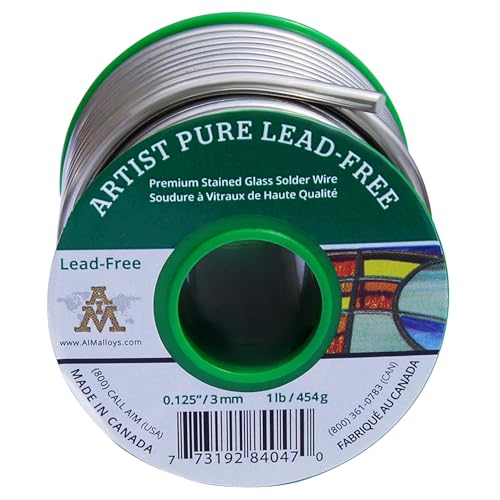
AIM Artist Pure earns the top position by matching its alloy and format closely to the demands of stained glass, jewelry, artware, and craft work. The product information identifies it as a high-purity, silver-bearing lead-free alloy with a stated eutectic melting range of 407°F to 439°F. That information gives the user a practical starting point for iron settings, while the 3mm wire provides the substantial feed rate that broad copper-foil seams often need.
The listing also emphasizes strong bonding, smooth flow, and a bright solder bead. Those qualities matter visually and mechanically on a panel where a lumpy seam can catch the eye from across the room. The one-pound quantity is useful for larger projects, though this thick wire is more material than a small electronics repair needs. A crafter moving from leaded solder to a lead-free alloy will still need to tune temperature and technique around the actual iron, tip, flux, and workpiece.
Pros
- Silver-bearing lead-free alloy is identified for craft and glass applications.
- Published melting range is 407°F to 439°F.
- 3mm diameter suits substantial stained-glass seams.
- Product information emphasizes smooth flow and a bright bead.
- One-pound format supports repeated projects and larger panels.
Cons
- Thick 3mm wire is less convenient for tiny electronic joints.
- The listing does not clearly specify the flux format or flux percentage.
This is the strongest starting point for stained glass, artware, and craft projects that need a visible, presentable bead and a generous spool. It also makes sense for jewelry work where a silver-bearing alloy and lead-free composition fit the project brief. Choose a finer rosin-core wire for PCB repair, and confirm your flux requirements before ordering because the available product information does not clearly identify a flux core.
To buy this product, click here.
2. Kester K100LD Lead-Free No-Clean Wire Solder — Best for Electronics

For small electrical joints, the clearest specifications often matter more than a long list of broad applications. Kester K100LD lists a 0.031-inch, or approximately 0.80mm, wire diameter along with 3.3% flux content and a no-clean flux type. That combination places it firmly in the electronics category, where controlled feeding and a defined flux format can make a crowded PCB less messy.
The 0.80mm size sits in a useful middle ground. It can deliver enough material for ordinary pads and wire connections without forcing a large blob onto every joint. No-clean describes the listed flux type, not a promise that every residue is visually or chemically irrelevant in every assembly, so project requirements still matter. The available information does not state the alloy composition or spool weight, which limits direct comparison with the Sn99 Ag0.3 Cu0.7 products.
Pros
- 0.031-inch diameter suits controlled electronics soldering.
- Flux content is clearly listed as 3.3%.
- No-clean flux type is identified in the product information.
- Wire format is practical for PCB pads and ordinary electrical connections.
- More technically defined for electronics than the craft-focused options.
Cons
- The available information does not identify the alloy composition.
- Spool weight is not clearly stated in the supplied product details.
Kester K100LD is the better fit for readers who want a clearly specified electronics wire rather than a large craft spool. Its diameter should feel manageable for routine board work, while the no-clean designation may reduce cleanup demands in suitable applications. Buyers comparing alloys or planning to solder at a specific melting range should confirm the current listing details before ordering.
To buy this product, click here.
3. ZSHX Sn99 Ag0.3 Cu0.7 Rosin-Core Solder Wire — Best Value for General Electronics

ZSHX takes a straightforward route for everyday electrical work. Its listed alloy is 99% tin, 0.3% silver, and 0.7% copper, commonly written as Sn99 Ag0.3 Cu0.7. The 0.8mm diameter is broad enough for wires and ordinary PCB joints while remaining more controlled than a thick stained-glass wire. A listed melting point of 217°C, or 422.6°F, gives the user a useful reference for setting up a compatible soldering iron.
The rosin core is the practical attraction here. Instead of reaching for separate flux for every small joint, the wire carries its flux inside the solder. The product information lists 2% flux content and a 50g spool, a compact quantity for repairs, kits, and occasional bench work. Rosin-core solder still leaves residue, and the listing does not identify the precise flux classification or cleaning instructions, so sensitive assemblies may call for additional process controls.
Pros
- Sn99 Ag0.3 Cu0.7 alloy is clearly identified.
- 0.8mm diameter works across many general electrical joints.
- Rosin core reduces the need to apply separate flux for routine work.
- 2% flux content is stated.
- 217°C melting point provides a useful setup reference.
Cons
- 50g quantity is smaller than the craft-oriented one-pound spools.
- Rosin residue may require cleaning for some projects.
This is a sensible lower-cost choice for wire repairs, connectors, hobby electronics, and ordinary through-hole work. It gives more process information than several craft products and avoids the fiddly feed rate of ultra-thin wire. For tiny surface-mount pads, the 0.6mm option below offers finer control, while stained-glass users will likely prefer a thicker solid wire.
To buy this product, click here.
4. 0.6mm Lead-Free Rosin-Core Solder Wire — Best for Fine Electronics
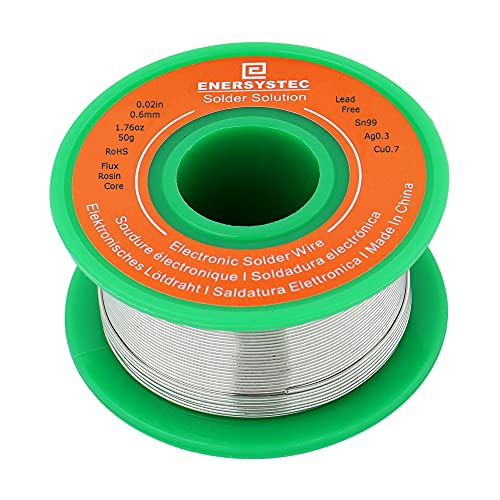
A narrow wire changes the rhythm of soldering. Rather than pushing a heavy strand toward a tiny pad and hoping the right amount lands in place, 0.6mm wire lets the operator feed smaller increments. This product pairs that diameter with the Sn99 Ag0.3 Cu0.7 alloy, rosin core, and a listed 419°F melting point. The supplied information also identifies the wire as suitable for PCBs, small resistors, smaller ICs, and other tiny parts.
The 50g spool is modest, but that can be an advantage for occasional repair work because the wire takes up little bench space. Its thin format is less efficient on large terminals, thick wires, and broad seams, where repeated feeding can become tedious. The listing describes the product as RoHS compliant, though compliance language should be matched to the exact project and purchasing requirements rather than treated as a universal substitute for process documentation.
Pros
- 0.6mm diameter gives precise control on small joints.
- Sn99 Ag0.3 Cu0.7 alloy is clearly listed.
- Rosin core supports convenient electronics repairs.
- Product information names PCBs, ICs, resistors, and tiny parts as applications.
- 419°F melting point is supplied as a practical reference.
Cons
- Thin wire feeds slowly on large joints and heavy-gauge connections.
- 50g spool may run out quickly during frequent bench work.
Pick this spool for small electronics where placement control matters more than speed. It is especially sensible for fine pads and compact boards, while the 0.8mm alternatives are easier for general wiring. Separate flux may still be useful for difficult surfaces or rework, despite the rosin core, so the wire should be viewed as a convenient baseline rather than a complete solution for every joint.
To buy this product, click here.
5. Canfield Lead-Free DGS Solder — Best for Smooth Craft Joints

Canfield DGS is aimed at users who care about how a finished joint looks as much as whether it holds. The listing describes a narrow melting range, strong flow characteristics, and a high-luster finish intended to resemble traditional 60/40 solder. Those details point toward stained glass, artware, jewelry, and craft work where a seam remains visible after the project leaves the bench.
The product information identifies pure virgin metals and describes the solder as suitable for professional and DIY projects. That wording is a listing claim, not independent test evidence, but the stated focus on flow and appearance gives the product a clear place among craft-oriented choices. The wire diameter, spool quantity, exact alloy, and flux arrangement are not clearly identified in the available details, making it harder to match against a specific iron setting or feeding preference.
Pros
- Product information emphasizes a narrow melting range.
- Flow characteristics are presented as a central feature.
- High-luster finish is intended to resemble traditional 60/40 solder.
- Pure virgin metals are identified in the listing.
- Craft, artware, jewelry, and general project use are all described.
Cons
- Exact alloy composition is not clearly stated in the supplied details.
- Wire diameter and spool quantity are not clearly identified.
DGS is a good match for a visible craft seam where a glossy appearance and smooth handling are priorities. It is less compelling for electronics buyers who need a known diameter, defined flux percentage, or a clearly published alloy. Confirm the current package details before ordering, especially if your project depends on a particular wire size or flux format.
To buy this product, click here.
6. Canfield Pewter Finish Lead-Free Solder — Best Satin Finish

A bright solder line is not right for every piece. Canfield Pewter Finish uses a tin, silver, and copper alloy, and the listing describes a satin appearance resembling antique pewter. That makes it a distinctive choice for jewelry and stained glass where a softer, muted line suits the design better than a mirror-like bead.
Performance claims include good flow, beading, wetting, and capillary action comparable to 50/50 solder. The listed melting range is 418°F to 440°F. The product information also states that the formulation excludes zinc, arsenic, bismuth, and cadmium, and describes it as suitable for jewelry and stained-glass projects. Those are useful application details, though the listing does not provide a wire diameter or spool weight in the supplied information.
Pros
- Tin, silver, and copper alloy is identified.
- Satin finish gives projects an antique-pewter appearance.
- Published melting range is 418°F to 440°F.
- Listing describes flow, beading, wetting, and capillary action.
- Jewelry and stained-glass applications are clearly stated.
Cons
- Muted finish is unsuitable for buyers seeking a bright silver-like bead.
- Wire diameter and quantity are not clearly stated in the available information.
This is the specialized pick for a deliberate visual effect. A jewelry maker or glass crafter who wants the solder line to look aged and subdued has a clearer reason to choose it than someone shopping for general electronics wire. The missing size information matters for feeding technique, so verify the current listing before purchasing if your project requires a particular diameter.
To buy this product, click here.
7. 3.0mm Lead-Free Solid-Core Solder Wire — Best for Stained Glass on a Budget
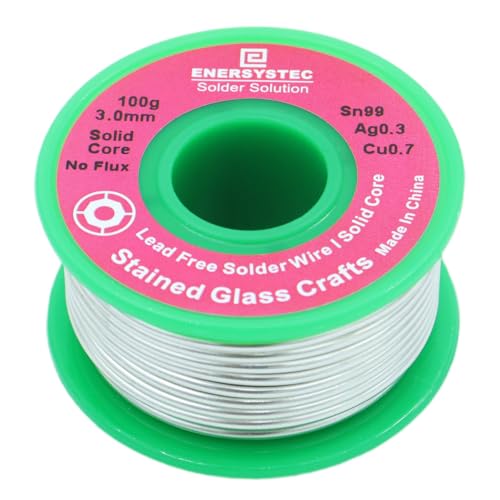
For stained glass, 3.0mm wire is a comfortable format for laying down material across a broad copper-foil seam. This product uses a Sn99 Ag0.3 Cu0.7 alloy and is supplied as solid-core wire without internal flux. The product information specifically describes the thick diameter as easy to handle for glass artwork, with a 100g quantity sized for a stained-glass project.
The absence of a flux core is both the defining strength and the main catch. Solid wire provides a direct feed of alloy, but flux must be applied separately to the copper foil before soldering. That extra step gives the user more control over flux choice and placement, though it adds another item to the bench. The listing does not state a melting temperature, so iron settings must be developed from the alloy, flux, and actual joint behavior rather than a supplied temperature figure.
Pros
- 3.0mm diameter is suited to broad stained-glass seams.
- Solid-core design provides solder without an internal flux formulation.
- Sn99 Ag0.3 Cu0.7 alloy is identified.
- 100g quantity is sized for craft projects.
- Product information emphasizes glass artwork compatibility.
Cons
- Separate flux is required for better flow on copper foil.
- The listing does not state a melting temperature.
This wire is a practical match for glass crafters who already keep suitable flux on hand and prefer a thick, easy-to-grip strand. It is a poor fit for someone who wants a ready-to-feed electronics wire or wants internal flux to simplify every joint. Compared with AIM Artist Pure, it offers less supplied information about melting behavior and a smaller quantity, but its lower-cost format can suit a focused craft project.
To buy this product, click here.
8. Essmetuin Sn99.3Cu0.7 Lead-Free Solder Wire — Best Multipurpose Solid Wire

Essmetuin occupies the middle ground between fine electronics wire and heavy stained-glass solder. Its Sn99.3Cu0.7 alloy is supplied in a 2.0mm diameter, and the listed melting point is 217°C, or 422.6°F. That size can feel more substantial than 0.8mm wire for craft work while remaining less bulky than 3.0mm solder.
The wire contains no flux, so the user needs to apply a compatible flux separately. The listing describes use for stained glass, artware, home DIY, copper pipe welding, crafts, and jewelry, and it states a 3.2oz quantity. That broad application language should be read with care: soldering requirements differ between electronics, copper plumbing, and decorative work, and a product listing alone does not establish universal suitability for every one of those tasks.
Pros
- Sn99.3Cu0.7 alloy is clearly identified.
- 2.0mm diameter bridges craft and general-purpose use.
- 217°C melting point is supplied.
- Solid wire lets the user select and apply separate flux.
- 3.2oz quantity is suitable for smaller projects.
Cons
- No flux is included inside the wire.
- Broad application claims do not replace project-specific compatibility checks.
This option suits a bench where separate flux is already part of the process and a medium-thick wire is more useful than a fine electronics strand. It can make sense for craft and decorative work, while users repairing small PCBs should step down to 0.6mm or 0.8mm. Plumbing work deserves extra attention to applicable codes, flux, fittings, and product certification rather than relying on the general application wording alone.
To buy this product, click here.
9. Canfield Silvergleem Lead-Free Silver Solder Wire — Best Silver-Rich Craft Option

Canfield Silvergleem is aimed at stained-glass soldering, craft work, and jewelry making, with a listed composition of 96% tin and 4% silver. That silver-rich formulation gives it a clear identity among the craft options, especially for projects where the alloy composition matters as part of the finished material choice.
The product comes as a half-pound spool, which is more substantial than a small repair reel but smaller than the one-pound AIM format. The supplied information does not state the wire diameter, melting range, flux type, or detailed flow behavior. Those gaps make it difficult to predict how the wire will feed beside the more fully specified craft products, so the purchase decision rests mainly on its stated alloy and intended applications.
Pros
- 96% tin and 4% silver composition is identified.
- Lead-free formulation suits the stated craft applications.
- Stained glass and jewelry use are clearly named.
- Half-pound spool provides more material than a small electronics reel.
- Silver-rich alloy offers a distinct alternative to tin-copper wire.
Cons
- Wire diameter is not clearly provided in the available information.
- Melting behavior and flux arrangement are not clearly stated.
Choose Silvergleem when the 96/4 tin-silver composition is the reason you are shopping, particularly for jewelry or decorative glass. It is less suitable for buyers who need a clearly published melting range, a known feed diameter, or integrated flux. AIM Artist Pure provides a better information base for a first general craft purchase, while Silvergleem remains an appealing specialized alternative.
To buy this product, click here.
Buying Guide
Match the Alloy to the Workpiece
Lead-free solder is a category label, not a complete performance description. Sn99 Ag0.3 Cu0.7 wire appears in several electronics-focused options here, while AIM Artist Pure uses a silver-bearing alloy aimed at stained glass and crafts. Canfield Silvergleem lists 96% tin and 4% silver, and Essmetuin lists Sn99.3Cu0.7. Those compositions can behave differently under heat, so match the product to the application rather than assuming every lead-free spool is interchangeable.
Wire Diameter Controls Feed Rate
Diameter changes how quickly solder enters the joint. The 0.6mm wire is easier to meter onto small pads, while 0.8mm options suit general electrical work. The 2.0mm and 3.0mm products place more material into a craft seam with each feed, which is useful on stained glass but excessive on a tiny resistor. A large diameter is not automatically better, just as fine wire is not automatically faster.
Rosin Core and Solid Core Serve Different Processes
Rosin-core wire carries flux inside the strand, as seen with the ZSHX and 0.6mm electronics products. That can simplify routine electrical joints. Solid-core products such as the 3.0mm stained-glass wire and Essmetuin require separate flux, which creates an extra step but gives the user control over flux selection and application. No-clean, rosin-core, and solid-core are different descriptions, so do not treat them as interchangeable labels.
Use Melting Information as a Starting Point
A listed melting point or range helps establish an initial iron setting, but it does not guarantee that the joint itself reaches that exact temperature. Tip condition, tip geometry, heater control, contact with the workpiece, and thermal mass all affect the process. The listed 217°C figures on the ZSHX and Essmetuin products, the 419°F figure on the fine wire, and the 407°F to 439°F range on AIM Artist Pure are useful reference points rather than promises of identical behavior on every setup.
Separate Electronics Needs from Craft Needs
Small PCB joints usually benefit from a narrow wire and a suitable flux core. Stained glass generally calls for a thicker strand that can cover copper-foil seams efficiently and produce a controlled bead. Jewelry adds appearance and material concerns, which is where the pewter-finish and silver-rich options become more relevant. A spool marketed for plumbing or broad craft use should not be selected for electronics solely because it is lead-free.
Check Quantity Against Project Size
A 50g electronics spool can be convenient for occasional repairs, while a one-pound craft spool is more appropriate for repeated panels or larger art projects. Quantity also affects storage and waste. A buyer working on one small board may have little reason to purchase a large craft format, and a stained-glass maker can burn through a small electronics reel surprisingly quickly on broad seams.
Best Lead-Free Solder FAQ
What is the best lead-free solder for electronics?
Kester K100LD is the clearest electronics-focused choice in this selection because its 0.031-inch diameter, 3.3% flux content, and no-clean flux type are explicitly identified. ZSHX and the 0.6mm Sn99 Ag0.3 Cu0.7 wires are also relevant, with rosin cores and listed 217°C or 419°F melting information. Choose the diameter based on pad size and how much solder you need to feed at once.
Is 0.6mm or 0.8mm solder better?
Neither size is universally better. A 0.6mm wire gives finer control on small pads, compact ICs, and delicate rework. An 0.8mm wire feeds more quickly for ordinary through-hole joints, connectors, and electrical wires. If most of your work involves small PCB pads, start with 0.6mm. For mixed electrical repairs, 0.8mm is usually the more flexible format.
Does lead-free solder need more heat?
Lead-free alloys often have different melting behavior from traditional leaded solder, so the iron may need a different setting and technique. The actual requirement depends on the alloy, tip, heater, joint size, and workpiece. Use the listed melting point or range as a starting reference, then follow the solder and tool instructions rather than assuming a single temperature works for every spool.
What is the best lead-free solder for stained glass?
AIM Artist Pure is the strongest overall craft choice here because it uses a silver-bearing alloy, comes in a 3mm format, and lists a 407°F to 439°F melting range with an emphasis on smooth flow and a bright bead. The 3.0mm solid-core wire is a more focused alternative for stained glass, but it requires separate flux.
Can solid-core solder be used without flux?
Solid-core solder does not carry internal flux, so flux generally needs to be applied separately to help the solder wet and flow across the joint. The 3.0mm stained-glass wire and Essmetuin product both state that they contain no flux. The correct flux depends on the application. Electronics flux and plumbing flux should not be treated as interchangeable.
Is rosin-core solder suitable for every electronics project?
Rosin-core solder is convenient for many general electrical joints, but the flux residue, activity, and cleaning requirements still matter. A product described as rosin core is not automatically right for every sensitive assembly or production process. Check the project requirements, apply the correct amount of heat, and clean residue where the process calls for it.
Is lead-free solder safer?
Lead-free solder removes lead from the alloy, but soldering still involves heat, fumes from flux, molten metal, and potentially sharp or hot tools. Use appropriate ventilation, eye protection, safe handling practices, and hygiene. Lead-free does not mean risk-free, and a small bench fume absorber does not replace suitable ventilation or workplace controls.
Final Verdict
AIM Artist Pure Lead-Free Stained Glass Solder is the strongest overall recommendation because it combines a useful 3mm format, a silver-bearing lead-free alloy, a stated 407°F to 439°F melting range, and clear attention to flow and bead appearance. It is especially well matched to stained glass, artware, jewelry, and craft projects where the finished seam remains visible. For electronics, Kester K100LD is the more appropriate choice because its diameter and flux details are clearly identified, while the 0.6mm Sn99 Ag0.3 Cu0.7 wire gives finer control on small pads.
The right purchase still depends on the bench in front of you. Pick ZSHX for broad general electrical work with a rosin core, use the 3.0mm solid wire when stained-glass handling and separate flux fit your process, and choose Canfield Pewter Finish when a muted satin line is part of the design. Before ordering, verify the alloy, diameter, flux format, and project compatibility. Those four details will shape the result far more than the words “lead-free” printed across the label.

- Jesse
Jesse is the editor behind Soldering Gear, where he covers soldering irons, stations, rework equipment, and the tools that belong on a practical electronics bench. His work focuses on comparing product specifications, features, compatibility, and intended uses so readers can make more informed buying decisions.
- Best Soldering Iron for Phone Repair: 9 Picks in 2026 October 27, 2026
- Best Hot Air Rework Station for Phone Repair: 9 Picks in 2026 October 26, 2026
- Why Is My Soldering Iron Not Melting Solder? October 25, 2026
- Best Portable Solder Fume Extractor: 9 Picks in 2026 October 24, 2026
- Best Desoldering Wick: 9 Picks in 2026 October 23, 2026