Best Soldering Iron for Electronics: 9 Picks in 2026

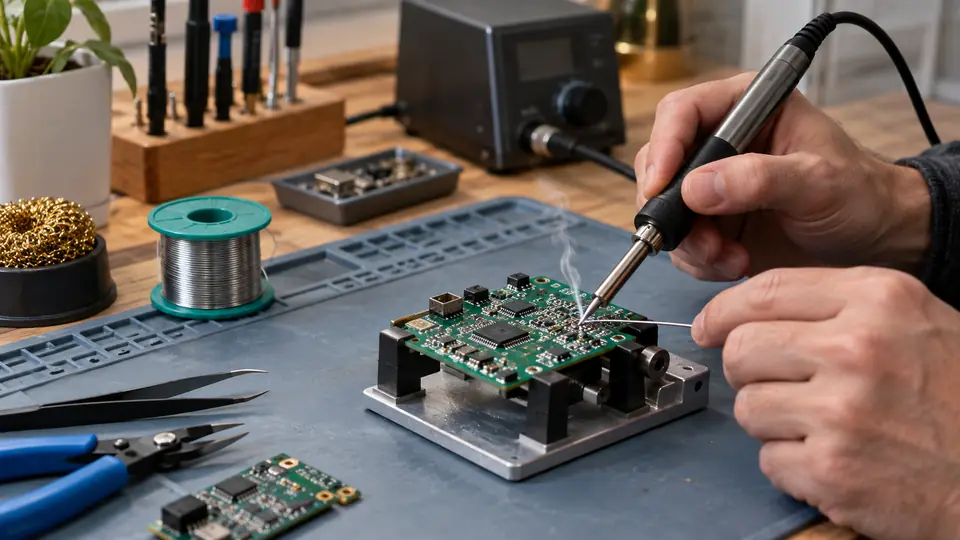
A good electronics soldering iron must do more than get hot. PCB work moves between tiny pads, heavier ground planes, through-hole leads, wires, and heat-sensitive components, so controllable temperature, usable tip choices, steady handling, and sensible heat recovery matter more than a dramatic maximum-temperature figure. A pencil iron may suit an occasional repair, while a station can make repeated joints easier to manage and safer to pause between connections.
Wattage also needs context. A higher rating can provide more available heating power, but the actual result depends on the heater, control system, tip, joint size, and thermal mass of the workpiece. A small cordless model can be wonderfully handy inside a cramped enclosure, yet a bench station remains the more dependable choice for long sessions or large copper areas. Clear displays, sleep modes, calibration functions, and included tips can simplify the work, but they do not replace ventilation, eye protection, careful handling, or a suitable work surface.
This comparison favors tools that offer useful temperature control and practical electronics accessories rather than simply the biggest number on the box. The Weller WE1010NA leads for repeatable bench work, while the YIHUA 939D+ and WEP 927-IV give strong alternatives at different feature and accessory levels. Portable users have a very different priority, which is where the Fanttik T1 Max becomes more interesting.
Quick Answer
- Best Overall: Weller WE1010NA for stable, repeatable electronics soldering and a focused station setup.
- Best Station Value: YIHUA 939D+ for precision heat control, a built-in transformer, and a solid metal stand.
- Best Accessory Package: WEP 927-IV for preset temperatures, a magnifier, helping hands, and a broad starter setup.
- Best Cordless Option: Fanttik T1 Max for small repairs where a wall outlet would get in the way.
Best Soldering Iron for Electronics Comparison Table
| Product | Best For | Power And Control | Tip Or Accessory Setup |
|---|---|---|---|
| Weller WE1010NA | Regular bench electronics work | 70W, 2°C stability claim, temperature lock | WEP70 iron, one ETA tip, safety rest |
| YIHUA 939D+ | Precision-focused station use | 75W equivalent, 392°F to 896°F | Metal stand, calibration support |
| WEP 927-IV | Accessory-rich electronics bench | 110W, dual display, three presets | Five tips, magnifier, helping hands |
| YIHUA 926 III | Compact station and PCB projects | 60W, 194°F to 896°F, PID control | Six tips, helping hands, solder sucker |
| Fanttik T1 Max | Cordless spot repairs | 12W wireless, 16W wired, six levels | Four C210 tips, aluminum stand |
| Plusivo 60W Kit | Portable starter kits | 60W, 392°F to 932°F | Five tips, tools, carry bag |
| 60W Adjustable Soldering Iron Kit | Basic electronics repairs | 60W, 392°F to 842°F | Five tips, stand, solder, flux paste |
| Liouhoum 80W LCD Kit | Low-cost digital control | 80W, 356°F to 896°F, auto sleep | Five tips, stand, solder, paste |
| 100W Digital Soldering Station | Accessory-heavy home workbench | 100W, 356°F to 896°F, calibration | Five tips, helping hands, cleaner |
The detailed reviews below focus on how each tool fits real PCB, wire, through-hole, and small electronics tasks.
1. Weller WE1010NA — Best Overall
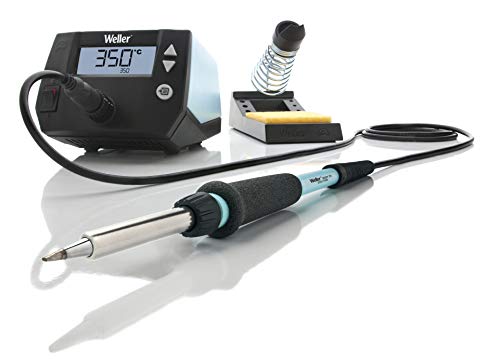
The Weller WE1010NA takes the cleanest approach to electronics soldering in this group. Its 70W station includes a WEP70 iron, a heat-resistant silicone cable, a safety rest with sponge, and an ETA screwdriver tip measuring 1.6 mm. The published product information also gives temperature stability of plus or minus 4°F, or 2°C, along with temperature lock and password protection. Those details matter during repeated PCB work because a stable setpoint is easier to reproduce than a dial that drifts or changes accidentally.
Its controls are aimed at a permanent bench rather than a grab-and-go tool bag. Standby and auto setback can reduce idle heating, while the temperature lock helps protect a chosen setting from accidental changes. The station is rated for 120V, and the supplied information identifies a focused package rather than a large pile of accessories. That restraint is useful if you would rather choose additional tips around your actual soldering tasks than store a dozen generic extras in a drawer.
Pros
- Published temperature stability of plus or minus 4°F, or 2°C.
- Temperature lock helps preserve a selected setting during repeated work.
- 70W station power suits a range of PCB and through-hole tasks.
- Heat-resistant silicone cable supports comfortable iron handling.
- Includes a safety rest, sponge, WEP70 iron, and ETA 1.6 mm screwdriver tip.
Cons
- The package includes fewer accessories than the larger all-in-one kits.
- The supplied information identifies one included tip, so additional tip purchases may be needed for specialized joints.
This is the strongest choice for someone who values predictable bench behavior over a magnifier, helping hands, or a large starter bundle. It makes particular sense for repairs that involve repeated joints, mixed component sizes, and a need to return to the same temperature. A buyer seeking a cordless tool or a low-cost kit with solder and a pump in the box will find the package less convenient, but the focused station design is precisely why it ranks first for serious electronics use.
To buy this product, click here.
2. YIHUA 939D+ — Best For Precision-Focused Bench Work

The YIHUA 939D+ is built around a station format with a little more emphasis on heat management and physical construction. Its product information lists 75W-equivalent performance, a 392°F to 896°F adjustment range, automatic handle detection, temperature calibration support, and a control program that the listing says compensates in 20 milliseconds. That last figure is a published claim rather than an independent measurement, but the presence of calibration support and a clear digital display still gives the user useful control over the set temperature.
A built-in transformer provides contact-safe voltage according to the listing, while the brushed-aluminum control panel and separate metal-alloy iron stand give the setup a more substantial bench presence. Picture a crowded repair table with a board clamped nearby and several wires waiting their turn. A stable station and a stand that can be positioned separately are easier to live with than an iron balanced on a tiny plastic rest, although this kit does not emphasize included magnification or a large selection of consumables.
Pros
- 75W-equivalent station performance with a 392°F to 896°F range.
- Temperature calibration support helps users refine the displayed setting.
- Automatic handle detection and digital °F/°C display support controlled operation.
- Built-in transformer is listed as providing contact-safe voltage.
- Separate metal-alloy stand and brushed-aluminum control panel suit a permanent bench.
Cons
- The supplied package information does not list multiple included soldering tips.
- Its station format is less convenient than a pencil iron for repairs away from a bench.
Choose this model over the Weller when the combination of calibration support, metal construction, and the included station features fits your priorities. It is a sensible match for regular PCB work where the iron can stay set up, particularly if you already own solder, cleaning materials, and the tips needed for your projects. Buyers who want an all-in-one kit ready for a first repair may prefer the WEP or YIHUA 926 III instead.
To buy this product, click here.
3. WEP 927-IV Soldering Station Kit — Best Accessory Package
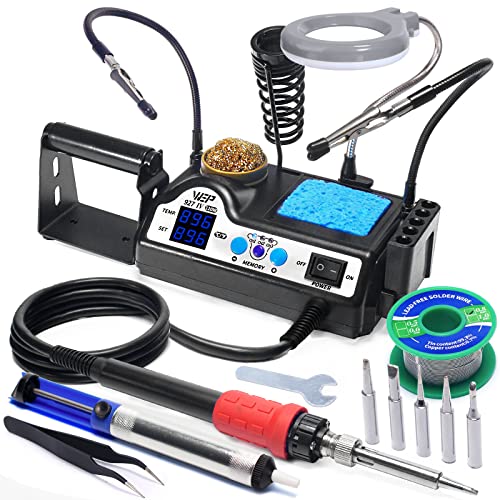
The WEP 927-IV makes a strong case for a station that also organizes the work surface. Its 110W heating element, 90°C to 480°C range, and dual numerical display show the selected temperature and the actual temperature display at the same time according to the listing. Three preset channels are especially handy when a project alternates between a fine component joint, a larger through-hole connection, and a higher-temperature lead-free setting.
The built-in LED magnifier, helping hands, tip cleaner, solder wire dispenser, and tip storage slots give this station a busy, practical character. Imagine trying to hold a small connector, feed solder, and keep the iron steady with only two hands. The included supports can reduce that juggling, though a magnifier built into the station is still a convenience rather than a substitute for a dedicated inspection setup. The model uses WEP #1400 tips, and the listing says those tips are available through the brand’s store, so tip-system planning belongs in the purchase decision.
Pros
- 110W heating element and a broad 90°C to 480°C adjustment range.
- Dual display shows the set and actual temperature readings.
- Three preset channels speed up changes between common temperatures.
- Includes an LED magnifier, two helping hands, tip cleaner, and storage slots.
- Sleep timer can be set from 0 to 99 minutes.
Cons
- Uses WEP #1400 tips, so tip replacement requires attention to that specified system.
- The compact integrated layout may feel crowded for larger boards or extensive bench equipment.
This is a good fit for a home electronics bench where the iron, magnifier, wire, and board supports need to stay in one footprint. It gives up some of the focused simplicity of the Weller, but it gives back a generous accessory setup and quick preset changes. If you already have a well-equipped bench, the extra fixtures may matter less, and the specified WEP tip family should be confirmed before ordering replacement tips.
To buy this product, click here.
4. YIHUA 926 III 60W Station Kit — Best Compact Station
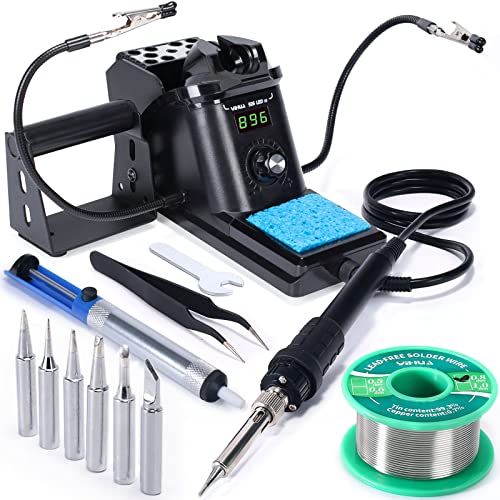
The YIHUA 926 III packs a useful amount of bench equipment into a relatively compact station. The 60W iron has a listed range of 194°F to 896°F, PID temperature stabilization, digital calibration, and a display controlled through a master knob. For PCB work, the important combination is the adjustable setpoint and the ability to calibrate the display, since different tips and joint sizes can change how much heat reaches the connection.
This version includes two helping hands, six YIHUA #1200/900M Series tips, lead-free solder wire, a solder sucker, stainless-steel tweezers, a wire dispenser, and a cleaning sponge. The rear mesh protector doubles as tip storage and helps separate the hot iron from accidental contact. A small desk with a half-finished circuit board can become cluttered quickly, so the integrated holder and accessory storage are practical touches, though the 110 to 127V US specification limits it to the intended electrical environment.
Pros
- PID temperature stabilization and digital calibration support controlled soldering.
- 194°F to 896°F temperature range covers fine and heavier electronics tasks.
- Includes six YIHUA #1200/900M Series tips.
- Two helping hands, a solder sucker, tweezers, solder, and sponge are included.
- Integrated holder and rear tip storage help conserve bench space.
Cons
- The 60W rating provides less listed power than the WEP 927-IV and 100W station.
- The included lead-free solder may require different heat and technique than leaded solder.
This model suits someone building a first electronics bench who wants station control without assembling every accessory separately. It ranks below the more powerful stations because 60W gives less headroom for large heat sinks and heavy copper areas, but its calibration, tip selection, and fixtures make it more useful than a bare pencil iron. Choose it when footprint and completeness matter more than maximum available heating power.
To buy this product, click here.
5. Fanttik T1 Max — Best Cordless Option

The Fanttik T1 Max changes the question from “Which station belongs on my bench?” to “How can I reach this repair without dragging a cord across it?” Its built-in 2600mAh battery supports wireless operation with a listed maximum DC output of 12W for up to 60 minutes at 840°F and a maximum wired output of 16W. The product information describes a Type-C power option, but it does not identify every charger or power-bank requirement, so the intended power setup should be confirmed before relying on it for field work.
Four included C210 tips, a seven-second advertised heat-up time, six temperature levels, and a 390°F to 840°F adjustment range make the T1 Max suited to small repairs and tight spaces. Gravity sensing places the iron into sleep mode after 30 seconds of inactivity and wakes it when picked up. That behavior could be handy when moving around a work area, while the lower output compared with corded stations means larger joints and broad copper planes are outside its natural comfort zone.
Pros
- Built-in battery enables cordless soldering away from a fixed bench.
- Supports wireless 12W output and wired 16W output according to the listing.
- Includes four C210 tips, including C210-I, C210-IS, and two C210-K tips.
- Six temperature levels cover 390°F to 840°F.
- Gravity sensing provides automatic sleep and pickup-based restart.
Cons
- Its listed output is far lower than the corded 60W to 110W stations.
- The supplied information does not clearly identify the complete charger and cable requirements.
Buy this tool for access, portability, and short repair sessions rather than as a universal replacement for a bench station. It could fit a vehicle kit, a cramped enclosure, or a repair bag where an outlet is awkward, but the battery and output limitations deserve respect. For routine PCB production, large connectors, or extended work, one of the corded stations above will provide a more suitable foundation.
To buy this product, click here.
6. Plusivo 60W Digital Soldering Iron Kit — Best Portable Starter Kit

Plusivo’s 60W kit is aimed at the person who wants a portable pencil-style iron and a box of tools for small electronics tasks. The digital display and 200°C to 500°C adjustment range make the temperature easier to read than a simple unmarked dial. Its listed 120V design, ceramic heating element, four ventilation holes, and silicone grip address the basics of handling and heat dissipation without the footprint of a separate station.
The accessory list is unusually broad for a pencil kit. It includes five replaceable tips, 0.8 mm flux-cored SnPb solder wire, a desoldering pump, tweezers, stand, sponge, mini wire stripper, screwdrivers, a small PCB, heat-shrink tubes, and a carry bag. Those pieces can turn a drawer into a workable repair kit, though the included SnPb solder is a lead-containing material and should be handled with appropriate hygiene and ventilation practices. The listing also mentions a 30-day money-back or replacement guarantee and lifetime customer support.
Pros
- 60W iron with a clear digital temperature display.
- Listed 200°C to 500°C adjustment range suits varied repair tasks.
- Includes five replaceable tips and a desoldering pump.
- Carry bag keeps the many small accessories together.
- Includes 0.8 mm flux-cored SnPb solder wire for initial projects.
Cons
- It lacks the separate station controls and bench organization of the top-ranked models.
- The included solder is SnPb, so users must follow suitable lead-handling practices and may need other solder for specific projects.
This kit makes sense for occasional repairs, classes, household electronics, or a second tool bag. It gives a new setup more immediate usefulness than an iron and stand alone, but the lighter pencil format offers fewer fine adjustments and less workspace support than a full station. Choose it for convenience and portability, then upgrade to a station if repeated work exposes the limits of a compact kit.
To buy this product, click here.
7. 60W Adjustable Soldering Iron Kit — Best Basic Value

This 60W pencil iron keeps the setup simple: plug it in, set the temperature, and work from the included stand. Its listed range is 200°C to 450°C, or 392°F to 842°F, with a thermostatic setting and an on/off switch. A ceramic heating core is advertised to reach the selected operating temperature within 15 seconds, while four ventilation holes are intended to reduce heat transfer toward the handle.
The kit includes five interchangeable tips, 0.6 mm solder wire, no-clean solder rosin flux paste, a sponge, and a basic stand. That combination is useful for a first circuit-board repair because solder and flux are present from the start, but the stand and controls are more modest than those found on a station. “No-clean” also describes a flux category, not a universal promise that residue never needs attention, so the board and flux instructions still deserve care after soldering.
Pros
- 60W adjustable iron with thermostatic temperature control.
- Five interchangeable tips support different joint shapes.
- Includes 0.6 mm solder wire for smaller electronics work.
- Includes no-clean rosin flux paste, sponge, and stand.
- On/off switch makes it easier to stop heating between tasks.
Cons
- The included stand is described as simple and offers less workspace support than a station.
- Its 392°F to 842°F range is narrower than several station options here.
For a low-cost repair drawer, this kit covers the essentials without adding a large control box. It is a reasonable match for wires, basic PCB joints, and occasional component replacement where portability matters. People working frequently on dense boards may prefer a digital station with stronger workspace organization, while buyers who need a straightforward iron with solder, flux, and several tips get a practical starting point here.
To buy this product, click here.
8. Liouhoum 80W LCD Soldering Iron Kit — Best Low-Cost Digital Pencil Iron

The Liouhoum kit puts a digital readout and automatic standby behavior into a compact 80W pencil format. The product information lists a 180°C to 480°C range, or 356°F to 896°F, and an advertised heat-up time of 10 seconds. A ceramic core, four ventilation holes, and a heat-resistant handle are intended to keep the tool responsive while limiting heat movement toward the grip.
Its sleep feature lowers the temperature after five minutes on the stand and displays “OFF,” then restores heating when the handle is picked up. Temperature memory can also return the iron to a previous setting after shutdown, according to the listing. That is convenient in a stop-and-start repair session, although it does not provide the dual display, preset channels, or separate station controls found on the WEP. The kit includes five tips, stand, sponge, solder wire, and flux paste, so a small repair can begin without a separate supply run.
Pros
- 80W ceramic-heater design with a listed 10-second heat-up time.
- LCD display shows the selected temperature clearly.
- Five tips, solder wire, flux paste, sponge, and stand are included.
- Automatic sleep mode lowers heat after five minutes on the stand.
- Temperature memory can restore the previous setting after power-up.
Cons
- It lacks the dedicated station housing and bench fixtures useful for repeated PCB work.
- The product information does not specify a broader replacement-tip ecosystem beyond the included five tips.
This model is aimed at buyers who want digital temperature visibility without moving to a full station. It can suit occasional circuit-board repair, appliance work, and small projects where a portable iron is easier to store. The low-cost format brings fewer refinements and less workspace support, so choose a station instead if the work involves long sessions, frequent temperature changes, or several components held at once.
To buy this product, click here.
9. 100W Digital Soldering Station Kit — Best Accessory-Heavy Station

The 100W Digital Soldering Station Kit sits between a compact station and a full starter workbench. It lists a 356°F to 896°F adjustment range, digital °C/°F switching, temperature calibration, an on/off switch, and an auto-sleep timer adjustable from 0 to 600 seconds. The 100W rating provides more stated power than the YIHUA 926 III, but wattage alone does not establish thermal recovery or joint performance. Tip design, contact, control behavior, and the board’s heat load still shape the result.
Its accessory package is the main attraction. Two helping hands, a solder wire dispenser, sponge, tip cleaner, five tips, elbow tweezers, solder sucker, solder wire, screwdriver, and mini wrench are listed. The steel-pipe design includes four vents, while the handle uses silicone sheathing. A crowded hobby bench could benefit from having the small tools nearby, although the supplied information gives less detail about the specific tip system and long-term replacement options than the WEP or Weller listings.
Pros
- 100W station rating with a 356°F to 896°F adjustment range.
- Temperature calibration and °C/°F switching are included.
- Auto-sleep timer can be set from 0 to 600 seconds.
- Includes two helping hands, five tips, tip cleaner, and solder sucker.
- Digital display, on/off switch, and silicone-sheathed handle support practical use.
Cons
- The supplied information does not clearly identify the replacement-tip family.
- Its larger accessory list does not by itself establish better temperature recovery than the lower-wattage stations.
This station fits a home workbench where included fixtures matter and the user wants more stated power than a 60W setup. It is a sensible choice for mixed repairs, wires, and through-hole work, but buyers focused on repeatability may prefer the Weller’s published stability specification, while users who want preset channels may prefer the WEP. Check the current listing for tip details before committing to a long-term setup.
To buy this product, click here.
Buying Guide: Choosing A Soldering Iron For Electronics
Temperature Control Matters More Than The Maximum Number
A range such as 194°F to 896°F tells you where the control may be set, but it does not tell you the temperature at the joint under load. A large copper ground plane can pull heat away quickly, while a tiny SMD pad needs careful control to avoid overheating nearby parts. Stations with calibration support, temperature locks, or published stability information provide more useful control clues than a high maximum alone. The Weller emphasizes stability, while the YIHUA 926 III and 939D+ list calibration support.
Wattage Is Available Heating Power, Not A Quality Score
The products here range from the Fanttik’s listed 12W wireless output to stations rated at 100W and 110W. More available power can help a tool respond to a demanding joint, but it does not automatically make the iron better for delicate electronics. Heater construction, tip mass, control behavior, and contact with the joint all matter. For small PCB pads, a manageable tip and a controllable setpoint may be more useful than simply choosing the largest rating.
Tip Shape And Replacement Access Affect The Work
Fine conical tips can reach small pads, while screwdriver or chisel shapes transfer heat across broader connections. The included tip count is useful, but it is equally important to know what replacements fit later. The WEP 927-IV specifically uses WEP #1400 tips, the YIHUA 926 III lists #1200/900M Series tips, and the Fanttik includes C210 tips. The Weller listing identifies a WEP70 iron and one ETA tip, so additional tip requirements should be checked before ordering.
Stations Reduce Bench Friction
A station gives the iron a dedicated rest, controls away from the hot handle, and usually a more organized place to work. Helping hands, magnifiers, wire dispensers, and tip cleaners can be useful when a board must be held steady while solder feeds into a joint. The WEP 927-IV and YIHUA 926 III are especially accessory-focused. A pencil kit remains easier to store, but a separate stand may be less stable or less convenient during repeated repairs.
Match The Power Source To The Workspace
The corded models in this guide are intended for specific US voltage ranges, including 110 to 127V or 120V depending on the listing. The Fanttik T1 Max adds built-in battery operation and Type-C wired use, but its output is much lower than the corded stations and its complete charger requirements are not clearly identified in the available information. A cordless iron is useful where access is the problem. It is a different tool choice from a station intended to remain on a bench.
Included Solder And Flux Are Part Of The Setup
Several kits include solder wire and flux paste, but their materials differ. The Plusivo kit lists flux-cored SnPb solder, while the YIHUA 926 III includes lead-free solder wire. The 60W adjustable kit includes 0.6 mm solder and no-clean rosin flux paste. Alloy, diameter, and flux chemistry affect feeding, heat requirements, residue, and cleaning. Follow the material instructions, use suitable ventilation, and do not assume that a no-clean label means every residue can be ignored in every application.
Safety Features Help, But They Do Not Replace Good Practice
Sleep modes, stands, temperature setbacks, and on/off switches reduce some idle-heating risks, but a soldering iron remains a hot electrical tool. Keep the tip in its proper holder, protect the work surface, avoid touching solder or flux residue unnecessarily, and provide suitable ventilation. Lead-containing solder requires sensible hygiene, while fumes and heated materials require workspace controls appropriate to the project.
Best Soldering Iron for Electronics FAQ
What Type Of Soldering Iron Is Best For PCB Work?
A temperature-controlled station is usually the strongest fit for regular PCB work because it gives the user a stable place to set the iron and adjust heat for different joint sizes. The Weller WE1010NA, YIHUA 939D+, WEP 927-IV, and YIHUA 926 III all use station formats. A digital pencil iron can still handle occasional repairs, particularly when storage space and portability matter more than bench organization.
Is Higher Wattage Better For Electronics Soldering?
Higher wattage can provide more available heating power, but it is not a direct measure of soldering quality. A 110W station may have more headroom for a heat-hungry joint than a 60W tool, yet tip shape, heater design, temperature control, and contact still affect the joint. For small components, controlled heat and a suitable tip are more useful than chasing the biggest wattage figure.
What Temperature Should Be Used For Electronics?
The appropriate setting depends on the solder alloy, joint size, tip, board, and component. Leaded and lead-free solder can call for different working temperatures, and a large copper area may need more available heat than a small pad. Start with the solder and component guidance for the project, use the lowest practical setting that forms a reliable joint, and avoid treating the displayed temperature as a guarantee of the actual joint temperature.
Are The Included Tips Interchangeable Between These Irons?
No. Tip compatibility depends on the exact handpiece and tip family. The WEP 927-IV listing specifies WEP #1400 tips, the YIHUA 926 III identifies #1200/900M Series tips, and the Fanttik T1 Max uses C210 tips. The supplied information does not establish interchangeability between these systems. Confirm the exact model and replacement-tip family before purchasing extras.
Is A Cordless Soldering Iron Suitable For Circuit Boards?
It can handle small board repairs, especially where reaching the work is more important than sustained power. The Fanttik T1 Max lists 12W wireless output and 16W wired output, which is substantially lower than the corded stations in this guide. That makes it better suited to small joints and portable repairs than large connectors, broad ground planes, or long bench sessions.
Should I Choose Leaded Or Lead-Free Solder?
Follow the requirements of the project, board, and any applicable workplace or material rules. The YIHUA 926 III includes lead-free solder, while the Plusivo kit lists SnPb solder. The alloy changes melting behavior and handling practices, so ventilation, cleanliness, and appropriate disposal matter. Do not choose solely from the solder included in a starter kit if the project specifies another alloy.
Do I Need Helping Hands Or A Magnifier?
They are useful rather than mandatory. Helping hands can hold a board, connector, or wire while the other hand feeds solder. A magnifier can make larger or closely spaced joints easier to inspect, but the built-in LED magnifier on the WEP 927-IV is not the same as a dedicated microscope. If your work involves very small SMD components, stable lighting and appropriate magnification may matter more than a basic integrated lens.
Final Verdict
The Weller WE1010NA is the strongest overall choice here for regular electronics work because its station format, 70W rating, published temperature stability, temperature lock, and focused accessory package support repeatable bench use. It does not arrive with the largest collection of helping hands, solder, and generic tools, yet that is part of its appeal for someone choosing a setup around actual PCB requirements. The YIHUA 939D+ is a strong alternative with calibration support, a built-in transformer, and substantial metal construction.
For a more accessory-heavy setup, the WEP 927-IV brings three presets, dual temperature displays, a magnifier, helping hands, and five tips. The YIHUA 926 III is a compact and balanced station with six tips and useful PCB accessories, while the Fanttik T1 Max earns its place for cordless repairs rather than sustained bench work. Match the tool to the job in front of you. Stable control and suitable tips matter most for repeated electronics soldering, while portability and a ready-to-use kit can matter more for occasional repairs.

- Jesse
Jesse is the editor behind Soldering Gear, where he covers soldering irons, stations, rework equipment, and the tools that belong on a practical electronics bench. His work focuses on comparing product specifications, features, compatibility, and intended uses so readers can make more informed buying decisions.
- Best Cordless Soldering Iron: 9 Picks in 2026 September 28, 2026
- Best Portable Soldering Iron: 9 Picks in 2026 September 27, 2026
- What Temperature for Soldering Electronics? September 26, 2026
- Best Soldering Station for Beginners: 9 Picks in 2026 September 25, 2026
- Best Solder Fume Extractor: 9 Picks in 2026 September 24, 2026