Best Soldering Station for SMD: 9 Picks in 2026

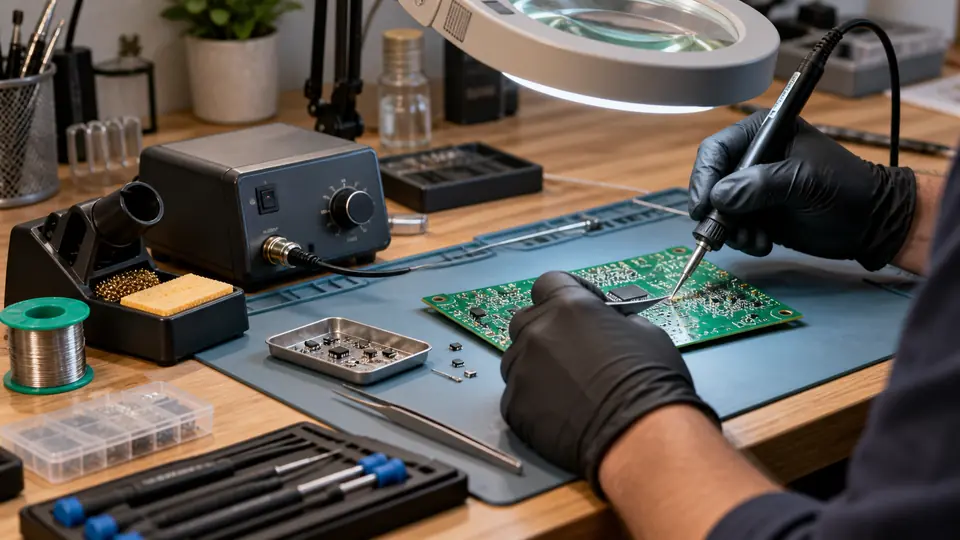
Small SMD parts punish sloppy heat control. A pad lifts, a tiny capacitor skitters away, or a neighboring component suddenly looks suspiciously shiny, and the difference often comes down to the station beside your bench. The best soldering station for SMD needs controllable temperature, a fine enough iron setup, manageable hot-air flow, and controls that let you repeat a repair without starting from scratch.
Headline temperature numbers can distract from the details that matter more. A station reaching 932°F is not automatically better for delicate boards, and higher wattage does not guarantee superior thermal recovery. Tip selection, airflow adjustment, sleep functions, display clarity, included nozzles, and voltage compatibility shape the real experience. A compact two-in-one may suit occasional board repair, while a four-in-one setup makes more sense for a repair bench handling through-hole joints, SMD rework, desoldering, and powered-device testing.
This comparison gives the YIHUA 853D the strongest overall position because it combines an iron, hot-air station, and adjustable DC power supply in one unit. Other picks make more sense for a lower-cost first setup, precision iron work, compact hot-air rework, or a broader repair station with suction and desoldering functions.
Quick Answer
- Best Overall: YIHUA 853D, for a versatile SMD bench with soldering, hot air, and DC testing in one enclosure.
- Best Two-in-One Value: YIHUA 862BD+, with PID-controlled iron and hot air, multiple displays, and a useful accessory kit.
- Best Precision Soldering Station: FNIRSI DWS-200, with separate F210 and F245 handles, 200W rated power, presets, and a temperature display with curve mode.
- Best Compact Hot-Air Pick: LRT 8858, for small benches that need adjustable SMD hot air rather than a full iron-and-air combination.
Best Soldering Station for SMD Comparison Table
| Product | Best For | Iron / Hot-Air Range | Standout Feature |
|---|---|---|---|
| YIHUA 853D | Complete repair bench | 392–896°F / 212–896°F | Integrated DC supply and meter |
| YIHUA 862BD+ | Two-in-one SMD rework | 392–896°F / 212–896°F | PID control and three displays |
| WEP 882D | Lower-cost starter setup | 392–896°F / 212–896°F | Tips, solder, nozzles, and tools included |
| WEP 8786D-I SE | Simple iron and hot air work | 392–896°F / 212–896°F | Hot-air standby mode |
| 8586D | Budget SMD rework | 356–932°F / 212–932°F | Independent controls and auto sleep |
| FNIRSI DWS-200 | Precision iron work | 212–842°F | F210 and F245 handles |
| YIHUA 948-II | Broad repair capability | 60W iron, 650W hot air | Four integrated tools |
| YIHUA 995D+ | Feature-rich two-in-one use | Temperature-controlled iron and hot air | Three presets and large LCD |
| LRT 8858 | Compact hot-air SMD work | 212–932°F | F1–F10 airflow adjustment |
The detailed reviews below show which stations fit fine iron work, hot-air rework, repeated repairs, and more demanding bench setups.
1. YIHUA 853D — Best Overall

The YIHUA 853D earns the top spot by treating an SMD bench as more than an iron with a hot-air handle. Its three-part layout includes a soldering station, hot-air rework station, and DC power supply with voltage measurement. For a repair involving a small board, a powered test, and a stubborn component, having those functions within arm’s reach can save a surprising amount of bench shuffling.
The iron adjusts from 392°F to 896°F, while hot air ranges from 212°F to 896°F with adjustable airflow listed up to 120L/min. The station also provides 0–15V output at 0–2A and can measure DC voltage up to 35V, plus a 5V USB port rated at 0.5A. PID temperature stabilization applies to both soldering and hot air. That combination gives this model unusually broad utility, though its US 110–127V design makes voltage checking part of the buying decision.
Pros
- Combines soldering, hot air, and an adjustable DC power supply.
- Offers PID temperature stabilization for both primary heat tools.
- Provides adjustable hot-air flow with a listed maximum of 120L/min.
- Includes DC output, voltage testing, and a 5V USB port.
- Sleep mode and automatic shutdown help reduce idle wear.
Cons
- Its 110–127V US configuration limits use with other power systems.
- The larger multi-function station may be more equipment than a simple iron setup requires.
This is the strongest choice for a bench handling component replacement, SMD rework, board testing, and occasional powered diagnostics. A buyer focused exclusively on fine-tip iron work may prefer a dedicated precision station with fewer controls, but the 853D makes a compelling case for anyone who wants one central repair unit. It is also the clearest pick for reducing separate equipment around a crowded workspace.
To buy this product, click here.
2. YIHUA 862BD+ — Best Two-in-One Value
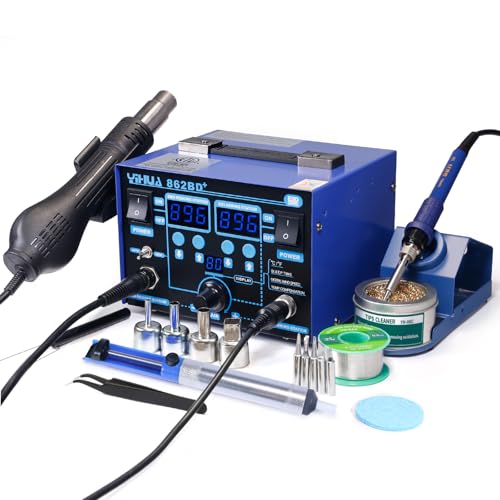
For a straightforward iron-and-hot-air combination, the YIHUA 862BD+ keeps the controls easy to read and the kit unusually complete. Three digital displays show soldering temperature, hot-air temperature, and simulated air volume, so a small board repair does not require guessing which setting is active. The listing also includes five soldering tips, four hot-air nozzles, tweezers, a desoldering pump, brass wool, sponge, and lead-free solder.
The soldering side is listed at 75W with a 392°F to 896°F adjustment range. PID control checks the heating element at short intervals according to the product information, and the sleep timer can be set from zero to 99 minutes. Those features are useful during stop-and-start SMD work, where an iron may sit in its holder while a component is positioned under hot air. The detachable tools and safety receptacles also make replacement more practical than a sealed, non-serviceable arrangement.
Pros
- Combines an iron and hot-air rework station in one unit.
- Uses three displays for quick access to active settings.
- Includes five tips, four nozzles, tweezers, solder, and desoldering tools.
- Offers PID temperature control and an adjustable sleep timer.
- Lists ESD-safe design and detachable station tools.
Cons
- It does not include the DC power-supply and voltage-testing functions found on the 853D.
- The US 110–127V configuration is unsuitable for direct use on 220V power.
This model suits a first serious electronics bench where the owner wants to work on both fine joints and SMD removal without buying a separate hot-air unit. It gives up the 853D’s testing functions, but that trade-off can make sense for board assembly and repair rather than powered diagnostics. The included accessories also reduce the need to gather basic tools before the first project.
To buy this product, click here.
3. WEP 882D — Best Lower-Cost Starter Setup

The WEP 882D aims at the buyer who wants a complete SMD rework station without building a tool collection piece by piece. It places independent displays, power switches, temperature controls, and airflow adjustment on a compact two-in-one unit. That separation matters during a repair session because the iron can be set for a joint while the hot-air handle is prepared for a nearby component.
Both heat tools use PID control according to the listing. The iron adjusts from 392°F to 896°F, and hot air from 212°F to 896°F with variable airflow. The box includes two solder-wire spools, five tips identified as I, B, K, 3.2D, and 3C, three nozzles, tweezers, a brass-wool cleaner, and a desoldering pump. Sleep, standby, automatic shutdown, Celsius/Fahrenheit conversion, and calibration functions add useful control for a lower-cost setup.
Pros
- Provides independent controls for soldering and hot air.
- Lists PID control for both temperature systems.
- Includes two solder-wire spools and five identified soldering tips.
- Comes with three nozzles, tweezers, brass wool, and a pump.
- Offers sleep, standby, shutdown, and calibration functions.
Cons
- The product is rated for 110–127V US power and should not be connected to 220V.
- The listing does not provide a separate DC output or electrical testing function.
The 882D is a sensible fit for small electronics projects, component replacement, and learning how iron and hot-air techniques work together. Its included accessories are practical rather than decorative, especially the range of tips and nozzles. Buyers handling demanding repair work may prefer a station with more advanced testing or display functions, but this one keeps the basic SMD workflow approachable and contained.
To buy this product, click here.
4. WEP 8786D-I SE — Best for Simple Two-in-One Work
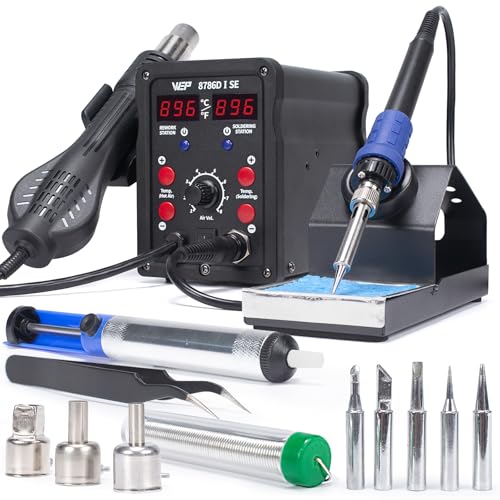
Some benches need a clear, uncomplicated path from a cold board to a repaired joint. The WEP 8786D-I SE provides separate digital temperature readouts, power switches, iron control, and adjustable hot-air volume without adding a DC supply or other testing hardware. That narrower focus can be useful when the job is component removal, pad cleanup, and resoldering rather than fault-finding.
The soldering station ranges from 392°F to 896°F, and the hot-air station ranges from 212°F to 896°F. PID stabilization is listed for both. A 10-minute iron sleep mode reduces heat during pauses, while the hot-air handle enters standby in its holder and cools to 212°F. The kit includes lead-free solder wire, five soldering tips, three nozzles, tweezers, and a desoldering pump, giving a new bench enough basic equipment for SMD practice and repair.
Pros
- Uses separate readouts and power switches for the two heat tools.
- Offers adjustable airflow for hot-air component work.
- Includes five tips and three hot-air nozzles.
- Provides iron sleep mode and hot-air holder standby.
- Includes solder wire, tweezers, and a desoldering pump.
Cons
- It is limited to 110–127V US power.
- It lacks the power-supply, voltage-meter, and expanded display functions of higher-ranked options.
This WEP makes sense for a compact electronics bench where the main tasks are soldering and hot-air rework. The standby behavior is particularly useful in a small workspace, where a hot handle left active can become an awkward hazard. Choose a more capable model if you need board powering or advanced diagnostic features, but the 8786D-I SE keeps the core SMD tools in a tidy package.
To buy this product, click here.
5. 8586D — Best Budget SMD Rework Kit

The 8586D targets a low-cost entry into combined soldering and hot-air work. Its independent LED displays and control buttons allow the two stations to operate separately or together, which is useful when a board needs a little iron work after a component has been lifted with hot air. The product information also describes a spiral outlet for gentle airflow, a detail that may help with smaller parts where aggressive air movement can scatter components.
The iron range is listed as 356°F to 932°F, while hot air spans 212°F to 932°F. Air speed is adjustable from 10 to 99, and the station includes Celsius/Fahrenheit conversion plus an abnormal-handle indication. The kit contains five iron tips, three air nozzles, solder wire, tweezers, a sponge pad, and a desoldering pump. Auto sleep activates when the hot-air handle is placed down, then returns it to working mode when picked up.
Pros
- Combines iron and hot air with independent displays and controls.
- Offers a broad listed adjustment range for both heat tools.
- Provides adjustable air speed from 10 to 99.
- Includes five tips, three nozzles, solder, tweezers, and a pump.
- Uses auto sleep for the hot-air handle.
Cons
- The product information does not identify a separate calibration function.
- The supplied listing does not clearly state the station’s exact input-voltage range.
This is a practical choice for occasional SMD repair, school projects, and a first combined station where the lowest equipment cost matters. Its feature list is broad, but the available information gives less detail about calibration and long-term replacement parts than the higher-ranked YIHUA and WEP models. Confirm the current listing details before ordering, particularly if your local power system is outside the usual US range.
To buy this product, click here.
6. FNIRSI DWS-200 — Best Precision Soldering Station

The FNIRSI DWS-200 takes a different route from the two-in-one stations here. It focuses on powered iron work and supplies two handles: the F210 for precision soldering and the F245 for SMD and higher-power jobs. That separation is valuable on a board crowded with tiny pads, where a smaller precision handle may feel more appropriate than a general-purpose handpiece.
The station is listed at 200W, with an adjustable temperature range of 212°F to 842°F. Its 2.8-inch TFT display can show temperature, a temperature curve, or both, and three presets store frequently used settings. Sleep mode activates when the iron enters its stand. Two 360-degree adjustable helping-hand clips are included, along with nine tips. There is no hot-air station in the supplied configuration, so SMD work here means controlled iron soldering rather than air-based component removal.
Pros
- Includes separate F210 precision and F245 higher-power handles.
- Offers 200W rated station power.
- Provides temperature, curve, and combined display modes.
- Includes three preset functions and nine soldering tips.
- Comes with two adjustable helping-hand clips.
Cons
- It does not include a hot-air rework station.
- The listed maximum temperature is lower than several two-in-one models here.
Choose the DWS-200 if your SMD projects revolve around controlled iron placement, drag soldering, touch-up work, and varied component sizes. The two-handpiece arrangement gives it a stronger precision identity than the combined stations, while the helping hands can steady a small PCB during alignment. It is a poor match for buyers who routinely remove QFPs or other parts with hot air, but a compelling iron-focused alternative.
To buy this product, click here.
7. YIHUA 948-II — Best Broad Repair Station

The YIHUA 948-II is aimed at repair work that moves quickly between heating, soldering, desoldering, and component handling. Its four integrated functions include a 75W desoldering station, 650W hot-air station, 60W soldering station, and suction pen. That broad toolset can be useful when a board arrives with old solder, a damaged component, or several different rework steps waiting in sequence.
PID control is listed for the station, along with Celsius/Fahrenheit display, sleep functions, hot-air automatic or manual modes, cool/hot-air switching, and digital temperature calibration. Error messages such as “S-E” and “F-1/F-2” are identified in the product information. The trade-off is scale and specialization. This is a 110–127V US unit built for a fuller repair bench, rather than a minimal station for occasional fine joints.
Pros
- Combines soldering, hot air, desoldering, and suction pickup.
- Lists a 650W hot-air station and 75W desoldering station.
- Includes PID control and digital temperature calibration.
- Offers automatic or manual hot-air operation and cool-air switching.
- Provides listed error detection and replacement-part support information.
Cons
- Its larger four-tool format may be excessive for simple SMD touch-up work.
- The station is designed for 110–127V US power.
This model belongs on a repair bench where desoldering is as routine as soldering. The suction pen and powered desoldering function can reduce the need to swap between several separate tools, while the hot-air section covers larger rework tasks. Buyers who mostly place new SMD components may prefer the smaller 862BD+ or a precision-focused iron, but the 948-II offers more range for repair-heavy work.
To buy this product, click here.
8. YIHUA 995D+ — Best Feature-Rich Two-in-One
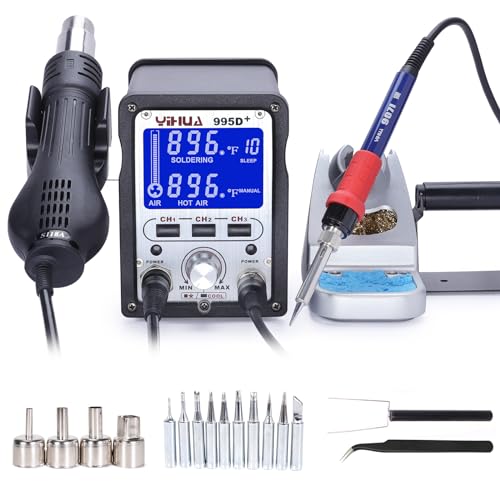
The YIHUA 995D+ gives the familiar iron-and-hot-air format a more configurable control panel. Its large LCD supports Fahrenheit and Celsius readouts, while three memory buttons store repeat settings. A bench repair often involves returning to the same temperature and airflow combination several times, so quick presets can be more useful than a long list of rarely touched functions.
The listing describes PID control, programmable temperature compensation up to ±90°F or 50°C, manual or automatic hot-air modes, cool- or hot-air selection, and an iron sleep timer adjustable from zero to 99 minutes. It also identifies an ESD-safe design, self-test function, and a compact, low-noise format. The listing does not provide a specific iron wattage or detailed included-tip list, so buyers who need those details should confirm the current configuration.
Pros
- Uses a large LCD with selectable Fahrenheit and Celsius display.
- Provides three temperature preset buttons.
- Offers programmable compensation and PID temperature control.
- Supports manual or automatic hot-air operation.
- Includes sleep, self-test, cool-air, and ESD-safe design features as listed.
Cons
- The available product information does not clearly state the iron’s wattage.
- The included tip and nozzle selection is not detailed in the supplied listing information.
The 995D+ suits repeat repair work where saved settings and a larger display can reduce fiddling around a small board. It sits below the 862BD+ for accessory clarity, but offers more control flexibility in several areas. Choose it for programmable operation and a compact footprint, or skip it if a complete box of tips and nozzles matters more than display and memory functions.
To buy this product, click here.
9. LRT 8858 — Best Compact Hot-Air Pick
Not every SMD bench needs a second soldering iron. The LRT 8858 focuses on hot-air rework in a micro-sized controller that takes little room beside a microscope or PCB vise. Its temperature range runs from 212°F to 932°F, and the F1–F10 airflow settings provide a simple way to adjust air delivery for chip removal, rework, heat-shrink tubing, and preheating.
The handle enters cooling mode in its holder, which helps limit idle heating between tasks. The kit includes six nozzles in 3, 4, 5, 6, 8, and 10mm sizes, plus ESD tweezers, an IC extractor, a stand, and a power cable. Since this is a hot-air station rather than a combined soldering station, it pairs best with an existing fine-tip iron. That focused design is its strength for limited bench space, but also its clearest limitation.
Pros
- Compact controller suits crowded repair benches.
- Offers temperature adjustment from 212°F to 932°F.
- Provides ten listed airflow settings from F1 to F10.
- Includes six nozzle sizes for different SMD tasks.
- Provides handle cooling mode when placed in the holder.
Cons
- It does not include a soldering iron station.
- Hot-air airflow control is presented as numbered settings rather than a detailed flow-rate specification.
The LRT 8858 is best for someone who already owns a reliable iron and needs controlled hot air for removing or placing small components. Its six nozzles cover a useful range, and the small controller leaves more room for a board, lighting, and hand tools. A buyer assembling a complete station from scratch should choose a two-in-one model instead, but this focused unit can fill the hot-air gap neatly.
To buy this product, click here.
Buying Guide
Choose the Right Heat Arrangement for SMD Work
SMD work can mean placing a resistor with a fine iron tip, removing a multi-pin component with hot air, or doing both during one repair. A two-in-one station covers more situations than an iron alone, while a dedicated iron such as the FNIRSI DWS-200 can make more sense for precise joint work. A hot-air-only model such as the LRT 8858 is best treated as a focused companion tool, not a complete soldering setup.
Tip Selection Matters More Than a Huge Temperature Number
Small components benefit from a tip shape that can deliver solder without touching nearby pads. The 862BD+, WEP 882D, WEP 8786D-I SE, and 8586D list multiple included tips, which gives a new setup more starting flexibility. Included tips are different from long-term compatibility, so confirm replacement availability and fit before assuming every tip in a similar-looking kit will work.
Airflow Control Helps Protect Small Components
Hot air must transfer heat without pushing loose components across the board. Adjustable airflow appears in different forms here, including the 853D’s listed maximum air volume, the 8586D’s numbered air-speed range, and the LRT 8858’s F1–F10 settings. These figures should not be compared as identical measurements. A temperature setting also does not equal the actual component temperature, which depends on nozzle distance, board mass, airflow, and surrounding copper.
PID Features Need Practical Context
PID control appears throughout several listings and refers to a control system that adjusts heating around a target setting. It can support steadier operation, but the setting alone does not guarantee a particular joint temperature or recovery behavior. Tip geometry, heater construction, sensor placement, contact with the work, and the board’s thermal mass still influence the result.
Presets and Sleep Modes Reduce Bench Fiddling
A sleep timer can reduce idle heat while you position a component or inspect a joint. The 862BD+ offers a zero-to-99-minute sleep setting, the 995D+ provides three memory buttons and an adjustable iron sleep timer, and the FNIRSI DWS-200 stores three presets. These controls matter most for repeated work, where returning to familiar settings saves time without encouraging careless temperature choices.
Match Voltage and Bench Equipment Before Ordering
Several models in this guide are identified for 110–127V US power, including the YIHUA 853D, 862BD+, 995D+, and 948-II, along with the WEP models. The FNIRSI DWS-200 lists 100–240V input. Check the exact product listing and your local power system before ordering. Also check whether the station includes the tools you actually need. The 853D includes a DC supply and meter, while the LRT 8858 includes hot-air accessories but no soldering iron.
Best Soldering Station for SMD FAQ
What type of station is best for SMD work?
A two-in-one station with a controllable soldering iron and adjustable hot air is the most broadly useful format for SMD repair. It can handle fine joint work and component removal in the same session. A dedicated precision iron may be preferable for soldering-heavy work, while a hot-air-only station suits a bench that already has a reliable iron.
Is a higher maximum temperature better for SMD?
No. A high setting does not prove better heat transfer, temperature stability, or recovery at the joint. SMD work usually benefits from controllable heat, appropriate tips, sensible airflow, and careful technique. Maximum temperature is one specification, not a complete performance rating.
Do I need hot air for small components?
You can solder many small components with a fine iron tip, flux, and suitable solder wire. Hot air becomes especially useful for removing multi-pin packages, heating several pads together, reworking solder paste, or handling components where an iron would contact too many pins at once.
Are the included tips and nozzles enough?
They provide a useful starting point, but the right selection depends on the board and component. A narrow nozzle can focus hot air, while a larger nozzle spreads heat across more pins. Included tips and nozzles may be specific to the listed station, so verify fit before buying replacements.
What does PID temperature control do?
PID control uses feedback to adjust heater output around the selected temperature. It can help a station maintain its target more consistently, but it does not guarantee that the component or solder joint reaches the displayed number. Tip size, board mass, airflow, and contact all affect real work.
Is a two-in-one station enough for board repair?
For many home electronics and hobby repairs, yes. An iron and hot-air tool cover a large share of common SMD tasks. More demanding repair benches may benefit from a DC supply, voltage meter, powered desoldering tool, or suction pen, which is why the YIHUA 853D and 948-II appeal to different kinds of repair work.
Can I use a US-rated station outside the United States?
Do not assume so. Several products here are specifically identified for 110–127V US power, while the FNIRSI DWS-200 lists 100–240V input. Confirm the exact voltage requirement and use an appropriate electrical setup rather than relying on the plug shape alone.
Final Verdict
The YIHUA 853D is the strongest overall choice for a full SMD repair bench because it combines an adjustable soldering station, hot-air rework, and DC power-supply functions. That extra testing capability separates it from ordinary two-in-one stations and gives the bench more room to handle powered diagnostics alongside component work. The YIHUA 862BD+ is the better fit for a simpler iron-and-hot-air setup with clearly listed accessories, while the WEP 882D offers a lower-cost route into the same basic workflow.
For precise iron work, the FNIRSI DWS-200 stands apart with its F210 and F245 handles, presets, and display modes, though it does not provide hot air. The LRT 8858 is a useful compact companion where hot-air rework is the missing piece. Before buying, match the station to the jobs you actually perform, check voltage requirements, verify the included tips and nozzles, and treat temperature and wattage figures as starting points rather than guarantees of joint performance.

- Jesse
Jesse is the editor behind Soldering Gear, where he covers soldering irons, stations, rework equipment, and the tools that belong on a practical electronics bench. His work focuses on comparing product specifications, features, compatibility, and intended uses so readers can make more informed buying decisions.
- Best Soldering Iron for Phone Repair: 9 Picks in 2026 October 27, 2026
- Best Hot Air Rework Station for Phone Repair: 9 Picks in 2026 October 26, 2026
- Why Is My Soldering Iron Not Melting Solder? October 25, 2026
- Best Portable Solder Fume Extractor: 9 Picks in 2026 October 24, 2026
- Best Desoldering Wick: 9 Picks in 2026 October 23, 2026