Best Soldering Iron for Phone Repair: 9 Picks in 2026

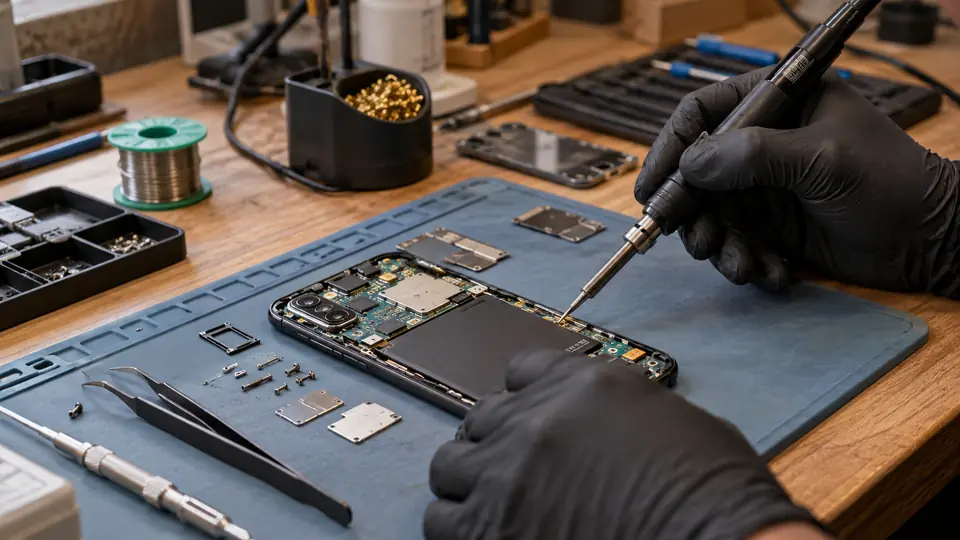
Phone repair puts unusual demands on a soldering iron. The joints are small, nearby components can be heat-sensitive, and a bulky tool can make a simple connector repair feel like threading a needle with oven mitts. A useful choice needs controllable temperature, a tip suited to fine work, a handle that stays manageable, and enough heating capacity to transfer heat without lingering on a pad.
Headline wattage can mislead. An 80W iron may heat quickly, but that number alone does not prove better temperature stability or safer work on a phone board. Tip shape, temperature adjustment, included accessories, and the quality of the stand matter just as much. A portable cordless model suits field repairs, while a station with helping hands and calibration support makes more sense for a fixed bench.
The YIHUA 926 III takes the strongest overall position because it combines adjustable temperature control, a digital display, sleep settings, calibration support, multiple tips, and a practical station layout. The other picks cover lower-cost pencil irons, a cordless option, accessory-rich kits, and a phone-repair work surface for buyers building a more complete setup.
Quick Answer
Best overall: The YIHUA 926 III 60W Digital Display Soldering Iron Station Kit offers the most complete bench setup, with a digital temperature readout, PID temperature stabilization listed by the product information, adjustable sleep mode, calibration support, six tips, helping hands, and a solder sucker.
Best cordless option: The Fanttik T1 Max is the practical choice for cable-free work. Its built-in battery provides up to 60 minutes at the published operating conditions, while its C210 tip set and compact stand suit quick repairs away from a full bench.
Best budget station: The 130W Digital Display Soldering Iron Station Kit offers a station layout, two helping hands, adjustable sleep timing, five tips, and a broad listed temperature range at a lower-cost position.
Best Soldering Iron for Phone Repair Comparison Table
| Product | Best For | Temperature Control | Tip Or Setup |
|---|---|---|---|
| YIHUA 926 III 60W Station | Overall bench repair | 194°F to 896°F, digital, calibration support | 6 tips, helping hands |
| Fanttik T1 Max | Cordless phone repair | 200°C to 450°C, 6 levels | C210 tips, built-in battery |
| 130W Digital Station Kit | Complete low-cost station | 356°F to 932°F, digital | 5 tips, helping hands |
| Plusivo 60W Digital Kit | Accessory-rich starter kit | 200°C to 500°C, digital | 5 tips, pump, carry bag |
| Liouhoum 80W Digital Iron | Fast-heating pencil iron | 180°C to 480°C, digital | Portable kit, stand |
| 80W Ceramic Heater Kit | Budget electronics repair | 180°C to 480°C, digital | 5 tips, solder, flux |
| 60W Interchangeable-Tip Kit | Simple pencil-iron setup | 200°C to 450°C | 5 tips, 0.6mm solder |
| ANBES 60W Electronics Kit | Portable repair kit | 200°C to 450°C | 5 tips, pump, storage bag |
| Boshanix Silicone Repair Mat | Organized phone-repair bench | Work-surface accessory | 82 screw positions, wrist strap |
The detailed reviews explain how each setup handles temperature control, small joints, organization, portability, and the compromises that matter around delicate phone boards.
1. YIHUA 926 III 60W Digital Display Soldering Iron Station Kit — Best Overall
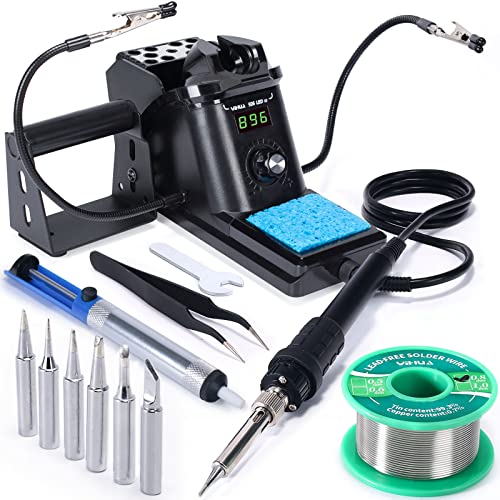
Phone-board work benefits from a stable setup, and the YIHUA 926 III provides more control than a bare pencil iron. The product information lists a 194°F to 896°F adjustable range, digital temperature readout, PID temperature stabilization, and digital calibration support. Those controls do not guarantee a particular tip temperature at a joint, but they give the user a clearer starting point than a simple dial with no display.
The station also includes two helping hands, six YIHUA #1200/900M series tips, lead-free solder, a solder sucker, ESD-safe tweezers, a wire dispenser, and a cleaning sponge. A phone repair setup can become cluttered quickly, so the integrated holder and rear tip storage are useful touches. Adjustable sleep settings of 5, 10, or 30 minutes also reduce idle heating between connector or wire repairs.
Pros
- Digital temperature display with a broad listed adjustment range.
- PID temperature stabilization and digital calibration support are listed.
- Includes six tips, two helping hands, tweezers, solder, and a solder sucker.
- Integrated holder and rear tip storage help conserve bench space.
- Adjustable sleep settings support safer idle periods and tip maintenance.
Cons
- The station requires a dedicated bench space and a 110 to 127V outlet.
- The included solder is lead-free, which can require different working habits than leaded solder.
This is the strongest match for someone doing repeated repairs at one workbench and wanting more structure than a plug-in iron. It may be excessive for a single loose wire or occasional craft job, but the controls and accessories make it easier to organize delicate work. Confirm that the listed 900M-series tips suit the tip shapes you need before ordering.
To buy this product, click here.
2. Fanttik T1 Max Soldering Iron Kit — Best Cordless Option

A dangling power cord can get awkward around an open phone, especially when the board is held at an angle or the repair is happening away from a full bench. The Fanttik T1 Max addresses that problem with a built-in 2600mAh battery and a published cordless output of up to 12W. The listing states up to 60 minutes at 840°F and describes a wired mode with up to 16W through a charger or mobile power source with a Type-C port.
Its four included C210 tips, including C210-I, C210-IS, and two C210-K tips, give the tool a more specialized feel than a generic five-tip kit. Six temperature levels cover 200°C to 450°C, while gravity sensing activates sleep mode after 30 seconds and wakes the iron when it is picked up. The trade-off is lower published output than the 60W and 80W corded choices, so larger thermal loads are outside its clearest use case.
Pros
- Built-in battery enables cordless repair work.
- Published cordless runtime reaches up to 60 minutes under stated conditions.
- Includes four C210 tips suited to varied fine soldering tasks.
- Six temperature levels cover 200°C to 450°C.
- Gravity-sensing sleep and restart reduce idle handling.
Cons
- Published cordless output is limited to 12W, with 16W in wired mode.
- A compatible charger or mobile power source may be needed for wired use.
The T1 Max is a strong fit for quick connector, wire, and small-board work where freedom from a cord matters more than maximum heating reserve. It is less compelling for large ground planes or repairs that demand sustained heat transfer. Buyers should also verify their Type-C power source before treating wired operation as a full replacement for a corded station.
To buy this product, click here.
3. 130W Digital Display Soldering Iron Station Kit — Best Budget Station

This station earns its place through a practical all-in-one layout. The listing gives a 356°F to 932°F adjustable range, digital display, temperature calibration function, and adjustable sleep timing from 60 to 999 seconds. The “130W” label should not be read as a guarantee of superior joint performance, yet the station gives buyers more bench structure than a loose iron and a small wire stand.
Two flexible alligator-clip helping hands are built into the unit, alongside the iron stand and solder-wire holder. That arrangement can be useful when a phone cable, small board, or connector needs to stay still while solder is fed with the other hand. Five tips, solder, rosin flux, a sponge, tip cleaner, tweezers, a solder sucker, and basic tools round out the kit.
Pros
- Digital temperature adjustment spans a broad listed range.
- Includes calibration support and adjustable sleep timing.
- Integrated helping hands can stabilize small repair parts.
- Includes five tips, solder, flux, cleaner, and desoldering tools.
- Combined station layout helps keep the holder and accessories together.
Cons
- The listing does not identify the specific tip family or replacement-tip ecosystem.
- The large advertised wattage does not by itself establish thermal recovery at a phone joint.
This is a sensible lower-cost station for someone who wants a supported work area without moving up to a more feature-specific setup. It may suit connector and through-hole practice particularly well, while buyers doing very fine SMD work should confirm that the included tip shapes are sufficiently narrow. The unclear replacement-tip information is the main long-term question.
To buy this product, click here.
4. Plusivo 60W Digital Soldering Iron Kit — Best Accessory-Rich Kit

For a first repair drawer, the Plusivo kit brings together the small items that are easy to forget. The 60W, 120V iron has a listed 200°C to 500°C adjustment range, an LED temperature display, four ventilation holes, and a heat-resistant silicone grip. Its 0.8mm flux-cored SnPb solder is more directly suited to small electronics work than a kit that leaves solder selection entirely to the buyer.
The accessory count is the attraction here: five replaceable tips, a desoldering pump, tweezers, stand, sponge, mini wire stripper, screwdrivers, a small PCB, heat-shrink tubes, and a carry bag are listed. That variety can help someone learn the basic sequence of heating, feeding, and removing solder. The trade-off is that a large accessory bundle does not tell you how stable the iron will remain under a demanding joint.
Pros
- Digital temperature control covers 200°C to 500°C.
- Includes five replaceable tips and a desoldering pump.
- Lists 0.8mm flux-cored SnPb solder for electronics work.
- Silicone grip and ventilation holes support more controlled handling.
- Carry bag keeps the many small accessories together.
Cons
- The included solder contains lead and requires appropriate handling and cleanup.
- The listing does not identify a specific replacement-tip family.
Choose this kit if convenience matters and you want solder-removal tools in the same bag. It fits occasional phone cable or board repairs better than a buyer seeking the most refined station controls. The included leaded solder can be useful for flow characteristics, but work habits should account for lead exposure and proper ventilation.
To buy this product, click here.
5. Liouhoum 80W Digital Adjustable Soldering Iron Kit — Best Fast-Heating Pencil Iron

The Liouhoum pencil iron is aimed at buyers who want a quick, uncomplicated setup. Its ceramic heater and 80W rating are paired with a listing claim of reaching operating temperature in 10 seconds, while the digital control spans 180°C to 480°C. The display makes it easier to repeat a setting between jobs, although a displayed setpoint is not the same as a verified temperature at a phone pad.
Automatic sleep mode activates after five minutes on the stand, and the product information describes temperature memory for the next startup. The heat-resistant handle, compact format, stand, and basic repair accessories keep the package easy to move. Compared with the YIHUA station, it gives up helping hands, calibration support, and a more organized bench layout.
Pros
- 80W ceramic heater with a listed 10-second heat-up claim.
- Digital adjustment spans 180°C to 480°C.
- Automatic sleep mode activates after five minutes on the stand.
- Temperature memory can restore a previously used setting.
- Includes a stand and a portable plug-in format.
Cons
- The kit has less bench support than a full soldering station.
- Its 110 to 120V design limits use to compatible outlets.
This is a useful pick for quick repairs at a fixed outlet where speed and a small footprint matter. It can make sense for wires, connector work, and general electronics, but fine phone work still depends heavily on choosing a suitable tip and avoiding excess heat. Buyers wanting repeatable station-based work should spend more on the YIHUA instead.
To buy this product, click here.
6. 80W LCD Digital Soldering Iron Pen Kit — Best Basic 80W Kit

This kit follows the familiar pencil-iron formula but adds an 80W ceramic heater, digital display, and adjustable 180°C to 480°C range. The listing states a heat-up time of up to 20 seconds and identifies four ventilation holes for heat dissipation. Those features make the tool easier to approach than a fixed-temperature iron, though the product information does not provide a measured recovery figure under load.
Five tips, a stand, sponge, solder wire, and flux paste are included, so a buyer can begin with basic electronic repairs without assembling every consumable separately. The heat-resistant handle is useful during longer sessions, yet the package remains a simple plug-in iron rather than a station with calibration, helping hands, or advanced idle controls.
Pros
- 80W ceramic heater with digital temperature adjustment.
- Listed temperature range runs from 180°C to 480°C.
- Includes five tips for different joint sizes.
- Package includes solder wire, flux paste, stand, and sponge.
- Ventilation holes and heat-resistant handle support extended handling.
Cons
- The listing does not provide thermal recovery data.
- It lacks station features such as calibration and adjustable sleep timing.
This model suits occasional board and connector repairs where a simple digital iron is enough. It gives more setup guidance than an unmarked pencil iron, but the absent tip-family information makes future replacement planning less clear. Keep a phone board supported and work with the smallest suitable tip rather than assuming 80W is automatically better.
To buy this product, click here.
7. 60W Interchangeable-Tip Soldering Iron Kit — Best Simple Starter Setup

A compact 60W pencil iron can be easier to store than a full station, and this kit keeps the controls straightforward. Its ceramic heating core is listed with a heat-up time of about 15 seconds, while the thermostatic temperature range runs from 200°C to 450°C. An on/off switch is built into the iron, which is handy for reducing unnecessary plug removal between jobs.
The five interchangeable tips are joined by a simple stand, sponge, 0.6mm solder wire, and no-clean rosin flux paste. The narrower solder wire can make controlled feeding easier on small joints than a thicker wire, while the included flux paste may help with oxidation and wetting. The product information does not identify the replacement-tip series, so confirm availability before building a long-term setup around it.
Pros
- 60W ceramic heater with thermostatic temperature control.
- Listed 15-second heat-up time.
- Includes five interchangeable tips.
- Includes fine 0.6mm solder wire and rosin flux paste.
- Built-in on/off switch simplifies routine use.
Cons
- The listing does not identify the replacement-tip standard.
- The included stand is simpler than the support provided by a full station.
This kit is a reasonable match for light electronics work, repair practice, and occasional phone wiring jobs. It is less suitable for a busy repair bench where repeatable calibration and secure board positioning matter. Its useful combination of fine solder wire and multiple tips keeps the entry setup practical without adding the bulk of a station.
To buy this product, click here.
8. ANBES 60W Electronics Soldering Iron Kit — Best Portable Tool Bundle
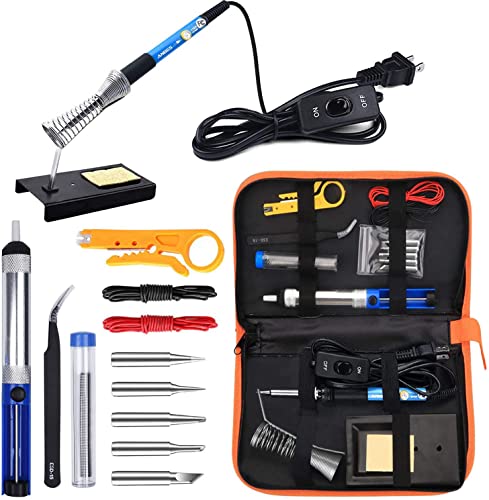
The ANBES kit leans toward portability and basic repair coverage. Its 60W iron adjusts from 200°C to 450°C, and the listing describes five interchangeable tips plus a heat- and impact-resistant screw thread intended to keep the iron head secure. That construction detail is useful because a loose tip can turn a careful joint into a frustrating stop-and-start job.
The package also includes a dual-spring stand with sponge, a metal-bodied desoldering pump, tweezers, wire stripper cutter, electronic wire, and a storage bag. A one-handed solder sucker can be useful when removing a connector or correcting a bridged joint. The kit does not provide the digital display, calibration support, or station-based helping hands found higher in the list.
Pros
- Adjustable 200°C to 450°C operating range.
- Includes five interchangeable tips.
- Dual-spring stand provides a dedicated resting place.
- Metal-bodied desoldering pump is included.
- Storage bag supports mobile or occasional repair work.
Cons
- Temperature is adjustable but the listing does not identify a digital display.
- The package lacks station-level calibration and helping-hand support.
This is a useful choice for a drawer, classroom-style kit, or repair bag where the solder sucker matters almost as much as the iron. It may be skipped by anyone who needs precise displayed settings or frequent bench work. The secure tip-thread description and compact storage format are its clearest advantages over a bare iron.
To buy this product, click here.
9. Boshanix Silicone Soldering Mat — Best Phone-Repair Work Surface

A soldering iron is easier to use when tiny screws, shields, tools, and a hot stand have defined places around the board. The Boshanix mat measures 13.8 by 23.7 inches and is listed as heat-resistant to 932°F. Its 82 numbered screw positions and 29 grid cells are especially relevant to phone disassembly, where a screw that looks almost identical can still belong in a different location.
The mat uses physical partitions rather than magnetic storage and includes an anti-static wrist strap. The listing identifies the mat as washable and flexible enough to roll for storage. Heat resistance and anti-static features address different concerns, so the wrist strap still needs to be used correctly and does not replace broader ESD procedures or a suitable grounding setup.
Pros
- Large 13.8 by 23.7-inch work area suits open-phone repairs.
- Listed heat resistance reaches 932°F.
- Includes 82 numbered screw positions and 29 grid cells.
- Includes an anti-static wrist strap.
- Washable silicone surface can be rolled for storage.
Cons
- It does not provide temperature control or heating capability.
- The non-magnetic layout may be less convenient for buyers who prefer magnetic screw retention.
This mat fits a buyer who already has an iron and wants a more orderly phone-repair station. It cannot replace the precision tool itself, but it can reduce the familiar bench chaos of loose screws and hot accessories. Pair it with a controlled iron such as the YIHUA rather than treating heat resistance as a substitute for careful soldering technique.
To buy this product, click here.
Buying Guide For Phone-Repair Soldering Irons
Temperature Control Matters More Than the Maximum Number
Phone work often involves small pads, fine wires, and nearby components that do not benefit from prolonged heating. A wide range can be useful, but a readable display or clear adjustment system matters more than a dramatic maximum figure. The YIHUA adds calibration support and sleep settings, while the basic pencil irons provide simpler thermostatic or digital adjustment. Treat every listed temperature as a setting, not a guarantee of exact tip or joint temperature.
Choose Tip Variety With Replacement Supply In Mind
A fine conical or small chisel tip can be useful for controlled work, while a broader tip transfers heat across larger joints. Five included tips sound attractive, but the listing should also make clear what family they belong to and whether replacement options are easy to identify. The Fanttik is more specific with its C210 tips, while several generic kits leave future compatibility less clear.
Wattage Is Available Heating Capacity, Not a Quality Score
The reviewed irons range from 60W to 80W corded designs, while the cordless Fanttik lists 12W in DC mode and 16W in wired mode. A higher rating may provide more available heating power, but heater design, tip geometry, control behavior, and the thermal mass of the joint also affect results. A phone board generally benefits from controlled contact more than from blindly selecting the largest number.
A Station Helps With Repeated Bench Repairs
A station can keep the holder, controls, tips, and accessories in a predictable location. Helping hands are useful when one hand must hold a board or wire and the other must feed solder. The YIHUA and 130W station include this kind of support, while the pencil kits are easier to carry but require a more manually arranged workspace.
Use Leaded And Lead-Free Solder Deliberately
The YIHUA package lists lead-free solder, while the Plusivo kit lists 0.8mm flux-cored SnPb solder. These are different solder materials with different handling and working characteristics. Follow appropriate ventilation, hygiene, and waste practices for lead-containing solder, and do not assume that a solder supplied with one kit is the best match for every phone repair.
Plan The Work Surface Before Heating The Iron
A heat-resistant mat protects the desk surface, but it does not make an iron safe to leave unattended. Numbered compartments can help during phone disassembly, and an anti-static wrist strap addresses a separate ESD concern. Keep the iron in its stand, use suitable ventilation, and follow the tool and solder instructions rather than relying on the mat alone.
Best Soldering Iron for Phone Repair FAQ
What temperature should a soldering iron use for phone repair?
There is no single setting for every phone repair. The correct choice depends on the solder alloy, joint size, tip geometry, board construction, and the component nearby. Start with the lowest setting that allows the solder to flow in a controlled way, keep contact brief, and avoid treating the iron’s displayed setting as an exact measurement at the pad.
Is an 80W soldering iron too powerful for phone work?
Not automatically. An 80W rating describes available electrical power, not the amount of heat forced into every joint. A controllable 80W iron can be useful, but careless tip selection or excessive dwell time can still damage a pad. Use a suitable small tip and moderate setting rather than choosing based on wattage alone.
Is a soldering station better than a pencil iron for phone repair?
A station is usually more convenient for repeated bench work because it combines controls, a holder, and sometimes helping hands or calibration support. A pencil iron is smaller and easier to store. The YIHUA station is the stronger structured choice, while the Liouhoum and other pencil kits suit occasional repairs or mobile storage.
Are cordless soldering irons useful for phone repairs?
They can be useful for quick work in tight or temporary spaces. The Fanttik T1 Max lists a built-in battery, up to 60 minutes of cordless operation under stated conditions, and a compact C210 tip set. Its published output is lower than the corded irons, so a full bench station may be preferable for heavier joints or long sessions.
Do more included tips mean a better soldering iron?
No. Tip shape and actual compatibility matter more than the raw count. A kit with five tips is helpful only when those tips suit the work and replacements can be identified later. Check whether the product names a tip family, and choose the smallest tip that transfers enough heat without making the joint difficult to control.
Is a silicone soldering mat ESD-safe?
Silicone construction and heat resistance do not automatically establish ESD performance. The Boshanix listing includes an anti-static wrist strap, but the strap must be used correctly and does not replace proper grounding practices. Treat heat protection and static control as separate parts of the work setup.
Should a phone-repair kit include a desoldering pump?
A pump can be useful for removing solder from through-hole joints or correcting excess solder. It is less suited to every fine surface-mount task, where controlled wick or specialized rework tools may be more appropriate. Kits such as Plusivo, ANBES, YIHUA, and the 130W station include a solder sucker, which adds useful general repair capability.
Final Verdict
The YIHUA 926 III is the strongest overall choice in this group for regular phone and electronics repair at a fixed bench. Its digital control, listed PID stabilization, calibration support, adjustable sleep mode, six tips, helping hands, and included desoldering tools create a more complete working system than the basic pencil irons. It also gives the user a clearer way to repeat settings from one repair to the next.
The Fanttik T1 Max is the better alternative for cordless work, while the 130W station offers a lower-cost route to a holder, helping hands, and a broad digital temperature range. For a simple portable kit, the 60W interchangeable-tip model or ANBES setup keeps the entry point straightforward. Add the Boshanix mat if screw organization and a heat-resistant phone-repair surface are part of the plan. Whichever route you choose, match the tip, solder, temperature setting, and work surface to the joint instead of chasing the biggest wattage number.

- Jesse
Jesse is the editor behind Soldering Gear, where he covers soldering irons, stations, rework equipment, and the tools that belong on a practical electronics bench. His work focuses on comparing product specifications, features, compatibility, and intended uses so readers can make more informed buying decisions.
- Best Soldering Iron for Phone Repair: 9 Picks in 2026 October 27, 2026
- Best Hot Air Rework Station for Phone Repair: 9 Picks in 2026 October 26, 2026
- Why Is My Soldering Iron Not Melting Solder? October 25, 2026
- Best Portable Solder Fume Extractor: 9 Picks in 2026 October 24, 2026
- Best Desoldering Wick: 9 Picks in 2026 October 23, 2026