Best Soldering Iron: 9 Picks in 2026
A soldering iron can be the difference between a clean, reliable joint and a frustrating afternoon of reheating pads, chasing cold connections, and watching solder bead up where it should flow. Buyers usually want three things: controllable heat, a tip that matches the job, and a handpiece that remains manageable around small components. The strongest options here range from compact plug-in irons to full stations with digital controls, sleep modes, calibration support, and broader accessory packages.
Wattage alone does not settle the decision. An 80W pencil iron may heat quickly, while a 60W station with temperature stabilization can offer more predictable control around circuit boards. A station also gives you a dedicated rest, better organization, and often a clearer path to replacement tips. The Weller WE1010NA stands out as the strongest overall choice for regular electronics work because its 70W station combines temperature stability, temperature lock, standby features, and a purpose-built handpiece without leaning on a huge accessory bundle.
Different projects call for different tools. A cordless iron makes sense for field repairs, a compact kit can suit occasional household jobs, and a higher-grade station becomes easier to justify when soldering moves from an occasional fix to a regular bench activity. The comparison below weighs power, control, tip systems, included equipment, and practical limitations rather than treating the highest advertised number as the winner.
Quick Answer
- Best Overall: Weller WE1010NA for stable, repeatable electronics work.
- Best Value Station: YIHUA 926 III for digital controls, calibration support, and a useful starter kit.
- Best Cordless Option: Fanttik T1 Max for portable repairs and Type-C-powered operation.
- Best for Regular Bench Use: Hakko FX888DX-010 for shoppers who prefer an established station format and rotary temperature control.
Best Soldering Iron Comparison Table
| Product | Best For | Power and Control | Tip or Kit Features |
|---|---|---|---|
| Weller WE1010NA | Regular electronics work | 70W, digital, temperature lock | WEP70 handpiece, safety rest |
| YIHUA 926 III | Complete starter station | 60W, digital, PID stabilization | Six tips, helping hands, solder |
| Fanttik T1 Max | Cordless repairs | 12W DC, 16W wired, six levels | C210 tips, built-in 2600mAh battery |
| Hakko FX888DX-010 | Established bench stations | Digital rotary encoder | Station format, updated controls |
| YIHUA 939D+ | Frequent soldering | 75W equivalent, digital control | Built-in transformer, metal stand |
| Hakko FX601-02 | Handheld controlled soldering | 67W, closed-loop control | Slender handpiece, adjustable dial |
| WEP 927-IV | Organized workbenches | 110W, presets, sleep timer | Helping hands, LED magnifier |
| WEP 926LED V3 | Compact complete kits | 130W maximum listing claim, PID control | Five tips, solder sucker, tweezers |
| Liouhoum 80W LCD Kit | Portable budget repairs | 80W, digital, 180°C to 480°C | Sleep mode, temperature memory |
The detailed reviews explain how each iron handles control, portability, accessories, and the trade-offs that may matter at your workbench.
1. Weller WE1010NA | Best Overall
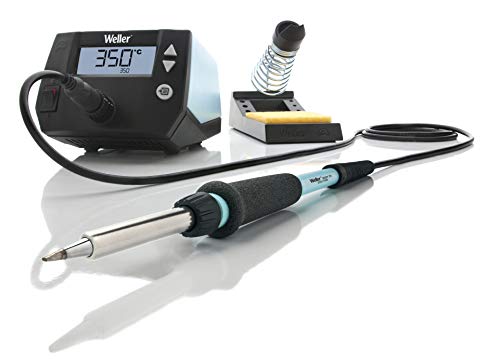
The Weller WE1010NA earns the top position through control rather than accessory volume. Its 70W station provides a stronger foundation for repeated electronics work than a basic pencil iron, while the listed temperature stability of plus or minus 4°F and 2°C gives the buyer a clearer sense of what the station is built to maintain. That distinction matters around PCB joints, where excessive heat can stress components and insufficient heat can create poor wetting.
The station includes a WEP70 iron, heat-resistant silicone cable, safety rest, sponge, tip retainer, and an ETA screwdriver tip measuring 1.6 mm. Temperature lock, standby, auto setback, and password protection are useful features for a shared or regularly used bench. The package is less accessory-heavy than several lower-cost kits, but its strength is a more focused station setup for people who care about repeatable settings and a cleaner workflow.
Pros
- 70W station offers substantial heating capacity for electronics work.
- Published temperature stability is plus or minus 4°F and 2°C.
- Temperature lock helps preserve a chosen setting.
- Includes a heat-resistant silicone cable and dedicated safety rest.
- Standby, auto setback, and password protection support regular bench use.
Cons
- The package includes fewer general-purpose accessories than several kit-focused stations.
- The supplied information identifies one included ETA tip, so buyers needing other geometries should verify replacement-tip availability.
This is the strongest fit for someone repairing boards, assembling kits, or soldering often enough to value stable control over a large pile of extras. Occasional users may prefer a lower-cost kit with solder, tweezers, and a pump already included. For a dedicated electronics bench, though, the Weller’s focused design and temperature-management features make its higher position easy to defend.
To buy this product, click here.
2. YIHUA 926 III | Best Value Station
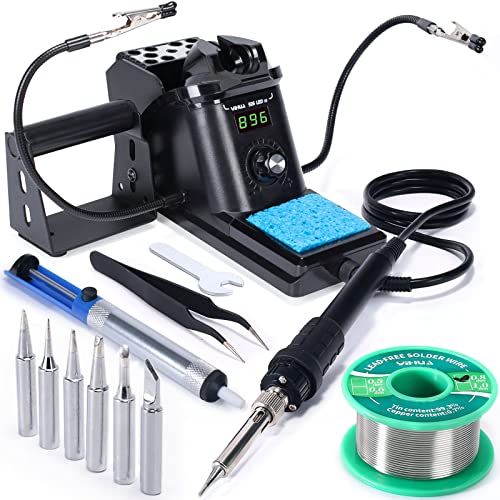
A compact station becomes much more useful when the box includes the small tools that otherwise scatter across a drawer. The YIHUA 926 III arrives with two helping hands, six YIHUA 1200/900M series tips, lead-free solder, a solder sucker, ESD-safe tweezers, a wire dispenser, and a cleaning sponge. That arrangement suits a first electronics bench, especially for through-hole assemblies and general repair work where holding the board and feeding solder are both part of the job.
Its digital display covers a listed range of 194°F to 896°F, while PID temperature stabilization, digital calibration, and a master control knob provide more control than a fixed-temperature iron. Adjustable sleep periods of 5, 10, or 30 minutes can reduce idle heating. The 60W rating is less substantial than the Weller’s 70W, but the broader kit and calibration functions make this a practical choice for buyers who want a complete setup without adding every accessory separately.
Pros
- Digital temperature control includes Celsius and Fahrenheit conversion.
- PID stabilization and calibration support are useful for repeatable work.
- Includes six tips, two helping hands, solder, tweezers, and a solder sucker.
- Integrated holder and rear tip storage help conserve bench space.
- Selectable 5, 10, and 30-minute sleep settings reduce idle heating.
Cons
- Its 60W rating leaves less listed power than the 70W and 110W stations here.
- The station is specified for 110 to 127V US power, limiting use outside that range.
The 926 III makes the most sense for a new bench or a repair drawer that needs a broad starting set. It gives up some refinement and station power compared with higher-priced models, yet its included tools remove several early purchasing decisions. If you already own tweezers, helping hands, and desoldering tools, the package advantage becomes less important.
To buy this product, click here.
3. Fanttik T1 Max | Best Cordless Option

The Fanttik T1 Max changes the workbench equation by removing the fixed power cord during portable jobs. Its built-in 2600mAh battery supports a listed maximum DC output of 12W and up to 60 minutes at 840°F, while wired operation reaches a listed maximum of 16W through a charger or mobile power supply with a Type-C port. Those figures place it in a different class from corded 60W and 70W stations, but that is precisely why it suits quick field repairs, cable work, and small jobs away from an outlet.
Four C210 tips are included, with C210-I, C210-IS, and two C210-K versions. The tool heats in a listed seven seconds, offers six temperature levels from 390°F to 840°F, and enters sleep mode after 30 seconds of inactivity through gravity sensing. Picking it up restarts heating to the selected setting. The aluminum storage stand is a tidy touch, although the cordless design brings runtime and lower available power trade-offs that should be clear before purchase.
Pros
- Built-in battery supports cordless work away from a bench outlet.
- Can operate through a Type-C charger or mobile power supply.
- Includes four C210 tips for different soldering tasks.
- Listed seven-second heating time reduces waiting between jobs.
- Gravity sensing provides automatic sleep and pickup reactivation.
Cons
- Its listed 12W DC output is considerably lower than corded station ratings.
- Runtime depends on battery operation and the listing does not describe a replaceable battery.
Choose the T1 Max for mobility, compact storage, and small repairs where a full station would be awkward. It is less suitable for large ground planes, heavy connectors, or sustained work that benefits from more available heating power. The C210 tip format and Type-C power flexibility are the reasons to choose it, while its lower output explains why it does not lead the overall ranking.
To buy this product, click here.
4. Hakko FX888DX-010 | Best Established Station

The FX888DX-010 is aimed at buyers who want a dedicated digital soldering station and a control interface that is easier to adjust than the earlier FX-888D format. The supplied product information specifically highlights its rotary encoder, which gives temperature adjustment a physical control instead of forcing every change through small buttons. That can make repeated bench work feel more direct, particularly when moving between different soldering tasks.
Information for this listing is brief, so the station should be judged on the details clearly supplied rather than assumed specifications. Its place here comes from the updated user interface and established station format, not from an invented wattage, temperature range, or accessory list. Buyers should confirm the current package contents and compatible tips before ordering, especially if they are replacing another station and already have a particular tip family in mind.
Pros
- Digital station format suits a permanent electronics workbench.
- Rotary encoder provides direct physical temperature adjustment.
- Updated interface is identified as an improvement over the FX-888D controls.
- Hakko model naming makes the station easy to identify for replacement planning.
- Dedicated station design keeps the control unit separate from the handpiece.
Cons
- The supplied information does not clearly list wattage, temperature range, or included tips.
- Buyers should confirm package contents and tip compatibility before ordering.
This is a sensible selection for someone who values the station interface and wants a known model family rather than an accessory-heavy kit. It is harder to evaluate on raw specifications because the available listing information is limited. If detailed power and tip data are central to your purchase, the Weller or YIHUA stations offer clearer published information.
To buy this product, click here.
5. YIHUA 939D+ | Best for Frequent Bench Use

The YIHUA 939D+ focuses on a sturdier station experience, with a brushed aluminum control panel and a separate metal-alloy iron stand. Its product information lists a 392°F to 896°F range, digital Fahrenheit and Celsius display, temperature calibration support, and a built-in transformer that provides contact-safe voltage. Those details create a more substantial setup than a basic plug-in pencil iron, particularly for someone who expects the station to stay on a workbench.
The listing describes a 75W-equivalent system and an intelligent temperature-control program that monitors and compensates in 20 milliseconds. That is a published product claim, not an independent measurement, so it should be read as a description of the control system rather than a guarantee for every joint. The station’s controls are straightforward, with a knob for temperature changes and a button for unit conversion, while the 110 to 127V specification limits its intended electrical environment.
Pros
- Wide listed temperature range from 392°F to 896°F.
- Digital display supports Fahrenheit and Celsius readings.
- Built-in transformer is specified for contact-safe voltage output.
- Brushed aluminum panel and metal-alloy stand suit a fixed bench.
- Includes temperature calibration support and automatic handle detection.
Cons
- The listing describes a 75W equivalent rather than presenting a conventional wattage rating.
- It is specified for 110 to 127V US power.
The 939D+ fits regular soldering better than occasional drawer storage. It offers more station structure and control than the inexpensive pencil kits, while its accessory package is less expansive than the YIHUA 926 III. Pick it for a sturdy control unit and metal stand, but compare the included tip and consumable details before assuming it replaces a complete starter kit.
To buy this product, click here.
6. Hakko FX601-02 | Best Handheld Controlled Iron

The FX601-02 takes a different route from a station by placing adjustable electronic temperature control inside a slender handheld iron. Its 67W rating gives it more listed power than small portable models, while the closed-loop control and temperature sensor in the heater are intended to keep the selected setting consistent. That combination can appeal to users who want a controlled iron without giving part of the bench to a separate station box.
The handpiece uses a dial for temperature selection and includes cord strain relief, which supports a simple, direct setup. The supplied information does not specify the full temperature range, included tip selection, or stand contents, so those details should be confirmed before purchase. Compared with a station, this model gives up a separate digital interface and station-based storage, but its slender form may be more convenient for work that moves around the bench.
Pros
- 67W handheld design provides a controlled alternative to a full station.
- Closed-loop electronic temperature control is built into the iron.
- Temperature sensor is located in the heater according to the listing.
- Slender handpiece supports a compact working setup.
- Cord strain relief contributes to practical cable durability.
Cons
- The available information does not specify the full temperature range.
- Included tips and stand contents are not clearly identified.
The FX601-02 suits buyers who prefer a handpiece-first tool and do not need a digital station display. It is less attractive for someone building a complete repair bench from scratch because the listing does not present the accessory package clearly. Its appeal is concentrated in closed-loop control, 67W power, and a compact handheld form.
To buy this product, click here.
7. WEP 927-IV | Best Organized Kit
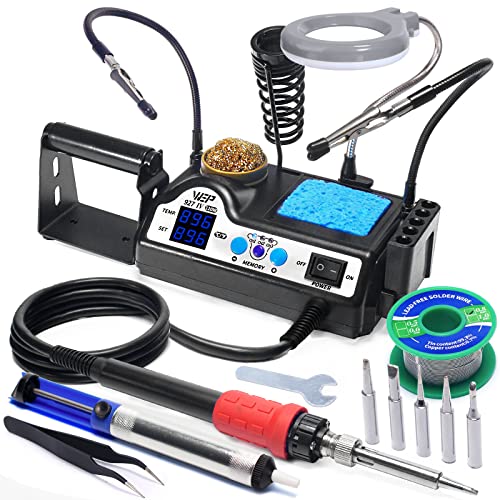
The WEP 927-IV is built around a crowded but practical workstation. Its 110W heating element, dual display, three preset channels, and adjustable sleep timer give the station a more feature-rich control panel than a simple pencil iron. The dual display shows the selected and actual temperature according to the listing, while the preset channels allow a user to move between familiar settings without repeatedly dialing them in.
Its integrated layout includes a holder, tip cleaner, solder dispenser, tip storage, two helping hands, tweezers, a magnifying glass with LED lighting, five extra tips, and lead-free solder wire. That setup can be useful for small assemblies where holding a board, feeding solder, and seeing the joint compete for both hands. The station uses WEP #1400 tips, which is a meaningful ownership detail because replacement planning depends on that specific family.
Pros
- 110W heating element gives the station substantial listed power.
- Three preset channels simplify repeated temperature changes.
- Dual display shows set and actual temperature according to the listing.
- Helping hands and LED magnifier support small bench tasks.
- Uses identified WEP #1400 tips for replacement planning.
Cons
- The integrated accessory layout may take more bench space than a simple station.
- Replacement tips must match the WEP #1400 family.
Choose the 927-IV if your soldering area benefits from built-in organization and you regularly work with small parts. The magnifier and helping hands are practical additions, but the station’s value depends on actually using those accessories. Buyers who already have a clear bench and prefer a lighter, simpler setup may find the Weller or Hakko formats easier to arrange.
To buy this product, click here.
8. WEP 926LED V3 | Best Compact Complete Kit

The WEP 926LED V3 keeps the station and iron holder together, which is useful when desk space is tight. Its temperature control covers a listed 392°F to 896°F, with a digital readout and PID microcontroller described as compensating for temperature changes. The product title also advertises a 130W maximum, although that figure should not be treated as a direct measure of joint performance. Tip geometry, contact, control, and the workpiece still affect the result.
The kit includes solder wire, five extra tips, tweezers, a solder sucker, and a tip cleaner. That mix is well suited to basic repairs and learning the rhythm of soldering and desoldering without assembling a separate accessory order. A sleep mode activates after more than 10 minutes of inactivity, and the temperature display can switch between Fahrenheit and Celsius. The station is specified for 110 to 127V US use, so electrical compatibility deserves a quick check.
Pros
- Integrated holder keeps the station footprint compact.
- Digital control covers a listed 392°F to 896°F range.
- PID temperature compensation is included in the product description.
- Five tips, solder wire, tweezers, solder sucker, and cleaner are included.
- Sleep mode and Celsius-to-Fahrenheit switching add practical convenience.
Cons
- The listed 130W maximum should not be read as guaranteed thermal performance at every joint.
- The station is rated for 110 to 127V and should not be connected to 220V power.
This is a good match for a compact repair corner where included tools matter as much as the iron itself. It gives up the more refined temperature-stability information provided for the Weller, but it offers a broader starter bundle and a tidy integrated layout. Confirm the tip shapes and workspace clearance before purchase if your projects involve unusually large boards or long components.
To buy this product, click here.
9. Liouhoum 80W LCD Soldering Iron Kit | Best Budget Portable Kit

A digital pencil iron can be the right answer for occasional repairs when a full station feels like too much equipment. This Liouhoum kit lists an 80W ceramic heater, a 10-second heat-up claim, and an adjustable range from 356°F to 896°F. The LCD shows the selected temperature, while the heat-resistant handle is intended to keep the grip cooler during use. Its plug-in format also makes setup quick, with no separate control box taking up space.
The iron adds automatic temperature reduction after five minutes on its stand and remembers the previous temperature setting after shutoff. Those features are useful for short repair sessions where the tool is picked up and set down repeatedly. The supplied information describes broad uses including circuit boards, appliances, jewelry, and household repairs, but it does not identify a detailed tip family. That makes the kit appealing for basic work, while more frequent users may prefer a station with clearer replacement planning.
Pros
- 80W listing provides strong available power for a compact plug-in iron.
- LCD display makes the selected temperature visible.
- Listed temperature range spans 356°F to 896°F.
- Automatic temperature reduction activates after five minutes on the stand.
- Temperature memory restores the previous setting after shutdown.
Cons
- The available information does not clearly identify a replacement-tip family.
- A pencil format provides less bench organization than a complete station.
This kit is a sensible lower-cost entry point for small electronics and household fixes, especially if portability around the home matters. It gives up the calibration, station controls, and clearer accessory ecosystems found higher in the list. Pick it for a simple plug-in tool with a display, and choose a station instead if soldering becomes a regular part of your work.
To buy this product, click here.
Buying Guide
Wattage Does Not Tell the Whole Heating Story
Wattage describes available electrical power, but it does not independently prove how well an iron maintains heat at a joint. A 110W station may have more reserve than a 60W model, yet tip geometry, heater construction, temperature sensing, and contact with the workpiece still affect results. For circuit boards, controlled heat and a suitable tip often matter more than chasing the largest number on the box.
Temperature Control Matters Around Components
Adjustable temperature lets you adapt the tool to the solder, joint size, and component sensitivity. Digital control can make a setting easier to repeat, while calibration support and published stability information provide more useful context than a maximum temperature alone. A temperature setting is still a control target, not a guarantee that every solder joint reaches exactly that number.
Choose a Station or Pencil Format Deliberately
A pencil iron is compact and quick to store, which suits occasional repairs and small home projects. A station adds a control box, a dedicated rest, and often better organization. It may also provide features such as sleep mode, presets, temperature lock, or calibration. If the tool will remain on a bench, the extra footprint can pay off in easier setup and repeatable work.
Check the Tip System Before Ordering
Tips are consumable working parts, and the included tip is not the same as a promise that every future geometry will fit. The WEP 927-IV identifies WEP #1400 tips, the Fanttik T1 Max lists C210 tips, and the YIHUA 926 III identifies 1200/900M series tips. Confirm the correct family before buying replacement parts, especially if you need fine, chisel, or larger thermal-mass options.
Included Accessories Can Change the Real Value
Helping hands, tweezers, solder, a solder sucker, and a cleaner can make a starter kit immediately useful. They also take up space, and experienced users may already own better versions. Compare the actual contents with your bench drawer instead of assuming a longer accessory list means better soldering performance.
Match the Voltage and Power Source
Several stations here are specified for 110 to 127V US power. The Fanttik T1 Max is the portable exception, with built-in battery operation and Type-C wired power described in its listing. A Type-C connector does not automatically mean every charger will provide the required power, so check the product requirements and charger capability before relying on a portable setup.
Best Soldering Iron FAQ
What wattage is suitable for electronics soldering?
There is no single correct wattage for every electronics task. The products here range from lower-output cordless operation to stations rated around 60W, 70W, 80W, and above. For ordinary PCB work, controllable heat and a suitable tip are more useful decision points than wattage alone. Larger joints and heat-sinking workpieces may benefit from more available heating power.
Is a soldering station better than a pencil iron?
A station is usually easier to organize and repeat because it separates controls from the handpiece and often includes a dedicated rest. Some also add sleep modes, presets, temperature locks, or calibration support. A pencil iron remains attractive for occasional repairs because it takes less space and can be simpler to put away.
Are higher maximum temperatures better?
A higher maximum setting does not automatically mean better soldering. Most jobs require a controlled temperature suited to the solder and workpiece, not the highest possible setting. Excess heat can damage pads or components, while insufficient heat can prevent proper wetting. Tip mass and heater recovery also influence how an iron handles a joint.
Do all soldering tips fit every iron?
No. Tip families differ by handpiece and model. The Fanttik T1 Max lists C210 tips, the YIHUA 926 III identifies 1200/900M series tips, and the WEP 927-IV specifies WEP #1400 tips. Treat included tips, compatible tips, and optional replacement tips as separate details, and confirm the exact family before ordering.
Is a cordless soldering iron suitable for large joints?
The Fanttik T1 Max is convenient for portable repairs, but its listing gives a maximum DC output of 12W in wireless mode and 16W in wired mode. That is much lower than the listed ratings of the corded stations here. It is better suited to lighter repairs and jobs where portability matters than to large, heat-hungry connections.
What should a first soldering kit include?
A useful starting setup includes an adjustable iron or station, a stable rest, suitable tips, solder, a cleaning method, and eye protection and ventilation appropriate to the work area. Helping hands and a desoldering pump can also make early projects easier. The YIHUA 926 III and WEP 926LED V3 include several of these accessories, while the Weller focuses more tightly on the station and handpiece.
Does temperature memory replace temperature control?
No. Temperature memory simply restores a previous setting, as described for the Liouhoum kit. It can save time between sessions, but it does not demonstrate that the iron maintains the setting accurately under load. Look for control-system information, stability claims, and a suitable tip when repeatability matters.
Final Verdict
The Weller WE1010NA is the strongest overall choice for regular electronics work because it combines 70W of station power with listed temperature stability, temperature lock, standby functions, and a heat-resistant silicone cable. It does not arrive with the largest accessory bundle, but the focused design is a strength for a bench that already has basic tools or needs a more repeatable soldering setup.
The YIHUA 926 III is the better value-oriented station for a fresh workbench, while the Fanttik T1 Max is the clear portable alternative for repairs away from an outlet. The Hakko FX888DX-010 and FX601-02 appeal to buyers who prioritize their respective station and handheld formats, while the WEP kits and Liouhoum iron keep setup costs and space demands lower. Match the tool to your joint size, work frequency, power environment, and tip needs before choosing the biggest wattage number.

- Jesse
Jesse is the editor behind Soldering Gear, where he covers soldering irons, stations, rework equipment, and the tools that belong on a practical electronics bench. His work focuses on comparing product specifications, features, compatibility, and intended uses so readers can make more informed buying decisions.
- Best Soldering Iron: 9 Picks in 2026 September 12, 2026