Best Portable Soldering Iron: 9 Picks in 2026

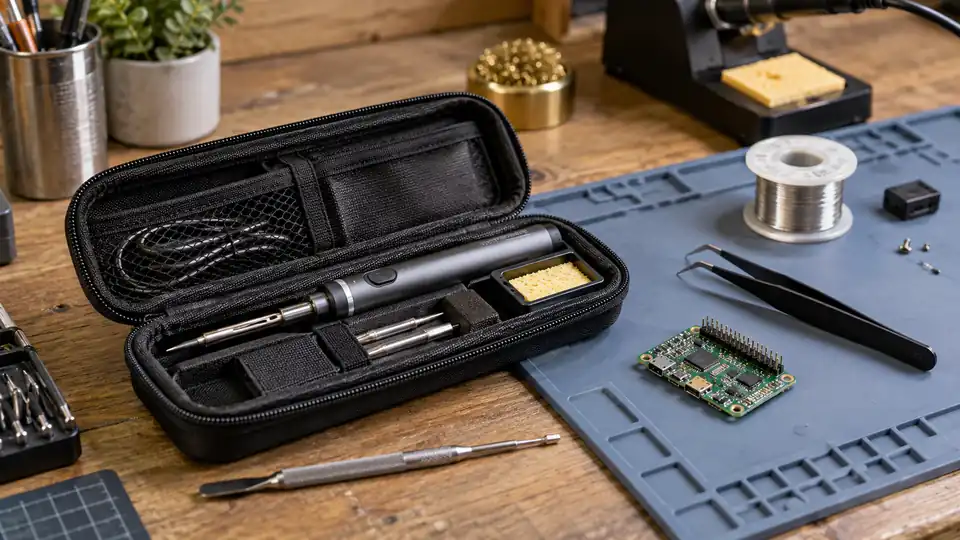
A portable soldering iron earns its place when the workbench is a kitchen table, a tool bag, a garage shelf, or the back of a vehicle. The right model should heat quickly, hold a useful temperature, accept practical tips, and run from a power source that fits the job. Battery operation adds freedom, while USB-C and DC input can keep a project moving after the internal charge runs down.
Portability alone does not guarantee a good soldering experience. A tiny iron with a weak power source may struggle with larger joints, while a high-temperature model can be awkward for delicate PCB work if its controls are crude. Tip shape matters too. A pointed tip helps with tight spaces, but a chisel or K-style tip transfers heat more effectively across a larger joint. The FNIRSI HS-03 stands out overall because it combines cordless use, wired operation, a broad stated temperature range, quick heating, and several useful control features.
The ranking below weighs power flexibility, temperature control, tip options, battery operation, included equipment, and the practical compromises behind each design. Some picks favor field repairs, others suit USB-C-powered benches, and a few are better for occasional household fixes than fine electronics work.
Quick Answer
Best overall: The FNIRSI HS-03 offers the most balanced portable setup, with a 2600mAh battery, Type-C operation while charging, a screen, adjustable controls, and tool-free tip changes.
Best USB-C value: The PINECIL Smart Mini is a compact choice for buyers who already have a suitable USB-C PD or QC 3.0 power source.
Best cordless kit: The Fanttik T1 Max includes four C210 tips, a built-in 2600mAh battery, a stand, and automatic sleep and wake behavior.
Best for maximum power flexibility: The UY CHAN TS101 supports DC input up to 65W and USB-C PD input up to 45W, though the required power source must be matched carefully.
Best Portable Soldering Iron Comparison Table
| Product | Best For | Power Format | Temperature Control |
|---|---|---|---|
| FNIRSI HS-03 | Best overall | Battery and Type-C | 212°F to 842°F, screen and fine adjustment |
| PINECIL Smart Mini | USB-C portability | USB-C PD/QC and DC5525 | Digital control with boost |
| Fanttik T1 Max | Cordless repair work | Built-in battery and Type-C | 390°F to 840°F, six levels |
| Cordless 3200mAh Kit | Complete portable kit | Battery and USB-C | 392°F to 932°F, 5°C adjustment |
| UY CHAN TS101 | Advanced USB-C and DC use | USB-C PD and DC5525 | 122°F to 752°F, OLED display |
| M12 Soldering Iron | Cordless tool-system users | M12 battery platform | Optimized temperature control |
| FNIRSI HS-02A | High-power corded portability | Configured cable and adapter | 212°F to 842°F, presets |
| LEXIVON LX-770 | Fuel-powered field work | Refillable butane | Adjustable flame and soldering tips |
| Mini Cordless Soldering Iron Kit | Short repair sessions | 1100mAh battery and USB-C | 500°F to 788°F, LED display |
The detailed reviews explain where each iron fits, what its specifications mean in practice, and which trade-offs deserve attention before purchase.
1. FNIRSI HS-03 Cordless Soldering Iron Kit — Best Overall

The HS-03 makes a strong case for the top position because it handles the awkward moments that make portable soldering frustrating. Its 2600mAh battery allows cordless work, while Type-C input lets the iron operate from a power source when the battery needs help. That combination suits a quick wire repair in the garage just as well as a longer electronics session beside a laptop.
Its control layout is unusually useful for a compact iron. The listing describes a 212°F to 842°F range, five-level temperature jumps through a knob, and smaller 1°F to 50°F adjustments through buttons. The 0.96-inch IPS color screen, adjustable brightness, sleep settings, and left or right-hand viewing modes add practical polish. K, I, and IS tips cover broader joints, precision work, and tight spaces, although tip availability after the included set should be checked.
Pros
- 2600mAh battery supports cordless operation.
- Can operate from Type-C power while charging.
- Fast stated three-second heating time.
- Screen, knob, and buttons provide flexible temperature adjustment.
- Tool-free tip changes and left or right-hand display modes improve field usability.
Cons
- The listing does not clearly identify the full long-term replacement-tip range.
- Battery runtime under different temperatures and joint sizes is not specified.
This is the best fit for someone who wants one compact iron for PCB work, gaming modifications, wire repairs, and occasional household jobs. Its broad control range and multiple tip shapes make it more adaptable than a basic mini iron. Buyers who already own a complete USB-C station may prefer the simpler PINECIL, while those needing the highest available wired power may lean toward the TS101 or HS-02A.
To buy this product, click here.
2. PINECIL Smart Mini Portable Soldering Iron — Best USB-C Value

The PINECIL takes a different route from battery-equipped irons. It is a slim, wired tool that draws power through USB-C or a DC5525 barrel jack. That means a laptop-style power bank, suitable USB-C PD source, or compatible DC supply can become part of the soldering setup. It also means the iron itself does not carry the weight and charging limits of an internal battery.
The published information lists a 12-second warmup, an on-demand boost feature, and automatic standby. Its stainless-steel core sits inside a polycarbonate shell, and the package includes one B2 tip. This is a clean fit for portable electronics work, especially where the user already understands USB-C power requirements. The power supply is not included, so the small iron can become a less convenient purchase if the existing charger cannot provide the needed output.
Pros
- Supports USB-C PD and QC 3.0 input.
- Also accepts a DC5525 barrel input.
- Compact stainless-steel-core and polycarbonate construction.
- Stated 12-second warmup with boost mode.
- Automatic standby helps reduce idle heating.
Cons
- Power supply is not included.
- Only one B2 tip is listed in the package contents.
PINECIL makes sense for a portable bench built around USB-C chargers and power banks. It is less attractive for someone who wants to work immediately from a box or needs true cordless operation. Check the output requirements of the charger before ordering, since a USB-C connector by itself does not guarantee suitable soldering power.
To buy this product, click here.
3. Fanttik T1 Max Soldering Iron Kit — Best Cordless Kit

A compact stand and four included C210 tips give the Fanttik T1 Max a tidy, ready-to-carry character. The set includes C210-I, C210-IS, and two C210-K tips, so the user can move between fine access and broader contact without immediately shopping for a second tip. The listing describes rapid seven-second heating and anti-oxidation tip construction.
Its built-in 2600mAh battery supports wireless operation with a stated maximum DC output of 12W, while wired Type-C use raises the maximum AC output to 16W. The published cordless runtime is up to 60 minutes at 840°F, which should be treated as a listing claim rather than a universal result for every joint. Six temperature levels cover 390°F to 840°F, and gravity sensing puts the tool to sleep after 30 seconds before waking it when picked up.
Pros
- Includes four C210 tips in useful shapes.
- 2600mAh battery supports cordless repairs.
- Can run in wired mode from a Type-C charger or power bank.
- Gravity-based sleep and wake behavior reduces idle operation.
- Aluminum storage stand keeps the tip and tool organized.
Cons
- Six temperature levels offer less fine adjustment than a continuously adjustable control.
- The published wireless output is limited to 12W.
This is a sensible choice for portable repair work where the stand and extra tips matter as much as the iron itself. The T1 Max is easier to pack as a small kit than a bare pen, yet it remains more mobile than a traditional station. Choose the HS-03 for finer temperature adjustment, or the 3200mAh kit if included solder, tweezers, and desoldering tools are higher priorities.
To buy this product, click here.
4. Cordless Portable 3200mAh Soldering Iron Kit — Best Complete Kit

The appeal here is the box of supporting gear. Alongside the iron, the listing includes three C210 tips, a desoldering pump, precision tweezers, lead-free solder wire, a USB-C cable, two sponges, a stand, and a toolbox. That arrangement is handy for a repair drawer where the goal is to grab one case rather than gather every small accessory separately.
The iron uses a 3200mAh battery and supports wired or wireless operation. Its stated temperature range runs from 392°F to 932°F, with 5°C adjustment through buttons and an LED display. The product information gives up to 60 minutes of wireless use at 932°F and identifies 12W wireless and 16W wired output. Automatic sleep after 15 seconds and shutdown after 10 minutes add convenience, though the high maximum setting should be used with care around heat-sensitive parts.
Pros
- Largest stated battery capacity among the battery-powered picks here.
- Includes three C210 tips with fine and broader shapes.
- Comes with a desoldering pump, tweezers, solder, stand, and toolbox.
- 5°C temperature adjustment and LED display aid repeatable setup.
- Supports both cordless use and USB-C wired operation.
Cons
- The listing does not identify a brand or model name clearly.
- The stated 932°F maximum can be excessive for delicate electronics if used carelessly.
This kit suits occasional repair work, RC projects, small wiring jobs, and anyone starting with very little equipment. It is less compelling for a user who already owns solder, a stand, and desoldering tools, since the value lies heavily in the bundled accessories. For a more established electronics bench, the PINECIL or TS101 offers a cleaner pen-focused approach.
To buy this product, click here.
5. UY CHAN TS101 Portable Soldering Iron — Best Advanced Power Flexibility

The TS101 is aimed at users who want a small iron with more control over the power arrangement. Its DC5525 input accepts 9V to 24V with a listed maximum of 65W, while the USB-C PD port supports 12V to 24V with a maximum of 45W. That range can make the iron useful at a home bench, beside a power bank, or in a field kit, provided the chosen supply matches the stated requirements.
An OLED display shows the selected temperature across a 122°F to 752°F range. The listing also describes boost heating, dual temperature sensors, acceleration sensors, automatic sleep, overheat warning, and programmable functions through a computer. A B2 tip and USB-C cable are included. The power adapter is not listed among the supplied items, so this is a sophisticated portable pen rather than a complete plug-and-solder package.
Pros
- Supports both DC5525 and USB-C PD power.
- Accepts up to 65W through DC input and 45W through USB-C PD.
- Wide stated temperature range from 122°F to 752°F.
- OLED display, boost function, sleep mode, and overheat warning.
- Programmable functions and temperature behavior through computer connection.
Cons
- Power adapter is not listed as included.
- Only one B2 tip is identified in the package contents.
The TS101 is a strong fit for someone who already understands USB-C PD and DC power specifications. Its lower stated temperature setting also gives it a wider control envelope than several cordless alternatives. A first-time buyer seeking a self-contained kit may find the HS-03 or Fanttik simpler, while this model rewards users who care about power-source flexibility and programmable control.
To buy this product, click here.
6. M12 Soldering Iron — Best for M12 Battery Users

The M12 Soldering Iron earns its place through a different kind of portability. Rather than relying on a built-in battery or a USB-C charger, it is a bare tool intended for users who already have the relevant M12 battery system. That can be convenient on a job site where compatible packs are already in the tool bag and a wall outlet is nowhere nearby.
The listing states an 18-second heat-up time, optimized temperature maintenance, a ready-to-use and safe-to-store tip indicator, and a three-position pivoting head. Tool-free tip changes allow switching between chisel and pointed tips. The limited supplied information does not identify a temperature range, runtime, charger, battery, or included stand, so those details should be confirmed before ordering.
Pros
- Uses a cordless M12 battery platform.
- Three-stop pivoting head improves access in awkward positions.
- Tool-free changes between chisel and pointed tips.
- Ready-to-use and safe-to-store tip indicator adds a useful visual cue.
- Published 18-second heat-up time is practical for quick repairs.
Cons
- Sold as a bare tool, so the battery is not included.
- The supplied information does not specify temperature range or runtime.
This iron is most logical for an existing M12 tool owner who values cordless job-site access over a compact USB-C setup. It is a weaker standalone purchase for someone starting from scratch, since the battery requirement changes the total setup. The pivoting head is the standout feature, especially for wiring tucked behind panels or inside cramped equipment.
To buy this product, click here.
7. FNIRSI HS-02A 100W Portable Soldering Iron Kit — Best High-Power Corded Pick

The HS-02A is portable in its storage and form factor, but it is not cordless. The listing specifically says it must be used with the configured charging cable and does not support battery operation. That makes it a better match for a compact field case, vehicle kit, or portable bench with an available power source than for work far from electricity.
Its main attraction is the stated up-to-100W support across 9V to 20V input, along with a supplied 100W adapter. Six included tips, a stand, brass tip cleaner, solder wire, and a storage case create a more complete package than the typical pen-only design. The temperature range is listed as 212°F to 842°F, with three preset groups, sleep and standby modes, and wake-up through shaking or a button.
Pros
- Supports up to 100W input according to the listing.
- Includes a 100W adapter for immediate wired operation.
- Six included tip shapes broaden the working range.
- Comes with a stand, brass cleaner, solder wire, and storage case.
- Offers presets, sleep mode, standby mode, and automatic power-off functions.
Cons
- Does not support cordless use.
- Its higher power capability requires careful matching of voltage and operating mode.
Choose the HS-02A if a portable case and higher available input power matter more than battery freedom. It can be a useful companion for heavier wires and larger thermal loads, though advertised wattage alone does not guarantee better results on every joint. For small PCB work away from a power source, the HS-03 or Fanttik T1 Max is more convenient.
To buy this product, click here.
8. LEXIVON LX-770 Butane Soldering Iron Kit — Best Fuel-Powered Option

Butane changes the portable soldering equation. The LX-770 does not need a battery bank, USB-C charger, or wall outlet, and its self-igniting design is useful for field work where electrical power is inconvenient. The kit includes seven tips and 13 accessories, along with a refillable metal fuel tank and carrying case.
The flame is adjustable from one-half inch to two and one-half inches, while the listing gives a working temperature up to 2,400°F in flame mode and up to 1,100°F with soldering tips. Those figures describe different operating modes, so the flame temperature should not be treated as the soldering-tip temperature. Runtime is listed as up to 75 minutes, but butane is not included and fuel handling adds a different set of precautions.
Pros
- Operates without an electrical power source.
- Self-igniting trigger and flame-locking button simplify operation.
- Includes seven soldering tips and a carrying case.
- Refillable metal fuel tank is built for repeated use.
- Listing gives up to 75 minutes of runtime per fill.
Cons
- Butane is not included.
- Open-flame operation is less suitable for delicate electronics and confined workspaces.
The LX-770 is best for mobile repairs, heat-shrink work, and situations where a power bank is not practical. It is a poor substitute for a temperature-controlled electronics iron around sensitive components, since flame-based tools demand more awareness of nearby materials and heat spread. Buyers should follow the product instructions and use appropriate ventilation and heat precautions.
To buy this product, click here.
9. Mini Cordless Soldering Iron Kit — Best for Short Repair Sessions

This mini kit focuses on simple portability. Its built-in 1100mAh battery supports a stated 15 to 30 minutes of use, depending on the selected temperature, and the iron can also run while charging from a 5V/2A adapter. That makes it handy for a loose wire, a small connector, or a quick household repair where setting up a full station would feel like overkill.
The LED display shows the selected temperature across a stated 500°F to 788°F range. Three soldering heads, a base, solder wire, paste, and a Type-C cable are included. The product information also describes a three-second power control, an insulated outer layer, and automatic power-off after 10 minutes. The listing warns that cordless use is unsuitable for large projects, which is a useful boundary rather than a minor detail.
Pros
- Compact battery-powered design for short jobs.
- Can operate while charging from a 5V/2A adapter.
- LED temperature display covers the stated 500°F to 788°F range.
- Includes three tips, a base, solder, paste, and charging cable.
- Automatic power-off after 10 minutes limits idle operation.
Cons
- 1100mAh battery and stated 15 to 30 minute runtime limit extended work.
- The listing says it is unsuitable for large projects.
This is a practical emergency or occasional-use iron for small joints and light repairs. It keeps the kit inexpensive and compact, but the shorter stated runtime and lower power suitability place it below the larger cordless models for regular electronics sessions. Pick it for convenience in a drawer or vehicle bag, not for repeated work on large connectors or heavy wire.
To buy this product, click here.
Buying Guide
Battery Operation Is Convenient, but Wired Backup Matters
A built-in battery removes the cord from a work area, which is useful for a repair outside the workshop or beside a large piece of equipment. The HS-03, Fanttik T1 Max, 3200mAh kit, and mini cordless kit all offer that freedom in different forms. Runtime varies with temperature, tip, joint size, and operating habits, so a model that also works from USB-C offers a valuable fallback.
USB-C Does Not Mean Every Charger Will Work
The connector is only the beginning. PINECIL lists USB-C PD and QC 3.0 support, while the TS101 identifies specific PD voltage ranges and maximum input levels. Check the power source, cable, and required output before relying on a phone charger or power bank. A compatible-looking cable cannot make an underpowered supply perform like a suitable PD source.
Temperature Range Should Match the Work
A wide range gives more adjustment, but the highest number on the display is not a direct measure of heating quality. Small PCB joints may benefit from controlled settings and a fine tip, while larger wires need enough available heat to keep the joint flowing. The HS-03 offers broad adjustment, the Fanttik uses six levels, and the TS101 reaches down to a lower stated setting for more controlled light work.
Tip Shape Changes How Heat Enters the Joint
A pointed tip can reach a tight pad, but a chisel or K-style tip usually presents more contact area to a larger joint. The HS-03 includes K, I, and IS shapes, the Fanttik provides C210 variants, and the HS-02A includes six listed tips. Before buying, confirm that replacement tips are available for the exact iron and model rather than assuming a similar-looking tip will fit.
Included Accessories Can Change the Practical Value
A portable iron is easier to use if the case also contains a stand, cleaner, solder, or desoldering pump. The 3200mAh kit is particularly accessory-heavy, while the PINECIL includes one tip and no power supply. A bare M12 tool makes sense for someone with compatible batteries, but its setup is very different from a complete kit purchased for occasional repairs.
Butane and Battery Irons Serve Different Environments
Butane makes the LX-770 independent of electrical power, but it introduces an open flame and different heat behavior. Battery and USB-C irons are generally easier to manage around electronics benches, while the butane design can be useful for outdoor or field work. Neither format replaces safe ventilation, heat-resistant surfaces, eye protection, and careful handling of hot tips.
Best Portable Soldering Iron FAQ
What is the best portable soldering iron overall?
The FNIRSI HS-03 is the strongest overall choice in this group because it combines a 2600mAh battery, Type-C operation while charging, a stated three-second warmup, a screen, adjustable controls, and multiple tip shapes. It offers a broader working setup than a basic pen without requiring a separate DC power system.
Is a cordless soldering iron good for electronics?
It can be useful for small PCB repairs, wire work, and field fixes, provided the iron offers suitable temperature control and a fine tip. Battery runtime and available heating power can limit larger joints. For frequent bench work, a cordless model with wired backup is more flexible than one that depends only on its internal battery.
Can a USB-C soldering iron use any USB-C charger?
No. The charger must provide a suitable power profile, and the cable must support the required connection. PINECIL lists USB-C PD and QC 3.0 support, while the TS101 identifies particular PD voltage ranges. Check the product requirements and charger output before connecting the iron.
Are higher wattage ratings always better?
No. Available wattage can help with larger thermal loads, but tip construction, heater design, control behavior, and contact with the joint also affect results. A 100W-capable iron is not automatically the best choice for a small PCB pad, where excessive heat or an unsuitable tip can create problems.
What tip shape is best for portable soldering?
A small pointed or knife-style tip can help reach tight spaces, while a chisel or K-style tip transfers heat across more surface area. A kit with several shapes is more adaptable than one with a single tip. Confirm the exact tip family before assuming inexpensive replacement tips will fit.
Is a butane soldering iron suitable for circuit boards?
A butane iron can handle some circuit-board work with the correct tip and careful heat control, but it is less convenient around delicate electronics than a temperature-controlled electric iron. Its flame mode also creates additional heat and workspace concerns. The LX-770 is better suited to field repairs and general heat work than precision bench electronics.
Does a portable soldering iron need a stand?
A stand gives the hot tool a controlled resting place and reduces the chance of damaging a surface or catching a cable. Some portable kits include stands, such as the Fanttik T1 Max, HS-02A, and 3200mAh kit. If a model does not include one, plan a safe heat-resistant storage method before use.
Final Verdict
The FNIRSI HS-03 is the strongest overall pick for portable soldering because it balances cordless freedom with Type-C backup, quick stated heating, adjustable temperature control, a visible display, and useful tip shapes. It is a versatile choice for small electronics repairs, hobby projects, and mobile work without forcing the buyer into a separate battery platform or a specialized power supply.
The PINECIL is the cleaner choice for USB-C users who already own a suitable power source, while the Fanttik T1 Max offers a well-organized cordless kit with four C210 tips and a stand. The TS101 is better for users who understand USB-C PD and DC input requirements, and the LEXIVON makes sense where electrical power is unavailable. Match the iron to the work, power source, tip needs, and session length rather than choosing by maximum temperature or wattage alone.

- Jesse
Jesse is the editor behind Soldering Gear, where he covers soldering irons, stations, rework equipment, and the tools that belong on a practical electronics bench. His work focuses on comparing product specifications, features, compatibility, and intended uses so readers can make more informed buying decisions.
- Best Cordless Soldering Iron: 9 Picks in 2026 September 28, 2026
- Best Portable Soldering Iron: 9 Picks in 2026 September 27, 2026
- What Temperature for Soldering Electronics? September 26, 2026
- Best Soldering Station for Beginners: 9 Picks in 2026 September 25, 2026
- Best Solder Fume Extractor: 9 Picks in 2026 September 24, 2026